
Latest News
Duckett, Crawley flatten India on day headlined by Pant’s bravery

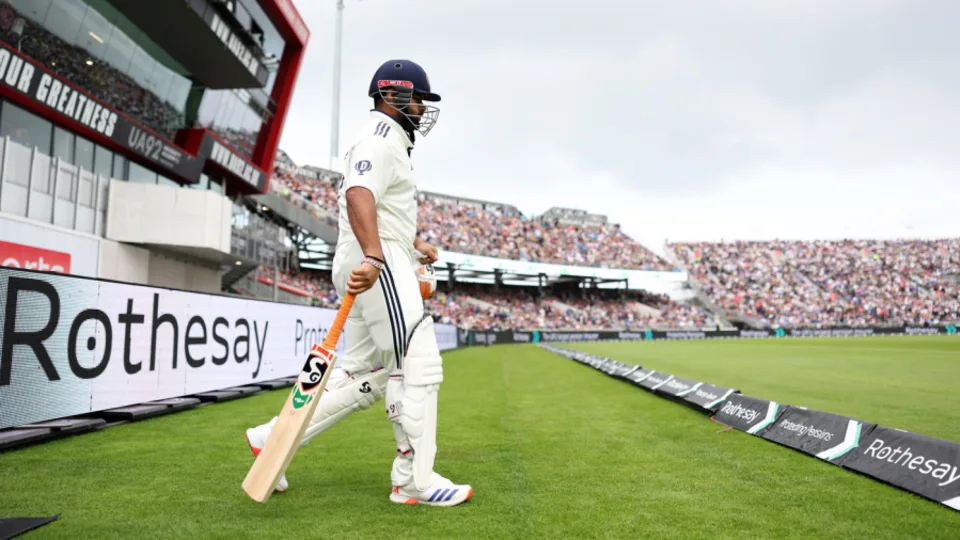
India had one high moment at Old Trafford, the kind that cuts through eras, uniting the hardcore fan, radicalising the casual ones and irritating those who have no idea about cricket because why is a video of a man walking down the stairs wearing weird body armour suddenly blowing up on social? Rishabh Pant’s bravery rendered trivial things like the match situation and its result as he walked out to bat on a fractured foot, which is just as well because by the end of the day his team was losing control of the Manchester Test.
England’s openers alone took a massive bite out of India’s total of 358 as Ben Duckett and Zak Crawley put on a 166-run stand at 5.18 runs an over. It was accidental Bazball though. Neither of them was really looking to score quickly but they were given no choice in the matter by a bowling performance so error prone that packaging it as a highlights reel would be a missed opportunity. There’s a word starting with ‘B’ and ending with ‘looper’ that fits better.
India might contend that they were doing what England had done. Jofra Archer bowled leg stump to left-handers and kept picking up wickets. When the debutant Anshul Kamboi tried that he gave up three fours in the second over. Ben Stokes claimed his first five-for in eight years by pitching the ball right up. When Mohammed Siraj tried that he kept getting driven for boundaries. It took until the last 45 minutes of play for a contest to break out as Ravindra Jadeja removed Crawley for 84 and Kamboj KO’d Duckett for 94.
It is a quirk of the Dukes ball that it isn’t at it’s most threatening when its brand new. The lacquer needs to wear off, whch takes about 10-15 overs. India found ways to manage this period better in the previous Tests (barring maybe the second innings at Headingley) but here they were found rather wanting. Which meant even the last half-hour when they had two new batters, including a skittish Ollie Pope, to prey on and the opposition finally felt some pressure, it didn’t really matter. England gritted it out and went to stumps at 225 for 2 in 46 overs, with batting all the way down to No. 10 to get the other 133 they need to take a first-innings lead.
A largely uneventful morning session got its adrenaline shot when Stokes dismissed the stubborn Shardul Thakur for 41. The BCCI had sent word that Pant, who had injured his right foot on the first day’s play so badly that he required four-wheeled transportation from the pitch to the dressing room, was available to bat if the team needed it. The assumption was he would come out as the last man standing. But, having bucked a diagnosis of six-eight weeks rest to join the squad at the ground, Pant grabbed his bat and his gloves and began to make his way down the stairs at Old Trafford.
Applause rained down from all corners. Cricket has seen its share of wounded warriors. Anil Kumble with a bandage around his head. Graeme Smith with one working arm. Shamar Joseph steaming in with a broken toe. Rick McCosker and his shattered jaw. Moments like these transcend sport. They live on for years and years.
Pant’s willingness to put his body on the line – he is set to miss the fifth Test – ushered India to an above-par total. He finished with 54 off 75 balls and hit the 90th six of his Test career, equalling Virender Sehwag who holds the national record. He also went past 479 runs on this tour, which meant he eclipsed Alec Stewart and now has the highest tally for a wicketkeeper in a Test series in England. Not bad for a man who came to his office wearing a moonboot. Between those wild shots, the back flip celebrations, the silly mistakes, the commentary from behind the stumps, Pant’s heart often goes unnoticed. It shouldn’t. Not when it’s so overwhelmingly big.
Stokes continued his stellar series with the ball, picking up 16 wickets – a new career best going past his efforts on debut in the 2013-14 Ashes. It is often said when he has the ball in hand that he makes things happen. That’s possibly because he’s never afraid of having a punt. Sometimes, he bowls too full and that works because he gets movement both ways – Thakur found that out the hard way. Sometimes, he bowls way too short for way too long and that works because he has the strength to hurry batters up – Washington Sundar found that out the hard way. A peach brought him his fifth wicket – angled in, nipping away, taking Kamboj’s outside edge for a duck.
England built on their captain’s hard work with Duckett especially showing how little the margin of error is to him now. He turned a pretty good ball, on the base of off stump, maybe even outside, into a boundary through midwicket that kept two fielders interested right the way through and the crowd absolutely loved it. They went “oooooooohhhhh…yaaaaaaaayyyyyy” as Siraj and Washington were beaten. Given he was able to do that, it was barely a surprise that any time India went too straight, Duckett was able to access the square-leg region to great profit. He went to fifty without a single boundary on the off side and celebrated the landmark with a backfoot punch for four through cover.
Crawley, at the other end, had to be a lot more circumspect. He took 13 balls to get off the mark and those runs came with a reminder of the danger the pitch still posed as a Jasprit Bumrah delivery rose up sharply to rap him on the bottom hand. That is why India would feel like they’ve let themselves down. There was help to the fast bowlers right through the day. Those late wickets they picked up resulted in a mini-session where it was revealed how hard it was to bat out there when the ball was in the right areas. Just that it was difficult to find for a bowling unit that isn’t used to this kind of bounce. Their stock length coupled with the movement on offer kept beating the edge. So they went fuller, only to stray a little too close to the pads or the half-volley mark.
Crawley, in particular, played some sumptuous drives through cover and down the ground, and it looked like the opening partnership itself might see England through to stumps. India did raise their game towards the close and they need to raise it again on the third day to keep themselves in the fight. Otherwise the revellers in the party stand – repurposing the Mitchell Johnson song for Siraj – would be proven right. India bowled to the left. They bowled to the right. Their bowling was, well…
Brief scores: [Day 2 stumps]
England 225 for 2 in 46 overs (Ben Duckett 94, Zak Crawley 84, Ollie Pope 20*, Joe Root 11*; Ravindra Jadeja 1-37) trail India 358 in 114.1 overs (Yashaswi Jaiswal 58,KL Rahul 46, B Sai Sudharsan 61, Rishabh Pant 54, Shardul Thakur 41; Ben Stokes 5-72, Joffra Archer 3-73) by 133 runs
[Cricinfo]


The Cabinet of Ministers approved the resolution furnished by the Minister of Agriculture, Livestock, Lands and Irrigation to appoint Ms. P. M. Jayadeera (Engineer) in the Special Grade of Sri Lanka Engineering Service serving at present as the Additional Secretary (Water Resources Development) of the Ministry of Agriculture, Livestock, Lands and Irrigation to the post of Director General which will be vacant from 06.10.2026.
Approval has been granted at the meeting of the Cabinet of Ministers held on 08.06.2026 to prepare a draft bill for restructuring Sri Lanka Cricket.
Accordingly, the Legal Draftsman has formulated Sri Lanka draft bill providing legal provisions for the administration of Sri
Lanka Cricket, control, regulation, promotion, establishment of Sri Lanka Cricket for the development and administration, through the concepts of better governance, integrity, transparency, accountability, inclusiveness and providing equal opportunities for the betterment of the cricket sport, establishment of Sri Lanka Cricket for securing the wellbeing of all participants and securing cricket from corruption and other mal practices.
Clearance of the Attorney General has been received for the said draft bill. Approval of the Cabinet of Ministers has been received for the resolution furnished by the Minister of
Youth Affairs and Sports to publish the said draft bill in the government gazette notification and thereby forward the same to the Parliament for its concurrence.
Latest News
Appointment of Cabinet Sub-Committee for the Organization of 79th Independence Day Commemoration
The Cabinet of Ministers has approved the resolution furnished by the Minister of Public Administration, Provincial Council, and Local Government to appoint a Cabinet Sub-Committee chaired by the Prime Minister and with the participation of relevant Ministers, to organize and direct the affairs of the country’s 79th Independence Day Commemoration
Ceremony, which falls on 2027-02-04.

Ms. P. M. Jayadeera (Engineer) appointed Director General of Irrigation
Sri Lanka Cricket Draft Bill to be gazetted
Cabinet approves purchase of machinery for the Sri Lanka Land Development Corporation
Cabinet approval for Project to Build Secure, Skilled, and Empowered Community for families resettled at the at Kalinga Mawatha, housing scheme
Appointment of Cabinet Sub-Committee for the Organization of 79th Independence Day Commemoration
Establishment of New Management Framework for the Dr. Nevil Fernando Hospital

‘Dates have the highest sugar content to fight Coronavirus’

Sunday Island 27 December – Headlines

#SundayIsland 17th December – Headlines

Sunday Island – 28th March

Sunday Island Headlines – 21 March

Sunday Island – 21st February – Headlines
-

 News6 days ago
US embassy won’t comment on IGP’s probe into joint drug raid
-

 News4 days ago
Shanakiyan urges urgent action over reported death sentence for Lankan in Saudi Arabia
-

 News5 days ago
Bid for Basil’s extradition nears final stage: Police
-

 News3 days ago
Namal Rajapaksa Buddhist gambit fails, bail denied
-

 Business6 days ago
All-new Bolero MaXX unveiled in Sri Lanka
-

 Opinion6 days ago
A journalist who wrote across the divide
-

 Features3 days ago
Why the spelling Sri Lankan names in English vary
-

 Features3 days ago
Three bands, a new identity: Sri Lankan wolf snake recognised as distinct species