
Latest News
Seifert, Ravindra and Sodhi keep New Zealand’s 100% record intact

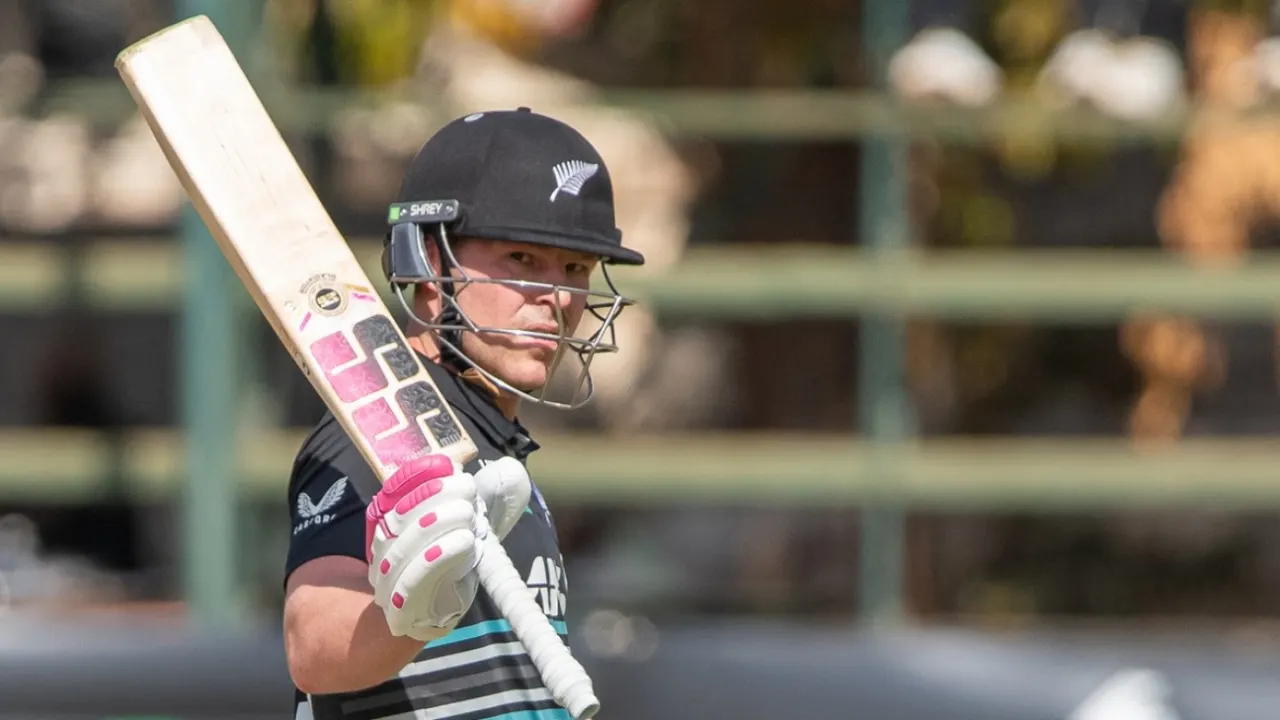
New Zealand smashed the highest score of the tri series and any hope of Zimbabwe earning a consolation win as they laid down a marker ahead of Saturday’s final against South Africa.
After choosing to bat first – despite captains in this tri-series usually bowling – a second-wicket stand of 108 between Tim Seifert and Rachin Ravindra set New Zealand up well. Both went on to score half-centuries before a Michael Bracewell cameo of 26 of 16 balls pushed New Zealand to 190. They bowled Zimbabwe out in 19 overs, as only three Zimbabwean batters got into double figures.
As dominant as New Zealand were, Zimbabwe will be particularly unhappy with their lapses in the field. They put down three catches – Tim Robinson on 0, Seifert on 13 and Bracewell on four – and bowled seven wides and a no-ball in a messy display which left them needing to complete their second-highest successful chase to win.
Any chance of that happening was blown away when Zimbabwe were reduced to 44 for 5 in the eighth over. Ish Sodhi took three of those wickets, bowling in the powerplay, and proved too much to handle for Zimbabwe’s top-order. A sixth-wicket stand of 51 between Tony Munyonga and Tashinga Musekiwa leant the innings some respectability Sodhi’s career-best 4 for 12 scripted a simple win for New Zealand. With 150 T20I wickets, he also climbed to third on the all-time wicket taker’s list in the format.
Zimbabwe will be spectators on Saturday and have no more fixtures scheduled before they host the Africa Region T20 World Cup Qualifiers in September.
Richard Ngarava has been Zimbabwe’s most successful bowler of the series and almost struck with his second ball when Robinson chased a delivery that angled away and got a thick outside edge. Ryan Burl at wide slip could not hold on. There was not too much damage done from that miss as Ngarava had Robinson caught at deep third off the second ball of his next over. Ngarava was brought back at the death and though he was hit for three successive by Seifert, he eventually foxed him with a slower ball that he feathered through to Clive Madande. Two balls later Bevon Jacobs tried to hit a short, wide ball out of the ground but was done for pace and sliced it to backward point.
Ngarava’s change-ups worked again when he had Mitchell Santner caught behind off a slower ball in an over that lasted 10 balls. His next challenge is to enhance his wicket-taking skills with a bit more discipline in order to truly lead Zimbabwe’s attack.
Don’t drop Seifert. He was put down on 0 by South Africa in the previous match and went on to score 66* in a clinical run-chase. In this match, he was on 13 and had already hit two fours when Munyonga, at deep backward square, put him down off Tino Maposa and Seifert didn’t need a second invitation.
Two overs later, he smacked Dion Myers into the leg side for his third four and the runs kept coming. Wellington Masakadza was sent through extra cover, Myers through the slip area and Sikandar Raza past short fine. Seifert brought up his 12th T20I fifty off 33 balls and went on to score his first six when he deposited Raza over long-on. He was especially good in a wide ‘v’ down the ground with 50 of his runs coming between extra cover and mid-wicket before he eventually fell to Ngarava for 75.
In search of a solid start, Zimbabwe asked Myers to open the batting, ahead of Wessly Madhevere, for the first time in his T20I career and he was off to a flier. He drove and cut Matt Henry for back to back boundaries to give Zimbabwe a blazing start and then showed off his pull shot to end the first over on 14 without loss. Myers was less in control against Zakary Foulkes, who he inside-edged over the keeper but showed intent against legspinner Sodhi, albeit without success.
He walked across his stumps off the second ball he faced from Sodhi and tried to flick him fine but gave himself too much room and was bowled. A score of 22 from 18 balls is not much to write home about but given how poorly Zimbabwe have batted through this series, it could be an option worth exploring in future.
They got to 130 but were never in the hunt to chase down the target and have serious questions about their batting depth.
Brief scores:
New Zealand 190 for 6 in 20 overs (Tim Seifert 75, Tim Robinson 10, Rachin Ravindra 63, Michael Bracewell 26*; Richard Ngarava 4-34, Tinotenda Maposa 2-33) beat Zimbabwe 130 in 18.5 overs (Dion Myers 22, Tony Munyonga 40, Tashinga Musekiwa 21; Ish Sodhi 4-12, Matt Henry 2-34, Zakary Foulkes 1-14, Will O’Rourke 1-19, Michael Bracewell 1-16) by 60 runs
[Cricinfo]

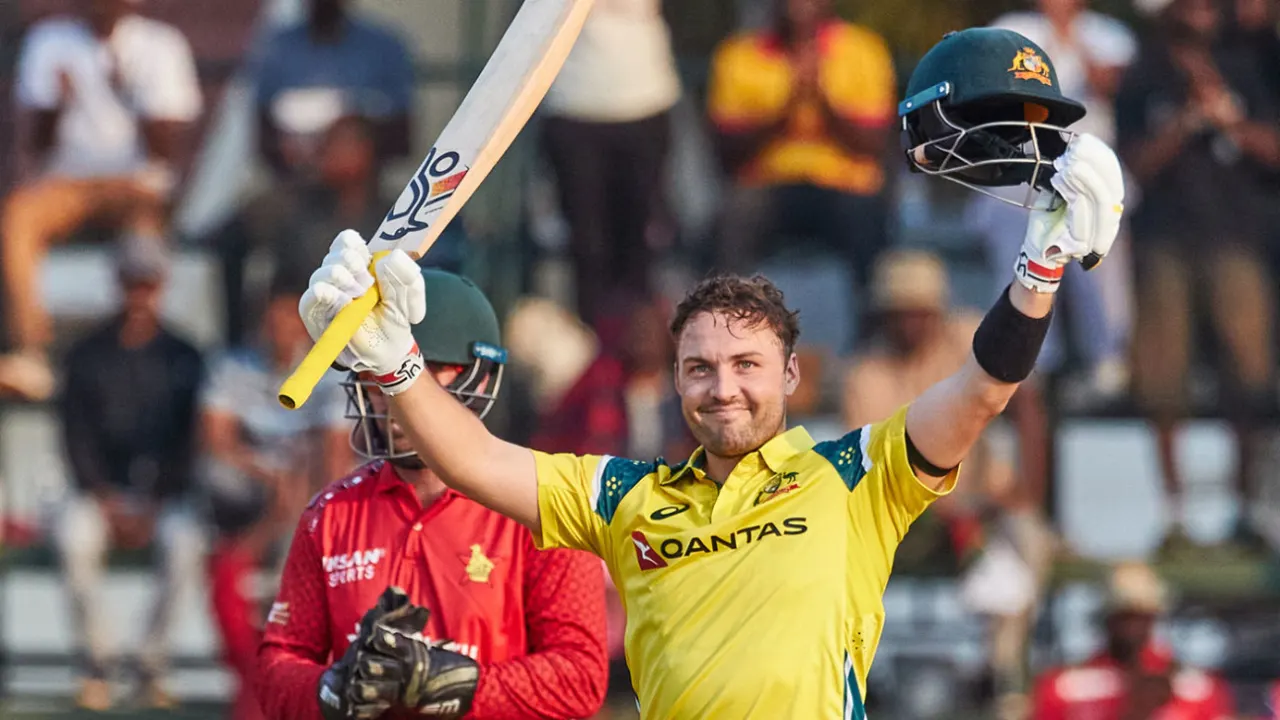
Australia concluded their first Zimbabwe tour after 12 years with a clean sweep of the hosts, who were unable to deliver a consolation win to a festive Harare crowd, as Nathan Ellis held his nerve alongside No. 11 Spencer Johnson in a match-winning tenth-wicket stand of 27. Zimbabwe do not have any internationals at home for the rest of the 2026 and, after posting their second-highest total batting first against Australia, saw the match slip from their grasp in the dramatic closing stages.
Pressure changed sides throughout the last quarter of the contest. Australia were cruising on 162 for 3 in the 26th over, when Brad Evans removed Alex Carey for the third of his four wickets and set the cat among the pigeons as wickets fell regularly. Josh Inglis was holding the chase together with his second ODI hundred but when he fell 45 were still needed. Then Ellis, who had earlier taken 3 for 50, put together a superbly-measured 36 not out to secure a thrilling win.
Their chase was built largely on the efforts of Inglis, who was the third Australian to reach a hundred in the series, after Matt Renshaw in the opening match and Travis Head in game two. In contrast, Zimbabwe did not have a century-marker, though Sikandar Raza and Craig Ervine scored two fifties each, including in this match and were the leading run scorers across the three matches.
Zimbabwe also had two of the three top bowlers and will know that it was in moments, not personnel terms, that they lost to Australia. In this match, there were four major ones. The first came when Innocent Kaia, batting well on 55, had to retire hurt with what looked like a hamstring injury to interrupt an 80-run fourth wicket stand with Ervine and stall Zimbabwe. The second was when Ervine, on 59, tried to accelerate with 10 overs left to go and holed out to long-on to spark a collapse of 4 for 22 which left Zimbabwe short of the 300 that was in their sights.
Then, in the field, Inglis, on 48, cut Ernest Masuku in the air to backward point and Wessly Madhevere leapt to his right but could not hold on. The drop proved costly even though Madhevere took a stunner to dismiss Carey. Madhevere’s biggest mistake was still to come. In the penultimate over when Ellis launched Masuku to deep midwicket, Madhevere got under the ball and spilled the chance.
With nine runs needed off the last six balls, Raza then gave Madhevere the ball, even though Graeme Cremer had an over in hand having caused problems in his first ODI in 2018. The first ball went for six and left Madhevere inconsolable at the end.
Inglis was in early after Evans struck twice in his first two overs. He had Head caught at deep backward square when he flicked off his pads and then found Mitchell Marsh’s inside edge to leave Australia were 25 for 2 in the fourth over. Inglis announced himself with a swivel pull that went for four and was brutal through the point area. He greeted Cremer’s return by sending his first ball – a full toss – through mid-on for four. But Cremer came back well and bowled Cooper Connolly with a classic leg break to announce his return in some style.
Inglis and Carey put on 85 for the fourth-wicket to keep Australia in control and Inglis’ big challenge came when Australia started to wobble. They were on 203 for 5 after 35 overs, 69 runs away from victory, and in the space of two overs Raza had Ollie Peake out lbw and Cremer got Xavier Bartlett with a googly. Then, Blessing Muzarabani was brought back to keep Australia under pressure and bounced Ellis, who fended him skywards but the chance fell out of Brendan Taylor’s reach. Muzarabani finished the series wicketless.
Inglis reached his century with a strong sweep against Cremer off his 94th ball and victory was still 55 runs away. When Raza bowled Inglis in the 42nd over, Zimbabwe were ahead in the contest but the management of their attack towards the end will raise questions. Muzarabani was bowled out after 44 overs and Evans with two overs to go. Cremer, despite his experience, was overlooked for his final over.
That won’t be the only area Zimbabwe will leave with questions. Their batting line-up underwhelmed in parts, especially after they chose to put runs on the board in the final match. They started off reasonably well and were on 34 without loss after six overs before their opening pair gave way.
Ben Curran’s poor returns in white-ball cricket continued when he gloved Johnson down leg and was caught behind for 7. His partner Brian Bennett didn’t fare much better. After showing promise with classy flicks off the pads and crunching pulls off short balls, Bennett skied a Ellis delivery to Head at midwicket to depart for 30. Bennett has not crossed 40 in his last eight ODI innings, despite getting several starts. Zimbabwe were 57 for 2 at the end of the powerplay.
Taylor took his time to get to a 16-ball nine before he was bowled by an Adam Zampa flipper and his form will also be a concern. Kaia, whose first runs had come off a thick inside edge, offered a chance on 27 when he was out of his crease early as Renshaw fired in a delivery down leg. Inglis fumbled and recovered but could not stump Kaia, who put the early jitters aside to play some classy strokes. He drove Renshaw through mid-on and pulled Johnson flat and hard to bisect the fielders in the deep. His fifty came just after the innings’ halfway mark, off 59 balls, and marked the first time he had crossed the milestone in 12 innings, since January 2023.
Kaia and Ervine got Zimbabwe into a good position and when Kaia retired on 148 for 3, it was up to Raza and Ervine to accelerate. They brought up the Zimbabwean 200 with 10 overs to go but the final flourish never came. Ervine was eager to up the ante but could not clear Renshaw at long-on and Madhevere sent an Ellis slower ball to cover to give Australia two wickets in two overs.
Evans showed glimpses of his finishing skills with back to back fours off Johnson but then top-edged a short ball to give Johnson a second wicket and Cremer was out lbw to a pinpoint Ellis yorker. Raza reached fifty soon after that and farmed strike for the final five overs to end unbeaten on 81 which gave Zimbabwe a competitive total, but agonisingly not quite enough.
Scores:
Australia 272 for 9 in 49.5 overs (Josh Inglis 103; Brad Evans 4-47, Graeme Cremer 2-53, Sikandar Raza 2-42) beat Zimbabwe 271 for 8 in 50 overs (Innocent Kaia 55 retired hurt,Craig Ervine 59, Sikandar Raza 81*; Spencer Johnson 2-50, Nathan Ellis 3-50, Adam Zampa 2-53) by one wicket
[Cricinfo]

Kenya’s Agnes Ngetich took a second off the women-only half-marathon world record on Sunday when she won the World Athletics Road Running Championships in Copenhagen, stopping the clock at one hour, five minutes, and 15 seconds.
Ngetich, who also broke the women-only 10km (6.2-mile) world record last year, pushed to the front from the outset on a sunny morning in the Danish capital and led until the end, finishing 50 seconds ahead of compatriot Veronica Loleo, who came in second.
The previous record was set by Peres Jepchirchir, another Kenyan, when she won the World Half Marathon title in Poland in 2020.
The overall women’s half-marathon world record is held by Ethiopia’s Letesenbet Gidey, who clocked 1:02:52 in 2021 at the mixed-gender Valencia Half Marathon in Spain.
Sunday’s win was the latest major title this year for the 25-year-old Ngetich, who also won the team half marathon in Copenhagen and the World Cross Country Championships in Florida in the US in January.
(Aljazeera)
Latest News
Flood warning issued to the Divisional Secretariat Divisions of Ganga Ihala Korale, Udapalatha, Doluwa, Udunuwara, Yatinuwara, Gangawata Korale, Harispattuwa, and Pathadumbara

Due to heavy rainfall received in the upper catchment areas of the Mahaweli River over the past few hours, there is a risk of minor flooding in the low-lying areas surrounding the Mahaweli River within the Divisional Secretariat Divisions of Ganga Ihala Korale, Udapalatha, Doluwa, Udunuwara, Yatinuwara, Gangawata Korale, Harispattuwa, and Pathadumbara.Residents living in the above mentioned areas and motorists using roads passing through these areas are urged to exercise extreme caution and remain highly vigilant regarding the prevailing situation.
Furthermore, residents living in close proximity to the Mahaweli River in these areas are advised to remain highly alert to the situation and take all necessary precautions to protect themselves from any potential flooding.The relevant disaster management authorities are requested to take all necessary measures in response to this situation.

Trophy row unlikely to repeat in Japan

Powerful explosions at Syrian army site near Aleppo injure at least four

Government committed to ensuring the rights of children with disabilities and providing equal opportunities – PM

Ellis and Inglis break Zimbabwe hearts to secure one-wicket thriller

Kenya’s Ngetich breaks women-only half-marathon world record by a second

Showers about 100 mm are likely at times in the Western, Sabaragamuwa and North-western provinces and in Galle, Matara, Kandy and Nuwara-Eliya Districts

‘Dates have the highest sugar content to fight Coronavirus’

Sunday Island 27 December – Headlines

#SundayIsland 17th December – Headlines

Sunday Island – 28th March

Sunday Island Headlines – 21 March

Sunday Island – 21st February – Headlines
-

 News4 days ago
US embassy won’t comment on IGP’s probe into joint drug raid
-

 News3 days ago
Bid for Basil’s extradition nears final stage: Police
-

 Features6 days ago
The emptying university: why are academics leaving?
-

 Business4 days ago
All-new Bolero MaXX unveiled in Sri Lanka
-

 News2 days ago
Shanakiyan urges urgent action over reported death sentence for Lankan in Saudi Arabia
-
 Opinion6 days ago
Who committed genocide and created mass graves in Sri Lanka?
-

 Opinion4 days ago
A journalist who wrote across the divide
-

 Weather6 days ago
Showers above 100 mm expected at times in the Western, Sabaragamuwa, Central, Uva and Southern provinces, and in Ampara and Batticaloa districts