
Latest News
US and Iran trade attacks as Khamenei is buried

The US and Iran again traded strikes in exchanges that continued into Thursday, as observers reported a “dramatic” drop in the number of ships travelling through the Strait of Hormuz.
The US says it hit 90 military targets, some near the Strait. Iran says 14 people have been killed in the past two days.
State media also reported that targets near the Bushehr nuclear power plant were hit, citing the deputy governor of the province. The US has not commented on the latest strikes.
Iran said it targeted US assets in Kuwait, Bahrain and Qatar in response. Later on Thursday, Tehran launched more strikes on sites in Kuwait, Jordan and Iraq, state-linked media reported.
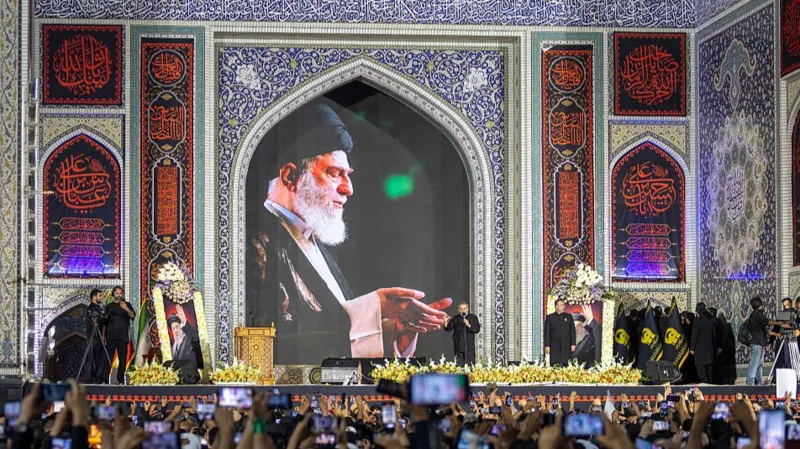
Separately, huge crowds gathered as Iran’s late supreme leader, Ayatollah Ali Khamenei, was buried after six days of funeral events.
Crowds massed on the streets of Mashhad in north-eastern Iran waving Iranian flags, while some were pictured holding signs carrying death threats directed at US President Donald Trump.
Khamenei was killed on 28 February during the first hours of US and Israeli strikes against Iran.

Iran’s foreign ministry denounced the latest US strikes as a “grave war crime”, describing the US administration as “evil and psychopathic”
Bridges and a railway route connecting Tehran to the city of Mashhad, where the late supreme leader’s funeral is being held, were also damaged, the foreign ministry said.
Iran’s health ministry said 14 people had been killed and 78 people injured across five provinces.
Gulf nations reported Iranian attacks following the US strikes, with explosions in Bahrain’s capital Manama, Kuwait intercepting missiles and drones, and Qatar issuing a security alert.
Later on Thursday, explosions were heard in Iran’s southern port of Konarak, with a local official telling Iran’s official news agency a navy site was attacked by an “enemy”.
However a US defence official told the BBC it had not carried out any strikes in Iran in recent hours.
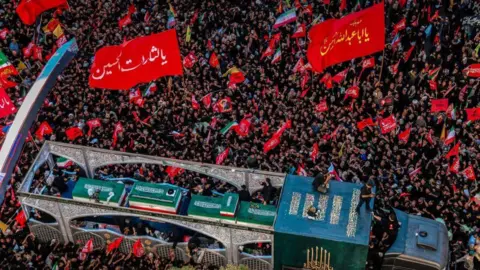
The funeral of Iran’s late supreme leader Ali Khamenei is being held in the city of Mashhad [BBC]
Iran’s parliamentary speaker Mohammad Bagher Ghalibaf, who is also the country’s chief negotiator with the US, said on X that America “still hasn’t learned that bullying and breaking promises are no longer cost-free”.
“Let me put it plainly: if you strike, you’ll get hit,” he wrote, adding that the Strait of Hormuz will only open under Iranian arrangements – not “American threats”.
US Central Command (Centcom) said the most recent round of strikes was carried out to “further degrade Iran’s ability to attack commercial shipping and innocent civilian mariners” in the vital waterway.
In a statement, it said it had struck 90 Iranian military targets, which included air defense systems and military logistics infrastructure along Iran’s coastline.
“The latest strikes follow successful execution of offensive strikes in Iran the night before,” Centcom added.
Phil Belcher, marine director at Intertanko, an international organisation for independent tanker owners, said the number of ships travelling through the Strait via the southern route closer to Oman was now in “single figures” following the step up in hostilities.
Belcher added that the overall daily figure of about 30 ships was down from about 70 a week ago and well below the normal number of 130 ships that was seen before the Iran war began earlier this year.
He told BBC Radio 4’s Today programme that there had been an “exuberance of optimism” around shipping in the region following the signing of the SMemorandum Of Understanding between Iran and the US last month, but now the mood has changed.
“This cycle of violence, this cycle of up-and-down, positive-negative news, it’s having an enormous impact both on business and on the seafarers themselves,” he said.
On Wednesday night Iranian state TV reported eight explosions in Bandar Abbas, and said two missiles had hit the ports of both Sirik and Jask – also in southern Iran.
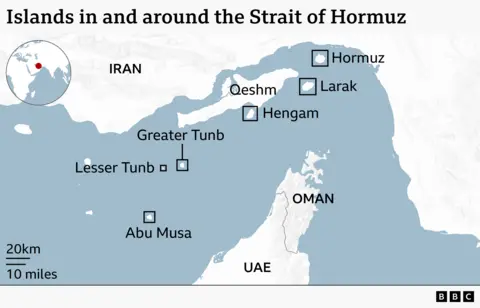
It added that two projectiles had hit the island of Abu Musa, which has been the subject of a longstanding ownership dispute between Iran and the United Arab Emirates.
The extent of damage from the US strikes is not yet known, but Iranian media have reported power cuts in Chabahar and a fire at an Islamic Revolutionary Guard Corps (IRGC) barracks in Bushehr. Images on social media showed damage to a marine control tower in Chabahar.
Earlier on Wednesday, Centcom wrote in a statement that it held Iran accountable for “recent unjustified aggression against commercial shipping and civilian crews freely navigating a vital international waterway.”
President Trump said late on Wednesday that Iran had “called a little while ago” and wanted to make a deal “so badly”.
Trump added: “I just don’t know if they’re worthy of making a deal – I don’t know that they’re going to honour the deal, that’s the problem.”
The current flare up has been the worst exchange of strikes between the US and Iran since the deal – known as a memorandum of understanding (MoU) – was signed on 17 June.
Trump said the ceasefire agreement signed last month with Iran was now “over”. He told reporters: “I don’t want to deal with them anymore, they’re scum. You know what scum is? They’re scum. They’re sick people.”
In response, Iran’s Foreign Minister Abbas Araghchi said in a post on X: “We do not answer vulgarity with vulgarity, but with action: fearlessly and with great valour.”
The deal between the US and Iran included 14 points, among them a 60-day period for a ceasefire during which negotiations should continue, the safe passage of vessels through the Strait of Hormuz and the US lifting sanctions on Iran.
The 60-day period for negotiations is not yet up, but Trump said he saw further talks as “a waste of time”.
[BBC]


President Anura Kumara Dissanayake today (20) paid his last respects to the remains of Most Venerable Kappetiyagoda Siri Wimala Thera, Anunayake of the Sri Lanka Ramanna Maha Nikaya and Chief Incumbent of the Rajopawanaramaya Temple in Gatambe, Kandy, who passed away.
The President visited the Rajopawanaramaya Temple in Gatambe, Kandy, where the remains of the Thera are lying, and paid his last respects. He subsequently expressed his deepest condolences to the Maha Sangha and the temple’s Dayaka Sabha, who are mourning the passing of the Thera.
Central Province Governor and Consultant Physician Dr Harsha Suranga Fernando, Kandy District Secretary Indika Udawatta and several others were present.
President’s Media Division (PMD)

India opener Shafali Verma has received an official reprimand and a demerit point for breaching Level 1 of the ICC Code of Conduct during the second T20I against Zimbabwe on Sunday.
Shafali, an ICC release said, breached Article 2.2 of the ICC Code of Conduct for Players and Player Support Personnel, which relates to “abuse of cricket equipment or clothing, ground equipment or fixtures and fittings during an International Match.”
It was Shafali’s first offence in a 24-month period.
The incident occurred in the 12th over of Zimbabwe’s innings when Shafali threw the ball into the ground in frustration after dropping a chance at mid-off offered by Chipo Mugeri-Tiripano off Sree Charani.
Shafali admitted the offence and accepted the sanction proposed by match referee GS Lakshmi, which meant there was no need for a formal hearing.
Level 1 breaches carry a minimum penalty of an official reprimand, a maximum penalty of 50% of a player’s match fee, and one or two demerit points.
India currently lead the three-match series 2-0 with the third game to be played on Tuesday evening. The T20Is will be followed by three ODIs in Vadodara from October 23.
(Cricinfo)

A total of 146 players will be competing for 27 available slots in the WPL 2027 mini auction on October 28 in Kochi. Of these, England batter Sophia Dunkley and Australia captain Sophie Molineux are the only two players who have listed themselves at the maximum base price of INR 50 lakh.
The auction pool has 119 Indian players, including 22 capped and 97 uncapped players, with 20 slots available for Indian players. The overseas pool has 27 players – 14 capped and 13 uncapped – including six from Associate teams, with seven slots available.
G Kamalini (released by Mumbai Indians), Kiran Navigre (released by U P Warriorz), Heather Graham and Jess Jonassen have registered at the second-highest base price of INR 40 lakh, while a total of 30 players have registered at INR 30 lakh.
Among the notable absentees are West Indies allrounder Deandra Dottin, who was released by UPW, and Australia legspinner Alana King, who was released by Delhi Capitals. Lizelle Lee, who was DC’s highest run-scorer last season, has also not listed herself after being released by the franchise.
What the teams look like going into the auction
Only two English players – Dunkley and Kira Chathli (INR 10 lakh) – have registered for the auction, with several others, including Danni Wyatt-Hodge, Alice Capsey, Dani Gibson, Lauren Filer and Linsey Smith opting to skip the WPL next year.
Cricinfo has learned that England are likely to play three T20Is in Sri Lanka in early February, which will clash with the final week of the WPL. While the ECB is likely to allow players to stay in India to complete the tournament, most players have instead chosen to prioritise their international commitments ahead of the Champions Trophy later that month.
The relatively low salaries on offer at the WPL are also understood to be a factor in many English players deciding not to register, with most internationals earning significantly more to play in the Hundred (up to £190,000 last year) than the highest permitted base price in the WPL of INR 50 lakh (£40,000 approx).
Molineux was part of the Royal Challengers Bengaluru [RCB] title-winning squad in 2024, and had bagged 12 wickets in ten games at an economy rate of 7.31. She was retained by RCB for the 2025 season but a knee injury ruled her out of the season. Dunkley, meanwhile, played for Gujarat Giants [GT] in 2023 before opting not to register for the 2024 season. She went unsold in the 2025 auction.
Among the premier internationals who have listed themselves for INR 30 lakh are Australia allrounder Grace Harris (released by RCB), Sri Lanka captain Chamari Athapaththu, South Africa left-arm spinner Nonkululeko Mlaba and South Africa allrounder Chloe Tryon.
UPW, who released nine players, will go into the auction with the biggest purse of INR 3.75 crore.
[Cricinfo]

Showers above 100 mm are likely at some places in the Western, Sabaragamuwa, Central, North-western, Northern and Southern provinces and in Anuradhapura district.

Low-quality coal causes power cuts: Ex-LECO Chief

Power cuts continue

GL stresses importance of post-war Shangri-La investment after CIABOC questions him

Coal inquiry gets extension until 16 December

Dilshan, Hirupama named best athletes at All Island Schools Games Athletics Championships

‘Dates have the highest sugar content to fight Coronavirus’

Sunday Island 27 December – Headlines

#SundayIsland 17th December – Headlines

Sunday Island – 28th March

Sunday Island Headlines – 21 March

Sunday Island – 21st February – Headlines
-

 Features3 days ago
Kotahena:A Small Enclave, An Extraordinary Legacy
-

 News4 days ago
Asgiri Mahanayake calls for immediate release of Gnanasara Thera
-

 News3 days ago
Record 1,600 students take Russian Classical Ballet examination in Sri Lanka
-
 News6 days ago
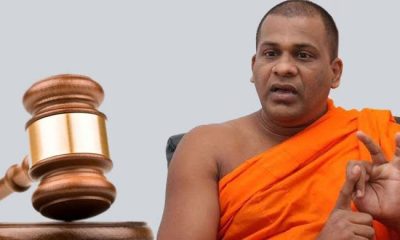
AC President recuses himself from hearing prison attire case pertaining to Gnanasara Thera
-
 News5 days ago
Naval officer testifies Yoshitha received Rs. 5.15 mn in salaries during SLN service
-

 News3 days ago
Karannagoda pushed for £24,536 for Yoshitha’s UK training, Court told
-

 Editorial5 days ago
Saving Anojan: Beyond Executioner’s Blade
-

 News6 days ago
CID informs Fort Magistrate’s Court investigation into money laundering case against Namal completed