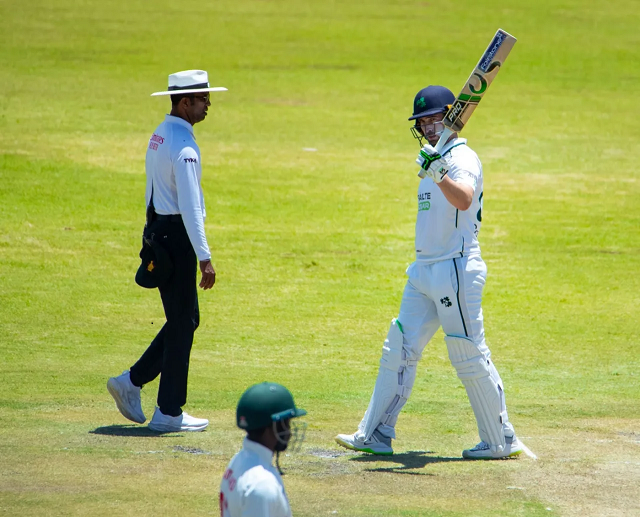
Ireland are well placed to complete a hat-trick of Test wins after setting Zimbabwe a target of 292 and reducing them to 38 for 3 at stumps. Andy Balbirnie and Lorcan Tucker struck fifties with contributions all the way down the order helping them take control of the game in Bulawayo.
Richard Ngarava, who took three of the last four wickets to fall, finished with a four-four; but it was the part-time spin of Wessly Madhevere that removed Balbirnie and Andy McBrine – Ireland’s top scorers of the second and first innings respectively.
Balbinie started the day with Campher and the duo grew their partnership from 37 to 75 with relative ease. There were nicks – like in the first over of the day – that weren’t carrying, the funky fields from Jonathan Campbell weren’t forcing batters into shots, and Blessing Muzarababi’s five-over opening spell was seen off without loss.
Campher picked up two boundaries off Trevor Gwandu – a stylish whip and a technically sound straight drive – before the bowler found his length to quieten the batter and then nick him off after drinks.
Ireland were 121 for 2 – a great entry point for Harry Tector, who got off a pair and got into his innings cautiously. Balbirnie, meanwhile, coasted along at his own pace to bring up a 106-ball fifty. He nearly dragged one on in the 34th over and weathered an examination by spin to take the lead up to 142 at lunch.
The spin of Campbell and Madhevere took hold after the break; first with the former ripping a legbreak to beat Tector’s full-faced block and trap him lbw, then the latter ripping an offbreak to beat Balbirnie’s flick to do the same.
Paul Stirling, who was more generous in peppering attack with defence, swept Madhevere over square leg for six and heaved Campbell wide of mid-on for four. He was out caught down leg, trying to pull Muzarabani fine, but was unhappy with the decision.
Tucker was off to a quick start too. He swept Campbell for two fours in the 59th over and consolidated after Stirling fell. He stitched handy 39-run and 23-run stands with McBrine and Mark Adair as Zimbabwe kept at it with spin before the second new ball became available.
McBrine was troubled by Madhevere, who beat his outside edge first (71st over) then snagged it for Nick Welch at slip to complete the catch (75th). Adair slogged a six off Madhevere and was comfortable against the old ball but edged two of the five he faced against the new ball, the second of which went to Takudzwanashe Kaitano’s hands at slip. It left Ireland 261 for 7 at tea.
Ngarava toyed with Barry McCarthy before knocking him over with a well-executed slower ball. Gwandu got a shortish ball to skid past Craig Young’s defences but that inconsistent bounce might be something that comes back to haunt Zimbabwe soon. Tucker and Matthew Humphreys, the last pair to bat, did run and walk along the danger area of the pitch a couple of times, but they were not pulled up by the umpires.
Tucker brought up fifty by pulling Ngarava and then flayed him over extra cover. But when he charged and tried to slap him over the off side two overs later, the top edge took the ball straight to cover. Ireland, who had conceded a seven-run lead, were all out for 298.
Zimbabwe came out to bat with an hour left in the day and McCarthy induced an edge from Ben Curran in the sixth over to have the opener caught behind for the second time in the game. A length ball that went away was set up by a few coming in to find the edge.
Adair ended Kaitano’s promising start, which included three boundaries, with another set-up. This time with outswingers before slowing up a fullish ball to beat the inside edge and hit the stumps.
Humphreys trapped Welch, Zimbabwe’s top scorer in the first innings, lbw with an arm ball that beat his flick. It brought Gwandu for nightwatch duty and he survived 12 balls to stumps. Brian Bennett, in at No. 4, had a close shave in the final over.
The highest successful chase in the fourth innings in a Test hosted by Zimbabwe is 192. So, the hosts will need to break that record if they are to win.
Brief scores:
Zimbabwe 267 in 86.1 overs and38 for 3 in 15 overs (Brian Bennett 15*; Mathew Humphreys 1-4, Barry McCarthy 1-14, Mark Adair 1-15) need another 254 runs to beat Ireland 260 in 56.4 overs and298 in 93.3 overs (Andy Balbirnie 66 Lorcan Tucker 58; Richard Ngarava 4-55, Trevor Gwandu 2-28, Wessly Madhevere 2-48)
Prime Minister Dr Harini Amarasooriya in her Environment Day message said that the environment is the foundation of our livelihood and called upon all Sri Lankans to come forward with the responsibility in mind to bequeath a secure a secure, prosperous and green planet to future generations.The PM’s Environment Day message:
“The environment is the foundation of our livelihood. It is the responsibility of the government to bequeath a secure, prosperous, and green planet to future generations.
In line with the global theme, “Urgent Climate Action,” and guided by the vision of “A Sustainable Biosphere – An Evergreen Life,” Sri Lanka commemorates World Environment Day this year at a critical moment. Drawing lessons from the climate-related challenges we have recently experienced, special attention has been directed toward protecting the water catchment areas of the central highlands and restoring ecosystems.
Under the theme “Dalulanna Idadenna” ( Let it Bloom), the Ministry of Environment has organized a series of programmes across the island to mark World Environment Day. These initiatives include environmental conservation inspired by religious values, awareness programmes on climate change, the protection of the Diyawanna Oya, the development of infrastructure in the wildlife sector, the conservation of water resources, and the promotion of medicinal plant cultivation, and through these efforts, it is evident that environmental conservation has evolved beyond a mere concept and become a practical and active commitment.
At this significant moment in our nation’s history, as more than 63,000 hectares of forest land have been gazetted as protected reserves through the “Wanaspathi” National Programme, which was launched last year, every citizen must resolve to live in harmony with the environment.
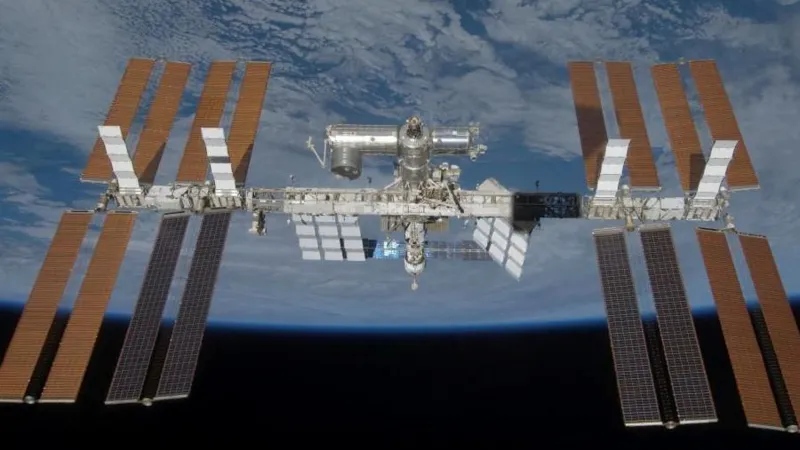
Astronauts on the International Space Station (ISS) were ordered to shelter in an attached spacecraft after the structure suddenly started leaking more air.
Five of the seven crew were directed to go into the docked SpaceX shuttle Dragon “Freedom” on Friday afternoon and were braced for a potential evacuation.
Meanwhile, two remaining personnel – a pair of Russian cosmonauts – attempted to repair a part of the Russian segment of the ISS, where the leaks had started increasing on Monday.
The repairs were paused and the crew ordered back onto the ISS by Nasa on Friday afternoon.
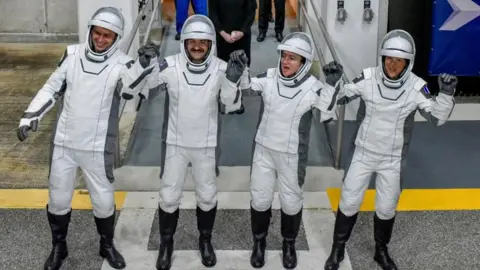
Jessica Meir, Jack Hathaway, Sophie Adenot and Andrey Fedyaev, who arrived on the ISS in February, had been sheltering on the docked ship, along with another astronaut Chris Williams.
They had been told to put on their spacesuits so they were ready to undock and return to Earth at short notice.
The Dragon effectively functions as a lifeboat – attached to the station but ready to detach the moment the order is given.
The trigger for the order was a worsening air leak in the transfer tunnel, known as PrK, leading to a section of the Russian segment of the station called the Zvezda service module.
Russian cosmonauts, station commander Sergey Kud-Sverchkov and flight engineer Sergei Mikaev, attempted to fix the problem. Their escape route was the separately docked Soyuz MS-28 spacecraft.
It is not the first time the station has had to deal with this problem – the cracks responsible have persisted on and off for around six years.
However, following the arrival of a Russian cargo ship last month, the Russian space agency Roscosmos noticed a fresh slow pressure drop in the tunnel, prompting the decision to move beyond patchwork fixes and attempt a more extensive repair operation on Friday.
(Left to right) Russian cosmonaut Andrey Fedyaev, Nasa astronauts Jack Hathaway, Jessica Meir and ESA astronaut Sophie Adenot [BBC]
But it was the method they were planning to use that prompted the order to take shelter, according to news agency Reuters.
Kud-Sverchkov and Mikayev were said to be using a saw to try and get into an area to access the crack that was leaking air.
Nasa disagreed with the method they were using and mission control in Houston ordered five crew to take “safe-haven” procedures on the Dragon ship.
When Roscosmos told their crew to pause repairs, Nasa instructed the astronauts to return to the station.
Nasa spokeswoman Bethany Stevens said on X: “Given this development, Nasa has instructed the crew members inside the Dragon spacecraft to end the safe haven procedures and return to planned operations aboard the International Space Station.”
Russian news agency Tass, citing Roscosmos, reported that nothing had been threatening the safety of the crew or the ISS’s onboard systems.
The ISS, which spans the length of a football field, is the largest human-made object in space.
It has been continuously operated by a US-Russian-led consortium that includes Canada, Japan and 11 European countries since 1998.
Maja Chwalinska lost in the Wimbledon second round (2022) and Australian Open first round (2025) in her only two previous Grand Slam appearances (BBC)
Qualifier Maja Chwalinska is one win away from a fairytale French Open triumph after setting up a final showdown with Russian teenager Mirra Andreeva.
The Polish world number 114, who had only ever won one match at a Grand Slam before this tournament, continued her astonishing run at Roland Garros by beating 25th seed Diana Shnaider 7-6 (7-4) 6-4.
Three weeks and nine matches after her French Open campaign began, Chwalinska dropped to the ground after firing in the 32nd and final winner of another scintillating display.
With that, she became the first qualifier in history to reach the women’s singles final at Roland Garros, and the crowd chanted her name as she spoke in her post-match interview.
On Saturday, she will attempt to become only the second qualifier in the Open era to win a Grand Slam after Britain’s Emma Raducannu at the 2021 US Open.
It would be a fitting conclusion to a French Open filled with spectacular shocks from the outset.
But, on the evidence of her dominant victory over Ukraine’s Marta Kostyuk, the in-form Andreeva will provide the sternest test of her credentials to date.
A beaten semi-finalist in 2024, the 19-year-old was hugely impressive in a 6-1 6-3 victory that made her the third-youngest woman to reach the Roland Garros showpiece this century, after Coco Gauff and Kim Clijsters.
Should she prevail in her first major final, eighth seed Andreeva would become the third-youngest first-time Grand Slam champion this century, after Maria Sharapova and Raducanu.