
Midweek Review
US exposes Lanka over Zuberi, Wickramasuriya affairs

The ongoing protest campaign in the wake of eruption of violence at Mirihana underlines the responsibility on the part of Sri Lanka to address issues – economic and political at hand. Successive governments have encouraged waste, corruption, irregularities and mismanaged the national economy. The bottom line is the current balance of payments crisis, the cumulative effect of mismanagement and corruption at every level over the years and exacerbated by two colossal blunders — the doing away with key taxes at the beginning of President Rajapaksa’s term, which deprived government coffers several hundred billion rupees per year and the abrupt decision by him to halt chemical fertiliser imports. But the culpability for the situation must be borne by the Executive, the Legislature and the Judiciary. There is more than a grain of truth in what big mouth Ranjan has been saying. Then of course there was a worldwide calamity in the form of the pandemic and some foolish measures taken not only here but worldwide like turning to the printing press for easy cash is now haunting almost the entire world.
By Shamindra Ferdinando
Political appointee Jaliya Chitran Wickramasuriya, 61, of Arlington, Virginia, served as Sri Lanka’s Ambassador to the United States and Mexico from July 2008 to May 2014. Wickramasuriya, on April fool’s Day, 2022, pleaded guilty to diverting and attempting to embezzle $332,027.35 from his employer, the Government of Sri Lanka (GoSL). The attempt had been made when the GoSL acquired a new embassy building in Washington D.C. in 2013.
Having repeatedly denied his involvement, in spite of returning the stolen money, Wickramasuriya, a cousin of the ruling Rajapkasas, pleaded guilty in the U.S. District Court in Washington DC (District of Columbia) to a charge of conspiracy to commit wire fraud. The charge carries a statutory maximum sentence of five years in prison and potential financial penalties.
Judge Tanya S. Chutkan is scheduled to sentence Wickramasuriya on July 20, 2022.
Wartime Foreign Minister Rohitha Bogollagama didn’t mince his words when he declared Wickramasuriya’s conduct as nothing but a disgrace, though the then Minister’s conduct, while in office, was anything but stellar, especially when it came to matters relating to his family, personal and political life. Bogollagama, who handled the matters relating to the war effort well, said that Wickramasuriya caused irreparable damage to the Foreign Service and humiliated the country.
Interesting, Bogollagama, who succeeded Mangala Samaraweera following a dispute that led to the Matara MP’s sacking, had been the Minister in charge of foreign affairs at the time the US-based Wickramasuriya received the ambassadorial post at the behest of President Mahinda Rajapaksa. Wickramasuriya succeeded top career diplomat Bernard Goonatilleke in Washington.
The Parliamentary High Post Committee (PHPC), chaired by the Speaker, cleared Wickramasuriya’s appointment pronto. In fact, PHPC over the years cleared almost all appointments recommended by successive governments. At the time Mahinda Rajapaksa won the presidency in Nov 2005, the US-based Wickramasuriya had been engaged in the tea export business and was first appointed the Consul General in Los Angeles, California.
Bogollagama lost at the April 2010 parliamentary election. Prof. G.L.Peiris took over the Foreign Ministry as External Affairs Minister but no change was made in Washington for obvious reasons. The then Monitoring MP of the Foreign Ministry Sajin Vass Gunawardena wielded immense power over the ministry. That was the time R. Duminda Silva functioned as the Monitoring MP of the Defence Ministry. In the absence of proper supervision at all levels, the situation deteriorated rapidly. The fraud perpetrated by the Ambassador while purchasing a new building for the Sri Lankan Embassy, in Washington, should be examined in that context.
The US compelled Sri Lanka to recall Wickramasuriya in July 2014 following investigations conducted by the Internal Revenue Service (IRS) about six months before Mahinda Rajapaksa lost the presidential election. Career FS officer Asela Weerakoon took over the mission, temporarily, before another FS senior Prasad Kariyawasam moved in. Before inquiring into the tax fraud further, it would be pertinent to discuss how Wickramasuriya held such a diplomatic appointment for seven years. Wickramasuriya was on a contract.
FS officers serve a particular mission for a period of three years whereas retired FS officers and political appointees receive contracts for two to three years. But, Wickramasuriya, having served as Consul General in Los Angeles, received the topmost diplomatic appointment and held it until the US exposed him.
The yahapalana administration waived the diplomatic immunity granted to Wickramasuriya.
The US Attorney’s Office for the District of Columbia, in a statement dated April 01, 2022, based on documents furnished to the court, declared from in or around late 2012 through November 2013, Wickramasuriya devised a scheme to defraud the GoSL during its 2013 purchase of a new Embassy building in Washington, D.C. by inflating the price of the real estate transaction by $332,027 and, at closing, diverted those funds from the government to two companies which had no role in the real estate transaction. After the January 2013 closing, Wickramasuriya directed these payments to the two companies. Later in the same year, Wickramasuriya redirected an equal amount of funds back to government accounts, leaving the Sri Lankan government with no loss.
From Wyoming Avenue to Whitehaven
Why did Wickramasuriya return the money? The man in Washington had no option but to do so after President Mahinda Rajapaksa raised the issue with him. Unfortunately, the Rajapaksa administration quite conveniently refrained from initiating action against him and Wickramasuriya was allowed to continue. Obviously, President Mahinda Rajapaksa didn’t want his cousin penalised regardless of the grave offense committed while serving as Sri Lanka’s top envoy in Washington.
Did Wickramasuriya make the move to shift the Sri Lankan mission based at Wyoming Avenue, N.W, Washington DC, 20008 to 3021 Whitehaven, St. N.W., Washington DC, 20008 with specific intention of stealing money. The decision to purchase the property was made in Oct 2012 by the GoSL and the funds transferred to the HSBC Bank account in Washington DC. The Ambassador and others involved in the conspiracy devised a plan to swindle the GoSL. Having finalised the agreement to procure the new building at a cost of USD 6.25mn, the Ambassador obtained USD 6.6 mn from the GoSL. Having paid the sellers real estate company and the buyers real estate company USD 187,500.00, each, Wickramasuriya directed the title company and the closing attorney to transfer USD 332,027.35 to Embassy consultant company A (USD 82,027.35) and Sri Lankan company incorporated in Sri Lanka (USD250,000). US investigations revealed that the Embassy consultant had been a lawyer and a close associate of Wickramasuriya. The lawyer has operated Embassy consultant company A and Embassy consultant company B and in spite of no involvement in the transaction received part of the funds provided for the acquisition of the new building.
The US court was told how several attempts were made by the Title Company to carry out instructions given by Wickramasuriya after the bid to wire USD 250,000 to the Sri Lankan company on January 17, 2013 failed as a result of an intermediary bank rejecting the move. Finally, USD 250,000 has been wired to the Sri Lankan company’s Sri Lankan bank account on March 20, 2013.
US investigators exposed the sordid embezzlement carried out by the then Sri Lanka’s top envoy in the US. Although Wickramasuriya paid back the entire sum by late October 2013, the US investigated the fraud and brought the judicial proceedings to a successful conclusion.
The Foreign Ministry owed an explanation regarding the Wickramasuriya episode. When The Island raised this issue with the Foreign Ministry recently, the writer was told that the case was pending in the Fort Magistrate court. Now dismantled Financial Crimes Investigation Division (FCID) investigated Wickramasuriya’s case after he was arrested in Nov 2016 at the Bandaranaike International Airport (BIA).
The writer had been in touch with Wickramasuriya after he was granted bail and reported on the matter. Claims made by Wickramasuriya at the time have to be examined against the backdrop of him pleading guilty to the attempt to defraud the GoSL.
Those who served the Rajapaksa administration claimed that they were targeted for political reasons. Speaking to the writer from the US in April 2018, Wickramasuriya claimed that US authorities prevented him from leaving the US to appear in the case heard in the Fort Magistrate court.
Wickramasuriya said that he first realized restrictions placed on him when he tried to leave Atlanta for Chile late last year. “I got my boarding pass and was about to get in when Homeland Security personnel stopped me. They wanted to question me at the airport. I was taken to a room where they explained the reasons for my detention.”
Shavindra Fernando, PC, has represented Wickramasuriya, who was deprived of diplomatic immunity though he was assured of protection. Wickramasuriya said that he hadn’t been able to leave the US though he was ordered to appear in court over the alleged embezzlement of funds. The former diplomat quoted Homeland Security officers as having told him that the government of Sri Lanka (GoSL) had wanted the Embassy transaction probed.
Commenting on his Nov 2016 arrest, Wickramasuriya said. “I was in Sri Lanka for two years. They never wanted to record my statement. Although I have travelled overseas about 10 times since returning from the US in May 2014, the police stopped him as he was leaving for the US in the early hours of Nov 17, 2016.”
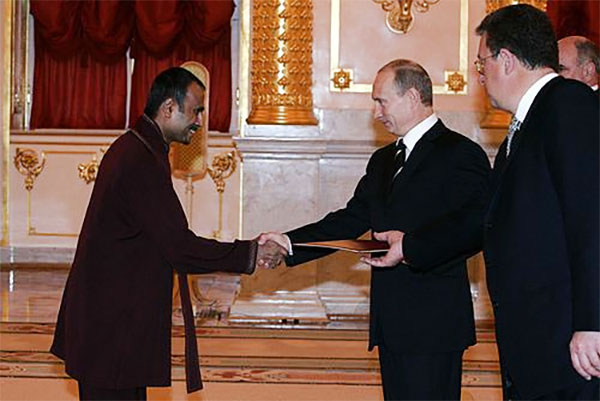 Udayanga Weeratunga presenting his letter of credentials to Russian President Putin at the Grand Kremlin Palace, Moscow
Inconsistency in GoSL reaction
Samagi Jana Balavegaya (SJB) lawmaker Dr. Harsha de Silva pointed out the discrepancy in the US and GoSL response to the Wickramasuriya affair. The US action in respect of Wickramasuriya should be examined taking into consideration the dismissal of several dozens of cases filed against the Rajapaksas and their acolytes.
Referring to a group of lawyers mounting a protest at the Attorney General Sanjay Rajaratnam’s Office during the ongoing campaign demanding President Gotabaya Rajapaksa to step down, Dr. de Silva said that a foreign court was able to carry out the judicial process to a successful conclusion. “How strange. All the high powered and connected crooks are found not guilty in local courts. We have a huge responsibility to do all we can to ensure the institutions are strengthened so that the corrupt are dealt without fear or favour.”
The Wickramasuriya affair has exposed the pathetic way overseas appointments are made at a time cash-strapped Sri Lanka is in the process of pruning diplomatic missions. Sri Lankan mission in Oslo is among those missions.
Successive governments have used diplomatic missions to accommodate those who served the interests of the powers that be. The incumbent dispensation is no exception. Although the appointment of non-career diplomats as heads of missions cannot be totally discontinued under any circumstances, no one can dispute the need for a balance. Over the years, diplomatic posts have been offered to various persons for a variety of reasons. There cannot be a worse example than misusing political authority in respect of diplomatic postings than former President Maithripala Sirisena offering an overseas posting to disgraced former IGP Pujith Jayasundara. Appearing before the Presidential Commission of Inquiry (PCoI) that probed 2019 Easter Sunday massacres, Jayasundara claimed that the President offered him a diplomatic post if he accepted the responsibility for those multiple suicide attacks. Jayasundara also claimed that he received an assurance he would be cleared by an inquiry that was being conducted at that time.
Corruption accusations
Against the backdrop of one-time Sri Lankan head of mission found guilty by a foreign court and the verdict to be delivered on July 20, in spite of Sri Lanka’s failure to do so, the need for a fresh look at the high profile case of Imaad Shah Zuberi, a Los Angeles-based venture capitalist and political fundraiser receiving 144 months in federal prison for defrauding Sri Lanka. Zuberi was sentenced in Feb 2021.
A US court found him guilty for cheating the Sri Lankan government millions of dollars promising to rebuild the country’s image following the end of the war with the crushing victory over the LTTE. The court was told Zuberi received USD 6.5 mn in 2014 following discussions initiated during Wickramasuriya’s tenure as Sri Lanka’s Ambassador in Washington.
Zuberi operated Avenue Ventures LLC, a San Francisco-based venture capital firm, and solicited foreign nationals and representatives of foreign governments with claims he could use his contacts in Washington, D.C. to change U.S. foreign policy and create business opportunities for his clients and himself.
US skullduggery
The US moved the Geneva-based United Nations Human Rights Council (UNHRC) against Sri Lanka in Oct 2015 after playing a significant role in the then Opposition campaign against President Mahinda Rajapaksa. No less a person than US Secretary of State John Kerry declared US funding for regime changing projects in four countries in 2014/2015, including Myanmar and Sri Lanka.
The Justice Department said: “Zuberi promised to make substantial expenditures on lobbying efforts, legal expenses, and media buys, which prompted Sri Lanka to agree to pay Zuberi a total of $8.5 million over the course of six months in 2014. Days after Sri Lanka made an initial payment of $3.5 mn, Zuberi transferred $1.6 million into his personal brokerage accounts and used another $1.5 million to purchase real estate.”
In total, Sri Lanka wired $6.5 million pursuant to the contract, and Zuberi used more than $5.65 million of that money to the benefit of himself and his wife. Zuberi paid less than $850,000 to lobbyists, public relations firms and law firms, and refused to pay certain subcontractors based on false claims that Sri Lanka had not provided sufficient funds to pay invoices.”
It has to be stated that the then government spent money on such foolish attempts to lobby Washington as the country was being hounded by the West for militarily crushing the LTTE, as their experts had been repeatedly telling us over the years our security forces were incapable of achieving such a task.
The Foreign Ministry here acknowledged that payments made to Zuberi had never been investigated at any level. The ongoing protest campaign demanding the government to quit also focused on corruption during the previous Rajapaksa administration. There is no point in denying waste, corruption, irregularities and mismanagement caused irreparable damage to the national economy.
Sri Lanka never investigated the Wickramasuriya affair and the role played by the Sri Lankan mission in Washington in hiring Zuberi, an American of Pakistani and Indian descent. A proper investigation would have probably revealed the involvement of certain politicians and officials there in the scam perpetrated by Zuberi.
The yahapalana administration never made a genuine attempt to investigate the Wickramasuriya affair though he was arrested. However, the then government facilitated the US investigation by waiving diplomatic immunity. But, the payments made to Zuberi via the Central Bank never received the attention of the yahapalana lot.
Once the writer raised this issue with Arjuna Mahendran, the then Governor of the Central Bank, a Singaporean national who fled the country in the wake of the Presidential Commission of Inquiry into the Treasury Bond scams handing over its report to President Maithripala Sirisena in late Dec 2017. Mahendran didn’t indicate any interest. In fact, he did nothing.
Udayanga Weeratunga, a first cousin of the then President Mahinda Rajapaksa, received appointment as Sri Lanka’s Ambassador to the Russian Federation. Weeratunga presented his credentials to Russian President Vladimir Putin at the Grand Kremlin Palace, Moscow, on Nov 16, 2006, a year after Mahinda Rajapaksa won the presidency. Weeratunga served in Moscow till Mahinda Rajapaksa’s defeat at the 2015 presidential election. Having enacted the dictatorial 18th Amendment to the Constitution at the onset of his second term, the war-winning President sought a third term but was defeated.
In January last year, SJB lawmaker Chaminda Wijesiri, raised concerns in Parliament regarding key diplomatic posts offered to those with political affiliations and to friends and relatives of political leaders. The MP questioned the manipulation of the whole process for the benefit of a few.
The then Foreign Affairs Minister Dinesh Gunawardena denied MP Wijesiri’s accusations. The MEP leader who is also the Leader of the House claimed that appointments hadn’t been based on political relationships. The Foreign Ministry followed the recruitment procedure and the appointments made to the Foreign Service had to be approved by the PHPC headed by the Speaker of Parliament. Of course, both Wickramasuriya and Weeratunga had been out of Foreign Service by 2014. Whatever the accusations directed at Weeratunga, he should earn the respect of the public for helping Sri Lanka enhance its firepower with the acquisition of Ukrainian MiGs for the SLAF at the onset of the Eelam War IV. Weeratunga secured the contract for the acquisition of four MiGs and the overhaul of four other MiGs that had been in service with the Air Force. However, controversy surrounds the 2006 deals with those who never believed in Sri Lanka’s triumph over the LTTE, causing media furore.

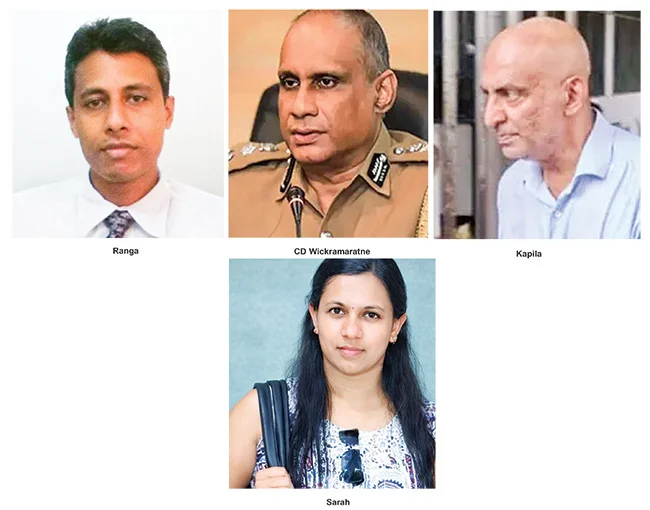
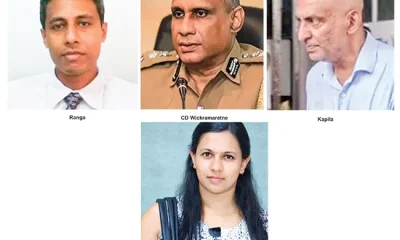
Former IGP Chandana Deepal Wickramaratne, 63, succumbed to gunshot injury he received at his residence at Parakrama Mawatha, in Thalahena, Malabe, on 17 July. Wickramaratne, the 35th IGP (25 November, 2020, to 23th November, 2025), was pronounced dead at the Mulleriyawa Hospital.
The incident triggered speculation regarding the circumstances leading to the ex-IGP’s death. Some declared that Wickramaratne shot himself with a weapon issued to his bodyguard. Others alleged that Wickramaratne had been deeply depressed over divorce proceedings, involving his son and daughter-in-law, and accusations directed at his son over domestic violence. They claimed that the situation may have had unexpected bearing on Wickramaratne.
There are also lingering concerns regarding the impact of the ongoing investigations into the 2019 Easter Sunday carnage, on Wickramaratne’s demise, the third such incident after the last presidential elections held in September, 2024.
Assistant Director of the External Resources Department of the Ministry of Finance, Ranga Nishantha Rajapaksa, 50, was found dead in the garden of his Kuliyapitiya home on 30 April, 2026. At the time of Rajapaksa’s alleged suicide, blamed on injuries he supposedly inflicted on himself using a knife, while he was under suspension over the USD 2.5 mn heist from the Treasury. He was the official who lodged a complaint with the CID regarding the unprecedented theft.
Former Chief Executive Officer (CEO) of SriLankan Airlines, Kapila Chandrasena, 61, was found dead at No. 38, Pedris Road, Kollupitiya, on 8 May, 2026. Authorities declared Chandrasena died by hanging. Chandrasena was the prime suspect in the SriLankan Airlines bribery case, exposed by the UK Serious Fraud Office (SFO), in a joint investigation carried out with US and French authorities. At the time of his death, he was out on bail but faced re-arrest over alleged violations of bail conditions.
The Finance Ministry official and ex-IGP died as a result of ‘incidents’ at their respective homes, while Chandrasena allegedly took his own life at the posh residence of his brother-in-law Aravinda de Silva. Their deaths are mired in controversy for obvious reasons. One of the major issues at hand is whether their deaths impacted the ongoing politically sensitive cases.
The USD 2.5 mn theft sent shockwaves through the National People’s Power (NPP) government, struggling to cope up with a spate of other sensitive developments, such as the massive coal scam that led to the resignation of Energy Minister Kumara Jayakody, and the controversial release of 323 red flagged containers from the Colombo port, without any checks, in addition to two containers carrying narcotics.
The police faced the challenging task of conducting transparent investigations into the deaths of Ranga Nishantha Rajapaksa, Kapila Chandrasena and C.D. Wickramaratne.
Although the Finance Ministry official’s death was caused by cardiorespiratory failure due to heavy loss of blood, many questioned how he inflicted grievous cut wounds on his legs and on his left wrist. The judicial post mortem report that was made available within 24 hours after the alleged suicide raised concerns. The Opposition expressed suspicions. A section of the media, too, weren’t satisfied with the way the government handled the case. The truth is in spite of a post mortem examination conducted by a four-member expert panel, suspicions remain regarding the Finance Ministry official’s death.
It would be pertinent to mention that The Sunday Leader Editor Lasantha Wickrematunga was stabbed to death though police and all others concerned initially claimed firearms attack caused his death. The Attorney-at-Law was killed inside his car that he was driving on the Attidiiya Road, Ratmalana, on 8 January, 2009. Over 17 years after the still unresolved killing of the one-time The Island staffer, the vast majority of people still believe Wickrematunga was shot dead. Wickrematunga’s case is just among several high profile investigations hampered by deliberate falsification of relevant autopsy reports.
Sarah Jasmine factor
Among those who paid their last respects to Wickremaratne at a funeral parlour in Colombo was former President Ranil Wickremesinghe. Former Minister Sagala Ratnayake accompanied the UNP leader.
One of the issues that received public and media attention, following Wickremaratne’s demise, was the controversial third DNA test conducted in spite of two previous DNA tests confirming that Pulastini Rajendran, alias Sarah Jasmine, was not among the dead caused by a series of explosions at Sainthamaruthu, in the East, a week after the 2019 Easter Sunday carnage.
She was married to Achchi Muhammadu Mohammadu Hasthun, the National Thowheeth Jaamath (NTJ) operative who carried out the suicide blast in St. Sebastian Church, Katuwapitiya.
The CID questioned Wickremaratne as he served as the IGP at the time of the third DNA test. Controversy surrounds the decision to call for a third DNA test and, in addition to Wickremaratne, the CID questioned former Deputy IGP of the CID Prasad Ranasinghe in the second week of December last year. Public Security and Parliamentary Affairs Minister Ananda Wiejapala commented on the issue at hand in Parliament in early June, 2025.
There had been contradictory claims on Sarah, a Batticaloa Tamil convert to Islam, who lived with the extremist group. In spite of investigations, controversy still surrounds her fate, though both Sri Lanka and Indian intelligence services investigated the circumstances of her ‘disappearance.’
There had been claims that she was taken out of the country by Indian intelligence. Let me remind you what the DSJB lawmaker Mujibur Rahuman said in Parliament on 10 November, 2022, during Ranil Wickremesinghe’s presidency. Declaring that Sarah had taken refuge in India, the outspoken parliamentarian alleged that the Wickremesinghe-Rajapaksa government was struggling to prove she died in the Sainthamaruthu blasts, on the night of 26 April, 2019.
Rajarathnam Kavitha, mother of Sarah, is on record as having told the Presidential Commission of Inquiry (PCoI) that her daughter had been with Zharan Hashim’s wife, Fatima, from early February, 2019, to 26 April, 2019, the day remnants of the NTJ group triggered the Sainthamaruthu blasts.
Sarah’s mysterious status remains a key factor in the overall investigation, with retired Major General Suresh Sallay named a suspect in the high profile case. Sallay served as the Director of State Intelligence Service (SIS) from November, 2019, to October, 2024. The CID arrested the one-time head of the Directorate of Military Intelligence (DMI/ 2012 to 2016) in late February 2026, under the Prevention of Terrorism Act (PTA).
Archbishop of Colombo, Malcolm Cardinal Ranjith, recently filed an intervening petition before the Court of Appeal in respect of the petition filed by Sallay challenging his arrest and detention under the PTA. Cardinal Ranjith sought permission to make submissions regarding Sallay’s petition while requesting the court to dismiss the latter’s petition.
The Church intervened after several prominent Buddhist monks, religious and civil society organisations filed intervenient petitions seeking leave to intervene in Sallay’s writ application, filed by the retired top intelligence officer, challenging the legality of his arrest and detention.
They highlighted the following points:
• The Supreme Court and the PCoI identified Zahran Hashim and the ISIS-inspired NTJ as the perpetrators of the 2019 Easter Sunday carnage while attributing responsibility to State officials for failing to act on prior intelligence.
• None of the official investigations or judicial findings implicated Sallay in planning or facilitating the Easter Sunday attacks.
• The PCoI recorded that Major General Sallay had warned authorities about the rise of Islamist extremism before the attacks.
• The intervening petitions expressed concerns that unsubstantiated allegations have created a public narrative suggesting a wider conspiracy involving Sinhala Buddhist military and intelligence officers, contrary to the findings of the Supreme Court and the PCoI.
• The petitions argued that such unsupported narratives risk undermining public confidence, damaging communal harmony, and unfairly tarnishing the reputation of individuals and institutions without credible evidentiary foundation.
Ex-IGP’s statement
In his statement to the CID, Wickremaratne explained that he directed the senior police officer, in charge of Ampara, to secure the military and STF backing for the Sainthamaruthu operation that led to the death of some inner remnants of Zahran’s group. The Ampara-based officer, identified as Samantha Wijesekera, had got in touch with the Department’s number two officer, as IGP Jayasundera couldn’t be contacted over the phone. That statement dealt with the measures taken by them to ascertain Sarah’s status and the final assertion on the basis of the Government Analyst’s findings (third DNA test) that she was among those who perished in the Sainthamaruthu suicide blast.
The then Police Spokesman DIG, Nihal Thalduwa, has been directed by Wickremaratne to issue a press release confirming Sarah’s death. In his statement to the CID, Wickremaratne explained the deep interest shown by the head of the Indian Intelligence, based in Colombo, regarding Sarah’s status, underscoring their requirement to know whether she was dead or alive. The Indian official has repeatedly emphasised the pivotal importance of establishing Sarah’s status and, according to Wickremaratne, never tried to hide their interest in knowing her fate.
Did India accept the findings of the third DNA test? The possibility of Sarah being an Indian informant cannot be ruled out as India was able to alert Sri Lanka of the impending attacks. SJB Colombo District MP Rahuman has often commented on this possibility. Or, perhaps, India knew of Sarah’s status but raised the issue with Wickremaratne in a bid to indicate they, too, weren’t aware. Perhaps, we’ll never know the truth.
Sri Lanka received three specific warnings on 4, 20 and 21 April regarding impending dastardly NTJ operation. The last warning was received several hours before the NTJ struck hotels and Churches in Colombo, Katana and Batticaloa. The blasts killed 270 persons and wounded about 500.
At the time of the NTJ operation, the DMI was headed by Brigadier Chula Kodituwakku, who appeared alongside President Maithripala Sirisena when he met the media at the Janadhipathi Mandiraya, several days after the attacks. Now retired, Kodituwakku, in his testimony in courts, declared that the SIS refrained from sharing foreign intelligence with the DMI. In fact, Army Commander Lt. Gen. Mahesh Senanayake, who also addressed the media, explained the difficulties experienced by the Army due to refusal on the part of the SIS to cooperate with the DMI.
According to an appeal filed against an order of the High Court-at-Bar, in terms of the Section 451 (3) of the Code of Criminal Procedure Act No. 15 of 1979, as amended, read with Article 128 of the Constitution, in the Supreme Court, India issued the following warning: “As per an input, Sri Lanka based Zahran Hashim of National Thowheeth Jamath and his associates are planning to carry out suicide terror attack in Sri Lanka shortly. They are planning to target some important churches. It is further learnt that they have conducted reconnaissance of the Indian High Commission in Sri Lanka and it is one of the targets for the planned attack.”
No holds barred investigation is required to establish the truth. The Opposition has repeatedly questioned the handing over of the investigation to retired Shani Abeysekera, who had been the Director, CID, at the time of the 2019 Easter Sunday carnage, and accommodating Senior DIG Ravi Seneviratne as the Secretary Public Security Ministry. They had been accused of failing to act on specific intelligence received from the SIS.
Both Abeysekera and Seneviratne, as members of the Retired Police Collective, backed the NPP campaigns in the run-up to the presidential and parliamentary polls, in 2024. Abeysekera, who retired on 30 June, 2021, was recalled and officially reappointed as the Director of the Criminal Investigation Department (CID), on a contract basis, by the NPP.
Political factors
There had never been a case as politicised as the 2019 Easter Sunday carnage. Immediately after the massive security lapse, and negligence on the part of the Sirisena-Wickremesinghe government, facilitated the NTJ operation, the Church threw its weight behind Gotabaya Rajapaksa’s 2019 presidential bid.
The Church backing made a significant difference on the ground. That prompted SJB’s Harin Fernando to directly accuse Malcolm Cardinal Ranjith of ensuring Gotabaya Rajapaksa’s victory at the expense of Sajith Premadasa. Since the SJB’s highly publicised June, 2020, accusations, there had been contradictory statements regarding the Easter Sunday attacks.
In February, 2021, on behalf of the JVP/NPP, Dr. Nalinda Jayatissa (current Health and Media Minister) declared that India masterminded the Easter Sunday attacks.
This accusation was made just a few weeks after the PCoI handed over its report to President Gotabaya Rajapaksa, who, for some strange reason, appointed a six-member committee, consisting of SLPP lawmakers, headed by his elder brother Chamal, than requesting the Attorney General Dappula de Livera, PC, to act on the recommendations.
In May, 2021, Dappula, after having failed to convince President Rajapaksa to extend his term by one year, alleged that the Easter Sunday attack was a grand conspiracy. In spite of growing doubts regarding the delay in implementing the PCoI recommendations, the Church tried to convince the President to act on them. In July 2021, the Church wrote to President Rajapaksa. Against the backdrop of the SLPP’s continuing indifference, by the end of that year, the Church reached a consensus with those opposed to the government.
The Church openly backed the protest campaign, against President Rajapaksa, and remained committed to the operation until the very end.
Two sons of wealthy spice merchant and JVP National List MP, at the 2015 general election Mohamed Yusuf Ibrahim’s sons Ilham Ahamed and Imsath Ibrahim, carrying out suicide attacks, on behalf of the NTJ, made no difference. Ibrahim was later released on bail, in May, 2022, during Wickremesinghe’s tenure as the President. Ilham Ahamed’s heavily pregnant wife detonated an explosive vest, inside their Dematagoda mansion, when the police surrounded the place, soon after the attacks. Did the spice trader know about the despicable NTJ strategy? Zaharan Hashim’s wife Abdul Cader Fathima, who survived the Sainthamaruthu blast too was granted bail in March, 2023, during Wickremesinghe’s presidency.
The Church, at one point, demanded that the Deputy Defence Minister Maj. Gen. Aruna Jayasekera be removed pending conclusion of the investigations. The Church claimed that as Jayasekera served as the Eastern Commander at the time of the Sainthamaruthu blasts, he should give up the Defence portfolio for the time being. The government ignored that demand.
By Shamindra Ferdinando
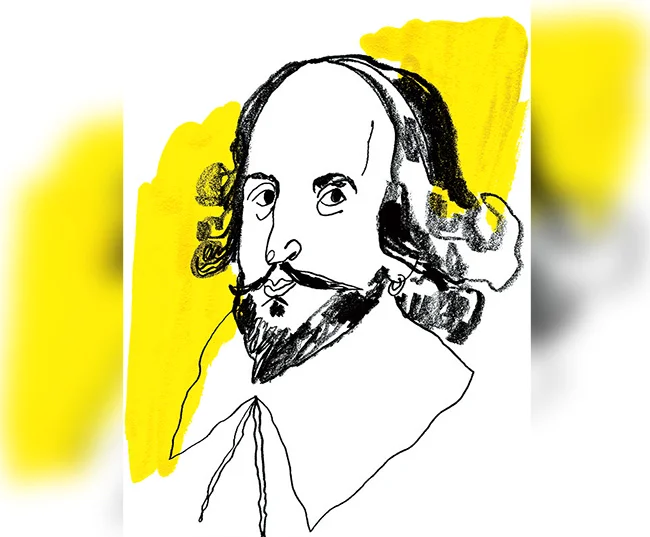
Exposing Complexities of the Human Condition in Man’s Quest for Power
Shakespeare believed that drama could illuminate truths about human nature more effectively than argument or philosophy. The famous line, “The play’s the thing, wherein I’ll catch the conscience of the king,” expresses not merely Hamlet’s strategy but Shakespeare’s own artistic philosophy – that theatre exposes hidden moral realities and awakens the human conscience.
Shakespeare and the Human Condition
Shakespeare displayed an extraordinary understanding of the human mind, long before psychology emerged as a formal discipline. He possessed an unparalleled gift for revealing human experience through vividly drawn characters and situations they create. He drew from Renaissance historical material as they provided a rich source of dramatic material, and chose themes that reflected musings of the Elizabethan era he lived in, taking his audiences with him.
Complexities of the human condition, regardless of culture, nationality or historical period have endured. As his fellow playwright, Ben Jonson famously proclaimed over four hundred years ago: “He [Shakespeare] is not of an age, but for all time”. He continues to alert our senses and raise our conscience about humanity with all its strengths and weaknesses by way of dramatic expression. Shakespeare is our contemporary.
I have endeavoured to examine the great playwright’s work in relation to the treatment of psychological and moral complexities surrounding humanity’s pursuit for power, in order to demonstrate how these works continue to speak with remarkable urgency to our own time. The enduring relevance of this idea becomes apparent in the following three Shakespeare’s plays: Henry V, Macbeth and The Tragedy of Julius Caesar, I have chosen to illustrate my argument.
Henry V: Leadership and the Cost of Glory
It is a reflection on Shakespeare’s stature that he portrays triumphalism of leadership and the anguish of those who pay with their lives in war, in equal measure. In his Historical play, Henry V. King Henry of England makes a claim to the French throne, egged on by church leaders who wish to distract him from domestic issues. Feeling mocked by the French response, Henry declares war. He invades France displaying strong leadership despite hardship and heavy loss of life. On the eve of the pivotal battle of Agincourt, on St. Crispin’s day, he delivers an inspiring speech to his outnumbered troops. The long and poetic speech, which came to be known as the St. Crispin’s day speech – one of the best known in all Shakespeare – strengthened his powerful status in the play.
“…This story shall the good man teach his son;
And Crispin Crispian shall ne’er go by,
From this day to the ending of the world,
But we in it shall be remember’d.
We few, we happy few, we band of brothers;
For he to-day that sheds his blood with me
Shall be my brother; be he ne’er so vile,
This day shall gentle his condition …”
Against the odds, the English defeat the French at Agincourt. The play ends with a note of political and personal triumph, as Henry woos and marries Princess Catherine of France, securing peace between the two nations, at an immense cost to human life.
Macbeth: Ambition and Moral Corruption
In the reign of King Duncan of Scotland, General Macbeth who commands respect as a valiant soldier, returning home with his colleague Banquo following a victorious military expedition, is confronted by three witches who predict cryptically that he is destined to become King of Scotland. Macbeth is urged on by his wife, who, in an ‘’unquenchable desire to become queen’’, attempts to persuade her husband with ‘a humane disposition’ to assassinate the king while he is asleep as a royal guest in their home, and frame the two intoxicated royal aides. Malcolm and Donalbain, King Duncan’s two sons who accompanied him, fled to England.
Macbeth, the play, portrays the tale of a man in pursuit of power destroying anyone on his way, bringing about a collapse in moral order, providing insights into everything inhumane about humankind. The character of Macbeth is first acknowledged as a ‘hero’; his innate desire for power is activated by the prophecy of the witches. But bound by his loyalty to his king, his ‘conscience’ would not allow him the thought of regicide: “If chance will have me king, why, chance may crown me/ without my stir”. Weighed down by fear and guilt, he drags his feet, but the valiant soldier succumbs to the “valour of his wife’s tongue”: “Your hand, your tongue look like th’ innocent flower/ But be the serpent under’t”. She herself did not have the courage to murder her royal guest with her own hand, but was persuasive: morality yields to the pressure of evil desire. Macbeth completes the task, and they feign their lament at the king’s death which they themselves brought about.
Power did not bring in peace, but inner turmoil: “In the affliction of these terrible dreams/ That shake us nightly; better be with the dead/ Whom we, to gain our peace, have sent to peace/ Than on the torture of the mind to lie/ In restless ecstasy”. Fear, guilt and repentance grip the usurper but pride would not allow their expression.
Fear and insecurity bred paranoia in Macbeth. The usurpers became preoccupied with protecting the throne and handing over sovereignty to their progeny which they were yet to produce. With the advice of the witches he arranges the murder of all they suspect would take over rule after him. First they get Banquo, his colleague, ambushed and killed; Fleance, who accompanied his father, escapes. He then learns that Macduff, the feudal lord of Fife, has fled to England to join Malcolm, the son of the slain King Duncan, and, together they are mobilising an army to attack Scotland with the intent of displacing him from the throne. An outraged Macbeth orders the slaughter of Macduff’s wife and children who remained in Scotland, and anyone related to the defector.
Malcolm and Macduff invade Scotland with a powerful army. Lady Macbeth, afflicted with intense guilt, took her own life. Macbeth was slain after a fierce battle and his severed head was presented to the newly crowned king, Malcolm, who proclaimed …”I should/ Pour the sweet milk of concord, into hell? Uproar the universal peace, confound/ All unity on earth”.
In Macbeth, Shakespeare places on stage a disturbing portrayal of humanity with all its base characteristics that compels us to see ourselves in.
Julius Caesar: Political Power, Hypocrisy and Betrayal
The theme of humans competing with each other for power, exercised inappropriately, provides a fertile ground for Shakespeare to explore the complexities of the human condition. Drawing from history, he gives dramatic expression to such a scenario in his popular play, ‘The Tragedy of Julius Caesar’, displaying the patterns of behaviour of the main characters, the focus for interpretation. The propensity to manipulate the truth in political machinations takes centre stage in the play. “Men may examine things after their fashion/ Clean from the purpose of things themselves” [Cicero: Act 1]
Julius Caesar, the Roman military expansionist, emerged as a formidable leader of the territories, following his successful campaigns in Europe. The play begins with Caesar’s triumphant return to Rome after one of his military expeditions, accompanied by generals and political figures – Cassius, Brutus and Antony. They were welcomed by scores of cheering Romans for bringing ‘‘many captives home… whose ransoms, did the general coffers fill’’. The contention for leadership of the territories, in its entirety, between Caesar and Pompey resulted in a bitter civil war with Caesar emerging victorious.
Cassius and Brutus who too had leadership ambitions fought with Pompey against Caesar. Caesar in his magnanimity, while being merciful towards his defeated opponents, remained cautious about Cassius. There was growing concern amongst the common folk [plebeians] regarding their newly emerged leader “soar[ing] above the view of men”, and using his supreme power to establish a new monarchy. They were averse to the extravagant lifestyle and corrupt practices of their former monarchical rulers and feared that Caesar may override their desire to form a republican form of governance with greater representation by commoners.
Cassius, envious of Caesar’s might, instigates a plot to remove him from power. He hatches a plot to draw Brutus into the conspiracy to lend respectability to the project as Brutus is held in high regard by the populace. Brutus is faced with having to balance his personal friendship with Caesar against the “general good of the Republic”. He finally overcomes his ambivalence and joins the conspirators in a plot to assassinate Caesar. “Let not our looks put on our purposes/ But bear it as our Roman actors do/ With untir’d spirits and formal constancy”…. “Let’s kill him boldly, but not wrathfully/Let’s carve him as a dish for the Gods”. [Brutus: Act 2. Scene1]. Caesar is stabbed to death by the conspirators, one after the other, on the ‘ides of March’ – the first full moon of the New Year for festivities and sacrifice. Turning to his friend Brutus, Caesar uttered his last words: “et tu Brute?” [Even you Brutus?”].
In a funeral oration that followed, Brutus pacified an agitated crowd by stating that despite his love for Caesar, he loved Rome more, and that Caesar posed a danger to the liberty of the nation. The masses perceived his act of murdering Caesar as a deed of heroism! But, Mark Antony, a loyalist of Caesar, after skilfully negotiating with Brutus, delivers a stirring oration with the starting captivating lines, which lives on: “Friends, Romans, Countrymen” [Act 3, Scene 2]. In his speech replete with irony, while referring to Brutus as “an honourable man”, refuted the claim by Brutus that Caesar acted in ambition and self-interest. An enraged crowd drove away Cassius and Brutus.
The two exiled assassins, Cassius and Brutus, raise an army to combat a newly formed alliance of Antony, Lepidus and Octavius [adopted son of Caesar]. Undeterred by the suicide of his wife, in his absence, Brutus marched on to combat the enemy at Philippi. “There is a tide in the affairs of men/ Which take at the flood, leads on to fortune;/ Omitted on the voyage of their life,/ Is bound in shallows, and I miseries……[Act 4, Scene 2].
Following the poor performance at the Battle of Philippi, and facing defeat, Cassius gets one of his men to kill him with his own sword. Brutus learning about the death of Cassius, commits suicide by running through a sword held by a colleague. The power sharing alliance between Octavius, Antony and Lepidus ended following a struggle for supremacy.
Shakespeare and the Modern World
Shakespeare presents man’s quest for power as a lens through which the complexities of the human condition are revealed. Portraying such a pursuit as a powerful but destructive force, he reveals the tension between honour and ambition, rhetoric and reality, leadership and moral conflict and glory and human suffering – characteristics that are universal and timeless.
Shakespeare, like other great literary artists, does not lecture to us, nor does he offer solutions, but helps us broaden our sense in recognising the humanity we share with the good and the bad, and our desires that lead us into animosity.
We live in a volatile and unpredictable world marked by geopolitical tensions, economic competition, social discontent and armed conflict resulting in global instability. Contemporary societies are currently experiencing a sense of uncertainty, desperate to find answers to establishing world order and peace.
Alongside technological advancement, humankind has developed increasingly lethal weapons with which to wage war to gain power over one another. Warfare has transformed the battlefield from land to the skies, most recently through airborne long-range missiles targeted with the use of AI; and across the oceans both on the surface and beneath it through submarines, transforming the nature of combat at immense cost to human life and property. The loss of innocent civilians, including children, caught in these conflicts has given rise to the troubling yet widely invoked phrase ‘collateral damage’, a term that seeks to justify what remains profoundly deplorable. Powerful nations frequently evade meaningful accountability, despite widespread international condemnation. And, spirituality appears to have done little to awaken human conscience and humans continue to wage conflict over religious ideology.
Although art and literature do not intend to maintain order in the way the military, the laws and institutions do, their influence is subtle yet foundational in shaping how individuals and societies, and especially their leaders envisage justice, empathy and coexistence, and in lifting us out of the moral darkness we are in. Art, including dramatic art, has a transformative influence on humanity.
Conclusion
Human beings possess an enduring duality: they are capable of reason and irrationality, compassion and cruelty, cooperation and conflict, creation and destruction. These fundamental characteristics have remained remarkably constant across history, even as cultures and technologies have changed. Great literature – particularly Shakespeare’s plays – explores this universal human condition, revealing how love, ambition, fear, grief, honour, jealousy, and the desire for power continue to shape individual actions and the course of history.
by DR. Siri Galhenage, Psychiatrist [Retd.]
[sirigalhenage@gmail.com]
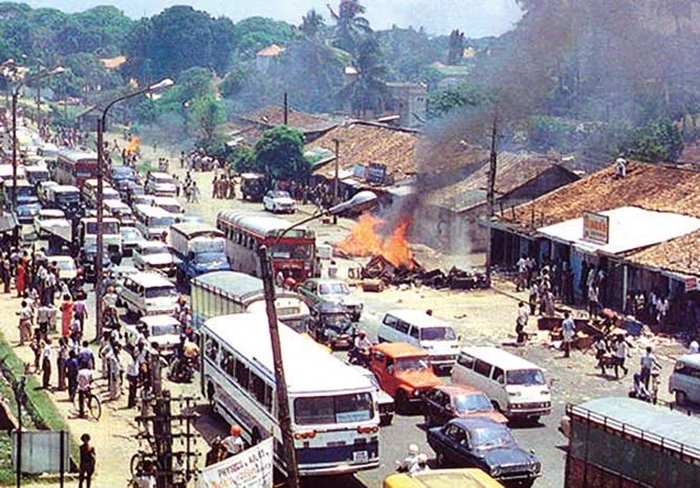
Forty three years and counting,
Big posers remain unanswered –
For instance, couldn’t the state,
See the bloodletting coming,
When restive young hands of the North,
Opted for the gun and not the ballot?
Couldn’t it be seen that counter-violence,
Would only lead to a wasting conflict,
Wherein ordinary folk of both halves,
Would be cruelly cut down in the cross fire,
And dumped in graves still being opened?
That hands of good will and friendship,
Extended warmly in statesman like fashion,
Over the divide that was seen as enduring,
Would have laid the basis for reconciliation?
Will only ‘the peace of the graveyard’,
Be made to reign in the pauperized Isle?
By Lynn Ockersz

Dambulla Sixers hand Galle Gallants first defeat in LPL 2026

Jaffna Kings beat Colombo Kaps by five runs

Showers will occur in the Western and North-western provinces and Galle, Batticaloa, Ampara and Monaragala districts

United Opposition moves to halt interference with judicial independence

PM labels seven Presidential Houses white elephants ; govt. to make them commercially viable

Gen. Sallay’s writ application against arrest: PC questions validity of Moulana’s statement

‘Dates have the highest sugar content to fight Coronavirus’

Sunday Island 27 December – Headlines

#SundayIsland 17th December – Headlines

Sunday Island – 28th March

Sunday Island Headlines – 21 March

Sunday Island – 21st February – Headlines
-
 Features4 days ago
Two memorable excerpts from a former SLAF commander’s memoir
-
 Business4 days ago
‘Giving up was never an option’: The fisherman who fought back after losing millions in SL
-
 Latest News5 days ago
Davis cup Asia/Oceania Group IV 2026 to be held in Colombo from 20th to 25th July
-
 Features4 days ago
Erdoğan’s New Republic
-
 Life style4 days ago
Taste of the Swiss Alps comes to Colombo
-
 News5 days ago
Evidence recorded in money laundering case against Yoshitha Rajapaksa
-

 News5 days ago
Dengue outbreak gallops ahead: Infections surpasses 73,455, leaving 50 dead
-
 Midweek Review1 day ago
Three high-profile alleged suicides shaping key investigations