
Sports
The incomparable Vijaya Malalasekera

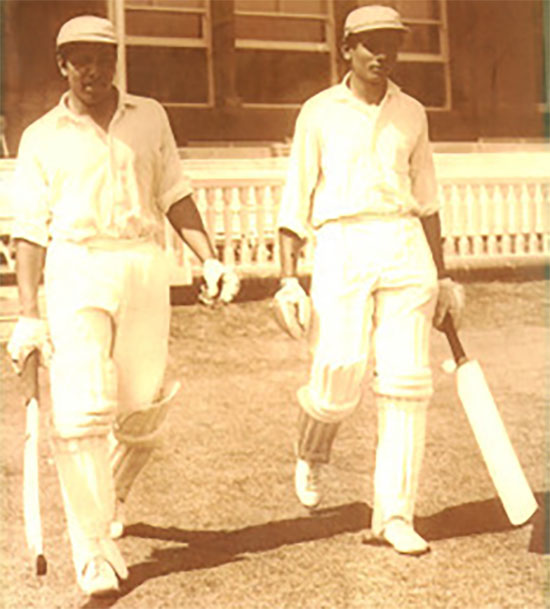
By Rohan Wijeyaratna
 It was the Royal – Thomian of 1963. Royal batting second were facing a formidable Thomian total of 254 for 8 declared. Before long they were heading for trouble at 34 for 3. That’s when a fresh-faced youngster still only 17, made his way to the middle. Before his arrival, he was subjected to a copious dousing of well-meant advice from Saliya Atapattu – a former Royal sporting personality, seated next to him in the pavilion. It was all about what must be done to avert a possible calamity, since that possibility now seemed staring Royal, squarely in the face.
Distinctly funereal
As if to confirm Saliya Attapattu’s worst fears were no stretch of his imagination, Royal were soon 42 for 4 when Tony Sirimanne (later of CR fame) snared the scalp of the Royal skipper S.S. Kumar for very little. Let alone overhauling the Thomians, getting past the follow-on mark now seemed a distant dream for the Reid Avenue boys. The Thomian attack consisted of burly Roger D’ Silva, Barney Reid, Tony Sirimanne, Panditharatne and Sarath Seneviratne, and as Cedric Fernando now wended his way to join Vijaya Malalasekera in the middle, the mood in the Royal camp was distinctly funereal, while the noise from the Thomian camp threatened to lift the pavilion rafters.
Roger D’Silva with his tail up, was bowling like the wind, and Barney Reid was doing his usual thing – bowling spin and swing with mesmeric skill and guile, out-foxing everyone standing 20 yards away. With Cedric Fernando’s arrival, everyone resigned to expect the worst.
That was when the perfect anti-climax slowly began to unravel.
Took the bull by the horns
Malalasekera -a fresh faced lad, strong of build and even stronger of temperament, wasn’t the type to die wondering. Being a cricketing buccaneer of sorts, he quickly ditched Saliya Attapattu’s well meant advice, no sooner he got up from his pavilion seat. Deciding instead to take the bull by its horns, Malalasekera cut loose with an array of stinging square cuts, drives, pulls and hooks, against Roger D’ Silva’s menacing pace. Then he proceeded to nullify Barney Reid’s nagging accuracy, guile and cunning, by unleashing an array of strokes of such breathtaking fury, they were now being wildly cheered by even those in the Thomian camp, who by then had reached an advanced state of inebriation and didn’t know who was doing what. Noisy pavilion banter argued whether or not this was the most furious innings ever seen at a Royal-Thomian. Let there be no mistake; this was no exhibition of vulgar village green hitting. Instead, it was fearsomely orthodox stroke play, executed with immense power and precision. In short, it was reminiscent of an Everton Weekes’ innings when in full flow. Some of Vijaya’s drives to the cover boundary were of such ferocity and force, the ball would hit the short parapet wall at the front of block C or D at the Oval, and ricochet right back to the actual playing strip! Thanks to this unprecedented assault, Malalasekera reached a sensational hundred in just two hours and 10 minutes on either side of lunch on day two. That innings which contained 20 fours and one six turned the flow of the game on its head, and to date ranks as one of the most fiercest exhibitions of sustained hitting ever seen in the entire history of the Royal-Thomian. Shortly after that blitzkrieg, Royal declared at 207 for four.
Hadrian’s wall
Throughout it all, Cedric Fernando served as the perfect foil for Vijaya, presenting a bat which rivalled Hadrian’s great wall beyond which no ball could pass. No amount of praise would do him justice for the role he played in this gallant partnership. Although playing second fiddle, Fernando played a stellar role in the proceedings and at the declaration was unbeaten on 47. Malalasekera remained unbowed on 112,whilst playing the innings of his life.
Never a selfish cricketer
Vijaya Malalasekera was never a selfish cricketer. Instead, he was a supremely confident young man with a cavalier bent, ready and willing at all time to back his own instincts. Not in a conceited way, he was cocky up to his eye-lashes, of his own abilities. It was not in his character to tailor his innings to make good his promise to his parents, that should they come down from London to witness the match, he would make a hundred. Grapevine rumour has it that the father in a moment of light headed recklessness had responded saying that in that event, he would secure his son a seat at Cambridge. Being Ceylon’s Ambassador in England at the time, there was not a lot Gunapala Malalasekera could not do, given the esteem in which he was held in those parts. But Vijaya being Vijaya and therefore hugely popular and totally out-going in a literal and metaphorical sense, had little time for study whilst at Royal. As things panned out Vijaya secured his place at Cambridge after acquiring the necessary entrance requirements in England. The story heard through the grapevine of his father’s promise to get him to Cambridge in return for a ‘big match’ hundred may be or mayn’t be true, but it is a good story and therefore shall be retained. What is definitely true however, is that his sporting stock rose considerably after his ‘big match’ performance and tilted the scales in his favour, when the prestigious ‘Schoolboy Cricketer of the Year’ award was announced. That was a fitting culmination to a terrific season for this hugely popular, fun loving young man.
On the strength of that one inning Vijaya Malalasekera was included in the Colts XI which played the University in a crucial game which would decide the Sara Trophy champions for that year. Malalasekera played a brief but trademark innings as Colts got the better of their opponents who went on to win the championship on points. That was the only Sara trophy game Vijaya played in Ceylon, before proceeding to England to join his parents. With his departure, he forewent the Royal College captaincy the following year.
Having fulfilled the entrance requirements and charmed his way past the Admissions Tutor at Fitzwilliam College in Cambridge, Malalasekera was in like a breeze and allowed to read for a degree in Law in 1966.
Murray asked to leave
Much like Lorenz Pereira of a slightly earlier vintage and quite predictably, Vijaya enjoyed his life at Cambridge to the fullest. So did one Deryck Murray, who kept wicket for the West Indies and captained the Varsity at cricket in 1965 and 1966. Murray took an instant liking to Vijaya, both for his style of batting and his approach to life. In fact, Murray tended to enjoy himself so much, he was kindly asked to leave the University by the end of his second year whilst being Captain of Cambridge! The social life at Cambridge seemed irresistible to some, and a source of immense distraction to cavalier cricketers, who were unwilling to have their noses constantly pore over their books while the bright lights beckoned. In Malalasekera’s first year (1966) while batting at No 6, he played 24 innings in 13 first class matches, making 323 runs with a highest score of 80 at an average of 13.45. Against Essex in his very first match Vijaya batting in the same vein as his ‘Big Match’ innings of 1963, pummeled a brilliant 80 against the likes of Barry Knight, Robin Hobbs and Ray East, and against Northants, he made an attractive 72 teaming up with Deryck Murray to record the highest Cambridge total for the season. But as Wisden pointed out, “….. V.P. Malalasekera from Ceylon, flattered only to deceive too often.” All told, Cambridge enjoyed a poor season in 1966.
Peter May’s admiration
Having enjoyed a reasonably successful first year, Malalasekera failed to become an automatic choice the following year as his magical form deserted him. Consequently, and much to his chagrin he was left out of the Cambridge side, and was playing for the Fitzwilliam College XI instead; a crushing blow to a young man’s ego. However, in the annual Cambridge University v Quidnuncs (former Cantabrigians) fixture, Steve Russell, the Cambridge captain invited Malalasekera to open batting with All-Ceylon opener Mano Ponniah, who had by then, just joined the Varsity.
Stung by the fact that he was dropped from the Varsity team, Malalasekera on his way to the middle, somewhat nervously asked Ponniah not only to take first strike, but also to ‘take it easy’ against Test opening bowler Richard Hutton, who was tasked to open the proceedings. Ponniah taking first strike promptly forgot his solemn promise and gleefully took a single off the very first ball to get off strike. This brought Vijaya Malalasekera to face England Test paceman Richard Hutton, now in his prime.
As Ponniah recalls, nervousness was plainly visible on Vijaya’s face. In fact, his face seemed whiter than Hutton’s! That was before the ball arrived. It came at a screaming pace and left at a screaming pace. In-between, Malalasekera had leaned into it and stroked it superlatively on the up with such sublime timing and placement, the ball vanished like a startled banshee, gathering speed as it went. This was such a spectacular strike through the covers, Peter May standing at first slip could not resist applauding, and as he crossed to change ends at the end of the over, he stopped and asked Vijaya for his 2 lb 2 oz bat to have a closer look at it. Peter May the ex- English captain was renowned as one of the hardest strikers of a cricket ball in England in his glory days of active cricket.
 Cambridge team pictured besides the Grace Gates at Lord’s. Vijay Malalasekera seated front row extreme right and Mano Ponniah standing second from right.
The first Asians to open for Cambridge
For the record, Mano Ponniah and Vijay Malalasekera were the first Asians to open for Cambridge in the Varsity game of 1967. This was Ponniah’s first year at Cambridge. Vijaya missed playing in the entire 1968 season, thanks to a troublesome shoulder injury.
Completing his degree the following year, Malalasekera proceeded to Law College, where he passed his Law exams in 1970. Reading his name on the notice board one day, he was so thrilled, he ran all the way to his erstwhile friend Gijra Rajapakse’s digs to break the news and proceeded to ring all known Sri Lankan friends to come along to London House to fittingly celebrate his success!
Chose his friends wisely
Unsurprisingly, Vijaya– at least outwardly -was a strong Buddhist. He was also an internationalist in every sense of the word. He saw no division amongst religions; a fact driven home by his marriage to Niri – a strong catholic. Gijra Rajapakse was the Bestman at the wedding. The story goes that Gijra, walking alongside Vijaya just seconds before they entered the church together, whispered in his ear “Malalasekera, the car is outside; in case you change your mind”. There was no gain saying Vijaya chose his closest friends wisely!
Among the hand luggage he carried with him on his way back to Ceylon was a book on Buddhism picked up on the way. Knowing that it was very likely his parents would be at the airport to greet him, Vijaya carried the book prominently in his hand to impress his father in particular, who was a leading light in Buddhist affairs back in Ceylon. The tactic some say, worked wonders!
Nearly decapitated….
On his return, Vijaya played a few Sara Trophy games for the NCC and then shifted to the CCC where he played some Daily News cricket. Mahen Dayananda of the CCC who shared many a partnership with him recalls walking up to Malalasekera and pleading with him on one occasion to hit his straight drives not so straight, lest he be decapitated at the non-striker’s end!
Malalasekera tried his hand at practicing law but soon decided to join the private sector instead. Shortly, he was heading the legal Department at Ceylon Tobacco Company, and ended up as its Corporate and Regulatory Affairs Director. Upon his retirement he was invited to join several other companies as a Board member, since his expertise, experience and knowledge on good governance were in high demand, and valued by many.
The first two Interim Committees
Following gun fire at the Cricket Board AGM in early 1999, President Chandrika Kumaratunge dissolved the Board and installed the first Interim Committee, headed by Rienzie Wijetilleke. That Committee came across as a breath of fresh air into the musty cricket administration at the time. However, they functioned for less than one year from June 1999, resigning from their posts in May 2000, owing to continual political intrigue exercised by those who should have known better. Not before long, the Cricket Board was again mired in controversy, necessitating higher powers to intervene. Possibly because she knew him personally and trusted in his ability and sincerity, Vijaya Malalasekera was appointed by President Chandrika Kumaratunge as Chairman of the second Interim Committee of the cricket Board in 2002. He accepted, but not before making it quite clear that he wished her to always fully back his judgment, failing which he would be gone. To her eternal credit, President Kumaratunge kept to her word and respected the understanding. Appointed alongside him were Michael Tissera, Sidath Wettimuny and Kushil Gunasekera, in what was one of the most productive and efficient Interim Committees the Board had ever known.
During Vijaya’s tenure, Sri Lanka registered a record ten straight Test wins under Sanath Jayasuriya’s captaincy. At least a part of that success must be credited to Vijaya’s leadership and methods of governance. He led by example. He was clear cut, forthright, bold and fearless in his decision making. Yet he was non interfering. He set an example and displayed sterling qualities of leadership. This trend cascaded to each rung below. He strongly believed a leader is only as good as his team. Men of proven worth and capability were invited to serve on the various sub-committees, and they were allowed to utilize their expertise and work without hindrance. Alas, that Interim Committee too wasn’t destined to remain long in office. In the political upheaval of late 2002, the Ministry of Sports went into the hands of a different ruling political faction and Vijaya Malalasekera for no valid reason was removed from his post as a consequence. That was the end of one of the most productive spells of cricket administration in this country.
Walked with Kings ……
Fun loving and friendly by nature, Vijaya Malalasekera was comfortable in any crowd, be it royalty or men from the street. He could – as the poet said – walk with Kings, yet not lose the common touch. Although a colourful cricketer and a ‘character’ in his own right, he proved in a spell of less than one year, that his greatest contribution to the game could have been through its administration. It was to the eternal misfortune of this country that it failed to use him considerably more, than it actually did!






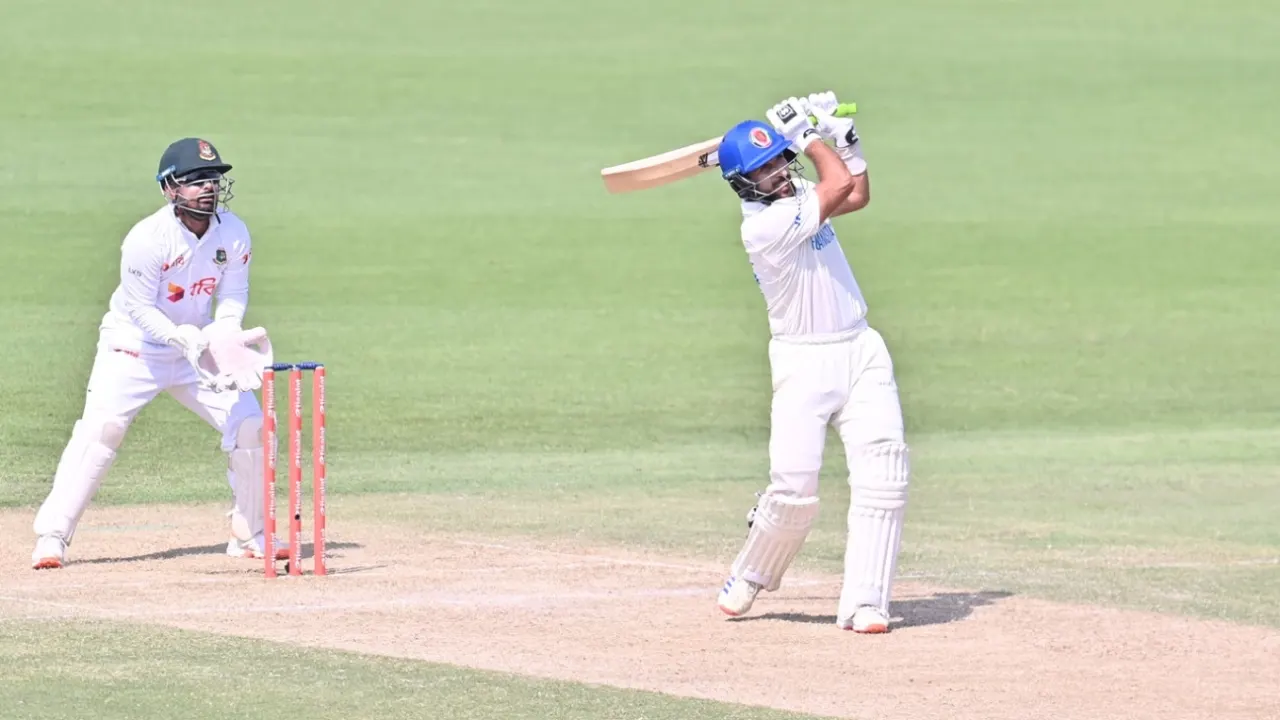
Captain Rahmat Shah played a crucial knock as he held Afghaniistan together on the second day in Abu Dhabi. He blunted Bangladesh’s threat by adding 72 runs for the unbroken fifth wicket with his deputy Ikram Alikhil.
Rahmat was unbeaten on 84 off 186 balls with eight fours and a six, while Alikhil’s 26 came off 91 balls. Ebadot Hossain was Bangladesh’s best bowler of the day.
Bangladesh wicketkeeper Litton Das got his side back into the contest shortly after the tea break. He first took a brilliant diving catch to his right, when the set Abdul Malik edged Ebadot five balls into the third session. Malik made 62 off 120 balls, with five boundaries including a six.
Next over, Litton completed a fine stumping when a Mehidy Hasan Miraz delivery turned and bounced sharply against Hashmatullah Shahidi. The former Afghanistan captain lasted just two balls as he fell for a duck.
Alikhil started with two well-timed boundaries before reining himself in for the next nine overs. Rahmat broke the boundary drought with two fours off Nayeem Hasan in the 60th over. He first pumped the offspinner through midwicket before finding the gap through mid-off for the second four.
Afghanistan then held off the Bangladesh bowling for the next 17 overs without a single boundary. Finally in the 77th over, Rahmat struck Mehidy for two fours in a row, both superb shots through extra cover, as he brought up Afghanistan’s 200.
The day began with the Afghanistan pace bowlers removing the two remaining Bangladesh wickets. It took them 8.3 overs, with Mohammad Saleem picking up his fourth wicket, having Taijul Islam caught behind and Yamin Ahmadzai removing Ebadot with a slower delivery.
Saleem finished with 4 for 82, having taken 6 for 140 against India in Afghanistan’s previous Test in June. Ahmadzai took three and Ismat Alam two wickets. This was the first time a fast bowling attack took nine wickets in a Test innings in Abu Dhabi.
After bowling out Bangladesh for 346, Afghanistan went to lunch on 34 for 1. Sediqullah Atal edged Hasan Mahmud to first slip. Atal struck three fours in his knock but also survived a caught-behind appeal in the third over. Replays showed that he had inside-edged it but Bangladesh did not use the review.
After lunch, Afghanistan batted positively. Shahidullah swept Mehidy while Mahmud conceded two fours early. Malik played the ball confidently, but Bangladesh kept things tight from both ends. It created a wicket when Shahidullah top-edged a hook against Ebadot in the 21st over. Mahmud took a good tumbling catch running in from fine-leg, as Shahidullah fell for 20 off 44 balls.
Rahmat though immediately stamped his authority with a crunchy cover drive in the same over. He hit Taijul for a straight six shortly afterwards, with Malik repeating the dose to the same bowler after a few more overs. Malik also cover-drove Nayeem before reaching his maiden Test half-century in the 34th over.
Scores:
Afghanistan 211 for 4 in 80.5 overs (Abdul Malik 62, Rahmat Shah 84*, Ikram Alkhi 32*; Ebadot Hossain 2-50) trail Bangladesh 346 in 92.3 overs (Shadman Islam 67, Tanzid Hasan 83, Litton Das 53; Mohammad Saleem 4-82, Yamim Ahmadzai 3-79, Ismat Alam 2-20) by 135 runs
[Cricinfo]

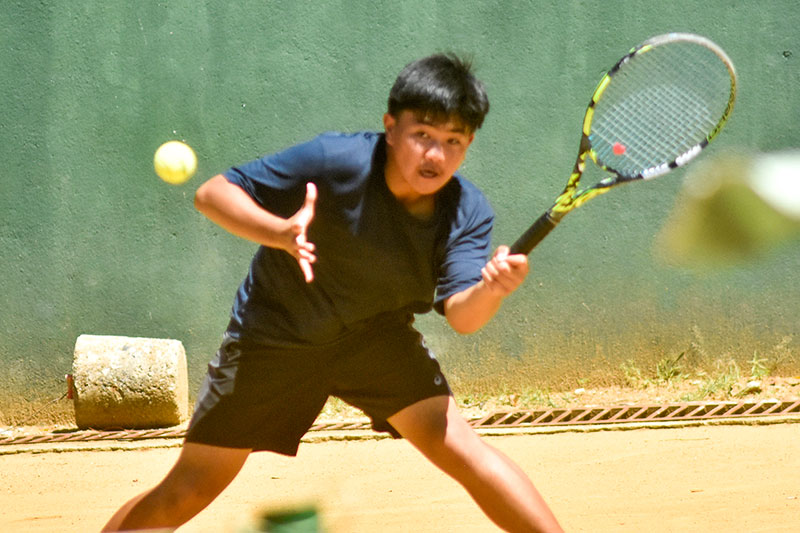
Risindi Hewawasam of Sri Lanka and Anthony Castigador of the Philippines won the girls’ and boys’ singles titles at the ATF 16 & Under Colombo 2026 – Week 1 tournament concluded at the Sri Lanka Tennis Association courts on Friday.
Castigador produced a dominant performance in the boys’ singles final, defeating India’s Gurshaan Chahal 6-2, 6-2 to secure the title. The Filipino maintained his advantage throughout the match, winning in straight sets to cap an impressive campaign.
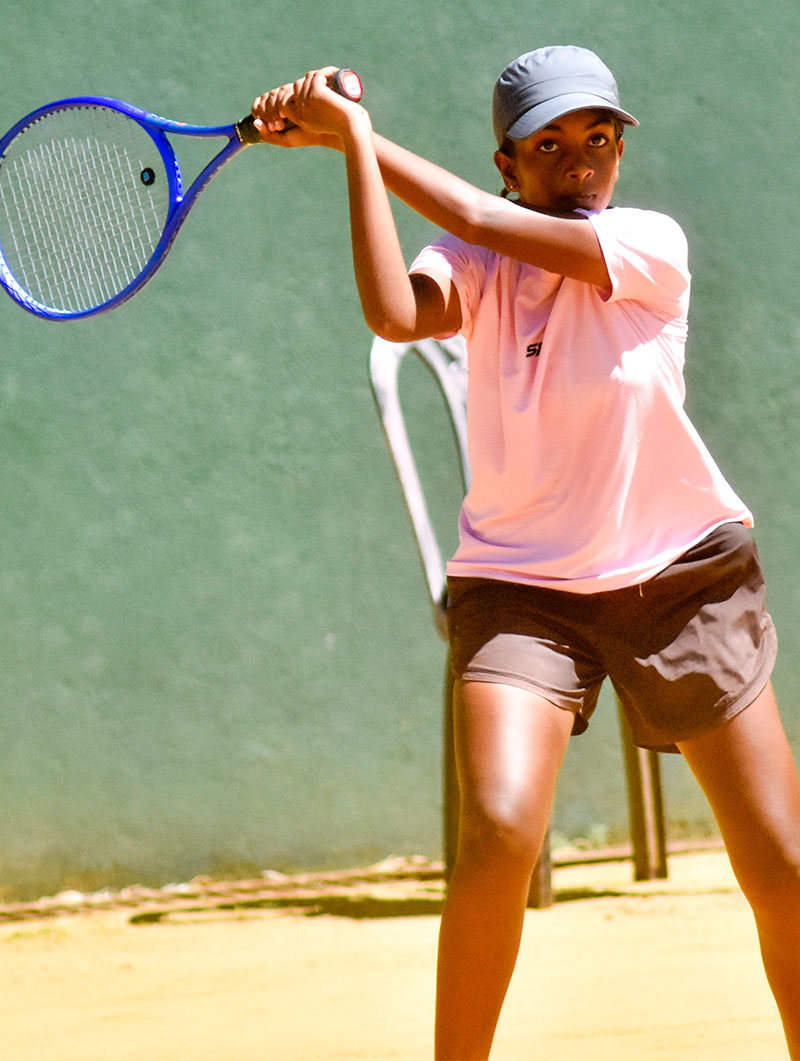
Risindi Hewawasam (Pix by Kamal Wanniarachchi)
In the girls’ singles final, Risindi delivered an equally dominant display to beat compatriot Kiara Jayamanne 6-1, 6-1. (RF)
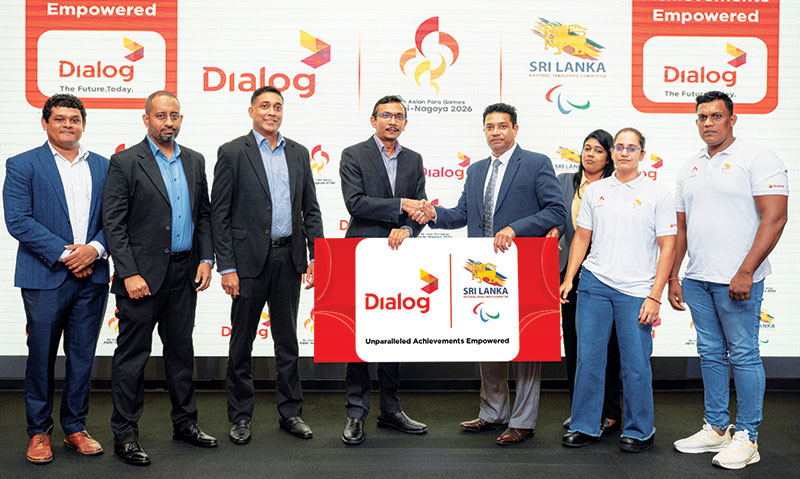
Dialog Axiata PLC is supporting Sri Lanka’s national contingent at the 2026 Asian Para Games in Achi Nagoya Japan, continuing its long standing commitment to supporting Sri Lankan athletes and helping them compete at the highest levels of international sport.
As the team sponsor, Dialog is backing a group of 21 athletes whose journeys have been shaped by determination, discipline and a strong desire to represent their country on the international stage. For Dialog, however, the value of this team goes well beyond the medal tally.
Each athlete has taken a different path into elite sport. Their physical abilities may differ, as do their individual stories, challenges, and ambitions. What they share is the commitment and determination required to train, compete, and continue pushing themselves to achieve their goals.
Dialog’s support reflects its wider commitment to creating opportunities for Sri Lankans to pursue their ambitions and represent the country with pride. For 26 years, Dialog has supported Paralympic sport in Sri Lanka, helping athletes compete at national and international level. Its continued support for the Asian Para Games contingent is part of that long-standing commitment to creating opportunities for athletes and recognizing sporting talent.
Among them is javelin thrower Samitha Dulan, a silver medalist at the 2022 Hangzhou Asian Para Games. Palitha Bandara, another experienced member of the athletics team, has also won medals at both the 2018 Jakarta and 2022 Hangzhou Games.
Nuwan Indika arrives with an impressive record after winning gold in the 100 meters and silver in the long jump at Hangzhou, while Pradeep Somasiri returns as an Asian Para Games champion after winning gold in the 1,500 metres.
Dhananjana Wickramasingha will also be looking to build on her silver medal winning performance in the women’s long jump at Hangzhou, while Madhuranga Subasinghe, who won bronze in the 400 metres, is also back in the squad.
Sri Lanka’s medal winning experience extends beyond athletics. Swimmer Naveed Rasheen won bronze in the 400 metre freestyle at Hangzhou, while Nadin Basnayake claimed silver in the women’s event.
The squad also includes Buddika Indrapala, who won bronze at the 2018 Asian Para Games.
Together, the contingent includes nine athletes who have previously won medals at the Asian Para Games, bringing valuable experience to the 2026 campaign.

Rahmat, Malik fifties lead Afghanistan’s strong reply

Showers above 75 mm are likely at some places in the Western, Sabaragamuwa, Central, Uva and North-Western provinces and in Galle, Matara, Anuradhapura and Mannar districts.

Iranian ships stranded, Lanka fears US sanctions

Sri Lanka CERT warns of overseas university admission scams

Navi Pillay’s Lankan affairs in focus as she wins 2026 Nobel Peace Prize

Lanka welcomes Indian SC remarks on Katchatheevu dispute

‘Dates have the highest sugar content to fight Coronavirus’

Sunday Island 27 December – Headlines

#SundayIsland 17th December – Headlines

Sunday Island – 28th March

Sunday Island Headlines – 21 March

Sunday Island – 21st February – Headlines
-

 News7 days ago
Geneva takes up Sallay’s case and govt. ignores opportunity to answer accusations
-

 Features6 days ago
Preventing grievances from becoming communal
-

 Features4 days ago
The Sri Lankan who made Scottish history
-

 Sports4 days ago
Nissanka absence opens door for Sri Lanka’s young guns
-

 News5 days ago
Gnansara Thera to be assigned to prison printing section: Officials
-

 News3 days ago
NDB fraud Rs 60mn more than reported
-

 Features7 days ago
Sri Lanka Cricket Bill: Governance reform is not yet a cricket strategy
-

 Features4 days ago
Future of Sri Lanka’s state university system: Should it be shut down and reopened?