
Features
THE HISTORY OF AMBALANGODA


By AN OCTOGENERIAN
Even though Ambalangoda is a little known sea side town, located approximately 54 miles south of Colombo it can claim to have a history which is not only interesting and significant but in many ways is unique. For these reasons especially its ‘uniqueness’, it is relevant to begin by describing the manner by which this ‘little known’ town derived its name.
One of the best is by referring to the celebrated historian D. W . Ferguson’s book ‘Ceylon in 1913’, in which he mentions that Ambalangoda had from earliest times been referred to as ‘The Rest House Village.’ The closest, if not the best translation of the words ‘Rest House’ into Sinhala is ‘ambalama.’ Hence ‘ambalama’ was transliterated to Ambalangoda.
Another oft repeated version is that a group of fishermen whose boat had been caught up in a violent storm which wrecked their sails as a result of which they were left drifting helplessly in the sea when suddenly they sighted in the near distance what appeared to be a plot of land located very near to a sandy beach. Whereupon in their joy and great relief they shouted to one another ‘ Aan Balan Goda.’ Which would mean Ambalangoda. This story though exciting can be dismissed as being a mythical.
At this point it is necessary to introduce the role of the Dutch in this town. Those readers familiar with the history of pre- colonial Ceylon would recall that the Dutch expelled the Portuguese from the island in 1658. However what is perhaps lesser known is that the first contact between the people of Ceylon and the Dutch was in 1602 when Admiral Joris van Spilbergen arrived in the port of Batticaloa and later proceeded to the Kandyan Kingdom to meet the reigning monarch Vimala Dharma Suriya the First and to have an audience with His Majesty in order to negotiate the terms by which the Dutch could conduct their trade in cinnamon.
As a result of the successful and cordial negotiations the Dutch as was traditional during that period delegated their authority to the Dutch East India Company from 1656 onwards till the British ousted the Dutch in 1796. It is a matter of interest to know that this company which was established on March 20, 1602 in the Netherlands has rightfully been recorded as being the first joint- stock company in the world.
This company is also referred to by its Dutch name as Vereenigde Oost -Indische Compagnie, and had its logo – VOC inscribed in many Dutch buildings scattered across the island. One prominent building being the Dutch Fort in Galle. A more prominent and certainly a more popular example is the DBU (Dutch Burgher Union) Club with its VOC Café in Colombo.
Many readers would be surprised to know that there was a time when cinnamon grew in abundance in the area around Ambalangoda. It was from the peeled bark of the evergreen branches of these trees that cinnamon was peeled. Ambalangoda by then had earned a reputation of having the best cinnamon in the world and had been referred to as the ‘Cinnamon Town’ which in Sinhala was ‘Kurundu Nagaraya.’ Furthermore, eight miles inland at the turn-off from the Southern Expressway there is a town referred to as ‘ ‘Kurundugahathepma ’which provides further proof regarding the prolific growth of cinnamon in the region.
It was the intention of the Dutch East India Company, to gain the sole monopoly of the cinnamon trade and consolidate their position against any foreigners specially the Arabian traders for which purpose they constructed an outpost in the town of Ambalangoda, consisting of a Court House which has since been identified as a protected historical monument by the Department of Archaeology.
Adjacent to the Court House there had been a remand cell for convicted prisoners and a stable for horses. On the front wall of the stable there can be seen even to this day a cemented plaque on which is inscribed the year of its construction which was in 1750 and also the name of the person who constructed it namely Adriaan Oustdyk, who was a high ranking official in the Dutch East India Company.
It is recorded that the stable was once used as the village church with a school master conducting the services in Sinhala. The floor of the church had been paved with tombstones taken from a nearby cemetery. In addition the Dutch also built a Rest House which served as the residence of the local Dutch magistrate. The Rest House was also a convenient and comfortable stop- over for Dutch dignitaries. During the British period it is claimed that the first British Governor of Colonial Ceylon, Sir Fredrick North ( 1798- 1805 ) spent a night at this Rest House during his tour around the island.
One of the attractions of this Rest House is that it is located on a rocky outcrop overlooking the sea and because of the protective rocks around it is safe for bathing. In fact it is very similar to that of a salt water swimming pool. However it is sad to mention that this Rest House was wantonly destroyed sometime between 2008 and 2009 on the instructions of a local politician, who wanted to sell the land to an entrepreneur for the construction of a hotel school. But for reasons best known to the parties concerned it was never built.
However a stone slab was erected mentioning the intended construction of the controversial hotel school. This was smashed and removed by residents of the town who were annoyed and angry by the chicanery of the local authorities. Sadly, the remnants of this once popular Rest House is now used by drug addicts and other undesirable elements.
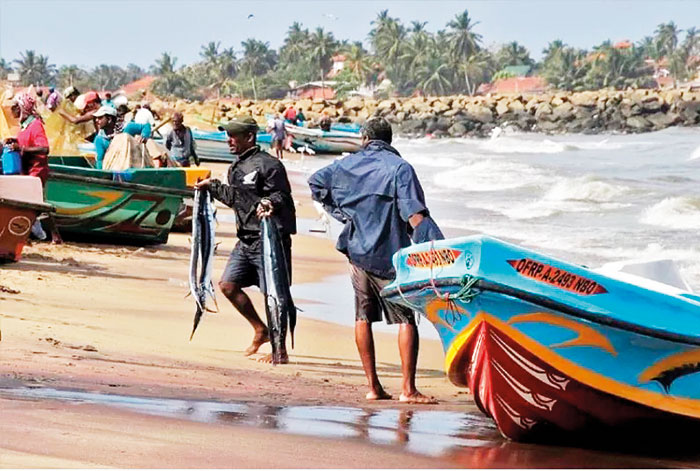
Located 200 meters or 218 yards east from the railway station is the large and imposing Sunandarama Maha Viharaya, built in 1750 on five acres of sacred land. Planted within these premises is the sacred Bodhi. According to reliable sources the Viharaya was once occupied by bhikkhunis. These same sources claim that in 1970 the Viharaya was ‘systematically started.’ Regrettably the writer is unable to explain the significance of this term. Irrespective of these dates, the Viharaya is reputed to contain some of the best known frescoes in the island, vividly depicting numerous Jathaka stories.
Synonymous with Ambalangoda to both tourists local residents are the intricate, eerie looking masks which have bulging eyes, protruding tongues painted in red to signify blood and fanged teeth. These are worn by those conducting specific rituals, the best known are the Kolam which has a tinge of humor since it ridicules the island’s former colonial life. Sanni – which is a form of exorcism performed to hopefully heal a person’s persistent illness. Raksha which is used in popular local festivals also involves the use of these masks.
It is claimed that the history of the crafting of these masks dates back to the 15th century and are hand painted and lacquered and made out of a type of a light strong wood similar to Balsa which grows in the rain forests of South America. Within the precincts of the town is a Mask Museum in which master craftsmen demonstrate the method of making these masks and if one so desires these can be purchased if for no other reason then just as souvenirs. Ambalangoda is also well known for the creation of string puppetry (readers of an early vintage may remember the hilarious movie – ‘Puppet on a String’ featuring the popular Hollywood actor Danny Kaye)
To get back to our own Ambalangoda string puppetry which had originated in 1830. The pioneer in this art form was Kandegoda Master Podisirina. When the former Prince of Wales – Edward VIII visited the island in 1922, Podisirina made a presentation which was based on the historical episode of the life of Ehelepola Nilame. The Prince was so impressed that he presented Podisirina with Rs. 500/- which at that time was a handsome reward and a gold medal. This was undoubtedly the very first gold medal won by a Ceylonese/Sri Lankan !! This presentation was conducted in a spacious house referred to as Bagatelle Walawwa, which as its name indicates would have been located in Colombo most probably along Bagatelle Road.
The writer is now reluctantly compelled to refer to a rather disreputable characteristic of many of the people of Ambalangoda by quoting Sir James Emerson Tennent who in 1845 was appointed by the British Government as Colonial Secretary of Ceylon in which capacity he travelled around the island.
In his Reminiscences he refers to the people of Ambalangoda many of whom he describes as being ‘ porawakarayo.’or ‘axe-weiIders.’ Paul E. Pieris the eminent scholar and historian has added his comments to that of Sir James Emerson Tennent by mentioning that the ‘porawakarayo’ were so proud of their ‘reputations’ that they would rather lay down their lives than abandon their stocks of ammunition!
Despite the notoriety of the ‘porawakarayo’ the people of Ambalangoda have gained a reputation for the preparation of a delectable cuisine consisting of mouth-watering Billing Achcharu, Ambul Thiyal and Jaadi. If none of the other attractions of this town and there are many- cannot tempt a visitor to this town these spicy preparations most certainly would.
The history of Ambalangoda does not end here. A list of alumni of one of the leading schools in Ambalangoda namely Dharmasoka College makes interesting reading. In this list can be read that Sisira de Abrew was a Puisne Judge of the Supreme Court of Sri Lanka, Dinesh Chandimal was captain of the Sri Lankan cricket team in Test cricket, Upul Tharanga captained the Limited Overs cricket team, Saman Jayantha played in 17 One Day International cricket matches., Ajit de Silva who represented the country in Test cricket, but was most unfortunately debarred from all formats of the game for having played in the controversial AROSA matches in South Africa. Mahinda Deshapriya who was the former Chairman of the Election Commission, J.E. Jayasuriya who was the Professor of Education in the University of Ceylon.
Lest we forget it is essential to mention that Field Marshal Sarath Fonseka who was the 18th Commander of the Sri Lanka Army and the first army officer to be promoted to that rank received his early education at Dharmasoka College. Two other high ranking officers of the services are mentioned namely Air Chief Marshal Jayalath Weerakkody, former Commander of the Sri Lankan Airforce, Admiral Piyal de Silva, former Commander of the Sri Lankan Navy and Osmund de Silva who was a former Inspector General of Police , .
Moving on to politics we come across the name of C. P. de Siva who first distinguished himself as a member of the elite Ceylon Civil Service and later became a leading politician who was an Honorable ( this term is used to precisely mean what it is meant to mean ) Minister of different Cabinets in which he held several portfolios. To write more about C.P.de Silva will take an entire page of this journal. Suffice it to mention that he was described as being the ‘Prince Amongst Politicians’. Alas! when will our country ever have persons like this! And finally and fittingly mention must be made of yet another Dharmasokian – Rohana Wijeweera who led the Janatka Vimukthi Peramuna.
May we end this article by exclaiming ‘Jayawewa’


 It may be some time before the full impact of food inflation is felt in the West. Until such time the world would continue to keep itself in suspense over whether the Trump administration is in earnest when it seeks to convey the impression that it is backing a negotiated solution in West Asia.
As is usually the case, consumer stress would be one of the final determinants of political change. To the degree to which the average US consumer somehow ‘muddles through’ and puts the food on the table, to the same extent would the Republican sections of the US public in particular be tolerant of the Trump administration’s inconsistent handling of the West Asian war and the main issues stemming from it. That is, there would be no grave popular disaffection and a demand for political change in the short term.
However, the indications are that the Trump administration’s support base is suffering some erosion in the wake of the current economic crisis. While reports indicate that Democratic sections are firming-up their opposition to the political centre, Republican support for Trump is also showing signs of waning, we are given to understand.
The above developments are probably why Trump is on record as having given Israeli Prime Minister Benjamin Netanyahu a ‘dressing down’ recently on his seeming intransigence on the question of giving negotiations a chance in West Asia. The show of displeasure could be really aimed by Trump at containing the impatience of the American public.
However, the current ground situation in the Middle East, particularly the uncontained bloodshed, is likely to impress on the thinking sections of the world that more than temporary political change is needed in West Asia and the US.
A well thought out political solution that addresses all the contentious issues at the heart of the Middle East conflict is what enlightened opinion would demand, and very rightly. Right now, the ‘peace efforts’ initiated by the Trump administration give the impression of being piecemeal solutions at best.
There have been, of course, numerous initiatives in the past aimed at bringing permanent peace to the Middle East. These failed mainly because they did not address in full the root causes of the conflict.
At bottom the Middle East conflict is mainly about race and religious hate bred by socio-economic and material inequalities. For instance, if the Palestinian people were not displaced and deprived of land occupied by them at the time of the founding of the Israeli state, ethnic enmities would not have grown to the current unmanageable proportions.
When addressing the above questions, though, it must be remembered that the Israelis too were a displaced people who were entitled to land and a state of their own in the Middle East. Basically, out of these seemingly irreconcilable and conflicting demands have grown the Middle East imbroglio.
Middle East peace is considerably about reconciling these demands and arriving at a solution that would ensure the creation of two states that would opt for peaceful co-existence thereafter.
As long as the US does not see the need for a non-partisan solution that addresses the needs of both ethnicities and religions and goes all-out, as it were, to have it implemented, the Middle East would continue to bleed.
However, staunching the blood flow through the creation of two states would be only half the job done, though a very important part of it. More pernicious, pervasive and difficult to remedy are the inter-ethnic and inter-religious hatreds that have been unleashed over the decades.
However, if substantial, long-lasting peace is to be fostered in the region the latter ‘demons’ would need to be exorcised from the hearts and minds of the communities concerned. No doubt an uphill task but one that must be undertaken by those who wish the region well.
The UN would need to put its ‘best foot forward’ in such undertakings but it is time that it dawned on the international community and other caring quarters that Middle East peace, and all other such uphill challenges, require proactive peacemaking on the part of all civilized sections for their effective management. That is, public involvement in peacemaking too is a must.
Since hatreds are harboured in the human consciousness the enmities embedded in the latter need to be managed and defused judiciously alongside other undertakings in a peace process. In the case of West Asia, such enmities could be even spread globe-wide besides being multi-dimensional. For instance, it ought to be thought-provoking that Iran is insistent on a peace initiative that would also include Lebanon.
Besides security considerations it is also ethnic and religious affiliations that account for Iran making this demand. For instance, the Shias are a numerically important religious community in Lebanon and they provide a significant number of Hizbollah fighters, who are in a vital sense carrying out a ‘proxy war’ for Iran. It also needs to be factored in that Iran is a Shia-majority country.
Thus trans-border religious affiliations could add to the complexities and enormity of ethno-religious conflicts. However, the task of managing centuries-long enmities needs to be launched and prodded on with by peacemakers since a downing of arms alone would not guarantee substantive peace.
It is not realized sufficiently that the process of ending hatreds begins with mutual apologies by antagonists to a conflict for the harm inflicted on each other. This would be anathema in some ears but there is no getting away from the requirement. It is the vital first step to permanent peace anywhere.
In fact there could be no reconciliation worth speaking of without such mutual apologies. It is a point worth re-iterating in these times when even the government of Sri Lanka is voicing the need for national reconciliation. Well, without the words, ‘I am sorry’, there could be no permanent end to enmities – they would do well to remember.
The above requirements may not go down very well with governments, but they resonate in the hearts and minds of most people, since they are inheritors of religious traditions of some kind.
This is a principal reason why peacemaking works well when publics too are involved in them. The effectiveness of such campaigns increases several fold when they have a Mahatma Gandhi or a Jawaharlal Nehru at their helm. A strong proactive involvement by the public in peace could lead to the emergence of such leaders at some point in these campaigns.
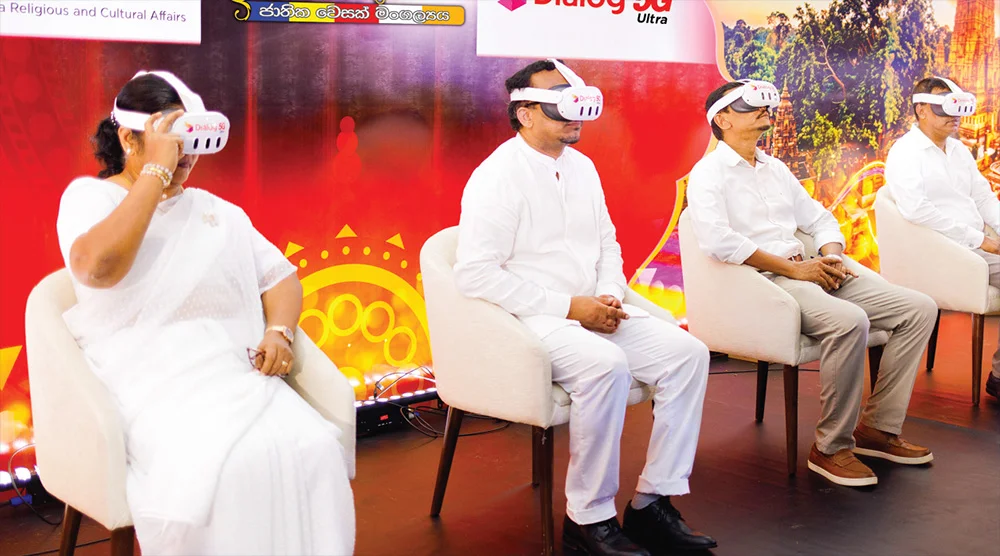
Official Digital Partner of the 2026 ‘Dakshina Prabha’ National Vesak Zone
Dialog Axiata PLC, Sri Lanka’s #1 connectivity provider, collaborated with the Ministry of Buddha Sasana, Religious and Cultural Affairs to bring one of Sri Lanka’s largest and most technologically advanced Vesak experiences to the ‘Dakshina Prabha’ National Vesak Zone. The three-day celebration, in Matara attracted more than hundred thousand visitors, who engaged with a series of innovative digital activities powered by Dialog 5G Ultra, including Artificial Intelligence (AI) and Virtual Reality (VR) experiences, digital pandols and a Data Dansala. The opening ceremony was attended by Hon. Sunil Handunnetti, Minister of Industry and Entrepreneurship Development and Hon. Saroja Savithri Paulraj, Minister of Women and Child Affairs, along with distinguished guests and Dialog’s senior management.
One of the key attractions at the venue was the Dialog 5G Ultra-powered Virtual Reality (VR) experience, which attracted more than 35,000 participants. The activation enabled devotees to virtually visit and pay homage to sacred Buddhist sites, including the Jaya Sri Maha Bodhi in India and the Atamasthana in Anuradhapura, directly from the Vesak zone in Matara.

Visitors receive complimentary mobile data through Dialog’s QR-powered Data Dansala.
Dialog also conducted an AI Digital Vesak Greeting Card Competition from 21 May to 01 June 2026, attracting numerous entries from across the country. The shortlisted designs were showcased across 20 large LED screens throughout the venue and across Matara City, and were also made available for download via mobile devices. Further, through the use of AI, traditional Jathaka Katha were reimagined in a digital format, demonstrating how technology can be used to preserve and enhance cultural and religious heritage. Together, these initiatives blended traditional Vesak celebrations with emerging technologies, offering visitors a unique and immersive way to engage with Vesak traditions.
Extending the spirit of Vesak through connectivity, Dialog conducted a special Data Dansala powered by its QR Reload platform, enabling visitors to receive complimentary mobile data by scanning QR codes placed across the venue. In addition to the Matara National Vesak Zone, similar Data Dansala activations were also conducted at the Gangaramaya and Bauddhaloka Vesak zones in Colombo.Visitors also had the opportunity to create personalised Vesak-themed digital photos through an AI Photo Booth, generating AI-enhanced portraits using their own photographs and adding a contemporary digital element to the Vesak celebrations.
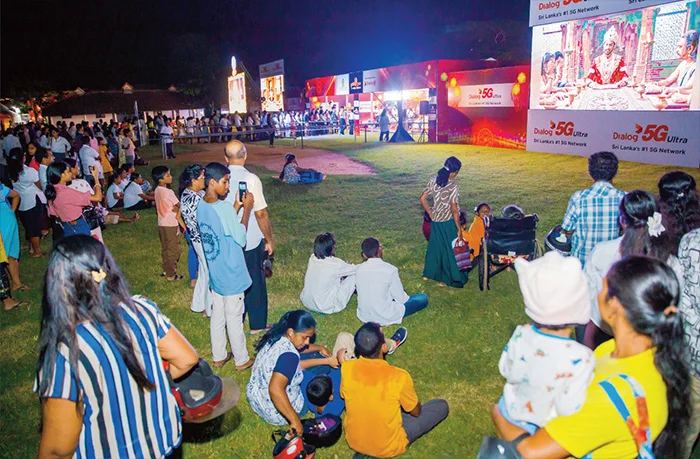
Visitors watch AI-generated Jathaka Katha
Commenting on the initiative, Hon. Sunil Handunnetti, Minister of Industry and Entrepreneurship Development, said, “The 2026 Dakshina Prabha Vesak Festival marked the first time AI-powered digital innovations were incorporated into a National Vesak Festival in Sri Lanka. Presenting Buddhist stories and teachings through technology created a new and engaging way for visitors to connect with these traditions. We thank Dialog for supporting this initiative and for working closely with us to bring our vision to life. Their contribution played an important role in making this first-of-its-kind event a reality.”
Lasantha Theverapperuma, Group Chief Marketing Officer of Dialog Axiata PLC said, “We thank the Government of Sri Lanka for the opportunity to support the 2026 Dakshina Prabha National Vesak Festival and for embracing technology as part of this year’s celebrations. As the Official Digital Partner, we were privileged to contribute through our Dialog 5G Ultra and AI capabilities, creating new ways for visitors to engage with Vesak traditions while preserving their cultural significance for future generations.”
Beyond supporting the National Vesak Zone in Matara, Dialog also enhanced the Gangaramaya and Bauddhaloka Vesak zones through a range of digital activations during the Vesak season. The company additionally continued its sustainability initiatives, including the Thirasara Aloka Poojawa, which illuminated rural places of worship through solar-powered lighting solutions.

Universal Woman is an international pageant focused on “beauty, elegance, and talent” for women, positioning itself as a platform to shape global ambassadors. The 2026 edition will be held in Cambodia, and Sri Lanka will be there, as well.
According to reports coming my way, contestants, at the international event, will work with industry trailblazers, under international standards.
Sri Lankan supermodel, runway and pageant trainer Chulpadmendra Kumarapathirana, is the National Director for Universal Woman Sri Lanka 2026.
With over two decades in the industry, Chula was crowned Miss Sri Lanka 2006, and has since shaped the next generation of titleholders through her Colombo-based Chulpadmendra Catwalk Studio, widely regarded as one of the country’s leading modelling academies.
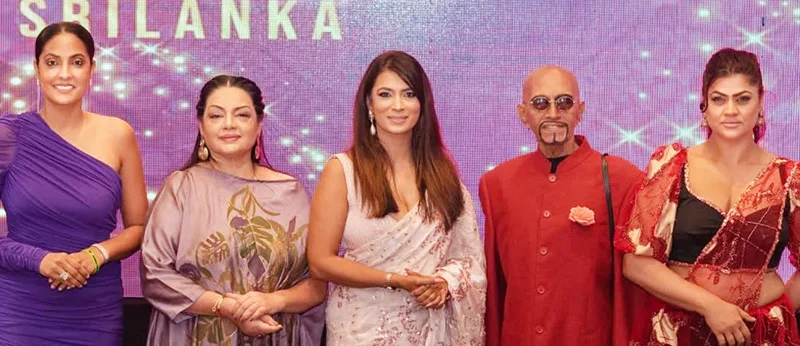
The team behind Universal Woman Sri Lanka 2026
A former host of Derana Miss Sri Lanka for Miss World 2008 and a judge for Miss Universe Sri Lanka 2025, Chula now serves as National Director for Universal Woman Sri Lanka 2026, leading the franchise’s search for Sri Lanka’s delegate to the international final in Cambodia.
Applications for Universal Woman Sri Lanka 2026 are being taken, via WhatsApp: 077 659 4994, says Chula.
The judging panel for Universal Woman Sri Lanka 2026 includes Senaka De Silva, Pageant Aesthetic Advisor & Chairperson of the Judging Panel, Angela Seneviratne, Caroline Jurie, Rozelle Plunkett, and Suraj Mapa.
Universal Woman Sri Lanka 2026 officially began its journey with a first round of auditions, held in Colombo, marking the start of an exciting new chapter in Sri Lanka’s pageant industry.

Launching the first round of auditions
The platform aims to empower women while selecting an intelligent, confident, and inspiring representative to compete at the Universal Woman International Pageant 2026 in Cambodia, this September.
Universal Woman Sri Lanka now moves forward with the vision of creating one of the country’s most prestigious and empowering pageants while preparing to crown a queen who will proudly represent Sri Lanka on the international stage.

SLC name squads for Tri-Nation ‘A’ series and Four-Day series
SLC name squads for West Indies Emerging Tour of Sri Lanka 2026

ICC delegation visits Bangladesh to ‘review developments linked to the BCB’

Indonesia’s rupiah falls to record low against US dollar

INS Airavat makes port call in Colombo

Netanyahu downplays US-Israel rift after Trump confirms criticism

‘Dates have the highest sugar content to fight Coronavirus’

Sunday Island 27 December – Headlines

#SundayIsland 17th December – Headlines

Sunday Island – 28th March

Sunday Island Headlines – 21 March

Sunday Island – 21st February – Headlines
-
 News6 days ago
IMF urges Lanka not to meddle with exchange rate
-

 News3 days ago
Lankan duo emerge winners in Latin dance championship held in Blackpool, UK
-
 Business7 days ago
Sri Lanka’s construction industry losing ground while no one watches
-
 Business4 days ago
IMF’s unstated rate:Sri Lanka’s $695m loan costs about 5.33% per annum
-
 News6 days ago
State of emergency extended
-
 Features7 days ago
The Division Bell Mystery
-
 Features5 days ago
Are threats to Buddha Sasana external or from within?
-
 News4 days ago
UNP challenges NPP move to amend Vihara – Devalagam Act