
Features
S L – a cauldron of casualties and trouble


Cassandra has stopped watching news at night for the sake of her wellbeing and peace of mind. Watching English news at 9.00 p m on a local channel caused her to toss and turn or wake up at the ungodly hour of 2.00 am to again toss and turn, but this time mentally with suppressed anger, frustration, and fear for the future surfacing and consequently inundating the mind with unease. Why all this? Because Sri Lankan news is always of protests, ministerial pontificating with next to nothing done to lift the country from rock bottom it has been thrust to; and violence, murders and drug hauls. All worrying issues. The present worry is spending 200 m on a celebration that most Ordinaries, the public Cass means, DO NOT Want.
What are the issues of the week just past? Hamlet’s disturbed and disturbing ‘To be or not to be’ twisted to ‘Will happen or will not.’ That specifically relates to the LG elections scheduled for March 9. The government has tried every trick of delay just because they face sure defeat – the combined Elephant and Bud that rules us as of now. Everyone else shouts for elections and follows up with the threat to come out on the streets. That seems to be Sri Lankans most resorted to pastime. And we dread the melees; the water cannon, police brutality and the disgrace of saffron robed, bearded and hair grown men in the vanguard of slogan lofting shouters. All a useless and worthless expense of energy achieving nothing but tear gas and water shooting, and remand jail for some. Some of these protests call for the release of one such IUSF protester deemed to be a terrorist by a draconian law and confined in solitary imprisonment for far too long.
A shot or more of arrack or kasippu was resorted to by men and excused by other men as necessary mental trouble relievers. A woman would imbibe a bit of brandy if not a sleeping pill to ease her troubled mind and thus queasy gut. Not any longer if one takes advice that comes pouring in via social media.
Canada’s new move on Alcohol Guidance
As questioned by Holly Honderich in Washington BBC January 18: “What’s behind Canada’s drastic new Alcohol Guidance?” She says a report funded by Health Canada warns that “any amount of alcohol is not good for your health and if you drink, less is better.” This is contained in a 90 page report from the Canadian Centre on Substance Abuse and Addiction. Health issues result from the intake of more than standard drinks and these include breast and colon cancer. Honderich says it may be a rude awakening for the roughly 80% of Canadian adults who drink. The ratio is higher, Cass presumes, in this resplendent isle with its arrack, illicit brews and toddy both kitul and palmyrah. So the comforting statement that was earlier in vogue, that a daily tot of alcoholic drink is good for health, is sent overboard by the Canadian advice. Of course now with money so short except in the hands of the corrupt, the latter advice will have to be taken, voluntarily or otherwise, by most Lankans.
Prez Gotabaya and his advisors’ ruling
We have all seen at least on TV, farmers mourning their yellowing crops of paddy and heard their heart-rending cries of hopelessness at the loss of a third harvest due to the utter crime of overnight stoppage of chemical fertilisers and pest control. Cass wonders how the ex-Prez who decreed this and his advisors sleep at night having blighted long term the entire agriculture of this predominantly agricultural country. Farmers cry out they are in debt, have no money to feed nor school their children; added to which hospitals are bare of medicines.
A highly-educated and experienced agriculturist sent Cass an email the gist of which is that rice farmers all over the island report a ‘yellowing’ of paddy, stunted growth and dead plants in patches. They had all used ‘compost’ issued by the govt. There is a hint this could be due to a nematode infestation. If correct, this has grave implications. It has occurred in tea with no easy cure. Only costly fumigation was effective, eventually. Once rice paddies are infected it would be very difficult to control – almost impossible; already impoverished farmers can bear no further expense.
A three wheeler driver told Cass that river bed soil had been mixed with thrown away household garbage (both obtained free, obviously) and sold as organic fertiliser. I hasten to add this is hearsay, but the obvious truth staring all Sri Lankans in the face and sending shivers of apprehension down all spines is that this Maha season crop is kaput; gone down the drain with farmers cheated and someone or some persons having made money from the deal.
Pointless it is to curse those who were in the racket; useless to commiserate farmers and their families; impossible to compensate them. Will those responsible for giving out dangerous fertiliser for distribution be traced and brought to justice? Never! However, that word ‘never’ is now pronounced with a mite of doubt after M Sirisena and others were dealt justly by judges of the Supreme Court. There are glimmers of hope that wrong doers, actually criminals who bankrupted the country and damaged its agriculture, will be dealt with suitably.
There will be no Aluth Avuruddha for the backbone of the country in April since celebrations centre around a good harvest and R&R after a Maha season of toil and filling bins and storehouses with bountiful paddy. This was pre-Gota days. Now it is all round misery since urban dwellers sorrow, and also suffer, with the farmers who supplied them with food.
Clear stats given to prove inefficiency of the state sector
A video clip came to Cassandra with Advocata CEO Dananath Fernando speaking on the inefficiency of the public service due to being too many in number. Dananath is much admired and spoke clearly and convincingly. He said more conversing with Faraz Shauketaly on Newsline presented by TVI channel on Tuesday 24 January at 8.30 p m.
Dananath said our bureaucracy is inefficient and ineffectual. Main reason being there are too many to do the work. His fact check went like this. In India for every 177 members of the general public there is one (01) government officer or as named earlier ‘government servant’. In Pakistan the figures are 117 to one. Bangladesh is almost the same. In Sri Lanka (hold your breath!) to every sixteen (16) citizens there sits one government officer, mainly twiddling his/her thumbs. It would be interesting to know the ratios in developed countries. But the very relevant to us countries have been named by the Advocata finding. Cass does not need to spell what the result is; she has already indicated it with the image of the thumb twiddler.
We knew the bureaucracy was over staffed, bloated and bulging big like the leaders we have: 225 in parliament, then local councils and pradeshiya sabhas. And in each of them, law makers, decision takers and those who carry them out are far too excessive in number and cost the government excessively in salaries, infrastructure, travel modes; etc. etc. So Advocata asks how development, or even mere running of the country can be achieved efficiently and effectively. A further shock, at least to Cass, was dealt by Dananath in proving the point by revealing statistics for the police service. 50% of the entire police force is deployed on security duty to 225 MPs, Ministers and state VIPs while the balance half is expected to provide safety and security to 22 million people! Lop sided and thus the country slants to sink or disintegrate. It has already slanted to bankruptcy and begging as never before and selling the meager money making ventures we possess.
How did the public service get so bloated? Again the guilty are, or were, those in power. They kept sending persons with chits and they had to be employed. Reason? Sympathy for the jobless? Not at all. Pure unadulterated self-interest so votes are assured them.
Rise up and show thy face, thou olde pensioner
That’s a government order to be observed by the old; most finding walking difficult and many finding the necessity to gather some money for three wheeler hire denting their January budget. But present yourself to the Grama Sevaka of your area is a must if you want to continue receiving your pension, now totally inadequate; but still very grateful for. Hence the procession of the old and weak leaning on walking sticks, even crutches or on willing supporting arms offered them.
Some years ago, questioned by Cassandra, an obliging woman Grama Sevaka said that those unable to present themselves are visited in their homes by officers. We do hope this is done since there must be plenty thumb twiddlers in this government department too.
Bravo Hirunika!
Cass most definitely is an admirer of beautiful Hirunika. She’s garnered another kudos by her latest action, OK, gimmick if you like that word to express the way she has shown displeasure, censure, disagreement of the general public on holding an elaborate National Day event to celebrate 75 years of’ democratic self-rule’ at the exorbitant cost of Rs 200m.. That expression itself calls for comment. Termed National Day it is far from being thus with so many protesting various issues. Celebration is a blatant falsehood. Feb 4 should really be a day of mourning, since the Nation is in the dregs of corruption, misrule and bankruptcy. Self-rule here equates to selfish rule by the leaders for themselves and misrule for us the public. Democracy is dead, actually it was totally dead during previous regimes but has revived somewhat lately,
And how did Hirunika express censure? By having black bows knotted on the posts erected to prop covered spaces for the march past, etc. Black connotes death, mourning, displeasure, bad times. Of course at expense, the bows will be removed before the posse of horses and motor riders and security cars conducts the Prez to the s venue. Cass entertains a jaundiced wish that the entire DPL Corps will, non-diplomatically, ignore invitation and not be present at the celebratory event. Rows and rows of empty chairs might convey the message of non grata, rather disdain for the powers that be. Ranil may be respected still, but those backing him and even guiding his hands are NOT.
Cheers till we meet next Friday!

By Ifham Nizam
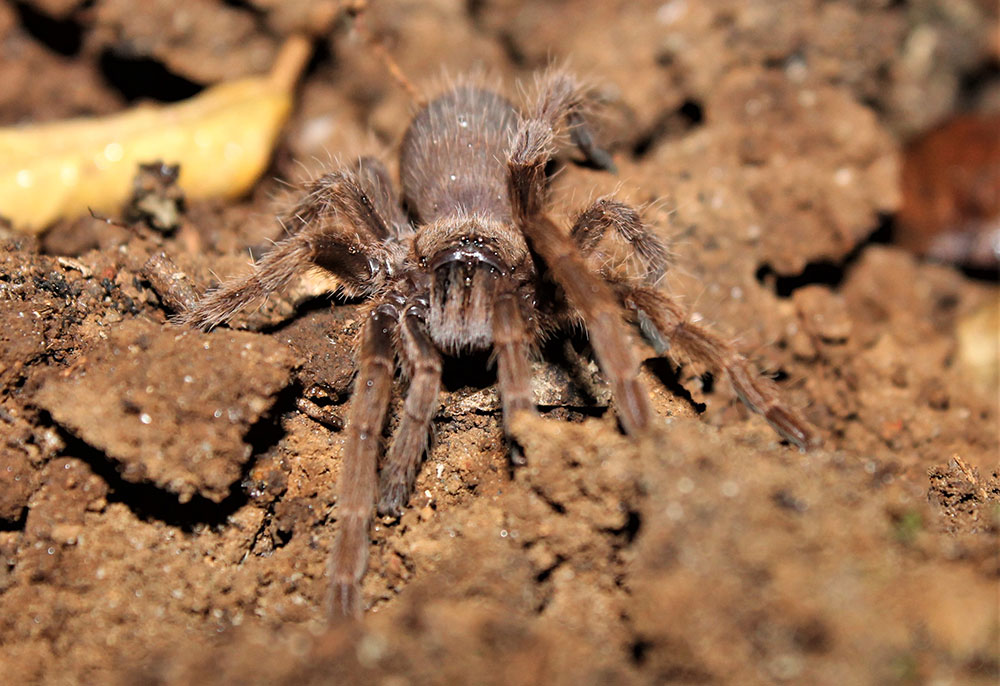
They are everywhere, yet most of us hardly notice them. In the corner of a garden, beneath a leaf, across a paddy field, inside a forest or quietly occupying an old tree, spiders are constantly at work.
They may be tiny enough to escape the human eye or large enough to command attention, but beneath their often-misunderstood appearance lies an ecological workforce that performs one of nature’s most important jobs.
They hunt
And in doing so, spiders help keep insect populations under control, strengthen food webs and contribute to the delicate ecological balance upon which both natural ecosystems and agriculture depend.
For Sri Lanka, a country celebrated for its extraordinary biodiversity and high degree of endemism, the world of spiders is particularly fascinating. Yet it remains one of the lesser-known chapters of the island’s natural history.
Field biologist and researcher Dr. Ranil Nanayakkara has spent years helping to open that chapter.
His work on Sri Lanka’s spiders, including the spectacular tiger spiders of the genus Poecilotheria, has demonstrated that there is much more to these creatures than the fear and suspicion with which they are often regarded.
Nanayakkara has been involved in the description and documentation of several remarkable Sri Lankan tarantulas, including Poecilotheria rajaei and Poecilotheria srilankensis, as well as Chilobrachys jonitriantisvansickleae. His research has also taken him into the less-studied corners of Sri Lanka’s biodiversity.
His approach is significant because the story of Sri Lanka’s spiders is not simply a story about unusual or frightening creatures. It is a story about ecosystems.
Nature’s pest controllers
A spider sitting motionless in a web may appear inactive, but its ecological role can be anything but passive.
Spiders are predators, feeding predominantly on insects and other arthropods. Across an agricultural landscape, this makes them natural allies of farmers.
Moths, beetles, flies, grasshoppers, leafhoppers, planthoppers and many other insects become part of the prey base of different spider species.
Some spiders wait patiently in intricately constructed webs. Others actively hunt across leaves, vegetation and the soil surface. Jumping spiders stalk their prey with remarkable precision, while wolf spiders move across the ground rather than depending on webs to capture food.
Different species therefore occupy different ecological niches.
Together, they form an army of natural predators.
This is why the presence of spiders in a paddy field or vegetable plot should not automatically be interpreted as something undesirable. On the contrary, their presence may be an indication that a functioning predator community is at work.
Nanayakkara’s own publication, An Introduction to Common Spiders of Sri Lanka, was designed partly to introduce the public and research community to these frequently overlooked animals.
The book covers spider morphology, natural history and Sri Lankan spider families, while highlighting their importance as biological control agents and bioindicators.
-
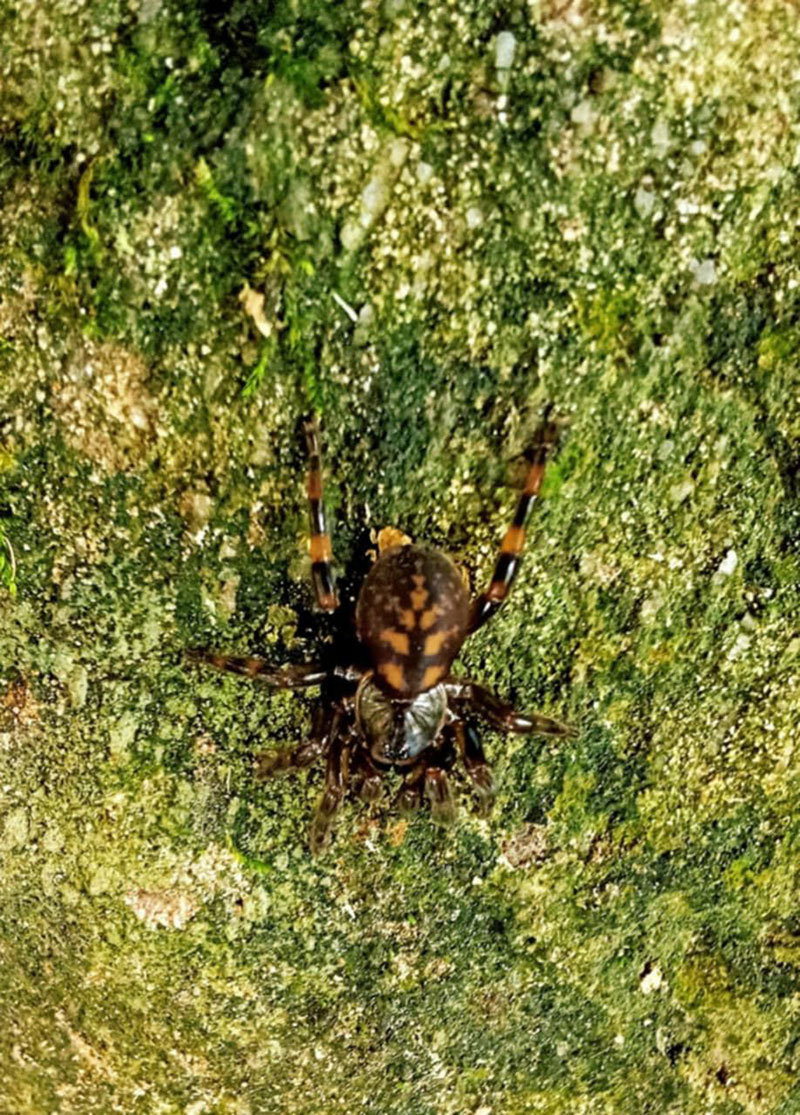
- Genus -Sason
-
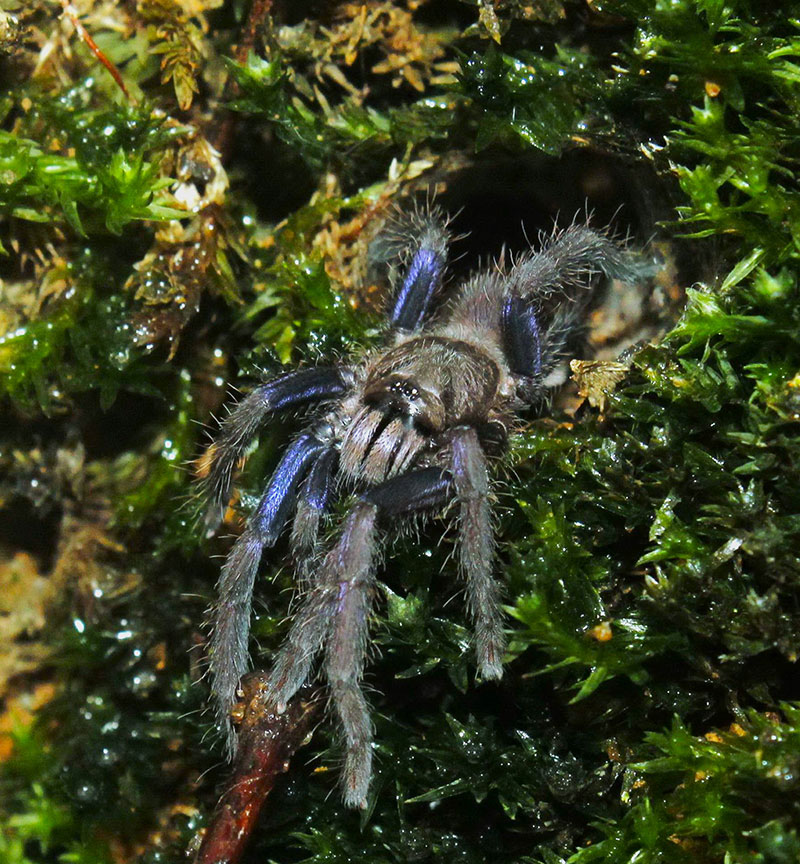
- Chilobrachy jonitriantisvansickelei
The invisible service
There is an important ecological service taking place every day that does not appear on an agricultural balance sheet.
A spider catches an insect.
Then another.
And another.
Multiply that interaction by thousands of spiders across thousands of hectares and the ecological significance becomes enormous.
Unlike a pesticide, a spider does not need to be manufactured, transported, mixed or sprayed. It does not require a farmer to purchase another container or return to the field with a spray machine.
It simply performs its ecological role.
That does not mean spiders can replace all forms of pest management. Rather, they can form one component of integrated pest management, in which natural predators, parasites, cultural practices and carefully targeted interventions work together.
The objective should not necessarily be to create an agricultural landscape in which every insect disappears.
It should be to create one in which pest populations are kept below damaging levels through a functioning ecological system.
When pesticides kill the allies
This is where the story takes a darker turn.
Broad-spectrum insecticides are designed to kill insects, but the ecological world does not always recognise the distinction between a farmer’s target species and a beneficial predator.
When chemicals are applied indiscriminately, spiders and other predatory arthropods can also be affected.
The consequences can be surprisingly complex.
A pesticide application may reduce a crop pest rapidly. But if it simultaneously reduces the predators that feed on that pest, the field may lose part of its natural defence system.
As surviving pest populations recover, farmers may again reach for the sprayer.
The result can become a vicious circle: fewer natural predators, greater reliance on chemicals and repeated disruption of the ecological relationships that once helped regulate pest populations.
Pesticides can also move beyond the field through runoff, spray drift and other pathways, potentially affecting surrounding vegetation, wetlands and waterways.
The real cost of chemical-intensive agriculture, therefore, cannot always be measured simply by the price of a bottle of pesticide.
There can be an ecological cost that remains invisible.
A paddy field is more than a crop
Sri Lanka’s paddy fields are often viewed through the lens of production: acreage, yield, irrigation, fertiliser and harvest.
But look more closely and another world emerges.
Between the rice plants are insects. In the water are aquatic organisms. Along the bunds are grasses and other vegetation. Amphibians move through the landscape. Birds forage. Reptiles pass through.
Microorganisms work beneath the surface.
And somewhere among the vegetation, spiders wait.
The paddy field is therefore not simply a food-production unit. It is an ecosystem.
Field margins, bunds, grasses and neighbouring vegetation can provide shelter and alternative habitat for spiders and other beneficial organisms. Maintaining this ecological complexity can help predator populations persist and recolonise cultivated areas.
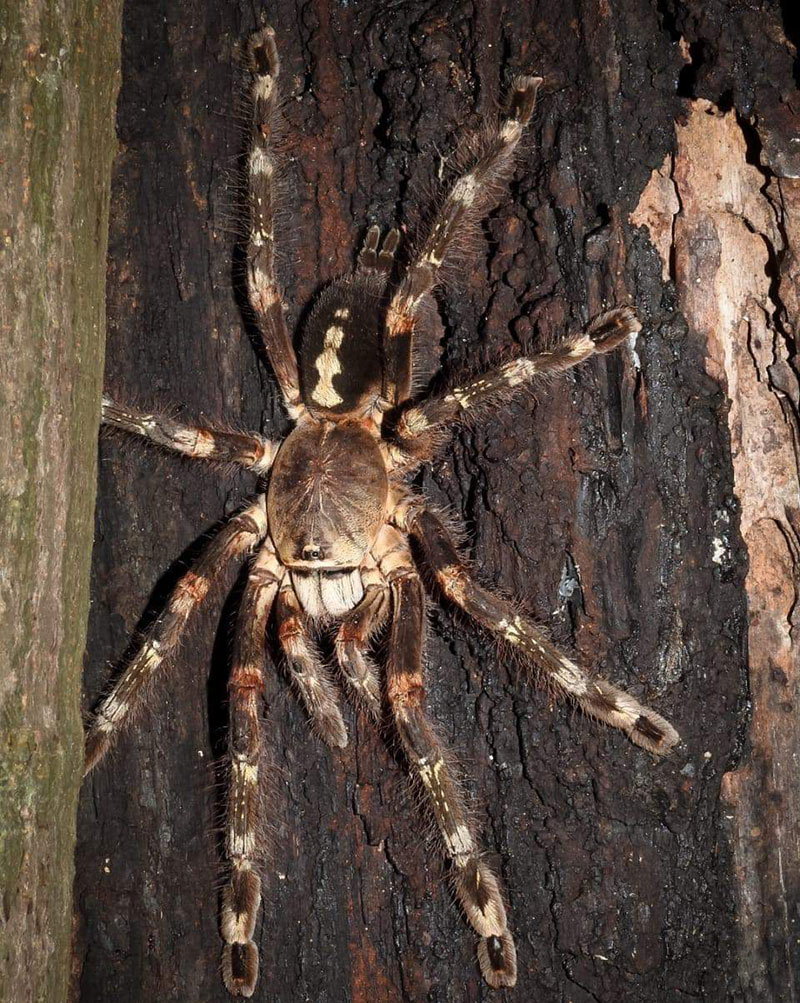
Poecilotheria sp.
Destroying those refuges or exposing them repeatedly to chemicals can simplify the ecosystem and weaken its natural resilience.
The spectacular world of tiger spiders
If ordinary garden spiders are largely invisible to the public, Sri Lanka’s tarantulas are impossible to ignore.
The genus Poecilotheria, commonly known as tiger spiders or ornamental tarantulas, includes some of the island’s most spectacular arachnids.
Their intricate patterns, extraordinary size and specialised lifestyles have made them subjects of scientific fascination.
Nanayakkara’s work brought international attention to this hidden world.
One of the best-known examples is Poecilotheria rajaei, a tarantula described from northern Sri Lanka after specimens were encountered during field surveys. The species was formally described in 2012 by Ranil Nanayakkara and co-authors.
The story illustrates something important about biodiversity research: discovery does not necessarily begin in a sophisticated laboratory.
Sometimes it begins in a forest.
Sometimes it begins with a local observation.
And sometimes it begins when a field researcher is willing to look closely at something that most people would rather avoid.
Another remarkable chapter came with Poecilotheria srilankensis, described from Belihuloya in 2019. The research documented another arboreal tarantula from Sri Lanka and added to understanding of the island’s highly distinctive Poecilotheria fauna.
Nanayakkara and his collaborators have also documented Chilobrachys jonitriantisvansickleae, a tarantula associated with a fragmented forest patch in Sri Lanka’s wet zone.
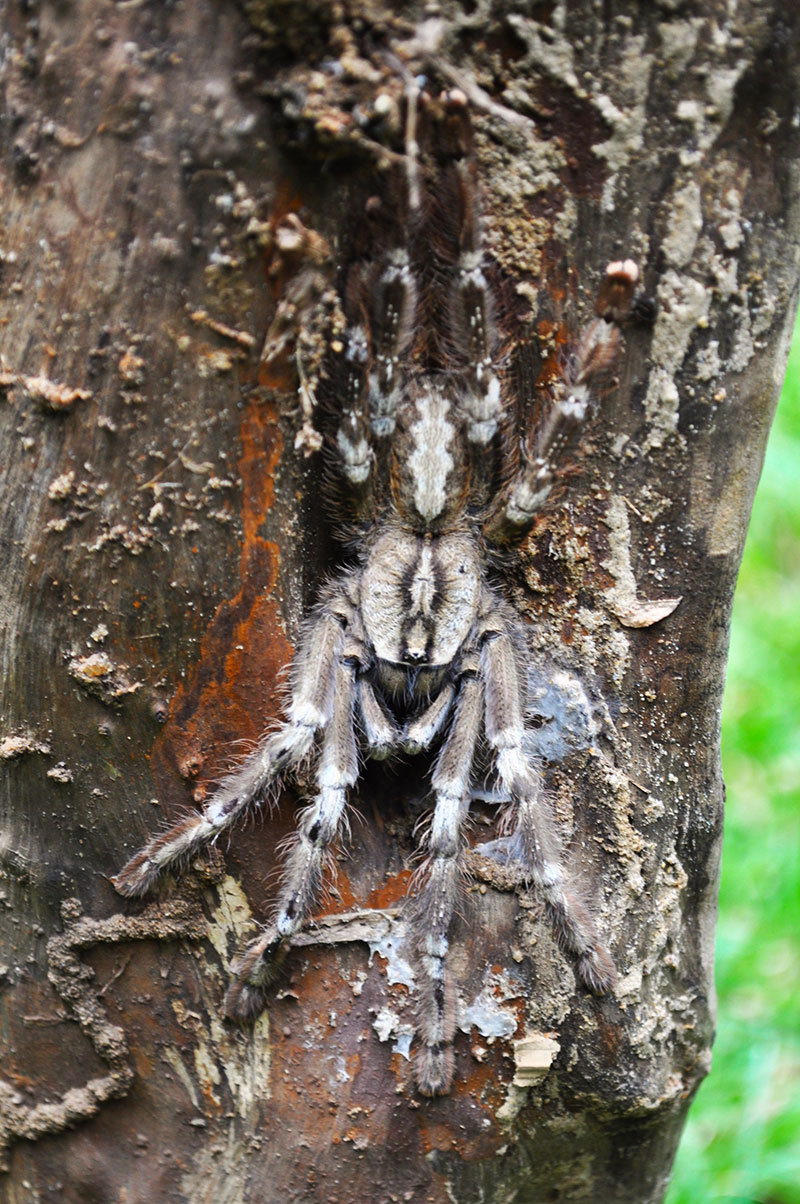
Poecilotheria smithi
These discoveries are not merely additions to a scientific list.
Each species raises questions.
Where does it live?
What does it eat?
How large is its population?
What habitat does it require?
How isolated are its populations?
What happens when its forest disappears?
The blue surprise in the forest
Perhaps nothing illustrates the richness of this hidden world better than the discovery of a striking blue tarantula in Sri Lanka’s rainforests.
The species, Chilobrachys jonitriantisvansickleae, was found in an isolated patch of southwestern rainforest surrounded by tea and rubber plantations. Its vivid blue colouring helped attract attention to an animal living in a highly fragmented landscape.
It is an important reminder that biodiversity does not always survive in vast wildernesses.
Sometimes it survives in small fragments.
And when a species is closely associated with a particular habitat, the destruction of even a relatively small area can have disproportionate consequences.
Beyond fear
One of Nanayakkara’s important contributions has been to make spiders accessible to people who may otherwise never look beyond their reputation.
His books, including An Introduction to Common Spiders of Sri Lanka and Poecilotheria – “Tiger Spiders” of Sri Lanka, have helped bring information about these animals to a wider audience. His Tiger Spiders of Sri Lanka focuses on the identification, habitats, behaviour and conservation of Poecilotheria.
The challenge is not simply scientific.
It is cultural.
For generations, spiders have often been associated with fear, danger and something that should immediately be killed.
But understanding changes attitudes.
Once a spider is seen as a predator rather than a pest, its role begins to look different.
Once a tarantula is understood as a specialised inhabitant of a particular forest habitat, destroying that habitat becomes a conservation issue rather than merely a matter of removing an unpleasant creature.
Small predators, enormous consequences
Spiders are also prey.
Birds, amphibians, reptiles and other animals depend on arthropods as part of their diets. Spiders consequently occupy several positions in food webs: they are predators of insects and, in turn, food for other animals.
Their disappearance can therefore create effects that travel through an ecosystem.
This is why biodiversity conservation cannot focus exclusively on elephants, leopards, birds or other charismatic wildlife.
The ecological machinery of a forest is also made up of creatures that are small, obscure and rarely photographed.
Some may never make the headlines.
But remove enough of them and the system changes.
A call to look closer
Sri Lanka still has much to learn about its spiders.
Taxonomy remains fundamental. Before conservationists can determine how a species is faring, they need to know what species exist, where they occur and how they differ from one another.
Field research is equally important because many species cannot be understood simply by examining specimens in collections.
Their habitats, behaviour, prey, reproduction and relationships with other organisms all matter.
Nanayakkara’s research illustrates the value of this patient field-based approach. His work has contributed to the documentation of Sri Lanka’s lesser-known biodiversity and to the scientific understanding of spiders that had previously received little attention.
But perhaps the larger lesson is even simpler.
Nature does not waste species.
The spider spinning a web beside a paddy field, the hunter moving through the undergrowth and the spectacular tarantula hidden in a forest tree are all pieces of a much larger ecological puzzle.
Protect the predators
Conserving spiders does not mean protecting every individual spider from every natural threat.
It means protecting the ecosystems that allow spider populations to survive.
It means reducing unnecessary pesticide use.
It means encouraging integrated pest management.
It means maintaining vegetation around agricultural fields, protecting forest fragments and conserving wetlands and streams.
It means giving farmers the knowledge to recognise that some of the creatures living among their crops are not enemies at all.
They are allies.
For Sri Lanka, there is another urgent reason to look more closely.
The island’s biodiversity is exceptional, but its habitats are increasingly fragmented and altered. The loss of specialised habitat can be particularly serious for species with narrow ecological requirements.
The work of researchers such as Dr. Ranil Nanayakkara reminds us that discovery and conservation are inseparable.
We cannot protect what we do not know.
And we cannot appreciate what we have never learned to see.
The next time a spider appears in a garden, on a paddy bund or quietly beneath a leaf, perhaps it deserves something more than a broom or a spray can.
It may be doing what nature designed it to do—hunting, regulating and maintaining balance.
For millions of years, spiders have been doing this work without asking for recognition.
Perhaps it is time we gave them some.
When we protect the predators, we protect the balance.


 Israeli Prime Minister Benjamin Netanyahu’s message to Israel’s enemies was blunt and stark.‘We’re going to win; we have no choice.’ He said so while the majority of attendees at a recent UN General Assembly session walked out of the conference hall when the Israeli Prime Minister took the podium; many of them booing in derision.
Those commentators who have been studying Israel’s handling of her enemy states over the decades are unlikely to dismiss the entirety of Netanyahu’s address as rhetoric. The general pattern has been for the Israeli state to stand up firmly against its enemies in the battle field. On most occasions, these adversaries have been beaten back.
It is also little realized in particularly the Southern hemisphere that Israel, for the most part, could defend herself without much US assistance. The history of the conflict bears this out.
However, from the viewpoint of working towards a just and equitable peace in the Middle East the Israeli hard line stance has proved and will prove incalculably detrimental. The sworn enemies of Israel are not going to be in any way deterred by Netanyahu’s stark warnings. On the other hand, they would be only further provoked into taking on Israel by conventional or unconventional military means and seek its destruction.
The recent aborted mid-air hijacking of a Flydubai flight, consisting mainly of Israeli passengers, by an Omani extremist drives home the point. Israel’s enemies are bound to redouble their efforts to annihilate Israel rather than be deterred by the latter’s warnings about standing firm against them. This too history has proved.
It would be in the fitness of things at this juncture to pay a tribute to the professionalism, courage and humanity of the relevant airline pilot, Captain Machchhar, whose timely action proved decisive in botching the hijack attempt. His intervention averted what could very well have been another 9/11 type tragedy. History is not going to forget his daring and resourcefulness.
Meanwhile, the ground realities in West Asia are undergoing further complications that portend increasing regional instability. For example at the time of writing Turkiye, Pakistan and Saudi Arabia have agreed under the recently established ‘Mecca Alliance for Defence’ to deploy ‘deterrence measures’ collectively in the event of any member of the alliance coming under military strikes from a non-member state.
The agreement is modeled on the NATO collective defence pact and should help in defusing any threat perceptions experienced by the alliance members in the short term. However, the group would need to be cognizant of the major and potentially divisive role Iran could play in the interstate politics of the Middle East region going forward.
Iran’s reported support, for example, for Yemen’s Houthi rebels, who are engaged in attacking Saudi national assets, could at some point in time compel the alliance, under the terms of the pact, to initiate deterrent military measures against Iran.
The implications for regional peace from such a turn of events hardly require elaboration. A full blown regional war emerges as a distinct possibility if Iran sees itself as being excessively antagonized by the alliance. A further complication is that antagonistic sectarian identities of an Islamic kind could come to play hugely divisive roles in it. Shiite Islamic states would be inclined to back Iran while those countries seen as Sunni Islamic in orientation are bound to support Saudi Arabia.
Accordingly, West Asia is a region rife with manifold aggravated insecurities. If the latter are not defused dexterously they could escalate into a conflict of extra regional dimensions. The latter development would render the world a collective loser.
Unfortunately, no constructive help could be expected from the US at this juncture by way of working towards regional and international peace even of short durance. Its war against Iran has only aggravated the world’s current insecurities.
For example, the world has been compelled to face the possibility of compounded economic woes as a consequence of the Hormuz crisis remaining unresolved. The world is currently experiencing what could be seen as a ‘winter of economic discontent’ of unprecedented proportions.
Unfortunately, the international community is to all intents and purposes helpless in the face of this multifaceted crisis. Substantial intervention is expected of the UN but since it has failed to reform itself over the years it is compelled to stand idly by while the world’s insecurities heighten and multiply.
Yet, it is the seemingly paralyzed UN system that has some potential to contain the current tide of international disorder to even a small measure. Given the persisting divergent and conflicting interests among the world’s principal power blocs, the G7 and BRICS for instance, it is mainly the UN and its principal agencies that could carry some credibility as peace brokers and mediators.
However, as an initial step towards bringing the principal protagonists to the negotiating table the UN would need to convince the principal powers of the UN Security Council of the need for a substantive broad-basing of the membership of the Council so as to reflect more accurately the current global political and economic realities. Such reforms would render the Council more representative and help in strengthening its credibility and effectiveness.
The above reforms call for years of dynamism, hard work and resourcefulness on the part of the international community, read the UN. Yet the aims are not impossible to achieve if strong leadership is brought to bear by the UN.
Meanwhile, the UN agencies and allied organizations need to pay stepped-up attention to the West Asian theatre and its wasting conflicts and wars. Here too there is immense hard work to be put in.
There is, for instance, identity politics and its issues that need to be managed urgently. While internal political matters of countries could not be addressed directly by UN agencies, awareness-raising programs and projects could be energetically carried out by them to blunt the appeal of identity-based slogans, relating to, for instance, religion and race.
Besides, values at the heart of democratic politics need to be freshly and enthusiastically propagated. Vast reserves of energy and resources are needed, to be sure, to consistently champion and implement these crucial projects but they need to be pursued single-mindedly if even a dent is to be made in the current runaway global disorder.
The aborted hijacking of the Flydubai flight pointed to the dehumanizing impact of identity politics on the human consciousness. It was also an indication that those sections endowed with humanity cannot stand idly by while identity politics continues to destroy civilizational values. The time to act is ‘now’.
by Professor Ranjith Bandara
Emeritus Professor of Economics, University of Colombo
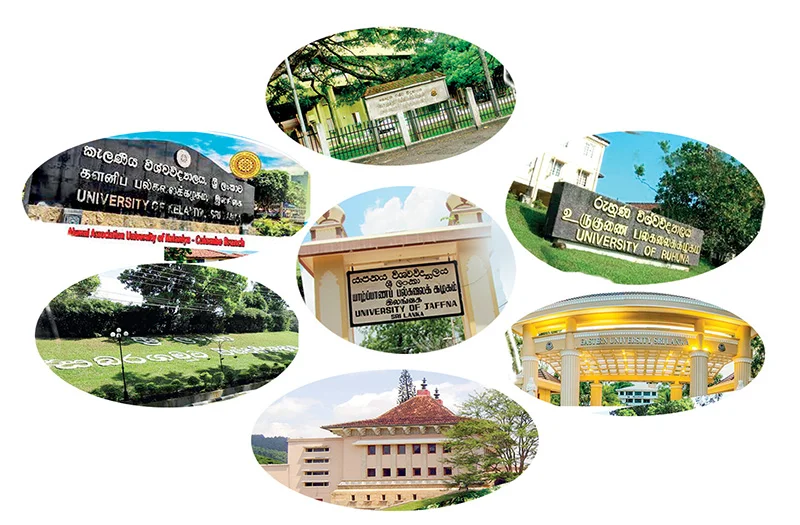
My life has been closely connected with Sri Lanka’s state university system for more than four decades. Its doors opened to me first as a student and later as an academic. The system gave me knowledge, opportunities and a life. Therefore, when I speak about its future, I do so not as an outsider, but as someone who owes much to it and genuinely wishes to see it become better.
Over the years, our university system has expanded significantly. New institutions, faculties, degree programmes and opportunities for students have been created. For 2024, the government expected to admit 43,204 students to national universities. By the time the relevant report was prepared, 42,282 students had been admitted through the general admission process, which had not yet been completed. This is an achievement that should not be dismissed.
However, expanding the system does not necessarily mean that its quality has improved. The real question is not simply how many students we have allowed through the doors, but what kind of education they receive after entering. (Source: Ministry of Education Annual Performance Report 2024.)
We often proudly declare that “our university is number one.” Yet a university does not become number one through publicity. Its true standing depends on the quality of its teaching, the strength of its research and the contribution it makes to society. A vice-chancellor writing about the institution’s, or his or her own, achievements on Facebook does not improve the quality of a university. What matters is good teaching, an education that encourages students to think, credible research and new knowledge that benefits society. A reputation must be earned through meaningful work, not through self-promotion.
The fundamental purpose of a university is clear: to create knowledge, to teach it and to train students to examine and understand it critically. To fulfil this purpose, academics need freedom, responsibility and time. Students must be free to ask questions, disagree and develop their own views based on evidence. Without such an environment, a university may award degrees, but it cannot fulfil the true purpose of university education.
The most serious danger I see is the growing tendency for political activity to take precedence over the academic mission of universities. Over the past five decades, this problem has gradually become more serious. In some universities today, it has become difficult even to hold or express an opinion that differs from the dominant political view.
Members of a university community have every right to hold political views and express them peacefully. A university should not be a place inhabited by silent people. However, when political loyalties, power blocs and struggles for positions become more important than research, teaching and learning, the university moves away from its true purpose. When the political camp to which an academic belongs matters more than the value of that academic’s ideas, the respect that should belong to knowledge is transferred to power.
These criticisms are not ideas I have borrowed from books. They are based on experiences from my own professional life. One such experience was the manner in which I had to leave the university nearly twenty years ago. In my view, the improper exercise of political power within the administration of the University of Colombo at that time, and the strong desire to retain that power, had a serious effect on my professional life. Although this was a personal experience, I mention it with regret because it reveals a deeper institutional problem.
The lesson I learned from that experience is not merely about one person or one incident. When there are no strong institutional safeguards to ensure that power is exercised fairly and individuals are protected, even an academic may be forced to leave an institution he deeply loves.
To those who criticise my later decision to enter national politics, my answer is this: when the university’s institutional system failed to provide me with fairness and professional protection in the face of the injustice I experienced, I had to choose another path through which I could use my knowledge and experience in the service of the country.
This does not mean that all vice-chancellors, academics or students behave in the same way. I personally know many people who, despite difficult circumstances, have taught with dedication, undertaken meaningful research and transformed the lives of their students. Scholars such as Professor W. D. Lakshman, Professor Arjuna Aluwihare and Professor Lakshman Jayatilake may be recognised among the distinguished vice-chancellors in the history of Sri Lanka’s university system. Their service deserves our respect and appreciation.
Nevertheless, the presence of a few good and committed individuals cannot, by itself, strengthen a weak institutional system. We must also create an institutional environment in which such people can work independently, fairly and effectively.
First, university leaders must be selected through a process based on clearly defined qualifications, transparent evaluation and accountability. Once a vice-chancellor has been appointed, his or her performance should be assessed according to the support provided for research, the quality of teaching, student welfare, the institution’s financial discipline and the fairness of its decisions. Personal loyalties and publicity skills cannot replace these measures of performance.
Second, academics must be given the time and space required to carry out their core responsibilities. It is meaningless to demand “world-class universities” without providing adequate time, facilities and reasonable funding for research. Teaching, too, should not be treated merely as delivering lectures. Students must be trained to reason, write, investigate and apply their knowledge to real-world problems. The quality of a degree programme should be measured not by its title, but by the capabilities of the graduates it produces.
Third, universities must establish an honest connection with the needs of the country. The problems confronting our economy, schools, healthcare system, agriculture, environment and wider society are all legitimate subjects for research. Seeking answers to these problems does not diminish the dignity of a university; it increases its value to society.
At the same time, research must not be controlled by short-term political demands. Knowledge can serve the country only when researchers are free to communicate what they discover. Sri Lanka’s World Bank-supported AHEAD higher education programme similarly connected the expansion of enrolment in priority disciplines with improving the quality of degree programmes and promoting research and innovation. These goals were linked because meaningful expansion cannot be separated from educational quality. (Source: World Bank overview of the AHEAD programme.
Fourth, the responsibilities of students must be clearly emphasised. The duty to protect the academic environment of a university cannot be placed solely on administrators and academics. Every student has a fundamental responsibility to give priority to his or her education, respect the right of other students to learn and allow the free exchange of ideas.
Student activities, social debate and political engagement all have an important place in university life. However, none of them should be allowed to disrupt education or prevent other students from learning.
When students abandon their primary purpose of learning and create an environment that obstructs education, the university system cannot fulfil one of its most important functions: producing knowledgeable and responsible graduates. A university may continue to award degree certificates, but if lectures, research, open discussion and intellectual inquiry do not receive sufficient attention, it risks producing graduates who lack depth of knowledge, critical thinking and professional competence.
The result may be the emergence of a group of “half-educated” graduates, individuals who possess certificates but have not received a complete intellectual education. Therefore, just as we discuss student rights, we must also have an honest and open discussion about student responsibilities within the university system.
My position on the current professional struggle of university academics is also clear. If they are demanding fair conditions of employment, those demands should be discussed seriously. If their struggle is also intended to free universities from political interference and restore research, teaching and learning to the centre of university life, I stand with them.
The rights of academics and the educational rights of students should not be presented as opposing interests. Both can be protected and respected only within a well-functioning university.
When I say that “the state university system should be shut down and reopened,” I do not mean that we should close the door on the future of our students. I mean that we must close the door on systems in which power matters more than knowledge.
Students have the right to hold political views and participate actively in debates on national issues. A university needs a student community that thinks about the country’s problems and speaks out against injustice. However, student politics should not shut down the university, deprive other students of their education or become a means of displaying organisational power. The right to fight for one’s beliefs comes with the responsibility to respect another person’s right to an education.
Simply attempting to establish another 50 universities will not solve these problems. Sri Lanka needs a higher education system that brings together the contributions of state, state-affiliated and private institutions while applying clear standards and responsibilities to all of them.
Strict discipline within such a system should not mean suppressing freedom of thought. It should mean ensuring that everyone fulfils their responsibilities in relation to teaching, research, examinations, institutional governance and student welfare. A degree certificate will then have value not merely because of the name of the institution that issued it, but because the knowledge and capabilities of the person who earned it can be trusted.
We should learn from advanced higher education systems, but we should not simply copy them. We must develop institutional autonomy, reliable quality-assurance mechanisms and publicly accountable governance in ways that suit our own needs. What we owe future generations is not merely a country with a larger number of universities, but a country in which people can trust the education those universities provide.
What we must close down, therefore, is not the universities themselves, but the outdated system that closes the door on knowledge, freedom and responsibility. What we must reopen is a genuine university system devoted to learning, inquiry, research and the creation of new knowledge in the service of the country.

COPE: Oil issue and ‘slippery’ answers

Montana Governor here to strengthen agricultural trade and security cooperation

Lankan on Saudi death row: AI throws its weight behind to secure Anojan’s release

Why Sri Lankan sports need science, sanity, and substance

R. S. (Siri) Palihawadana

The silent hunters: Why Sri Lanka’s spiders matter

‘Dates have the highest sugar content to fight Coronavirus’

Sunday Island 27 December – Headlines

#SundayIsland 17th December – Headlines

Sunday Island – 28th March

Sunday Island Headlines – 21 March

Sunday Island – 21st February – Headlines
-
 Editorial7 days ago
Colombo Port drug bust: The plot thickens
-

 Features5 days ago
The first woman in the foreign service or Ceylon Overseas Service it was then called
-

 Editorial6 days ago
Fuelling discontent and protest
-

 News4 days ago
Geneva takes up Sallay’s case and govt. ignores opportunity to answer accusations
-

 Foreign News6 days ago
Ten injured after car crashes into rugby supporters in Australia
-

 Latest News6 days ago
Tharindu Rathnayake, bowlers secure Asian Games Bronze for Sri Lanka
-

 News5 days ago
Nearly 20 Iranian tankers stranded off Lanka amid US sanctions
-

 Features4 days ago
Sri Lanka Cricket Bill: Governance reform is not yet a cricket strategy