
News
Economic crisis: How trade misinvoicing contributed to Sri Lanka’s bankruptcy


Public interest group points finger at corrupt public-private partnership
By Shamindra Ferdinando
A group representing trade union and civil society collective on Tuesday (07) called for urgent action to tackle the well-organised influential public–private sector partnership engaged in ‘overinvoicing’ and ‘under invoicing, with the blessing of successive governments.
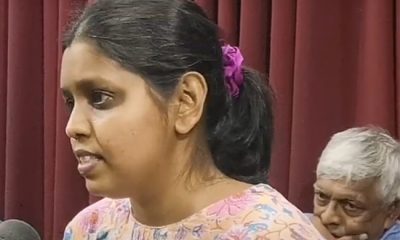
Addressing the media at the Centre for Society and Religion, Maradana, economic analyst Dhanusha Pathirana, civil society activist TharinduUduwaragedara and Attorney-at-Law Lakmali Hemachandra explained how ‘over invoicing’ and ‘under invoicing’ contributed to the economic crisis.
Pathirana asserted that a sharp reduction of capital, as a result of mispricing by importers, in respect of duty/tax free goods and taxable imports, was far more serious than the parking of funds overseas by exporters.
The group underscored the need to examine capital flows through four forms of trade mis-invoicing, namely import over-invoicing and under-invoicing and export over-invoicing and under-invoicing.
Opposition lawmakers Vasudeva Nanayakkara, Wimal Weerawansa and Gevindu Cumaratunga, in Parliament, estimated the stashed amount at over USD 35 bn. The trio has alleged that the Exchange Control Act No 12 of 2017, enacted during the Yahapalana administration allowed exporters to ‘park’ funds overseas.
Dr. Wijeyadasa Rajapakse, PC, has estimated as much as USD 53.5 bn had been ‘parked’ overseas. This claim was made during the committee stage debate on the Appropriation Bill last year.
Pathirana discussed the disclosures made by Global Financial Integrity (GFI), a Washington, DC-based think tank that examined illicit financial flows, corruption, illicit trade and money laundering, pertaining to Sri Lanka.
Commenting on statements made, both in and outside Parliament as regards parking of export proceedings, both Pathirana and Uduwaragedara emphasized that the country suffered much more losses due to capital outflows than ‘parking’ of export proceeds overseas.
They found fault with both importers and exporters, at different levels, and deceitful bureaucracy, that manipulated the entire process, for the benefit of a few, at the expense of the entire country. They stressed that such huge outflows couldn’t be caused by illegal money transferring schemes, such as ‘undial’ and ‘hawala.’
Referring to GFI findings that dealt with the 2009-2018 period, Pathirana, formerly of Asia Capital, stressed that the country lost as much as USD 40 bn due to over-invoicing and under-invoicing, in addition to parking of export proceeds, etc.
Secretary General of the Commercial and Industrial Workers Union, Arulingam Swasthika, didn’t join the discussion, as stated by the organizers.
At the onset of the briefing, Uduwaragedara pointed out that the Wickremesinghe-Rajapaksa government was on its knees before the International Monetary Fund (IMF) for USD 2.9 bn bailout package, whereas USD billions ,that could be utilized,remained overseas.
Sri Lanka has secured IMF bailout packages on 16 previous occasions.
The activist said that Justice Minister Wijeyadasa Rajapakse, PC, and Samagi Jana Balavegaya (SJB) heavyweight Patali Champika Ranawaka, in his capacity as the Chairman of the National Council sub-committee on identifying short- and medium-term programmes, related to economic stabilization, acknowledged the disclosures made by the GFI.
Cabinet spokesperson Bandula Gunawardena, too, admitted the issue at hand, though the government was yet to respond to this situation, Uduwaragedara said.
Actually, the government owed an explanation why, in spite of facing such extreme difficulties, those responsible for the revenue collection mechanisms, soft-pedal the issue.
“We are in a desperate situation. But, Parliament, responsible for public finance ,never really intervened in this matter. Parliament not only turned a blind eye to this daylight robbery but encouraged corruption at every level,” Uduwaragedara alleged.
Pathirana pointed out that even after President Gotabaya Rajapaksa’s government restricted imports, in 2021, the import bill remained high. “Our foreign reserves, amounting to USD 7.5 bn, simply evaporated as unscrupulous elements ,engaged in ‘over-invoicing,’ simply stepped up their operations,” Pathirana said.
According to him, even foreign loans, received by Sri Lanka, and foreign remittances, too, were vulnerable to these machinations. Both Pathirana and Uduwaragedara warned that unless remedial measures were taken to tackle corrupt cartels, the USD 2.9 bn received, over a period of four years, wouldn’t make a difference.
Pathirana emphasized that if the government was genuinely interested in breaking up the corrupt networks it could be done.
The public interest group urged the government to launch a comprehensive audit as part of the overall remedial measures. The Central Bank should intervene in this matter, without further delay, Pathirana said.
Uduwaragedara pointed out that those at the helm conveniently failed to act on the shocking disclosures made by Panama Papers (published beginning April, 2016) and Pandora Papers (2021). Referring to a spate of cases, involving Sri Lankans, that had been disclosed by Panama Papers and Pandora Papers, Uduwaragedara stressed that the failure on the part of the government to properly investigate, at least one case, exposed the bitter truth.
The media was told how those who had been exposed, invested in property overseas, ranging from luxury houses to art.
Stressing the urgent need and the responsibility on the part of the government to further strengthen laws to tackle these issues, Pathirana suggested that there should be a wider discussion, regarding writing off debt.
The Island
asked whether they really expected those responsible for the economic ruin here to genuinely address this issue, and anything tangible expected from those at the helm of power. Lawyer Lakmali Hemachandra said that they were still pursuing the issues and no final decision was taken on future course of action.
Pathirana said that Universities should engage in what he called an in-depth study of the growing problem. Referring to former Auditor General Gamini Wijesinghe’s declarations, pertaining to the ongoing crisis, Pathirana suggested that the government should commence an inquiry, beginning 2021.
The group said that this particular issue hadn’t received sufficient attention of the Sinhala media, both print and electronic, hence the need to make the public aware of the continuing threat. In spite of the Central Bank, in July 2006, responding to the threat posed by money laundering and terrorism financing, successive governments never really took concrete measures in that regard.
Towards the end of the discussion, the urgent need to introduce amendments to the Exchange Control Act No 12 of 2017, as part of Sri Lanka’s response to the continuing financial crisis was also taken up. Amendments were necessary to restore the authority exercised by the Central Bank in respect of regulation of foreign exchange, before the enactment of the above controversial piece of legislation by the Yahapalana government.
The group said that wider investigation was required to establish the truth, though the current crisis had been blamed on President Gotabaya Rajapaksa’s policy mismanagements, such as unprecedented tax cuts that caused the loss of revenue to the tune of Rs 600 bn.






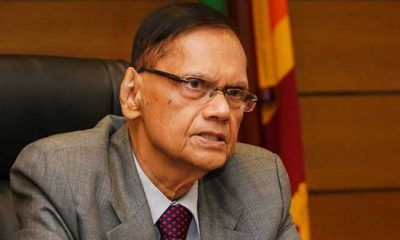




More than 1,600 students sat this year’s Russian Classical Ballet Examination, the largest number ever to take part in the examination in Sri Lanka. Exams were held in Colombo from 5, to 18, October and in Galle on 10 October.
Students aged four and above came from across the island, including Colombo, Galle, Gampaha, Negombo, Matara, Kelaniya, Panadura, Wattala, Kiribathgoda, Ratnapura, Kandy, Kurunegala, Bandarawela and Badulla. They are taught by 15 dedicated teachers trained in the Vaganova method, the renowned Russian system of classical ballet training.
They were examined by Dr. Oxana Karnovich of the Moscow State Academy of Choreography, a distinguished academic and curator.
The Russian School of Ballet and Dancing was established in 2001 by Michael Ustinov, Buddhapriya Ramanayake and Mrs Chandi Aluvihare, with Mrs Galina Pleshakova as its founding instructor. Today the School is led by Director Madam Maria Popova, Counsellor of the Embassy of the Russian Federation in Sri Lanka.


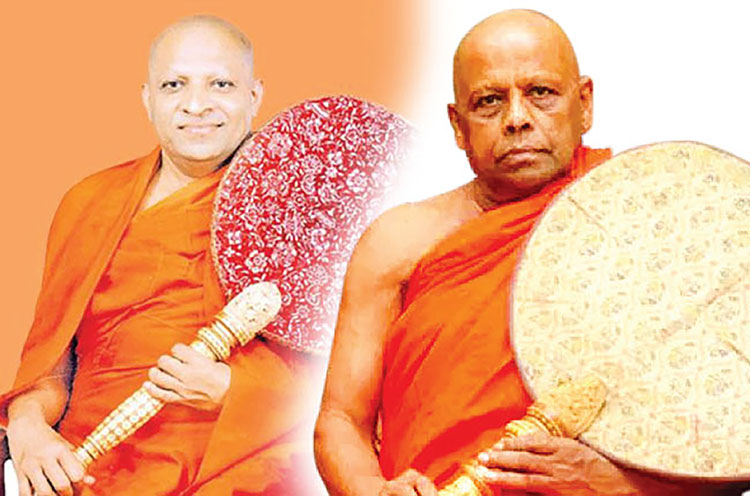
MONETABRIEF– Sri Lanka’s two most senior Buddhist chapters, Malwatte and Asgiriya, demanded special concessions for monks serving prison sentences, following the disrobing of convicted monk Ven. Galagodaatte Gnanasara in line with established procedures.
The chief prelate of the Asgiriya chapter, Most Venerable Warakagoda Sri Gnanarathana, told Prisons Commissioner Senaka Palletenna that Ven. Gnanasara, who is serving a six-year sentence for contempt of court, must be released immediately.
Prison authorities have no power to release or pardon convicts, but Palletenna told the monk in Kandy on Friday that he would convey his request to the relevant government authorities.
“There is no point in talking about this and that… The entire country has been shaken (??????? ) . He must be released,” the Asgiriya chief prelate said.
The Malwatte chief prelate, Most Venerable Thibbatuwawe Sri Siddhartha Sumangala, appeared to accept the court verdict against Ven. Gnanasara, but asked the prisons chief whether a separate section could be established for convicted monks.
Palletenna noted that a special ward for the clergy already existed at Welikada Prison.
At least 63 convicted Buddhist monks are currently incarcerated within Sri Lanka’s criminal justice system.
Meanwhile, a group of 34 Buddhist monks named in a Colombo Fort Magistrate’s Court order to vacate the vicinity of the Presidential Secretariat ended their protest and dispersed after lunch on Friday.The monks are demanding an unconditional pardon for Ven. Gnanasara, who has previously been imprisoned, making him a reconvicted prisoner.
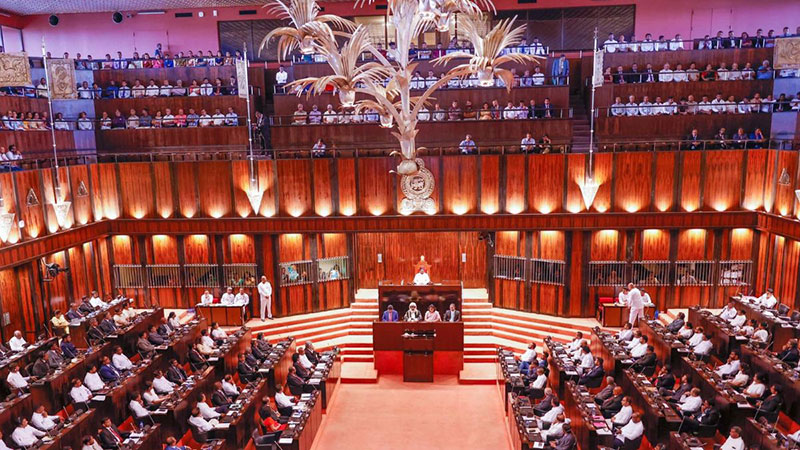
The debate on the no-confidence motion against Speaker Dr. Jagath Wickramaratne, submitted by the Samagi Jana Balawegaya (SJB), has been postponed indefinitely pending the Attorney General’s opinion on certain technical issues in the motion.
Government representatives raised the matter at a meeting of the Committee on Parliamentary Business, pointing out that several provisions of the motion required clarification and that the Attorney General’s advice should be obtained.
As obtaining the opinion would take time, the debate could not be scheduled for the next parliamentary week, parliamentary sources said.
Chief Opposition Whip Gayantha Karunatilaka said a date for the debate would be decided after the Attorney General’s advice was received.
Meanwhile, Parliament is scheduled to meet from October 20 to 23, Secretary General of Parliament Kushani Rohanadeera announced.
The parliamentary business for the week was finalised at a meeting of the Committee on Parliamentary Business held on Friday (16) under the chairmanship of Deputy Speaker Dr. Rizvie Salih.
On each sitting day, the period from 9.30 a.m. to 10 a.m. will be allocated for parliamentary business under Items 1 to 6 of Standing Order 22. Questions for Oral Answers will be taken up from 10 a.m. to 11 a.m., followed by questions under Standing Order 27(2) from 11 a.m. to 11.30 a.m.
On Tuesday, October 20, an Opposition-sponsored Adjournment Motion will be debated from 11.30 a.m. to 5.30 p.m.
On Wednesday, October 21, a resolution under the Public Debt Management Act and a Supplementary Estimate will be taken up for debate and approval from 11.30 a.m. to 5 p.m. The annual reports of five statutory institutions will subsequently be presented for approval without debate, while questions at the Adjournment Time will be taken up from 5 p.m. to 5.30 p.m.
On Thursday, October 22, the Second Reading debates on two Bills to amend the Poisons, Opium and Dangerous Drugs Ordinance (Bills Nos. 79 and 80) will be held from 11.30 a.m. to 5 p.m.
The annual reports of five statutory institutions will then be taken up for approval without debate, followed by an Opposition-sponsored Adjournment Motion from 5 p.m. to 5.30 p.m.
On Friday, October 23, the Second Reading debate on the Elimination of Rabies and Registration of Dogs Bill will be held from 11.30 a.m. to 5 p.m. A Government-sponsored Adjournment Motion will be debated during the final half-hour of the sitting.

Record 1,600 students take Russian Classical Ballet examination in Sri Lanka

Half a million people join protests in France, but some turn violent

Deadly fire breaks out at Canada military base

Showers or thundershowers will occur in most parts of the island after 1.00 p.m.

Buddhist hierarchy demands prison perks for monk convicts

Debate on NCM against Speaker postponed indefinitely

‘Dates have the highest sugar content to fight Coronavirus’

Sunday Island 27 December – Headlines

#SundayIsland 17th December – Headlines

Sunday Island – 28th March

Sunday Island Headlines – 21 March

Sunday Island – 21st February – Headlines
-

 Latest News5 days ago
Nissanka’s return headlines Sri Lanka’s Test squad against Pakistan
-

 Latest News6 days ago
Farhan and Sadaqat help Pakistan seal series in style
-

 Features6 days ago
Intake 16: 45 years of duty and honour
-
 News6 days ago
Malwathu Chapter issues statement on talks with President over Gnanasara Thera’s robes
-
 News6 days ago
CP alleges NPP has taken the blame for illegal US sanctions on Iranian vessels
-

 News4 days ago
Sri Lanka, India caught in US-Iran ship crisis
-

 Opinion6 days ago
How long can Sri Lanka remain silent on its demographic crisis?
-

 Latest News4 days ago
Kusal Mendis’ unbeaten 87 hands Sri Lanka consolation win