
Business
Dilmah – HSBC future writers festival attracts 150+ entries


Last year’s Future Writers winner makes it to Gratiaen Shortlist
Hafsa Rizvi, Taleetha Wambeck and Sohara Bandaranayake named winners of 2nd Future Writers Programme
With a focus on empowering emerging voices, the Future Writers Programme presented by Dilmah is a flagship initiative of the HSBC Ceylon Literary & Arts Festival and is fast becoming a catalyst for creative growth in Sri Lanka. More than a competition, it is a platform designed to foster and elevate the talents of young Sri Lankan writers, supporting their journey from inspiration to impact, a news release connected with the event said.
“A powerful example of this impact is evidenced in Savin Edirisinghe, last year’s competition winner, being shortlisted for the prestigious 32nd Gratiaen Prize – a milestone that affirms the programme’s mission, it noted.
This year’s Awards Ceremony, held at Genesis – The Dilmah Centre for a Sustainable Future, brought together distinguished literary figures and young creatives to celebrate and recognise the emerging national literary talents.
Speaking at the event, Dilhan C. Fernando, Tea Grower and Chairman/CEO of Dilmah, emphasised the importance of storytelling as a force for cultural preservation and personal expression: “Creativity is what differentiates us in this age of AI and so much mundane automation. It’s creativity that will make us distinct and give us an identity, he said”
Dilmah’s support of the Festival and young writers reflects its long-standing legacy of storytelling, beginning with founder Merrill J. Fernando’s mission to share the story of Ceylon tea with the world. Today, that legacy lives on in every young Sri Lankan who dares to write with heart, with purpose, and with the hope of being heard.
Ajai Vir Singh, Creative Platform Builder and Co-Founder & Director of the HSBC Ceylon Literary & Arts Festival added, “The role of platforms in modern day societies is very important as they re-engage a generation on common purpose. Our platform is driving the resurgence of arts and culture among the youth through their engagement and this programme is a testimony of that. It’s also building a unique Sri Lankan identity. The Future Writers Programme acts as a supply chain that boosts the arts and culture stream of Sri Lanka. Soft power enhancement has been our goal for a few years now and that remains the bigger purpose for us.”
Now in its second consecutive year, the Future Writers Programme presented by Dilmah invited aspiring writers aged 15 – 29 to develop their storytelling abilities through dedicated writing workshops and a national short story competition. This year, participants explored two evocative themes: ‘Whispers from the Jungle’ and ‘Echoes of the Protector’. The overwhelming response to the call for submissions reflected the interest in creative writing among Sri Lanka’s youth and a hunger for platforms that support creative expression.
The highlight of the evening was the announcement of the Future Writers Programme Competition winners. The top three were honoured for their imaginative and thought-provoking stories that captured the spirit of this year’s festival theme, ‘Writing with Purpose’. Hafsa Rizvi claimed the top prize for her story, while Taleetha Wambeck was named First Runner-up and Sohara Bandaranayake received Second Runner-up honours.
The judging panel for this year’s competition comprised acclaimed writers and literary professionals: Ameena Hussein, Lal Medawattegedara, and Artika Aurora Bakshi who shared their insights during a thought-provoking panel discussion at the awards ceremony moderated by lawyer and presenter Shanaka Amarasinghe. Their selection reflected a thoughtful and rigorous evaluation of the entries, recognising young voices with originality, creativity, clarity and identity.
The top three winners were awarded a cash prize and the opportunity to engage in a mentorship session with award winning author and publisher Ameena Hussein providing valuable guidance to refine their craft and continue their literary journeys. The 48 Shortlist and Longlist recipients were also presented with certificates and a token in recognition of their achievements.
To read the stories of the top 11 on the shortlist, visit: www.ceylonliteraryfestival.com

by SK Samaranayake
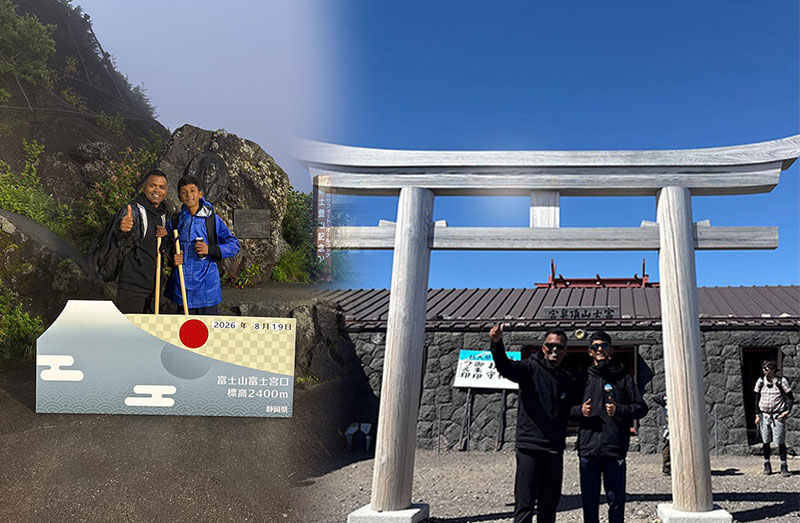
For Daham Gunasena, reaching the summit of Mt. Fuji with his 12-year-old son was not the end of the journey but the beginning of a different kind of lesson.
Gunasena, Director – Commercial at SPAR Sri Lanka and a senior business leader, academic and Chartered Accountant, spent nearly 12 hours on August 19 climbing Japan’s highest mountain with his son, Methum. After eight hours of climbing, the pair reached the 3,776-metre summit before beginning a demanding four-hour descent to Fujinomiya 5th Station.
“The summit was only halfway,” Gunasena reflected, describing the experience as a lesson in preparation, perseverance and responsibility.
Their journey began two days earlier with a trial excursion to the 6th Station and the volcanic landscape around Mt. Hoei. The experience allowed Gunasena to assess the altitude, terrain, weather and equipment before deciding whether his son was ready for the summit attempt.
The climb itself reinforced the value of taking one step at a time. Rather than focusing on the distant summit, father and son concentrated on the next marker, the next few steps and short periods of rest.
Reaching the summit brought another lesson. After taking photographs and celebrating, they still had four hours of descent ahead of them over loose volcanic terrain.
“Reaching the top was an achievement. Returning safely was success,” Gunasena said.
The experience also prompted him to reflect on how Japan manages Mt. Fuji, including visitor education, digital information, sanitation, transport, safety and environmental protection.
Having climbed Sri Pada 12 times last year and five times so far this year, Gunasena sees opportunities to apply some of these principles in Sri Lanka without compromising the mountain’s unique pilgrimage traditions.
He suggested a comprehensive digital platform for Sri Pada providing information on weather, congestion, transport, sanitation, first aid and emergencies, while educating foreign visitors about its religious significance.
For Gunasena, however, the most enduring lesson was personal: a mountain can teach what lectures cannot—through preparation, perseverance, respect for nature and the shared experience of taking each step together.

Sri Lankan industries are being encouraged to adopt advanced condition monitoring technologies to detect equipment problems before they develop into costly failures, as global technology company FLIR and its local partner Marlbo Trading Company strengthen their collaboration.
The companies brought together industry professionals at a technical seminar held on August 20 at Taj Samudra, Colombo, focusing on the use of thermography and acoustic imaging to reduce unplanned downtime, improve energy efficiency and lower maintenance costs.
Organised by Marlbo under the theme “Condition Monitoring Using Thermography and Acoustic Imaging for Measurable ROI,” the seminar highlighted the growing importance of proactive and predictive maintenance in improving equipment reliability and operational efficiency.
FLIR Sales Director – Instrumentation, India, Bhaskar Lala, and APAC Condition Monitoring Specialist David Gambarte shared their expertise on the latest diagnostic technologies and their practical industrial applications.
Thermal imaging can identify abnormal heat patterns linked to electrical and mechanical faults, while acoustic imaging can detect problems that may go unnoticed during routine inspections.
The technology is particularly useful in identifying compressed-air leaks, which can cause significant energy losses and increase operating costs.
Shevon Liyanage, Engineer – Measuring Instruments at Marlbo, also shared insights into applying condition monitoring technologies in the Sri Lankan industrial environment.
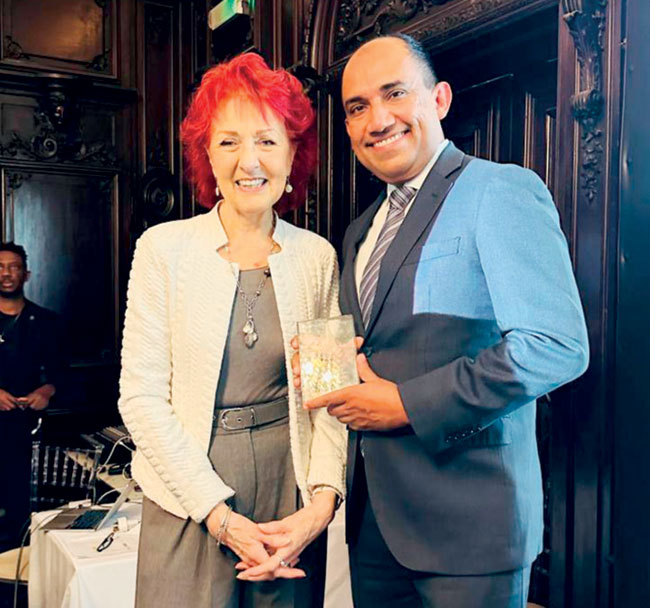
Lumbini Tea Valley Ceylon won an award for its Singharaja Wirytips at The Leafies: International Tea Awards held in London in 2024, marking another international recognition for the Sri Lankan tea producer.
The award comes as the company marks two decades of direct exports, with its premium and organic Ceylon teas now reaching 35 countries across six continents.
Established in 1984, Lumbini Tea Valley began its direct export drive after Chaminda Jayawardana joined the family business in 2000 alongside his father, Dayapala Jayawardana. The initiative materialised in 2006 with the company’s first direct shipment—a 15-kilogram consignment of Flowery Broken Orange Pekoe (FBOP) tea to the United States.
Since then, the company has expanded its direct-export operations, which now account for around 20% of its total manufacturing output. Following its transition to organic production, approximately half of its organic tea output is exported directly by the company.
Its key export markets include Japan, the United States, France, the Netherlands, Switzerland and Australia, with direct shipments now reaching 35 countries.
The company said its direct-export model would continue to expand amid growing international demand for traceable, single-origin Ceylon tea, with premium and organic grades at the centre of its export strategy.

Voting closes in Iceland’s knife-edge EU referendum

Showers in the Sabaragamuwa, Western and North-western provinces and in Galle, Matara, Kandy and Nuwara-Eliya districts

Sun directly overhead Mannar, Periyamadu, Puliyankulam, Welioya and Pulmoddai about 12.11 noon today (30)

Lanka tracks 11 US-sanctioned Iranian tankers off coast

House to debate abolition of Chief of Defence Staff post

Mass graves tragic evidence of failed states – Rathnayake

‘Dates have the highest sugar content to fight Coronavirus’

Sunday Island 27 December – Headlines

#SundayIsland 17th December – Headlines

Sunday Island – 28th March

Sunday Island Headlines – 21 March

Sunday Island – 21st February – Headlines
-

 News5 days ago
Missing doctor’s body found in Mahiyanganaya
-

 News5 days ago
Australia declines to release Finance Secy Suriyapperuma’s citizenship details
-
 News5 days ago
22A: BASL suggests CJ recuse himself from hearing petitions
-

 News2 days ago
Eight politicians in drug kingpin probe
-

 Editorial6 days ago
Govts. drag feet as undergrads age
-
 Features4 days ago
Insights from Chieftains of Uva: Genealogy of two Kandyan Families – Part II
-

 Features4 days ago
Export diversification: Missing the wood for the trees – Part I
-

 Features2 days ago
Redefining ageing in Sri Lanka