
Opinion
Devolution and Comrade Anura

By Austin Fernando
(Former Secretary to the President)
About ten months ago, among other things, I informally discussed the devolution of power with Anura Kumara Dissanayake, who was an MP at the time. The consequences of his low-priority approach to devolution, as predicted then, were reflected in the presidential election results in the North and the East. Perhaps, there were other reasons also for the low level of popular support for him over there. Now that he is the President of 23 million Sri Lankans, he must consider the presidential election results in the North and the East as a guide. Probably, the Indian External Affairs Minister Subrahmanyam Jaishankar has already reminded him of that.
Sri Lankan politicians’ mood changes
The policies of Sri Lankan politicians on power sharing are characterized by inconsistencies. Former Ministers Basil Rajapaksa and Prof. G.L. Peiris promised Indians the implementation of the 13th Amendment (13A). Though Namal Rajapaksa has specifically rejected the devolution of Land and Police powers, President Mahinda Rajapaksa promised “13A+,” including those. In Delhi, President Gotabaya Rajapaksa said 13A could not be implemented “against the wishes and feelings of the majority (Sinhala) community.” But he had solemnly declared that he would uphold and defend the Constitution, of which 13A is an integral part! The Indian political leaders’ policy on the devolution here has remained consistent.
We have conveniently forgotten that during the Oslo Peace Talks on 05 December 2002, the Sri Lankan delegation led by G. L. Peiris and the LTTE delegation led by Anton Balasingham agreed to “explore a solution founded on the principle of internal self-determination in areas of historical habitation of the Tamil-speaking peoples, based on a federal structure, within a united Sri Lanka.”
“Federal,” “areas of historical habitation,” and “internal self-determination” are anathema to many Southern politicians and not understood by civilians. Today, Ranil Wickremesinghe and Pieris will certainly dissociate themselves from the Oslo Declaration.
Wickremesinghe, who supported the passage of 13A and appurtenant legislations, was Prime.
Minister (PM) when the Oslo Declaration was made. But now he is unwilling to devolve police powers to Provincial Councils (PCs). Gotabhaya Rajapaksa informed Indians that he must “look at weaknesses and strengths of 13A.” Had he said so as an inexperienced President in 2019, it would have been tolerable, but he said so after 22 months in office. It reflected a lack of knowledge of governance systems on his part or something up his sleeve.
Evolution of 13A
In this background, it is appropriate, to reflect the evolution of 13A to evaluate it as against what was demanded in the name of devolution.
Sri Lanka came under pressure to devolve power following Black July (1983) and the beginning of the armed conflict. The contention that the Indians wished for Sri Lanka’s division through devolution is not true. India has always respected our sovereignty and territorial integrity owing to its experience with conflicts in Mizoram, Nagaland, etc.
On 01 March 1985, President J. R. Jayewardene personally sought Indian Prime Minister Rajiv Gandhi’s intervention to prevent the movement of armed terrorists from India and Sri Lankans seeking refuge in India. On 01 December 1985, the Tamil United Liberation Front (TULF) presented its proposals for devolution to Gandhi in a bid to pressure Sri Lanka to agree to power-sharing.
The salient features of the proposal were as follows:
• Sri Lanka—”Ilankai” be a union of states,
• Amalgamated Northern and Eastern Provinces, a ‘Tamil Linguistic State’, which cannot be altered without their consent,
• Parliament reflecting ethnic proportion shall be empowered to make laws under “List 1″ for Defense, Foreign Affairs, Currency, Posts / Telecommunications, Immigration/Emigration, Foreign trade/Commerce, Railways, Airports /Aviation, Broadcasting/Television, Customs, Elections, and Census only, • List 2” had all other subjects, inclusive of Law and Order, Land, etc., with the State Assembly possessing law-making powers, • Any person resident in Sri Lanka, on 1st November 1981, who is not a foreigner shall be a Sri ankan citizen, • No Resolution or Bill affecting any “nationality” should be passed by Parliament without the agreement of that “nationality,” (The term ‘nationality’ is misleading.)
• The State Assembly to be empowered to levy taxes, cess/fees, and mobilize loans/grants,
• Special provisions for Indian Tamils,
• The elected members are to be given enhanced powers, • Upgrading the judicial system, e.g. Provincial High Court to Appeal Court, and, • Muslim rights to be cared for.
The Jayewardene Government rejected the proposal out of hand. The TULF again addressed Gandhi (17-1-1986), incorporating more sensitive issues such as ‘traditional homelands,’ demographic imbalance, etc. Jayewardene steadfastly advocated a military solution and the war was dubbed as “genocide” by former Indian Minister B.R. Bhagat and several Lok Sabha members. The latter demanded punitive interventions such as ‘crushing Sri Lanka in 24 hours” (Sri Kolandaivelu on 29-4-1985), and Sri Gopalaswamy on 13-5-1985, asking India “to undertake every possible means, including military interventions.”
Gandhi would have been satisfied with the Sri Lankan proposals of 09 July 1986, prepared after consulting Minister P. Chidambaram, which fitted the Sri Lankan constitutional basics. There were ‘Notes’ incorporated into the proposals on PCs, law and order, and land settlements inclusive of land alienation under the Mahaweli Project, with allottees identified based on ethnicity. On 30 Sept.,
1986, the TULF responded to India in detail to the government’s proposals, adding more propositions.
Gandhi was mindful of Lok Sabha’s demands. He vented frustration in Lok Sabha and abroad (e.g. Harare). Efforts to project him and India as weak exasperated him and drove him to get tough. On 02 June 1987, he threatened to send a flotilla with ‘humanitarian assistance’, and on 04 June 1987, Indian Aircraft violated Sri Lanka’s airspace and carried out aid drops in the North. No superpower stood with us on this blatant violation. No wonder Jayewardene agreed to sign an Accord and follow up by introducing 13A.
After the signing of the Accord, the Indian Peace Keeping Forces (IPKF) were deployed in Sri Lanka.
Lt. General A. S. Kalkat, in an interview with Nithin Ghokle, has admitted that the deployment of the Indian army here was a mistake. Jaishankar (one-time political adviser to the IPKF- 1988-1990), has said in his ‘The India Way,’ that it was a ‘misadventure.’ We are aware of the IPKF’s ‘mistakes’ and ‘misadventures’ like the Valvettithurai Massacre of 64 persons on 02 August 1989, and more, best known to Kalkat and Jaishankar. Importantly, the IPKF operations instilled fear, especially conditioning Tamil people’s minds to search for whatever possible solution.
Concurrently, as explained by then-Indian Foreign Secretary A. P. Venkateswaran, Jayewardene met Gandhi in mid-November 1986 in Bangalore, along with Ministers Natwar Singh, Chidambaram, and himself, and Jayewardene allegedly ‘pleaded’ with Gandhi to send the Indian Army to prevent his government from collapsing, due to the JVP attacks in the South, and LTTE in the North. It was his sheer desperation that drove Jayewardene to opt for the Accord and 13A. After this meeting, Gandhi sent Chidambaram and Natwar Singh to Colombo knowing our vulnerability.
On 19 December 1986, they submitted the “emerged” proposals. The salient points were as follows:
* The Eastern Province to be demarcated minus Sinhala majority Ampara Electorate.
* A PC was to be established for the new Eastern Province.
* Earlier discussed institutional linkages to be refined for Northern and Eastern PCs. The
intention would have been to merge later under a second-stage constitutional development.
* Sri Lanka was willing to create a Vice Presidency for a specified term.
* The five Muslim parliamentarians from the Eastern Province may be invited to India to discuss matters of mutual concern.
The foregoing demands show how India tried to match the Tamils’ interest, vis-a-vis the wishes of the majority community.
Military operations continued provoking India, which threatened to abandon its intervenor role on 09 February 1987, unless Colombo pursued a political solution. Jayewardene responded on 12 February 1987, insinuating calming down on military actions, promoting negotiation and administration, and paving the release of persons in custody. This was how India reacted when rubbed wrongly.
Under successive governments, PCs were weakened by the withdrawal of powers and lacked cooperation. This may have led Jaishankar to address President Dissanayake, whose party is considered averse to 13A. This is the perception of the Tamil MPs, who have recently sought US Ambassador Julie Chung’s intervention for correction. Such aversion to PCs is hard to overcome as evident from an NPP’s public statement that devolution will not include Land and Police powers. It said so close on the heels of Jaishankar’s request that 13A be fully implemented.
Flashback to 1986
The Bharatiya Janata Party (BJP) stalwart, Jaswant Singh posed seven questions in Lok Sabha on 13 May 1986, based on the situation in Sri Lanka. They are relevant even today.
* What is the Indian stand in the debate on devolution and delegation?
* Where do India and Sri Lanka stand on the Northern and Eastern Provinces merger?
* What is the stand on land use by the Indian Government, the Government of Sri Lanka, and
the Tamil groups?
* What is the status of the language?
* What is the stand on Law and Order?
* What is the time frame for reaching a solution?
* What is the Indian Government’s stand on the foreign threats emerging in the context of the Sri Lankan issues?
If Jaswant Singh were alive today, he would either join the critical Lok Sabha Members or question PM Modi and Jaishankar why the Accord has not been implemented. Jaishankar’s reminder to President Dissanayake would have been due to his frustration stemming from:
* 13A being “paralyzed” by partial implementation, and delayed elections.
* The demerger of the North and the East legally
* The delay in devolving land and police powers
* The language issue has not been fully resolved despite constitutional guarantees
* Absence of a timeframe for a solution, even after crushing the Tigers in 2009, and,
* Increasing threat to India, especially from China.
Parallelly, the field situations have changed. Military operations have ceased. Public attention has been shifted from conflict to human rights and humanitarian concerns, returning refugees, and reconciliation. 13A has been internationalized owing to the incorporation thereof into UNHRC Resolutions by Mahinda Rajapaksa and Wickremesinghe in 2009 and 2015 respectively. Intense lobbying by Diaspora groups has also contributed to this situation. These are daunting challenges before President Dissanayake. 13A is only one of them.
What is in store?
As seen above, the 13A has trudged a rough path to be accepted domestically or in India. Parliamentarians resigned, opposition politicians and Bhikkus protested on roads against it and violence was experienced. If the rejected proposals had been accepted the consequences would have been disastrous. However, devolution has come to stay and is viewed as a ‘Made-in-India’ solution.
President Dissanayake must be prepared for negotiations with relevant parties on devolution and hence needs to study India’s experience with devolution. For instance, on the devolution of land powers, Dissanayake can refer to how the Indian government changed Jammu Kashmir rules allowing the center to release lands to Indians to attract development/investment. They permitted even non-residents to own immovable property in Jammu and Kashmir and transfer agricultural land for non-agricultural purposes. India considered changes as her “internal affairs”, which may not be acceptable to them if we say so on 13A!
PM Modi has declared that such abrogation brought about security, dignity, and opportunity for all communities that had been deprived of development, and helped eliminate corruption. If he wishes, President Dissanayake can make similar reasoning to bolster his arguments concerning devolution.
Indians also have asymmetrical administration in the Himachal and Uttarakhand States but do not apply that to Jammu-Kashmir, which we also could duplicate. However, asymmetrical devolution is extremely complex and warrants serious legal attention.
It is now up to President Dissanayake’s legal and administrative experts to propose how to
incorporate propositions concerning devolution into the proposed new Constitution. India might compromise on devolution and concentrate more on economic and humanitarian rights interventions. Such attitudinal change is the need of the hour.
Indian National Security Advisor Ajit Doval, a respected negotiator/strategist, recognised even by Chinese President Xi Jinping in Kazan, has advised Tamil politicians to negotiate with a winnable candidate and secure Tamil aspirations through negotiations. His wise counsel was not heeded by some Tamil politicians, who, while rejecting 13A, demanded a federal system with self-determination powers for Tamils, which is a non-starter. By reminding President Dissanayake of the need to implement 13A after Doval’s visit, New Delhi sent a clear message concerning Sri Lanka: that it does not consider self-determination or a federal system as a solution.
Hence, Tamil politicians also must revise their approach in light of the aforesaid message. Based on Jaswant Singh’s queries and current political trends, if Tamil groups reject 13A, a new power-sharing mechanism sans federalism must be proposed. Perhaps, the new Constitution promised by Dissanayake may offer an alternative to bring about nation-building, with equality, dignity, justice, self-respect, and inclusivity, through a political process. They are the crux of Tamil demands.
Some believe that devolution can be achieved through Local Government Authorities in contravention of international norms of devolution and the Principle of Subsidiarity. Additionally, making all political parties think out of the box is a formidable challenge. Yet, consensual decision-making is needed to ensure the sustainability of any mechanism.
Meera Srinivasan of The Hindu has said:
“Despite India’s known support to the Mahinda Rajapaksa administration in defeating the LTTE in 2009, sections among the Sri Lankan southern population remain India-sceptics, wary of the big neighbour, who ‘interfered’ in Sri Lanka’s ethnic conflict, ‘sided with Tamils’. They resist India’s commenting on power devolution or conduct of elections to PCs and oppose any Indian role in developing national assets.”
India and the Tamil political establishment may adapt to this Sinhala mindset. The upcoming parliamentary election is expected to enable the NPP to form a government. If so, it will be timely to change narratives, without risking the redirection of the government’s political allegiances elsewhere. India should be cautious. Change should be achieved through wider consultations and agreements.
From Bhandari to Vikram Mistri, and Rajeev Gandhi to Narendra Modi, Indians also have acted like their Sri Lankan counterparts in managing the national question here, as evident from Sri Lanka’s failure to implement the 13A fully for 37 years, and India’s failure to convince Sri Lanka of the need to use 13A to solve the national question.
Today India has to deal with a Sri Lankan leader, who is different from predecessors. It is hoped that Jaishankar and others will be able to persuade him to get to the genuine track to explore a solution for the national question. Good luck to Ministers Subrahmanyam Jaishankar and Vijitha Herath, Secretaries Vikram Mistri and Aruni Wijewardane, and High Commissioners Santhosh Jha and Kshenuka Senevirathe!

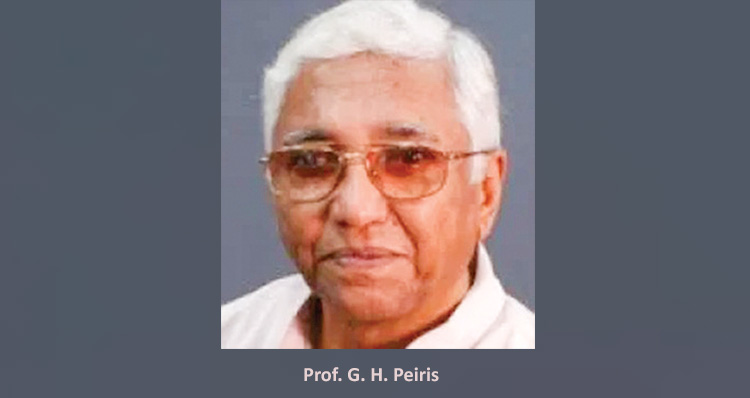
Prof. G. H. Peiris PhD, Emeritus Professor, University of Peradeniya, passed away on the 20th September 2026. His mortal remains were donated to the Anatomy Department, Faculty of Medicine, University of Peradeniya, according to his wishes. He was born on 30th January, 1938, in Junagaha, close to Negombo, and entered the University of Ceylon, at the age of 17 years. After obtaining a first class honours degree in Geography, the first to do so in the history of the University, he joined the staff of the Geography Department, Peradeniya University, and soon proceeded to Cambridge University to read for his doctorate.
Prof. Peiris excelled in academic work in teaching and research while serving the University for 43 long years. His research delved deeply into land reforms, economic and social change, irrigated agriculture, university education and ethnic conflict. He held visiting professorial appointments in Australia, Canada, the United States and Norway, and has undertaken sponsored study tours in the Philippines and the United States. His consultancy assignments include those conducted for the ILO, WHO and UNICEF. He has collaborated with scholars from India, Pakistan, Bangladesh, Nepal, Syria, the Netherlands and the United States in major research projects.
Based on his research, he debunked the homeland theory concocted by separatists.
Prof Peiris was appointed to the committee to draft a new constitution by the Gotabaya Rajapaksa government in 2020. He did not agree with the views of several members of the committee on the matter of federalism as a solution to the ethnic conflict. He held that the best solution would be devolution at the district level and consequently he submitted a dissenting report to the final draft constitution. In his extensive academic work and policy stances, such as his thesis Federalism and the ‘Federal Option’ for Sri Lanka, he argued that shifting from a unitary to a federal structure would not resolve ethnic tensions. Instead, he characterised federalism in the Sri Lankan context as an “absurdity,” given the island’s small geographic size.
He firmly contested the concept of a combined Northern and Eastern Province acting as a federal unit. He vocally opposed the “Traditional Tamil Homeland” hypothesis, arguing that merging these provinces, along ethnic lines, created severe risks to the country’s territorial integrity and ethnic harmony. Peiris maintained that supreme political power must be confined to the government.
After retirement, in 2003, Prof. Peiris authored and edited several major books focusing on socio-economic development, land policy, and ethnic conflict and these include; Sri Lanka: Challenges of the New Millennium (2006), Twilight of the Tigers: Peace Efforts and Power Struggles in Sri Lanka (2009), Political Conflict in South Asia (2013), Sri Lanka: Land Policy for Sustainable Development – To Strengthen the Struggle for Survival (2016/2017).
His book, in Sinhala, titled “Ganaduraka Sihivatana” (Memories of an Era of Darkness), a 307-page work, focuses heavily on the political history, ethnic conflicts, and peace efforts involving the Liberation Tigers of Tamil Eelam. In it, he draws from his extensive research career to provide a highly detailed critique of the LTTE’s secessionist campaigns, territorial claims, and the broader socio-political ramifications of the conflict in Sri Lanka.
Prof Peiris served as a member of the Council of the University of Peradeniya, from 2014 until he was appointed the Chancellor of the University in 2022, a post he held until 2025, when ill health forced him to step down. In the Council he consistently provided a mature viewpoint on many contentious issues and took up a balanced position that often helped the Council to arrive at an acceptable decision.
Prof. Peiris occupied the exalted seat of Chancellor of the University with much aplomb and dignity. It was so unfortunate that his tenure was cut short due to ill health.
He leaves his loving wife, Yasa, whom he had met in the University, a daughter, Indumathi, who is a Professor in Physiology in the Medical Faculty, Peradeniya, and a son, Manjula, who is a surgeon attached to the Department of Surgery, Faculty of Medicine Peradeniya. It gave him much happiness that his children and their spouses were all members of the academic staff of the University that he loved so much.
May he rest in peace!
Prof. N. A. de S. Amaratunga PhD, DSc, DLitt

An archetypal journey of life towards self-discovery
By Dr Siri Galhenage,
Psychiatrist [Retd]
The Odyssey is a narrative poem by Homer, the revered Greek poet of antiquity. Along with its forerunner, The Iliad, it is regarded as one of the foundational works of Western Literature. Both epics were transmitted for generations through the oral tradition by travelling bards before being committed to writing several centuries later. In 2026, it has received a major cinematic adaptation, and is currently being screened in theatres around the world. Written and directed by Christopher Nolan, the movie has a renowned ensemble cast including Matt Damon and Anne Hathaway, and is expected to top the charts this year.
The enduring interest in the Odyssey is reflected in its continuing reinterpretation across the arts and psychology. My interest in the epic is in the deeper meaning to the narrative – ‘the subterranean flow’ – which I have endeavoured to explore in light of the theoretical concepts developed by pioneer psychiatrists Sigmund Freud and Carl Jung, mainly the latter, while also appreciating the aesthetic dimensions of its cinematic presentation. My attempt, admittedly, is no road less travelled; yet each journey along it may reveal something new beneath the surface of the narrative!
Applicable Psychoanalytical Concepts
The psychoanalytical concepts developed by Freud and Jung concerning the structure and workings of the human mind are complex, but I shall restrict myself to outlining those aspects that are relevant to exploring the deeper meaning of the narrative in The Odyssey.
In psychoanalytical terms the human mind is divided into two domains – the conscious and the unconscious. Sigmund Freud’s structural model of the psyche was primarily applied to the individual. It consists of the ‘personal unconscious’, which harbours experiences that have been repressed or kept beneath the ‘conscious’ level.
In contrast, Carl Jung, Freud’s junior colleague, conceived the idea of a ‘collective unconscious’ as a deeper and a universal layer of the psyche shared by humanity as a whole. It contains innate patterns of psychological experience, which Jung called archetypes. An archetype may therefore be understood as an underlying psychic pattern or predisposition. In a narrative, such a pattern may appear in the form of a character, theme, image or symbol that becomes recognisable to consciousness. It is capable of presenting in different cultures and historical periods. What we encounter in a narrative, therefore, are archetypal manifestations rather than the archetype itself.
The Narrative
The Odyssey is a mythical tale; its setting and characters probably would have been familiar to the original Greek audience. A modern day audience, however, may find it ludicrous!
It is the story of Odysseus, King of Ithaca, and his struggle to return home after the victory at Troy, longing to be united with his wife, Penelope, and son, Telemachus. Meanwhile, in Ithaca, Penelope is besieged by a group of conceited suitors who pressure her to remarry, assuming that Odysseus is dead. Telemachus, now grown up, sets out in search of news of his father.
Odysseus embarks on a perilous journey across the Mediterranean Sea with his fellow soldiers, but his homeward voyage becomes a ten year ordeal as he encounters not only the forces of nature but also an array of hostile gods and mythical creatures.
The journey had a calamitous start with a raid on the Cicones at Ismarus where Odysseus loses many of his men. Soon afterwards, storms drive them to the land of the Lotus-Eaters, where some of his crew consume the intoxicating lotus and lose all desire to return home.
Odysseus rouses his men from their lethargy and moves on to confront the Cyclops, particularly the gigantic Polyphemus, son of the sea god Poseidon. Odysseus blinds Polyphemus who is blocking the cave they were trapped in, and escapes by clinging beneath a flock of sheep. It provokes the enduring wrath of Poseidon, god of the sea.
As the fleet sailed on, lost across the vast seas, Aeolus, keeper of the winds, gives Odysseus a bag of winds that might carry them home. While Odysseus sleeps, however, his suspicious crew opens the bag, believing it contains treasure. The released winds drive the ship away from their planned direction.
They next encounter the Laestrygonians, a race of gigantic cannibals who destroy most of the fleet. Odysseus escapes, but grimly continues his voyage.
He then reaches the island of Circe, where the powerful enchantress transforms some of his men into swine, who indulge in gluttony. Odysseus overcomes her spell, and Circe becomes his ally. At her direction, he consults the prophet Tiresias in the Underworld, who warns him about the continued hostility of Poseidon and advises him to refrain from harming the sacred cattle of the sun god Helios.
Returning to the sea, Odysseus encounters the Sirens, who use alluring sounds to lure sailors to their deaths. Forewarned by Circe, he orders his men to plug their ears with wax and bind him tightly to the mast so that he can hear their songs without steering the ship towards them.
He then navigates between Scylla, a six-headed sea monster, and Charybdis, a terrifying whirlpool. Choosing the lesser danger, he loses six of his men to Scylla. The incident becomes one of the most painful episodes of his journey.
With the surviving crew, Odysseus reaches the island of Thrinacia, where his starving men slaughter the sacred cattle of Helios, against the wishes of the prophet Tiresias, while he is asleep. In response to Helios’s demand, Zeus destroys their ship with a thunderbolt, killing all the men except Odysseus.
Odysseus is subsequently washed ashore on the island of Ogygia, where the nymph Calypso keeps him captive because she loves him. She commands the waves to wash him back to shore, each time he tries to make a raft and sail to sea. Odysseus turns down her offer to make him immortal if he remains with her. He longs to return home. At the command of Zeus, the God of the Heavens, Calypso eventually releases him, and Odysseus sets sail once more.
Angered by the release, Poseidon, the god of the seas, summons the winds and smashes Odysseus’s raft. Thrown overboard, an exhausted Odysseus manages to swim ashore in the land of the Phaeacians, a peaceful people living in relative isolation. With the help of Athena, the goddess of wisdom, he is brought before their king and queen. Moved by his story, they offer him hospitality and provide him with a ship, which finally carries him safely to Ithaca.
In Ithaca, Penelope has been besieged by numerous suitors, who have consumed his wealth and assumed that he was dead. With the help of Athena, he disguises himself as a beggar and secretly returns to his palace. Penelope meanwhile remains faithful to Odysseus, and has devised strategies to postpone remarriage. She announces that she will marry the man who can string Odysseus’s great bow and shoot an arrow through a series of axe-heads. None of the suitors succeeds. The disguised Odysseus effortlessly strings the bow and reveals his identity. With Telemachus and a few loyal servants, he kills the suitors and restores order to his household and reunites with Penelope.
Exploration of the ‘Subterranean Flow’ of the Narrative
Derived from the Greek root odussia, the word odyssey has entered the English language, meaning ‘long adventurous journey’ while, interestingly, some linguists argue that it is also linked to the word odyne meaning ‘pain and suffering, distress or consuming grief’.
The Odyssey can be understood as more than an adventure story. It is an archetype of the journey through life itself: departure, ordeal, wandering, self-discovery and return.
The narrative embodies three archetypal elements – a character [a hero], a theme [his journey] and a symbolic destination [home]
The character of Odysseus represents a pattern of struggle, confrontation with danger and transformation. He emerges as the archetypal ‘hero’, fighting the Trojan War to secure the release of Helen, who has been taken from her husband, Menelaus, the king of the allied nation of Sparta. Helen came to be known as ‘Helen of Troy’, an enduring archetypal image of feminine beauty. The war was brought to a dramatic conclusion by Odysseus’s ingenious stratagem: he and his men concealed themselves inside a giant wooden horse which was brought into Troy enabling them to launch a surprise attack. The ‘Trojan Horse’ has since become a lasting allegory for deception and cunning.
Odysseus is characterised as a ‘hero’, not only due to his military prowess, but also to the courage, resourcefulness and perseverance he displays throughout his archetypal journey home. Tested by forces both external and within, he endures suffering, confronts his limitations and undergoes a process of transformation before finding his way home.
He encounters storms, monsters, seductive enchantresses, intoxicating flora [lotuses: the ‘lotus eaters’ becoming an allegory for Indulgence in idle pleasure], enthralling music and the supernatural world – a realm divided between forces that protect, obstruct, tempt and test him. Yet his journey is not without errors of judgement or disagreement with his fellow crew members, and he must face the consequences of his actions, and most poignantly, the loss of his companions. His greatest challenge, however, is not merely survival, but the preservation of his identity and sense of purpose. He must resist the temptations that threaten to keep him from home, recognise the limits of his own pride and ingenuity, and ultimately learn the value of humility. The theme represents, in varying degree, a recurring pattern or journey of human experience, transformation and self-discovery, beyond its literary presentation.
Ithaca becomes not merely a geographical destination but an archetypal ‘home’, a symbol of selfhood, continuity and the restoration of order after chaos and suffering. One must not overlook the crucial role played by Penelope in preserving the home, enduring her own trials, sustaining the household and preserving its continuity against overwhelming odds.
In essence, the archetypal pattern beneath the narrative in Homer’s Odyssey is the human journey home – through danger, temptation, loss and transformation – towards identity, belonging and restoration.
Conclusion
A good piece of Art – literary or cinematic – much like Psychology, seeks to illuminate the complexities of human experience. In this regard, The Odyssey can be seen as a timeless metaphor for the human journey – the difficulties, hardships, setbacks and emotional challenges that people inevitably encounter throughout their lives: the trials and tribulations that may alter the course of a life. Such trials are not merely tests of character in the face of suffering but, more importantly, they may serve as opportunities for self-discovery, growth and transformation.
As Carl Jung, the renowned psychiatrist, postulated, much of this experience is rooted in the ‘collective unconscious’, a deeper layer of the psyche beneath conscious thought and individual experience. It is perhaps this deeper, often unspoken dimension of our shared humanity that enables The Odyssey to transcend its ancient origins and continue to resonate universally, across cultures and generations.
[sirigalhenage@gmail.com]


by Capt. (Ret) G.A.Fernando
‘Meritocracy’ is held to be an essential part of good governance in any organisation. The other two essential components are ‘pragmatism’ and ‘honesty as in Singapore’. Unfortunately, meritocracy is also subjective. Reportedly, in the early days of Air Ceylon, the first officer (co-pilot) would sometimes help to pack the operations manager’s bags before an impending trip, in order to gain ‘merit’ in the airline. Alternatively, the first officer considered for command may have been a ‘boozing buddy’ of the captain. In short, there was no system.
In Air Lanka all our managers, instructors and chief pilots were expatriates. Fairly or unfairly, a rumour had it that pilot promotions were decided at the whites-only Colombo Swimming Club. There were many instances when promotions were offered to someone of so-called ‘good standing’, or ‘a friend of the family’, in the eyes of airline management. Thus, some junior pilots were unfairly by-passed for no valid reason. Such was life in those days.
Consequently, in the mid-1980s the Pilots’ Guild declared that ‘enough was enough’, and after a quick survey of other airline practices, using data supplied by the International Federation of Air Line Pilots’ Associations (IFALPA), it was demanded of Air Lanka management that they too should establish a seniority list to ensure that no-one will be overlooked when it came to pilot promotions.
Essentially, a pilot would be given a ‘seniority number’ at the time of joining the airline. If the date of joining was the same for a batch of pilots, then the number of hours of experience at the time of joining in decreasing order would be the factor in determining individual pilots’ seniority within that batch. The lower the seniority number the greater the seniority of the pilot. That, and only that, would be the consideration. In other words, it was a pecking order of sorts. In case a pilot was bypassed due to some valid requirement, that pilot would be entitled to a good and acceptable reason, and then to a bypass allowance.
While accepting it on principle, no one in the Flight Operations department was willing to ‘bell the cat’ or buck the system.
Therefore, it fell upon the Pilots’ Guild, and specifically me as its secretary, to establish a draft copy of a seniority list, which was eventually accepted by the management of Air Lanka, for pilot promotions.
The pilot was to carry that number until his career with the airline ended. It also gave an opportunity for management to pick candidates out of sequence (for good reason), as the seniority will eventually be re-established. However, if the pilot left the airline for greener pastures and returned, he/she would have to join at the bottom of the list (as the most junior pilot).

Showers or thundershowers will occur at several places in the most part of the island after 1.00 p.m

Geneva takes up Sallay’s case and govt. ignores opportunity to answer accusations

Section of wartime KKS High Security Zone vacated to facilitate economic development in the area

Lawyer lodges complaint against Govt. Printer, Media Ministry Secy.

Sri Lankan troops in joint anti-terrorist exercise in Russia

Nine Indian poachers brought to KKS with their boat

‘Dates have the highest sugar content to fight Coronavirus’

Sunday Island 27 December – Headlines

#SundayIsland 17th December – Headlines

Sunday Island – 28th March

Sunday Island Headlines – 21 March

Sunday Island – 21st February – Headlines
-

 Latest News5 days ago
Gold winner Tharanga gets brand-new Honda Vezel from SLAAJ
-

 Features6 days ago
Why Sri Lanka needs an Inclusive Civic Nationalism – urgently
-

 News4 days ago
US-assisted ‘Ice’ detection: NPC to examine IGP’s move to transfer drug-busting team
-

 Features7 days ago
Thailand’s biggest new global star …
-

 News6 days ago
First cases taken up by SC after enactment of 22A dismissed
-

 News5 days ago
Civil society activist accuses govt. of favouring Ven. Gnanasara
-

 Editorial4 days ago
Colombo Port drug bust: The plot thickens
-

 Editorial7 days ago
Aftershocks of 22A