
Business
A memorable weekend Yasmin Cader

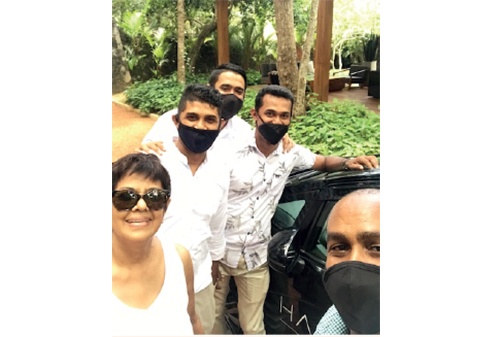
My first thought when I chose Haritha Villas and Spa to spend a weekend at was to experience sun, sea, sand and calm. However, while I was driven through paddy fields of Sri Lanka’s untouched natural landscapes, I was amazed at what I saw and was wondering where my final destination would be. Till suddenly, we approached these majestic gates which swung open spinning a breathtaking welcome as we drove in. There was the GM – Maxime Rachel, flanked by the Sales Director Fazal Zawahir and my Villa Master – Wasantha all of whom were hidden behind masks, but I could still feel their welcoming smiles and warmth! I knew then, I was in for a memorable experience!
Haritha Villas and Spa is a privately owned boutique hotel set in lush surroundings. For those who love the sea, the management has made arrangements with their compliments to take their guests to the Riff hotel – just three minutes away to the stunning beach of Narigama.
I was guided to my villa which boasted a stunning view of tall trees, paddy fields and many varieties of lush foliage springing up wherever I looked. We sat on the sofas, chatting over a cup of freshly brewed Sri Lankan tea, after which, the Villa Master or personal butler Wasantha assigned to me walked me through the amenities provided. Each villa features an in-room check-in and SPA services, a personal butler, a private garden and dining area, a plunge pool and your own terrace with sofas. Room amenities include a minibar with a wine fridge, Illy espresso machine and tea-making facilities, a Bose Bluetooth sound speaker, IPad and Ophir toiletries. All the villas offer stunning views of the surrounding jungles and paddy fields.
I was told the owner of this luxury resort is Mr. Kostadin Tolev from Bulgaria who spent almost four years creating the beautiful spaces the resort boasts. While, the father of this truly unique and extraordinary architecture is Gary Fell- a world famous and multi-award winning architect from Bali (http://gfabarchitects.com/)
It was evident that luxury and privacy are at the heart of the hotel’s design. Seven intimate one-bedroom contemporary villas, with rooftops covered in greenery, each with its own plunge pool are beautifully combined with two colonial mansions comprising two en-suite bedrooms and a common large swimming pool.
I opted to laze around under thick sun shades watching the sun go down instead of taking a dip in my own plunge pool. Listening to the sounds of the birds, I was quick to recognize many and happier still to see wild peacocks loitering along pathways like it was their own!
The six acre property has individual villas dotted around the terrain with two mansions where a large family could stay. Though every Villa has its own plunge pool, the mansions have their private lap pool, large dining spaces and more. Luxury beamed from all corners of each en-suite room, furnished with tailor-made high quality curtains, comfortable bed linen with herbal and organic toiletries placed in the bathrooms.
Executive Chef Gunasiri fondly known as Guna treated me to a world class dining experience despite me being vegetarian! He offered unique unscripted menus at the restaurant called The View interconnected to a lounge which could be converted to a meeting space as well. Adjacent to it, is a 20-meter long infinity swimming pool and a Pavilion named Sal-Sala. Chatting to him while he dished out an interesting rice and curry meal for lunch, and later during dinner which was a four course meal, he proudly told me about their “Farm to Table” philosophy – an ethos close to their heart.
As I walked around the property I noticed that in the rooftop of each villa, doing well were rich crops of lemongrass and leafy vegetables.
Meanwhile, I enjoyed Villa Master Wasantha’s assistance throughout my stay. He was a star! His simplicity and humbleness made him an outstanding team player and an absolute asset to the hotel. By dusk, having discreetly done a turndown service in the room, he multi-tasks taking on added responsibilities. He curates all the mocktails and cocktails for the guests at the bar with ingredients freshly picked from the herb garden, as he also is a qualified molecular mixologist which he mastered when he worked overseas!
After a simple but hearty late breakfast, and another stroll around the property, I headed home bidding farewell to the team who by then seemed like family to me!
In my opinion, Haritha Villas and Spa is the absolute and ultimate haven for a writer, or for someone like me to totally unwind and rejuvenate. All I can wish for them is for more guests to arrive in the near future to enjoy what they have on offer!
Haritha Villas and Spa is a fairly new and well-established property on the market in the area and considered as one of the most luxurious properties in the region. The endorsements and excellent reviews on Trip Advisor, Booking.com and Expedia says it all.

By Ifham Nizam
Australian High Commissioner to Sri Lanka Matthew Duckworth described Omega Traders’ latest investment in a modern dhal-processing facility as a strong example of how cross-border supply chains can translate into productive investment, local value addition and new business opportunities in Sri Lanka.
The investment, which adds a 150-metric-tonne-per-eight-hour-day processing capacity to Omega Traders’ operations, marks a significant expansion of the company’s manufacturing footprint as it celebrates 45 years in Sri Lanka’s food commodity industry.
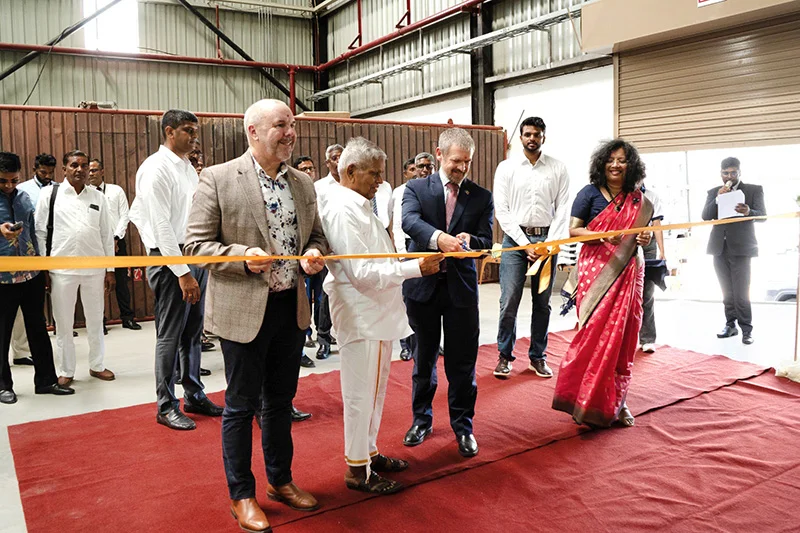
Speaking at the inauguration of the new Lentil and Orid Dhal Processing Factory in Wattala, last Friday, H.C. Duckworth said the facility represented more than an increase in production capacity, pointing to the wider economic value created when Australian agricultural production is connected with Sri Lankan processing and distribution.
‘This facility is not operating on its own. It is part of a long supply chain and a trade partnership between Sri Lanka and Australia, Duckworth said.
His comments placed the Omega Traders’ investment within a broader commercial context: Australia brings agricultural production and established export capabilities, while Sri Lanka provides processing capacity, labour, market access and opportunities for further value addition.
The investment comes as Sri Lanka continues to look towards greater domestic processing and value-added manufacturing rather than relying solely on the import and distribution of finished commodities.
Dr. (Mrs.) Siddhika G. Senaratne, Director General/CEO of the Sri Lanka Standards Institution (SLSI), who attended the inauguration as Guest of Honour, highlighted the importance of quality assurance in food processing and the role of standards in maintaining confidence across the supply chain.
The facility is equipped with new-generation cleaning, processing, sorting and quality-control machinery, including advanced colour-sorting technology, automated systems and an in-house quality-control laboratory.
The additional capacity will support Omega Traders’ three principal Mysoor Dhal brands — Rainbow Jumbo Dhal, Komas Dhal and Rozanna Dhal — which serve different segments of the Sri Lankan market.
But the investment also has a distinctly local agricultural dimension.
Through its Orid Dhal operation, Omega Traders plans to source locally grown black matpe from Sri Lankan farmers and process it at the new facility.
That creates a domestic value chain linking farmers to industrial processing and consumers, while potentially increasing demand for locally produced agricultural commodities.
Duckworth said this type of business partnership could generate benefits for both countries.
‘Australia produces some of the world’s best agricultural products and we are very efficient and very capable at trading them. But that alone is not going to bring success to Australia. Just as building a factory like this is not going to bring success to Sri Lanka, he said.
‘It’s when we bring these entities together that our products produced in Australia can be processed in excellence here in Sri Lanka that enables this to be a success, the H.C. explained.
The investment therefore combines two complementary supply streams: imported agricultural commodities, including Australian-origin products, and locally produced black matpe for the Orid Dhal operation.
For Sri Lanka, the business significance extends beyond Omega Traders itself. Increased processing capacity creates demand for logistics, packaging, distribution, services and agricultural inputs, while supporting employment within the food-processing ecosystem.
HR-led transformation places people, culture and business performance at the heart of the organisation
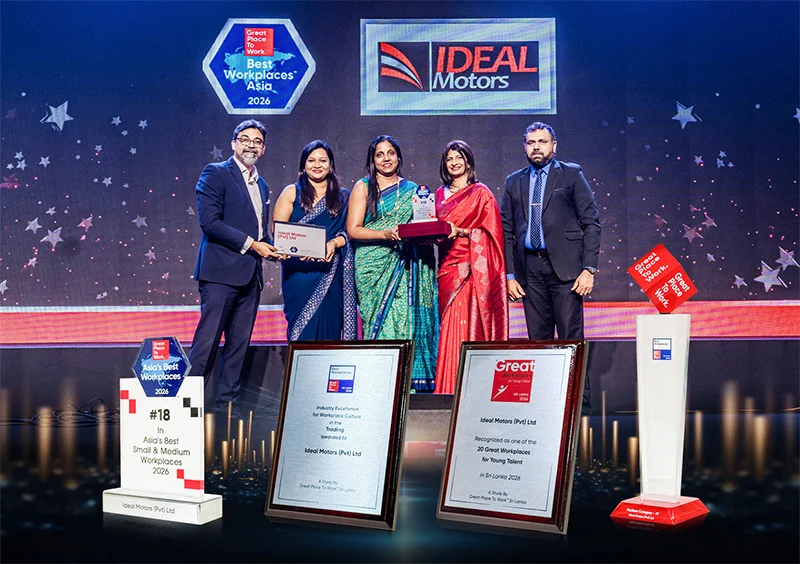
Ideal Motors (Pvt) Ltd,has achieved a significant milestone by securing multiple prestigious workplace and organisational culture accolades in 2026, reinforcing its position as an employer of choice in Sri Lanka’s automotive sector.
Among its latest achievements, Ideal Motors has been recognised as one of the 20 Great Workplaces for Young Talent in Sri Lanka 2026, ranked No. 1 and awarded the Gold Medal in the Small and Medium category of Best Workplaces™ in Sri Lanka 2026, and ranked No. 18 among Best Workplaces™ in Asia in the Medium Scale category—the highest-ranked Sri Lankan organisation in the category. The company also received Industry Excellence for Workplace Culture – Trading Industry.
The Young Talent recognition was presented at the Great Place To Work® CXO Forum 2026 held on 10 September 2026 at Cinnamon Life, Colombo. The recognition followed an evaluation of more than 100 certified organisations and highlights workplaces that create meaningful opportunities for employees under 35 to develop, contribute and grow.
At the Best Workplaces™ in Sri Lanka Awards Gala 2026, held on 11 September 2026 at Cinnamon Life, Colombo, Ideal Motors achieved another historic milestone by entering the Best Workplaces Sri Lanka list for the first time and securing the No. 1 Gold Medal in the Small and Medium category. The company also achieved No. 18 in Best Workplaces™ in Asia, reflecting the strength of its workplace culture beyond Sri Lanka.
These achievements represent more than a collection of awards. They reflect the transformation taking place within Ideal Motors, where people, culture and business performance are increasingly viewed as interconnected drivers of sustainable growth.
Over the past few years, the organisation’s HR function has evolved from a predominantly administrative role into a strategic business partner, with greater emphasis on employee experience, capability development, engagement, performance, communication, wellbeing, diversity and inclusion, and data-driven HR practices.
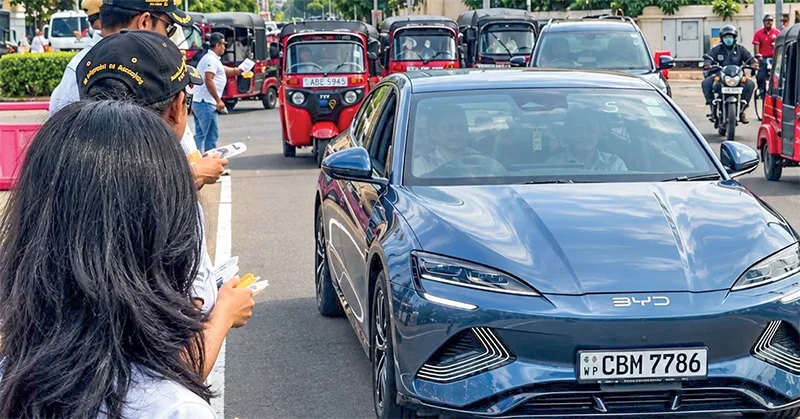
The Automobile Association of Ceylon (AAC) conducted a seat belt safety awareness programme in front of its headquarters and along Galle Face Centre Road, encouraging motorists and passengers to make seat belt use a habit on every journey.
AAC staff, working alongside officers of the Sri Lanka Police Traffic Division, distributed specially designed hanging tags and stickers to drivers. The material carries a clear reminder that seat belts protect drivers as well as passengers in both the front and rear seats.
The public awareness drive was held ahead of the requirement taking effect on 20 September 2026, under which seat belt use becomes mandatory for every occupant of a vehicle travelling on an expressway.
AAC emphasized that the regulation should be understood as a life-saving measure rather than only a legal obligation. Wearing a seat belt can help prevent occupants from being thrown inside or from a vehicle during a collision and can lessen the severity of injuries.
The Association said road safety legislation must be supported by sustained public education, visible enforcement and responsible behaviour by all road users. The participation of the Traffic Police helped the campaign reach motorists directly in a busy part of central Colombo.

Showers about 100mm will occur in the Western, Sabaragamuwa, Central and North-western provinces and in Galle and Matara Districts

Govt. confident of 2/3 majority despite NPP split speculation

Justice Corea appointed Acting President of the Court of Appeal

Protest against setting up of cement factory in highly populated area near BIA

India funding 13 new bridges, Moragahakanda structure receiving priority

Cross-border supply chains seen as key to new business opportunities

‘Dates have the highest sugar content to fight Coronavirus’

Sunday Island 27 December – Headlines

#SundayIsland 17th December – Headlines

Sunday Island – 28th March

Sunday Island Headlines – 21 March

Sunday Island – 21st February – Headlines
-

 News5 days ago
US embassy won’t comment on IGP’s probe into joint drug raid
-

 News3 days ago
Shanakiyan urges urgent action over reported death sentence for Lankan in Saudi Arabia
-

 News4 days ago
Bid for Basil’s extradition nears final stage: Police
-

 Business5 days ago
All-new Bolero MaXX unveiled in Sri Lanka
-

 News2 days ago
Namal Rajapaksa Buddhist gambit fails, bail denied
-

 Opinion5 days ago
A journalist who wrote across the divide
-

 Editorial6 days ago
More fuel price shocks shrouded in secrecy
-
 Sports6 days ago
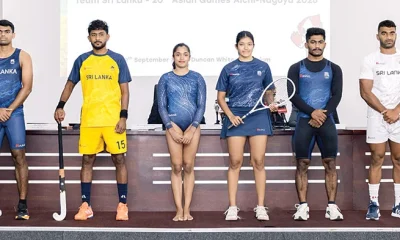
MAS Holdings, official clothing sponsor of Sri Lanka team at Aichi–Nagoya 2026 Asian Games