
Features
Traveling in Russia for UNESCO and more of life in Paris


(Excerpted from volume ii of the Sarath Amunugama autobiography)
In the final years of the gerontocracy that ruled the Communist Party and the USSR we received the green light to have the annual general meeting of the Internatioal Programme for the Development of Communications (IPDC) in the Soviet Union. This was a special plus for the IPDC because till now its main backers were the Third World countries and the Nordic group. The Soviet delegation which included the general manager of Tass News Agency as well as Zassousky of Moscow University and several top brass from the Foreign Ministry managed to convince the old men in the Kremlin that it was in their interest to ally with the many Third World countries associated with UNESCO and IPDC.
As if to reinforce their Third world connections it was suggested that the meeting be held in Tashkent – the capital of Socialist Uzbekistan. The USSR had already built up Tashkent as their window to Asia. For instance, the Tashkent Film Festival was well known in Asia and Africa. The city had the infrastructure to mount a global conference. Preparatory work for the meeting was assigned to me and my office. My counterpart was Sasha, an official in the USSR Embassy in Paris, who was charged with UNESCO relations.
We struck up an instant friendship as we had to travel many times to Moscow together to finalize arrangements for the meeting. Since it was a high level UN conference M’Bow himself would attend it. Having received a battering from the western press the DG looked forward to the choreographed welcome he was bound to receive in the USSR. This was a difficult time for him since the spat with the USA had led to him being demonized in the Western media.
He discovered too late that it was not possible to win over the western media if you take on the Jewish lobby. Once the press begins to demonize you, it becomes difficult even for political leaders to help you. M’Bow was beginning to go down the slippery slope and he found that the popularity of the IPDC among all political camps gave him a chance to mend fences. But the Reagan administration did not approve of him on the Israeli issue.
The US left UNESCO, which created a gaping hole in our budget. Japan came to the rescue by increasing its contribution. But there was a price tag to the rescue act. It began to suggest changes at the top and very soon M’Bow was replaced by a Japanese Secretary General.
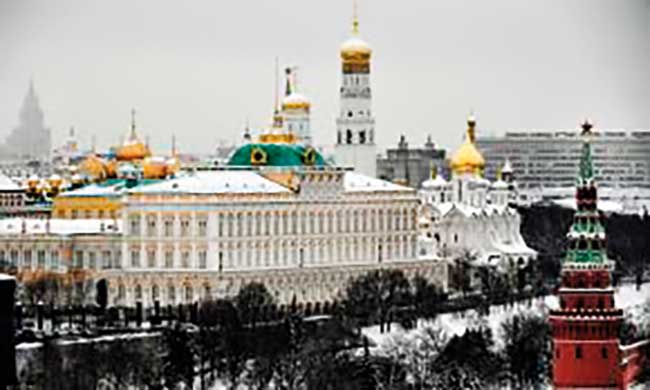
Kremlin
While preparations for the Tashkent meeting brought me to Moscow many times, I also had to negotiate some tricky points with the Communist Party bureaucrats. One such issue was regarding visas. Any UN meeting presupposes the issuing of visas to all participants recommended by it. The host country cannot impose any conditions regarding the travel and security of the participants once they are within its borders.
All arrangements for board and lodging of participants must be approved by us. All this had to be handled sensitively as the US had added several anti-Communist hardliners to their observer delegation perhaps hoping to sow confusion. In all probability these delegates would not have been issued visas if they had applied directly to Moscow. Among these hardliners or ‘cold war warriors’ was Alan Weinstein, a University Professor who had published a lengthy volume presenting evidence to prove his thesis that the killing of John F Kennedy was the act of a ‘lone assassin’ and was not a conspiracy.
Weinstein was considered to be a USSR watcher for Reagan. He was joined in the journey to Tashkent by an alcoholic Californian journalist Nossiter who was a favourite of the US President. It looked very much as though the US delegation was expecting some mishap which could be highlighted at home in their ongoing effort to vilify the United Nations. So we had to be extra careful in our preliminary arrangements.
While in Moscow I took time off for sightseeing. The city was full of old dynastic buildings. The multi-coloured churches with their onion like domes were an architectural wonder. The massive Red Square in the Kremlin with a lit up lone red star looking down from the highest building was an inspiring sight to me, who as an undergraduate at Peradeniya, had pored over books written about the historic Red revolution of the Bolsheviks led by Lenin.
To my pleasant surprise my guide to the historic sites of the city was Ordzhonikidze – the great grandson of a fellow Georgian revolutionary and comrade of Stalin. The original Sergo Ordzhonikidze was one of the heroes of the revolution. He was rare among the early leaders to die unscathed by the terror launched by Stalin. Stalin named one of his battle ships after him. However the latest research has thrown doubt about the manner of his death.
My guide was a young man well versed in the history of the revolution. He took me to the Museum of the Revolution which narrates the history of that epochal event. Communists have no hesitation in rewriting history to fit their current preoccupations. For example in all the old photos of revolutionary leaders, Trotsky had been air brushed out. Since I was familiar with the original photos from Isaac Deutscher’s books I asked my guide about it.
His answer shocked me. He told me that he had not even heard of such a name. He added that none in his generation knew of Trotsky. We then visited the Lenin Mausoleum to view Lenin’s embalmed body which a writer has described as a ‘communist relic’. By this time Khrushchev had ensured that Stalin’s sarcophagus which had lain side by side with Lenin’s was removed from the viewing hall. The Russians are obsessed with sarcophagi.
In the basements of the old churches with onion domes – of the Russian Orthodox Church – in ancient boxes lie the remains of church leaders of the past years. The communists have buried the remains of ancient kings but have left the churchmen alone in the crypts. I remembered that Moscow is only a part of the story. The revolution took place in St Petersburg with its Winter Palace.
Much later, on an official visit there with President Mahinda Rajapaksa I was able to imagine the drama at the beginning of the Russian Revolution. The ship ‘Aurora’ which figures largely in history because the sailors mutinied and threatened to bombard Petersburg in support of the revolutionaries was, we saw, moored in Petersburg harbour. But Moscow became the new capital. Ordinokidze and I motored to the outskirts of Moscow to see last ditch defences Stalin had set up to prevent Hitler’s tanks rolling down to take the beleaguered capital which housed Stalin and the Central Committees.
Soviet Tanks and soldiers had made a heroic stand there and driven back the Nazis. After the guided tour we lunched at Moscow’s famous five star restaurant `Matryoshka’ on Katuzovsky Avenue, which was a popular meeting place of the Moscow elite. I went back to my Hotel Moskva and got ready for the highlight of my tour, the visit to the Bolshoi Theatre to see ‘Swan Lake’ danced by the world famous Bolshoi Ballet. I had seen ‘Swan Lake’ in Paris, Berlin [called ‘Schwansee’ in German] and London but the Bolshoi version was the most breathtaking, both for the dancing and Tchaikovsky’s music.
After this encounter I was ready to fly back to Paris. My friend Sasha of the Paris embassy then introduced me to a touching traditional Russian gesture. He brought a home cooked loaf of bread wrapped in a bandana. His wife, who was a teacher of English in a University, had baked the bread. In the past in Russia when a family member or friend undertook a long journey his loved ones would cook him a loaf of bread, wrap it and hand it over so that he would not go hungry. I too was given that touching honour and was greatly moved.
Promising to come back, I took the Air France flight back to Paris and home after a wonderful experience in Soviet Russia. By a coincidence seated next to me on the flight was Bala Tampoe who was one of my heroes from University days. We talked and on the following day I took him out to lunch in a posh hotel close to the ‘Le Monde’ office where Bala had an interview with a French journalist.
Tashkent
The Tashkent meeting was quite a victory for the newly formed IPDC. The international situation was moving towards dialogue and nations were looking for signals, however small they may appear at first, of a thaw in the Cold War. The USSR was in a state of paralysis after a period of rule by geriatric leaders. Gorbachev was in the wings and soon ‘Perestroika’ and ‘Glasnost’ was to emerge to shake up the Communist world.
As mentioned earlier Ronald Reagan sent a delegation of right wing hardliners to Tashkent. They were carefully handled by the State Department officials who came along with them from Washington. They came expecting a frosty reception but the USSR and our staff made sure that they felt comfortable as they were invited to many meals, and especially drinking sessions, in the best Tashkent restaurants. According to American Foreign service officers, their report to Reagan was conciliatory.
Sensing the value of this meeting M’Bow himself attended the conference. He was treated with great respect by the USSR authorities, which was a contrast to the way in which he had been treated by a visiting US under-secretary. At the meeting, defying expectations of a boycott, western delegates who provided most of the funds, were happy that IPDC was short on rhetoric but had successfully collected funds and launched many projects to improve communications facilities in the poorer nations.
The USSR also by selecting Tashkent had signaled that they were on the side of the developing nations. Tashkent was their gateway to Asia and the “third world” countries. They had invested heavily in providing hotels and conference centres in the city. Though we were put up in the best hotel we got a shock when an earthquake hit Tashkent and we had to run out to the open in the night till the tremors subsided. It was a comic sight to see the distinguished delegates congregating on the lawn in their night clothes. Later we were assured that such tremors were not exceptional and the hotel was built to be earthquake proof I doubt whether our seasoned diplomats bought that story in its entirety.
Samarkand
After the grand finale of the meeting USSR authorities had arranged an excursion to Samarkand for the participants. Samarkand has been described by a poet as “a rose red city half as old as time”. It had been the cradle of the Mughal, which later became a famous centre of Islamic learning. We saw one of the oldest Universities of the world with its warren like rooms for the young scholars who then traversed Asia and the Middle East propagating the Islamic faith.
They were also the early scientists and astronomers who advanced learning in mathematics and tracking of changes in the sky and stars. The world’s oldest telescope to observe the skies was located in Samarkand. The Tashkent meeting brought me even closer to the Asian delegates to UNESCO and IPDC. Among them was G. Parthasarathy, the head of the Indian delegation. GP was close to the Nehru family having been the PMs roving ambassador. He was India’s Ambassador to Vietnam at a crucial time when Nehru was called upon to be a mediator in the growing political crisis in that country. We became close friends with consequences that I will describe later in this chapter.
The UNESCO top brass was pleased with our management of the conference. M’Bow held a reception for the staff and thanked them. When the inevitable cuts foIlowing the US withdrawal came, IPDC was not touched. We were encouraged to keep up our ties with the State Department Officials in Paris who were themselves unhappy about the withdrawal but could do nothing about it. They assured us that eventually the US will return and that is what really happened later. In the meanwhile, USAID with whom we had excellent relations continued several of our projects bilaterally with those countries concerned.
Rue Jean Daudin
As stated earlier with the arrival of my family in Paris I moved to a spacious flat in Rue Jean Daudin which was close to UNESCO headquarters and my office in Rue Miollis. This was a posh quartier in Paris being close to the Eiffel Tower, Trocadero, the Ecole Militaire and Champ de Mars – the most famous park in Paris. The shift of residence from a ‘Red’ working class district to the heart of upper class Paris gave me an opportunity of experiencing different historical cultures of that ancient city.
The topography of Paris is highly segmented on the basis of social class. As a jogger in my new locality I could run past the military school which had produced a Napoleon as well as all the military leaders of World wars including De Gaulle. In fact paratroop commanders led by Generals Salan and Massu, who opposed De Gaulle’s change of policy on Algeria, attempted to assassinate him in front of the Ecole Militaire. This real event forms the backdrop of the famous thriller ‘Day of the Jackal’ which became a bestseller.
I ran past the Invalides – a hospital for war veterans established by Napoleon, which is now a war museum. From there I would reach the Champs de Mars and the Tour Eiffel. Then I would go past the Trocadero, down the steps near the Musee de Homme and back to my home in Rue Jean Daudin. It was a daily chore which not many people would have had the privilege of enjoying. But it was also saddening because my route was dotted with plaques commemorating the resistance fighters who had been put against the wall in those locations and summarily executed by the Gestapo during the Nazi occupation. From time to time old ladies – relatives, girlfriends and surviving comrades-would hobble up to those monuments to lay a bunch of flowers as remembrance of those sad times past.
I then got down to the task of finding schools for my two daughters who were delighted to be in Paris at the best time of their young lives. Ramanika who was 18 enrolled in the American University of Paris while Varuni who was 15 joined the British school of Paris which was located out of the city in idyllic surroundings. The British school bus was parked at the Trocadero and the students, who were mostly from the posh quartiers, had to come there by car or metro.
Varuni would take the Segur Metro to Trocadero first with her mother but soon on her own, and catch the school bus to the suburbs with her mischievous schoolmates who were mostly drawn from UNESCO and embassy families. Occasionally my wife and I visited the school to inquire about Varuni’s progress. We were accompanied by Navaz as an interpreter and two other Sri Lankans. The school management would have been horrified to see a delegation of Asians descending on their school, all intent on following the early baby steps in education of their new entrant Varuni Amunugama.
But both children adapted themselves well and would merge easily with their new friends who were up to their usual pranks in class and on school tours to England, Ireland and parts of Europe. They were both on great demand as ‘baby sitters’ to small children of the super-rich like Bank Directors, Ambassadors and Supermodels who paid them handsomely. With the money so collected the two girls traveled through Europe by train on their own.
In Geneva they were looked after by Jayantha and Maureen Dhanapala. In Rome they stayed with Mahinda Ranaweera and his wife who were UNESCO functionaries there. In Germany they were guests of my wife’s cousin who was married to an embassy official in Bad Godesberg. They were popular ‘baby sitters’ because they spent part of their allowance buying chocolates for their wards.
We also had many Sri Lankan friends staying with us. Namel and Malini Weeramuni, our friends from way back, toured France with some companions in a caravan and I arranged a flat nearby for them to stay while visiting Paris. Lester and Sumitra Peries were regular visitors to Paris. Earlier their good friend Vernon Mendis, who was our Ambassador, had entertained them. They also had friends in the French film industry, some of whom were associated with the Cannes Film Festival.
Sumitra’s film `Loku Duwa’ produced and acted by Geetha Kumarasinghe was selected under a special section in Cannes called ‘Un Certain Regard’ which was a considerable achievement for both Sumitra and Geetha. A lot of work went into making a shorter version of the Sinhala film, subtitling, striking extra prints and launching of a publicity drive in the French media. All this was done and `Loku Duwa’ was screened to an enthusiastic audience.
On another occasion Sumitra visited Paris and stayed with us when one of her films was presented at the Nantes Film Festival. Richard Ross and his wife Jane who were our close friends when they were in Colombo as attaches to the US Embassy, were in Paris serving in the US embassy. They were living on a houseboat moored on the river Seine. Dick and Jane invited us for dinner on their boat. It was a fun party with plenty of drinks and as the music increased in tempo, we were scared that an inebriated guest would jump into the river.










by Rajan Philips
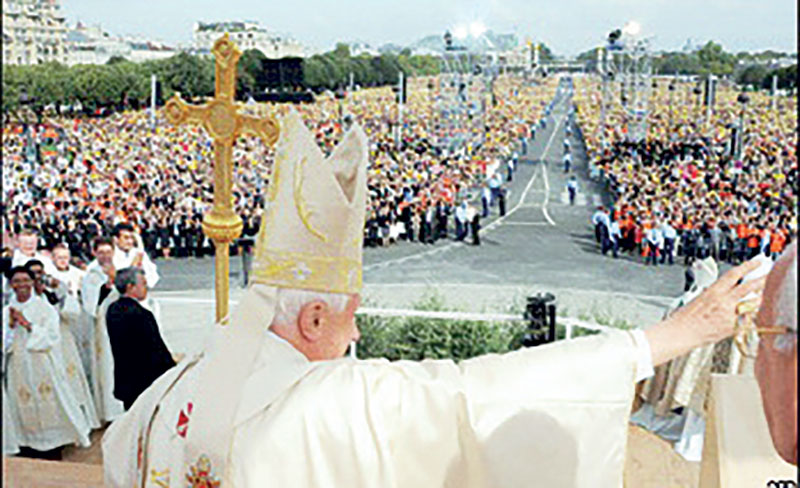
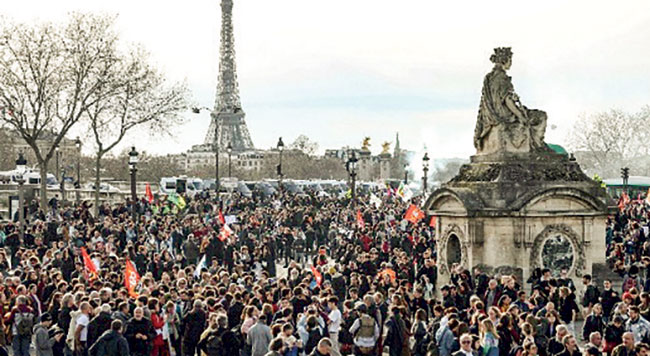
Paris has exploded in protests barely two weeks after peacefully assembling nearly a million people on its streets to welcome and salute Pope Leo XIV on his first visit to France. The good Pope himself has since been diagnosed with lung cancer and is convalescing after surgery in the Vatican. The protest triggers in France are youth frustrations over the state of the country’s education system and the broken conditions of its schools. The scale and mode of the current protests have brought back memories of the great French student protests in May 1968. The two are not the same and even though they may be comparable in appearance, the circumstances between then and now are vastly different and so will be the consequences.
It is not only in Paris, but the protests are also everywhere else in France. As well as in other cities in other countries in Europe and extending beyond. The protest triggers vary from country to country, but the arc of the protests from Paris to Delhi has a common strand: youth frustrations. Everywhere, it is the youth that is on the march – for better education in France, Belgium, Greece, Germany, Ireland, Albania and Austria; housing access and affordability in Spain; and opposition to official tampering with electoral voter lists in India. The young are restless about their future. “No future, no calm” is the chant in Paris.
France’s union of students, Union Syndicale Lycéenne (USL) had outlined four basic grievances before the protests began: “lack of teachers and staff, “dilapidated lycées,” overloaded timetables and classes, and the stress caused by Parcoursup” (a government web portal used for university admissions). The French government’s initial lukewarm response provoked the protests and when the government took a ham fisted approach, things went out of control. It has been the same story in other countries.
In India, the Modi government unleashed the police forces on students and others protesting the manipulation of the voter lists by the Chief Election Commissioner, Gyanesh Kumar, and calls for his resignation have become the rallying cry of the protests. The protests are no longer limited to the “Cockroach” youth movement or the Cockroach Janata Party (CJP), and more mainstream opposition parties are all in the fray.
Defending the Constitution has become the new motif for Rahul Gandhi and the Congress Party. The Cockroach movement that first tasted political blood in June this year, by forcing the resignation of the Union Education Minister Dharmendra Pradhan over national exam leaks, is looking for a second scalp. The government is not in any immediate danger, but Prime Minister Narendra Modi is rapidly losing his political varnish and these protests may mark the beginning of his retirement.
In Spain, Socialist Prime Minister Pedro Sanchez has called a snap election on the housing question, hoping to steal a march on the conservative Popular Party that has been leading in the opinion polls. Mr. Sanchez has been in power since 2018 and, despite the fluctuations in domestic approval rating, has gained international prominence following his clashes with Trump and Isreal over Gaza and the Iran war.
The beleaguered French President Emmanual Macron has six months left in office, and the next presidential election will be held in either April or May next year. In the cabinet meeting after three weeks of protests, President Macron reportedly acknowledged “that young people have legitimate concerns, but said these are being exploited for political purposes and turned into urban violence.”
The two main contenders to replace Macron are Jean-Luc Mélenchon who leads the far-left France Unbowed (LFI) Party, and Marine Le Pen leading the far-right National Rally (RN Party. Mélenchon is supportive of the protests, has condemned police brutality, and has participated in the Paris demonstrations. Le Pen, on the other hand, who is also the front runner in opinion polls, has blamed the students and supports police deployment against them.
There is also speculation that former President François Hollande (2012-2017) may stage a comeback as a more normal alternative to the two extreme contenders. Although he was deeply unpopular when he left office foregoing a second run, Mr. Hollande is considered to have been mostly mocked (as Rain Man) but not at all hated. His moderate positions and his socialist roots may attract a portion of the French electorate that is tired of “Jupiter” Macron and is weary of the diametrically opposite prospects.
-
- To Paris Turbulent
1968 Throwback
Whichever way, an orderly transition through France’s “rentrée politique” is in the offing, and the protesters are not clamouring to overthrow anything. That is a far cry from what transpired in 1968, when student protests ultimately led to the ouster of Charles de Gaulle. And there was more. Amidst convulsions in the US over Civil Rights legislation and the prosecution of the Vietnam War, Martin Luther King and Robert Kennedy were assassinated, President Johnson declared that he will not be a candidate in the 1968 presidential election, and Richard Nixon was elected as President eight years after his defeat by John Kennedy.
Besides the protests in France, there were protests in the then Communist countries and Yugoslavia, the Prague Spring in Czechoslovakia, the start of the troubles in Northern Ireland, and uprisings against military juntas in Latin America. Africa was becoming more and more independent and there were strong prospects of secular nationalism in the Middle East. The year 1968 also marked the start of many social movements including feminism, and the environmental and anti-war movements. Socialists were a force to reckon with in France and Italy, both politically and electorally. New Left politics was emerging as a counter to both unbridled capitalism and Soviet orthodoxy. The Club of Rome was born in 1968.
“L’imagination au pouvoir” (Power to the imagination) became the battle cry in Paris in May 1968. The protests were infused with optimism for a new social order supervening the postwar material progress. There were powerful cultural and literary overtones that have proved to be more durable than the political projects that inspired them. Television became the main political medium, if not also the message. Although the state power and structures survived, other structures were broken and the intellectual and cultural legacies of 1968 have continued.
It is a different ball of wax in 2026. The protesting students are not looking for any brave new world, but for decent furniture, clean toilets and back to basics teaching and immediate remedies to problems that should not be there in the first place. In Spain, the younger generation is looking for housing at affordable rents. European demographics are also not helpful. The ageing population has its own needs and demands while the youth are increasingly drawn from the immigrant and the working class sections of society. High youth unemployment, zero growth, and government debt have become recipe for stagnation and not resolution. In theory, it is called “gerontonomia,” a form of “democratically sustained economic stagnation.”
In politics, the radicals and populists were dominantly on the right unlike in 1968 when the political left held sway even if it was not in power. Donald Trump, who vulgarly led the rise of the ugly right, may be on his way out, but it is a different story elsewhere. The right has returned to power practically in every South American country. Brazil is almost equally divided between its socialist President Lula de Silva and his presidential challenger Flavio Bolsonaro, the Senator son of Jair Bolsonaro who is in prison for fomenting insurrection to upend the 2022 presidential election.
In 1968, China was at the peak of its Cultural Revolution. It is a different China now. Indonesia was beginning its post-Soekarno era, just as India was adapting to life without Nehru, albeit in vastly different ways. Field Marshal Ayub Khan was overthrown in Pakistan – then with its two wings, east and west, separated by a thousand miles of Indian territory. Within three years, Bangladesh would break free quite violently, redrawing forever the colonial map of the subcontinent. Bangladesh had another uprising in 2024 and the new government is struggling to keep the many promises it made in the elections that followed the overthrow of Sheikh Hasina after 15 years in power. Imran Khan decidedly eschewed Sri Lanka’s ‘aragalaya’ example to protest his ouster in Pakistan, but the army has locked him up and seems to be in no mood to release him. Now there are protests in Pakistan for his release before it is too late for everyone’s good.
It was all relatively quiet in Sri Lanka in 1968, but it would not be for long. The 1970s and every other decade since have seen political turmoils of one kind or another. 1968 / 1969 were also the years when Sri Lanka’s parliament began considering a response to the 1964 Privy Council ruling (in Bribery Commissioner v. Ranasinghe) and its implications for the ‘unalterably entrenched’ clauses of the Soulbury Constitution.
Dr. Colvin R de Silva, then an opposition LSSP MP, took over the debate and convinced everybody that the path to reforming the constitution was not through amending the Soulbury Constitution, but bypassing it and creating a new constitution and a new republic. Dr de Silva accomplished both but not without creating unintended consequences. Tamil separatism was one, and transforming Sri Lanka into a presidential polity was another. The former has come and gone, while the latter is still in force in spite of many promises and mandates to revert the country to its earlier parliamentary system.
President Dissanayake and the NPP government are the latest in a long line of promisers. The country is waiting for the final fulfillment of the promise and not its betrayal. The government can claim some credit for the current quiet in the country, but it would be a fool’s paradise to assume that peace and power are permanent.
By Milinda Moragoda
The latest proceedings before the Supreme Court of India offer an opportunity to move the Katchatheevu island debate beyond the familiar question of sovereignty. While hearing petitions challenging the 1974 and 1976 India-Sri Lanka maritime agreements, the court urged the central and Tamil Nadu governments to sensitise fishermen about the consequences of crossing the international maritime boundary and entering Sri Lankan waters. The Indian government, meanwhile, has made clear that it does not intend to reopen the agreements and is pursuing concerns relating to Indian fishermen through diplomatic channels.
More significantly, the Attorney General pointed to the depletion of fish stocks in Indian waters as one reason fishermen venture into Sri Lankan waters. The court also raised questions about fishing practices and the condition of Indian coastal waters during the hearing.
These observations point towards a more fundamental question: is the continuing focus on Katchatheevu distracting both India and Sri Lanka from the real crisis—the depletion of the Palk Bay’s marine resources and the persistence of destructive fishing practices?
A problem larger than an island
Over 50 years ago, Sri Lanka and India signed two maritime boundary agreements—one in 1974 and the other in 1976—defining the International Maritime Boundary Line and establishing the respective maritime jurisdictions of the two countries, including Sri Lanka’s sovereignty over Katchatheevu. The agreements did not grant Indian fishermen traditional fishing rights in Sri Lankan waters, nor did they provide reciprocal rights to Sri Lankan fishermen in Indian waters.
The constitutional and legal challenges to those agreements remain before the Indian Supreme Court. The court has not adjudicated their constitutional validity, and the matter remains pending. At the bilateral level, however, successive governments have treated the maritime boundary established by the agreements as the basis for managing relations between the two countries.
The concerns of Tamil Nadu’s fishing communities are genuine. Indian fishermen and their families face economic hardship when boats are detained and fishermen are arrested after crossing the maritime boundary. Tamil Nadu Chief Minister C Joseph Vijay has recently urged the Indian government to intervene to secure the release of detained fishermen and seized boats and called for renewed dialogue.
But these immediate concerns point towards a larger question: why are fish stocks being depleted, and what can be done to restore them?
The problem cannot be addressed simply through repeated diplomatic representations, arrests, releases and demands for the return of fishing boats. Nor can it be resolved by continually reopening the political debate over Katchatheevu.
The Palk Bay is a shared ecological system whose resources are finite. Its health ultimately determines whether fishing communities, on either side of the maritime boundary, can continue to make a living from it.
The ecological toll
Bottom trawling is at the heart of the problem. Dragging heavy nets across the seabed destroys marine habitats, captures juvenile fish and generates substantial bycatch. Its effects are cumulative and potentially long-lasting.
The issue is, therefore, not simply whether fishermen cross an international maritime boundary. It is also the impact on the marine ecosystem of continued large-scale, destructive fishing.
Sri Lanka’s Northern Province, once home to a thriving fishing industry, has experienced a sharp decline in fish catches, from 35,000 metric tonnes in 1995 to 17,000 metric tonnes in 2023. Multiple factors have contributed to this decline, including the legacy of decades of conflict and displacement. But pressure from large-scale trawling in the Palk Bay has added to the difficulties faced by northern fishing communities.
For fishermen on both sides, the long-term interest should, therefore, be the same: preserving the marine resource on which their livelihoods depend.
A consistent but passive response
Sri Lanka has maintained a consistent and restrained position on Katchatheevu for five decades, working within established legal and diplomatic frameworks. The island has also remained a symbol of the longstanding links between the two countries, particularly through St Anthony’s Church and the annual pilgrimage attended by devotees from both sides.
But Sri Lanka has done little to give Katchatheevu a constructive contemporary role. That should change.
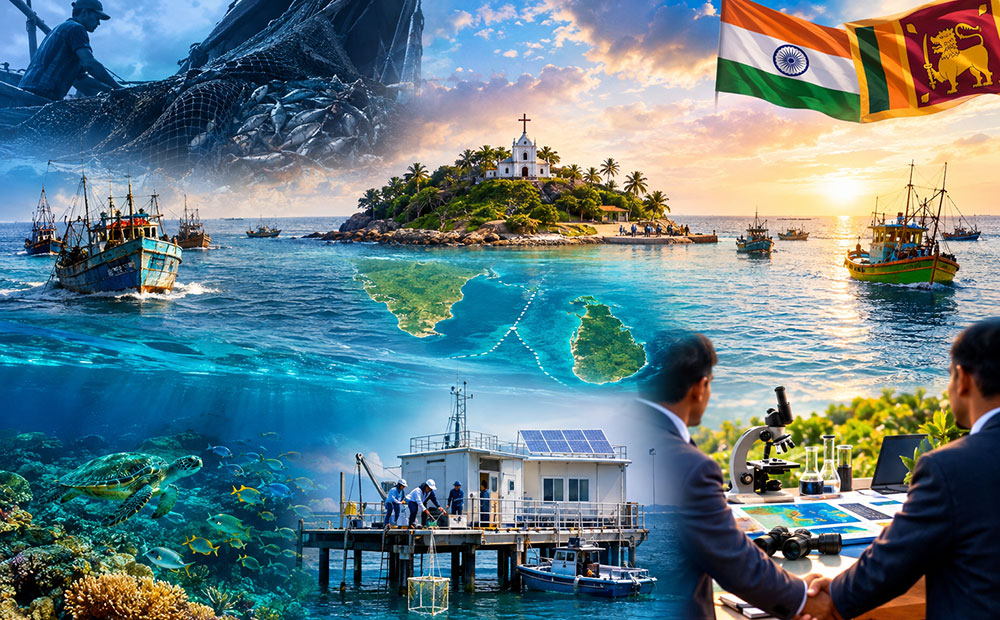
Years ago, the Pathfinder Foundation proposed the establishment of a marine research station on Katchatheevu, led by the Department of Fisheries, the National Aquatic Resources Agency (NARA), and Sri Lankan universities.
The proposal deserves renewed consideration.
Turning Katchatheevu into a platform for science.
A marine research station would give Sri Lanka a practical means of exercising responsible stewardship while contributing to the preservation of the wider Palk Bay ecosystem.
It could monitor marine biodiversity and ecological degradation, assess the long-term impact of bottom trawling, track migratory patterns and spawning cycles, and provide scientific data for fisheries policy. It could also serve as a platform for marine diplomacy and dialogue between India and Sri Lanka.
India already possesses substantial marine research capabilities. Sri Lanka should develop a complementary capability on its side of the maritime boundary.
Advances in solar power, desalination and modular construction have also reduced the logistical obstacles that might once have made such a facility difficult to establish. A low-impact, high-value research station is now a feasible proposition.
From dispute to cooperation
The current debate offers an opportunity to change the nature of the conversation.
Tamil Nadu’s concern for its fishermen is legitimate. Sri Lanka’s concern about illegal fishing and the degradation of its marine resources is equally legitimate. Treating one concern as valid and the other as an obstacle will not produce a durable solution.
Nor will repeatedly returning to the sovereignty question.
Instead, India and Sri Lanka should focus on the management of the Palk Bay as a shared ecological system. Joint scientific monitoring, conservation programmes and discussions on regulated and sustainable fishing could provide the basis for practical arrangements that protect livelihoods while phasing out destructive practices, such as bottom trawling.
Such cooperation would not require either country to compromise its sovereignty or its legal position.
It would require both to recognise that marine ecosystems do not respect political boundaries.
Science over sentiment
The Katchatheevu debate has continued for decades. The immediate concerns of detained fishermen and fishing communities must be addressed through established diplomatic and legal channels. But those measures cannot substitute for a long-term solution.
The real challenge is not simply who possesses Katchatheevu. It is whether the waters surrounding the island will continue to support the communities that depend on them.
For Sri Lanka, the answer should be neither rhetorical confrontation nor passive diplomacy. It should be science, responsible stewardship and constructive regional cooperation.
Katchatheevu need not remain a symbol of contention. Properly used, it could become a platform for marine research, environmental stewardship and sustainable cooperation between India and Sri Lanka.
(Milinda Moragoda is a founder of the Pathfinder Foundation, a strategic affairs think tank. tweets @MilindaMoragoda. email@milinda.org, courtesy of The Print)

(Excerpted from “Madam-Sir,” by Manel Abeysekera career and dilemmas of Ceylon’s first woman diplomat)
After the training in London I was assigned to our Embassy in Rome as Attache as I was still a probationer in the sense we needed to pass the First Efficiency Bar Examination plus acquire proficiency in the assigned foreign language within a period of three years before being designated Third Secretary. The Italians simply could not understand the meaning of “probationer” in my passport [which I do not think should have been in our passports] and always looked askance at me thinking I was out of jail on probation!
My Ambassador, Sir Arthur Ranasinha, much to my embarrassment [probably to his too], was my brother Lakshman’s father-in-law whom I used to address at home as “Uncle” and now had to address as “Excellency” in public. To my surprise, I made the transition quite easily and never made a faux pas. Sir Arthur and Lady Ranasinha insisted that I stay with them rather than at a hotel till I found an apartment. It was extremely kind of them, but I insisted, after the first few days, that I not travel with him in the official car but find my own way to the Embassy as I did not want the staff to think that I was being favoured by the Ambassador which would have been bad for both of us.
Little did I know that I would have only 10 months in Rome. I was grateful to Methodist College for my knowledge of Latin and Roman history as I wandered around the city having a closer look at places and monuments, some of which I had already seen on our family tour of Europe in 1950 ten years before. Once again I was able to treat myself to Grand Opera both in the magnificent Opera House as well as in the spectacular Baths of Caracalla. Art and architecture of such munificence was there for me to savour.
I think Rome is one of the most beautiful cities in the world and unique in the way that the old and the new blend naturally. Italy is the place to boost any woman’s ego especially if she were a foreigner because of the fun loving, romantic and gallant Italians to whom the chase was the thing rather than the capture! They seem to be able to spot a foreigner a mile off as happened to my English friend and flat mate from New Hall, Mary Anne Pritchard whom I had arranged to meet at the Memorial of Vittorio Emmanuele [the first King of Garibaldi’s united Italy], popularly known as “the wedding cake” as it had some tiers and was white in colour.
She had been a little ahead of time and, when I arrived on the scene, she was surrounded by a number of Romeos – wasn’t she glad to see me and be “rescued”! As I have observed, Italians have a nose for foreigners, whatever be their colour! I found it great fun as I had got used to it and as the Romeos were never dangerous and one could extricate oneself from them! On one occasion, when I was walking to the Embassy, two Romeos on a motor bike were insisting on giving me a ride when the Indian Ambassador drove past with flag flying and, seeing a woman in saree, put his head out of the car window and, in a flash the Romeos disappeared and I was able to proceed!
I feel that keeping up their reputation of being handsome Latin lovers was a cult with them! This seemed to be extended beyond belief as when I went to the telecommunication authority to pay the private portion of my telephone bill the officer who dealt with me who looked quite professional though young naturally came to know my telephone number. The next evening my delightful “daily” maid Maria asked me who was telephoning my apartment and asking for the “the princess” to whom she had firmly replied that there was no princess living there!
Subsequently when I answered such a call, I realized it was the official who had attended to my telephone bill! He professed a keen interest in the history and culture of Ceylon and wanted to come and learn all about it from me! I promptly told him that it was my male colleague in the Embassy that dealt with it – which was not really true – and that he was most welcome to meet him! As I expected, that cooled his ardour!
My senior colleague [he and I were the only diplomatic officers], Melville Fernando and his wife Shelagh took me under their wing and really looked after me. I fondly called him “Unkie” as he was quite avuncular to me and Shelagh “Agh Agh” and he called me Manuel Gomez! [shades of my Oxford tutor!]. Three Ceylonese who were in and out of the Embassy and who were sharing an apartment with Nada [A. Nadarajah] our Chief Clerk, were Lakdasa Hulugalle who was with FAO, a son of the former Ambassador – with whom I had stayed one night en route to Maratea to visit Maria my Italian friend from Cambridge — Mahinda Pethiyagoda [Peththa to his friends] and S.K Charles, both of whom were students.
They told me that they had seen me in my sitting-room through their sitting-room window. I simply did not believe them as they were great teasers, but when they described the saree I was wearing the previous day, it seemed convincing as I had not met them that day. So, when I went home, I looked out of the two windows of my apartment – the sitting-room one and my bedroom one and realized to my horror that it was in my bedroom that they had actually seen me and thanked my lucky stars that I had been fully clothed at the time. My bedroom window was directly below their sitting-room window as mine was on the ground floor and theirs on the first floor next door!
I had taken the first apartment I had seen within my rent ceiling as I was keen on moving out of the Ambassador’s residence, without bothering about who my neighbours were. After my discovery, I kept my bedroom window shuttered whenever I was in it. Soon after, my neighbours invited Melville, Shelagh and me to dinner and as I was only going next door, I did not bother to carry a handbag but put my set of keys and a handkerchief in my coat pocket. After dinner Melville and Shelagh insisted on seeing me home and luckily, before they left, I discovered that I did not have my key case and, thinking that the boys had taken it from my coat pocket after I had taken it off and hidden it, we went back to their apartment and demanded it.
They looked the picture of innocence and denied having hidden it and, fumbling in my coat pocket I realized that there was a hole in it through which the case could have dropped. Though we retraced our steps, with the boys joining in the search, we could not find it. The key case was an Indian one with a design on it and a zip and it may well have happened that someone could have picked it up thinking that it was a purse. I was able to get into my apartment with the Portiera’s [female porter] front door key.
Next day Melville organized the changing of the front door lock and that of my bedroom. Italians are rather like us: they are wont to do a job in fits and starts! So, when I got home that evening, I did not realize that though the front door lock had been changed, the bedroom one had one handle – only on the outside. After a shower and having had my dinner, I went into my room and having unwittingly allowed the door to close, I found that I could not open it from inside! As it was late, all I could do was to laugh myself to sleep!
Melville would always call for me on his way to the Embassy, and I woke up early and called him about my plight and asked him to come a little early so that I could throw him the key of my apartment door through my bedroom window so that he could enter and open my bedroom door where I was marooned! The good soul he was, he did so and got into the Portiera’s courtyard below my window from which I threw him the key. He made up his own funny version of it that he had to serenade me before I threw down the key, nor did he let me forget the episode!
Melville liked to take the mickey out of me and advised me to buy a Fiat Panic car. Knowing Latin I did not fall for it, but when he suggested that I buy a Super Cortomaggiore, I fell for it as I did not know that it was the Italian term for super petrol!
My Ambassador very thoughtfully let me handle FAO work and it was a great thrill for me to sit behind the Ceylon name board at meetings. The experience of getting to know the workings of a UN Specialised Agency stood me in good stead when I was accredited to ECAFE when I served in Bangkok. It also gave me entre to Dr. B.R. Sen, the Indian Director General of FAO. He even suggested that I join FAO but wisely advised that I should wait until I was more senior in my own Service so that I could join at a higher level.
An amusing incident involving Dr. and Mrs Sen comes to mind when I was back in Ceylon after Rome, and they visited as the guests of their friend, the Governor General Sir Oliver Goonetilleke. Since they knew me I was assigned the task of taking them to Kandy and Nuwara Eliya where we stayed at the Governor General’s Residence. Sir Oliver was a close friend of our family and as he considered Mother a lucky person, he used to come on the first of the year to partake of kiribath.
Needless to say, his recollection of me was as a young woman lacking in experience to handle the duty of looking after his illustrious friends. So he called the Manager of King’s Pavilion, Kandy to enquire after his friends and to advise me to make sure that they were offered drinks before dinner and the like. In Nuwara Eliya, H.M. Queen Elizabeth II and Prince Philip had stayed at Queen’s Cottage where we were to stay and while the Sens were accommodated in the room that had been used by the Queen, I was accommodated in the one next door which had been used by the Prince.
Before dinner I thought I would have a bath in the refurbished attached bathroom. Although it was December and quite cold, the warm water made me feel great but, as I was finishing my bath, I heard the telephone ring in the room; there was no time to dry myself and put on my dressing gown and so I wrapped a bath towel round me and, dripping wet and shivering, I dashed to the telephone and answered it. To my surprise it was Sir Oliver on the line, to enquire after his friends.
While Sir Oliver had a natural stammer, I too must have been stuttering because of the cold! As soon as the call ended, I buzzed the operator and asked from whom the call had been as I thought that perhaps my brother was pulling my leg! But the operator’s shocked reply was that it was the “Uthumanan” and had I not recognized his voice! Wasn’t I glad and relieved that I had responded correctly! My brother, who when told the tale, assured me he would never have pulled my leg when I was on official duty!
My first experience of a cocktail reception was in Rome and so was my introduction to the popular Italian aperatif Campari. It was popular as a long drink with soda or orange juice or as a cocktail called negroni mixed with vodka. The deep crimson colour of the negroni made me reach for it, but one sip of it and I never tasted it again – so bitter was it on my tongue. Campari was one of the few drinks I was unfamiliar with as Father was a connoisseur of both liquors as well as liqueurs and taught me much of what I know; however, it was in Rome that I became acquainted with Italian aperitifs like Campari and the finer points of wines, their vintages and “bouquet”.
I must say that I enjoyed every moment of my stay in Italy and everyone in the Embassy was most kind and helpful and, apart from the Ambassador and his wife, Melville and Shelagh, there were others like Ornella Gulmanelli, a secretary who was always so caring and with whom I am in touch and see whenever I go to Rome, as well as others outside the Embassy like Nelson Fernando, Director of the Ceylon Tea Centre, who was great fun and had a lovely tenor voice, and whom we called Nelsone and his Italian wife.
My young girl friend Nelun de Silva whose step father Mr. Williams was with FAO and whose mother would allow her only to spend a night or week end with me in my apartment and, of course, both of us became and still are good friends as also with her husband Selvan Mather.
We had a lot of fun together but I had a problem of keeping the Italian Romeos away from her as she was and still is beautiful! We took a photograph together and titled it “Manel Nelun ha!” as in the famous “Danno Budunge”! One of my treats was to have been taken by Nelun’s parents to the Verdi Opera “Aida” staged at the Baths of Caracalla, where the Triumphal March was depicted with horses and chariots on stage – a most spectacular scene.
During my term in Rome, I had the joy of being in Venice to organize our stall at the Venice Biennale of Art, and taking time to visit the old Palace and St. Mark’s Cathedral. While in Rome, I sat for the First Efficiency Bar Examination and passed it – two years ahead of time – which resulted in my becoming a “passed Probationer” with the promoted rank of Third Secretary. This meant that as the Mission had no financial cadre provision to have more than one Third Secretary it could not pay my salary and I had to be transferred out.
I was extremely sad to end my “Roman Holiday” as it were. My Ambassador told me that he felt this would happen but that he did not tell me so as he thought that I might postpone sitting the Examination and as he felt it was not good for my career since he believed that young officers should get over examinations as soon as possible. I was given a farewell by the Embassy and I recall that the cork of the Champagne bottle popped, flew out and landed on my head! This I was assured was a lucky omen! I was given not surprisingly a cocktail shaker as a parting gift!
The only reason that I was glad to get home was that Mother had had a stroke. Yet Father advised me to accept New Delhi if offered as he thought it would be a good experience and, in any case, I would not be far from home. But that was not fulfilled as the Government was economising on foreign exchange and, alas, I never had the chance of serving in India which I have always considered is the cornerstone of our foreign policy.
So I took the sea route to Colombo from Naples, where Melville and Nada took me. A lasting, appropriate memory of the Italian character and of my departure was the lunch we had of very good fish, with Melville ordering three portions of the same for each of us. However, when the bill was brought, he noticed that he had been overcharged as it was not divisible by three; when questioned, the waiter smiled disarmingly and asked Melville whether he had not noticed that the lady had been served a “beeg fish”!

Record 1,600 students take Russian Classical Ballet examination in Sri Lanka

Half a million people join protests in France, but some turn violent

Deadly fire breaks out at Canada military base

Showers or thundershowers will occur in most parts of the island after 1.00 p.m.

Buddhist hierarchy demands prison perks for monk convicts

Debate on NCM against Speaker postponed indefinitely

‘Dates have the highest sugar content to fight Coronavirus’

Sunday Island 27 December – Headlines

#SundayIsland 17th December – Headlines

Sunday Island – 28th March

Sunday Island Headlines – 21 March

Sunday Island – 21st February – Headlines
-

 Latest News5 days ago
Nissanka’s return headlines Sri Lanka’s Test squad against Pakistan
-

 Latest News7 days ago
Farhan and Sadaqat help Pakistan seal series in style
-

 Features6 days ago
Intake 16: 45 years of duty and honour
-
 News6 days ago
Malwathu Chapter issues statement on talks with President over Gnanasara Thera’s robes
-
 News6 days ago
CP alleges NPP has taken the blame for illegal US sanctions on Iranian vessels
-

 Opinion6 days ago
How long can Sri Lanka remain silent on its demographic crisis?
-

 News4 days ago
Sri Lanka, India caught in US-Iran ship crisis
-

 Latest News5 days ago
Kusal Mendis’ unbeaten 87 hands Sri Lanka consolation win