
News
The government intensified its crackdown on dissent in 2022 – Amnesty International

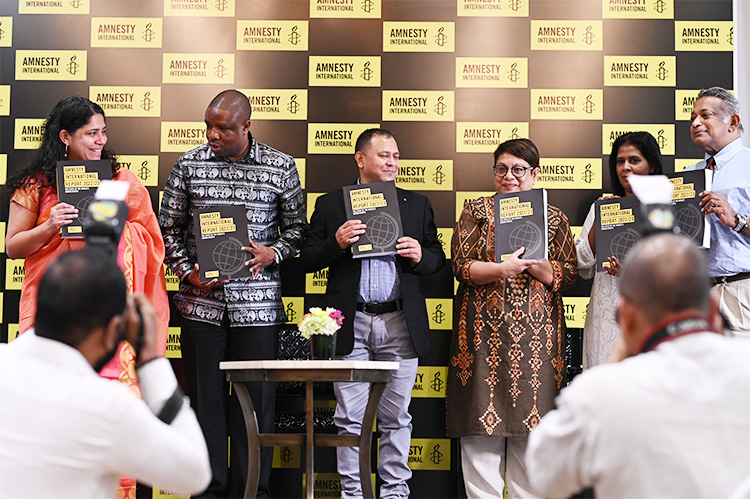
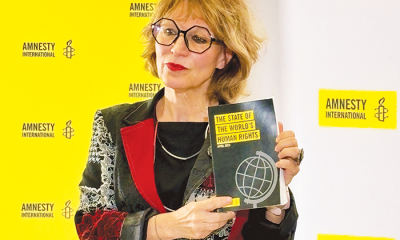
The government intensified its crackdown on dissent as thousands of people protested against the dire economic situation, Amnesty International said in its latest annual world report.
The report, The State of the World’s Human Rights, highlighted that The rights to freedom of expression and peaceful assembly came under fierce attack by law enforcement agencies, which at times used unlawful force leading to deaths and injuries.
“Protesters were arbitrarily arrested, detained using draconian counterterrorism legislation, and ill-treated in custody. Serious human rights violations committed during the internal armed conflict remained unaddressed. Families of people forcibly disappeared continued to seek truth and justice. Amendments to the Prevention of Terrorism Act failed to address key human rights concerns, and Muslims and Tamils continued to be targeted under the Act,” AI said.
Given below are excerpts of the report on Sri Lanka: “The PTA, which had been used in previous years to facilitate torture, enforced disappearances and prolonged detention without trial, remained in use despite government assurances of a moratorium. Amendments to the PTA in 2022 failed to bring it in line with international law and standards, as it continued to facilitate the prolonged detention of suspects without charge, among other concerns.
“The authorities made no progress in bringing to justice in fair trials before ordinary civilian courts all those suspected of criminal responsibility concerning allegations of violations of international human rights and humanitarian law during the three decades-long conflict. Emblematic cases made no notable progress. In light of Sri Lanka’s failures to provide redress to victims of crimes under international law and grave human rights violations, the UN Human Rights Council passed a resolution in October extending the mandate and capacity of OHCHR’s Sri Lanka Accountability project to collect, consolidate, analyse and preserve information and evidence for future accountability processes.
“Domestic transitional justice bodies, including the Office on Missing Persons and the Office on Reparations, lost the confidence of victims’ families further after being undermined by the appointment of members not deemed independent. Families complained of being surveilled, intimidated, and restricted from holding peaceful protests and memorialization initiatives, while being pressured to accept financial compensation and death certificates in lieu of certificates of absence until the fate of those forcibly disappeared could be ascertained.
“The government showed renewed interest in setting up a truth and reconciliation commission to address the grievances of those affected by the war. However, such a process had yet to be set up in line with the findings of public consultations on reconciliation mechanisms by the end of the year.
“Domestic redress mechanisms including the National Human Rights Commission remained politicized. In October, the legislature passed an amendment to the Constitution, ostensibly to make appointments to key commissions more independent. However, the council that makes such appointments required nomination by a majority of government members, bringing the independence of their appointments into question. The Global Alliance of National Human Rights Institutions recommended that the National Human Rights Commission be downgraded due to its lack of independence, amongst other concern
“In a landmark decision, in March the CEDAW Committee found that the criminalization of consensual same-sex sexual conduct between women under Section 365A of Sri Lanka’s Penal Code (1883) violates their right to non-discrimination. The CEDAW Committee called on the Sri Lankan authorities to decriminalize consensual same-sex sexual conduct between women. A Private Member’s Bill seeking to amend the Penal Code provisions that criminalize same-sex conduct was handed to the president in August, but did not receive government support by the end of the year.
Muslim and Tamil minorities remained disproportionately affected by the use of the PTA. Even in cases where suspects were released on bail, who included Hejaaz Hizbullah, Ahnaf Jazeem, Davaniya Mukunthan and Mohamed Imran, their livelihoods remained affected by bail conditions which included the freezing of their assets and restrictions on livelihood-generating activity.”








Access to safe drinking water for populations residing in small towns and rural areas of Sri Lanka has not yet been fully ensured, and this continues to pose a major challenge to the country’s social and economic development.
With a view to overcome this situation, a programme has been planned to provide clean drinking water to approximately 600,000 families living in semi-urban and rural areas through the implementation of 300 projects covering 50 small towns and rural areas.
The projects are aimed at establishing safe, reliable and sustainable drinking water supply systems, with water to be treated through modern purification technologies, including chlorination and filtration systems, in conformity with national and international drinking water standards.
Accordingly, having considered the resolution furnished by the Minister of Housing, Construction and Water Supply, the Cabinet of Ministers granted approval for the implementation of the proposed programme by the National Water Supply and Drainage Board and the National Community Water Supply Department during the period 2027–2029, subject to the conduct of a feasibility study on the proposed programme and inclusion in the Public Investment Programme based on its outcome.
News
Cabinet nod to submit Import and Export (Control) Regulations No. 04 of 2026 to Parliament for its concurrence

Hydrochlorofluorocarbons (HCFCs), which are chemical compounds widely used in refrigerators and air conditioning units, are being globally phased out under the Montreal Protocol due to their high potential for ozone layer depletion and global warming.
Sri Lanka has likewise committed to phasing out these chemical substances by the year 2030 in a stepwise manner. Accordingly,
regulations under the Import and Export (Control) Act, No. 1 of 1969, namely the Import and Export (Control) Regulations No. 04 of 2026, published in Extraordinary Gazette Notification No. 2487/29 dated 2026-05-07, have been issued, prohibiting, with effect from 2026-06-06, the importation of equipment and appliances that operate solely on hydrochlorofluorocarbons, and prohibiting, with effect from 2028-01-01, the importation of compressors used as components in refrigeration systems of equipment and appliances that operate solely on hydrochlorofluorocarbons.
Accordingly, the Cabinet of Ministers has approved the resolution furnished by the President in his capacity as
the Minister of Finance, Planning and Economic Development to submit the aforementioned Regulations to Parliament for its concurrence.
News
Declaration of Elephant Migratory Corridors to minimize HEC in Monaragala and Hambantota districts
Wild elephants inhabit approximately two-thirds of the land area of Sri Lanka, and it has been identified that the rapid obstruction of elephant habitats and migratory corridors due to various development projects and human activities has directly contributed to the escalation of human–elephant conflict.
It has been recognised that, in order to mitigate such conflict to a certain extent, the protection of wild elephant habitats and migratory corridors must be undertaken as a matter of urgency.
The Department of Wildlife Conservation is currently engaged in identifying wild elephant migratory corridors in collaboration with relevant Divisional Secretaries, stakeholder agencies, and organisations.
Under the Wild Elephant Migratory Corridor Identification Programme in Monaragala District, the Wild Elephant Migratory Corridor from Handapanagala to Demodara
across Menik Ganga (River Menik) up to Yala National Park has been identified, and approval has been granted by the Monaragala District Coordinating Committee for that.
The Elephant Migratory Corridor from Yala National Park’s Zone VI -Lunugamvehera National Park to Udawalawe National Park has already been declared as the Wetahira Kanda Nature Reserve in 2002.
Within this area, five (05) licensed land plots have been identified, and these lands have not yet been developed.
Accordingly, the Cabinet of Ministers has approved the resolution furnished by the Minister of Environment to take the following measures:
To declare, under the provisions of the Flora and Fauna Protection Ordinance, the elephant migratory corridor from Handapanagala in Monaragala District to Demodara across Menik Ganga up to Yala National Park as a sanctuary.
To provide alternative land outside the wildlife reserve area in lieu of the five (05) licensed land plots located within the Wetahira Kanda Nature Reserve area, and to re-declare the Wetahira Kanda Nature Reserve as an elephant migratory corridor.
To acquire, upon payment of compensation, land parcels containing buildings constructed in a manner that obstruct the Koholankala elephant corridor in the Hambantota District, and to declare the relevant area of the Hambantota Wild Elephant Management Reserve as a sanctuary.

Battling Australia force series decider as questions grow for Pakistan

West Indies bowl vs Sri Lanka, Hetmyer not in the XI

Implementation of water supply projects in small town and rural areas.
Cabinet nod to submit Import and Export (Control) Regulations No. 04 of 2026 to Parliament for its concurrence
Declaration of Elephant Migratory Corridors to minimize HEC in Monaragala and Hambantota districts

Qualifier Maja Chwalinska extends dream French Open run

‘Dates have the highest sugar content to fight Coronavirus’

Sunday Island 27 December – Headlines

#SundayIsland 17th December – Headlines

Sunday Island – 28th March

Sunday Island Headlines – 21 March

Sunday Island – 21st February – Headlines
-
 News5 days ago
IMF urges Lanka not to meddle with exchange rate
-
 Business6 days ago
Sri Lanka’s construction industry losing ground while no one watches
-

 Business3 days ago
IMF’s unstated rate:Sri Lanka’s $695m loan costs about 5.33% per annum
-

 News2 days ago
Lankan duo emerge winners in Latin dance championship held in Blackpool, UK
-
 News5 days ago
State of emergency extended
-

 Features6 days ago
The Division Bell Mystery
-

 News3 days ago
UNP challenges NPP move to amend Vihara – Devalagam Act
-

 Features4 days ago
Are threats to Buddha Sasana external or from within?