
News
AI says SL police must be held accountable for abuses during protests

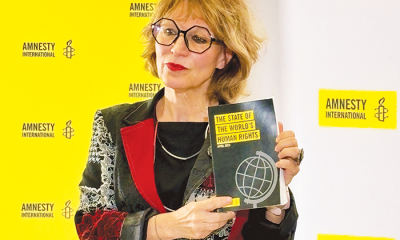
Sri Lankan law enforcement officials engaged in the violent repression of protests must be held accountable for committing widespread human rights violations, Amnesty International has said in a report.
The report, ‘Ready to suppress any protest’ Sri Lanka: Unlawful use of weapons during protests’, has analysed the use of force during policing of 30 protests that took place in Sri Lanka between March 2022 and June 2023.
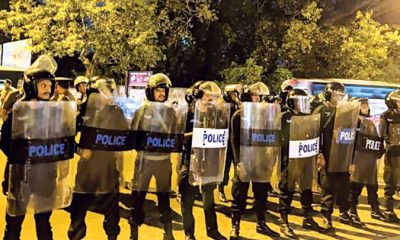
AI has said its analysis shows a pattern in the unlawful use of tear gas and water cannon and the misuse of batons by Sri Lankan law enforcement officials with video evidence revealing that in at least 17 protests – more than half of those analysed – the conduct of law enforcement officials fell well short of international law and standards on the use of force.
“From the outset, the Sri Lankan police approached the 2022-23 protests assuming that they would be unlawful and violent and that they would need to use force to repress them. The police failed to recognize that people have the right to peacefully protest, and that the authorities have a duty to facilitate and protect protests. Instead, they targeted, chased, and beat largely peaceful protesters,” said Smriti Singh, Amnesty International’s Regional Director for South Asia.
During 2022 and 2023, Sri Lankans called for accountability for the prolonged economic crisis, corruption and human rights violations, in large-scale protests and an occupy movement known as the Aragalaya in Colombo and other cities across Sri Lanka. Amnesty International has documented unlawful use of force against largely peaceful protests that continue to date, including in 2024.
Meanwhile, in the Northern and Eastern provinces of the country, security forces and intelligence agencies regularly carry out surveillance, intimidation, harassment, and obstruction of largely peaceful protests that have continued to take place since 2017 by the relatives of people forcibly disappeared during the internal armed conflict in Sri Lanka.
During its investigation, Amnesty International conducted 39 qualitative interviews and an open-source investigation into 95 verified videos gathered on social media of 30 protests, predominantly from Colombo, Battaramulla, Kelaniya, Jaffna and Galle. In March 2024, Amnesty International wrote to the Sri Lanka Police outlining the allegations in this report and requesting an official response but had not received a reply at the time of publication.










The Ministry of Industries and Entrepreneurship Development has recommended the establishment of Sri Lankan Standards, i.e. the import testing methodology for imported tires used for passenger cars and pneumatic tires for three-wheelers with the aim of ensuring a fair competitive environment for local
manufactures and ensuring consumer safety and security.
Taking into the said recommendations, “Import and Export (control regulations N0.08 of the 2026)” has been enacted to amend the existing regulations by means of the Extraordinary Gazette Notification No. 2508/27 dated 2026-10-01, prescribing Sri Lanka standard 1212 for the import of passenger types (HS Code 4011.10.90) and Sri Lanka standard 1347 for the import of
pneumatic tires for three – wheeled vehicles (HS Code 4011.90.10).
Accordingly, the Cabinet of Ministers has approved the resolution furnished by the President in his capacity as the Minister of Finance, Planning, and Economic Development to submit the aforementioned regulations to Parliament for approval.
Approval of the Cabinet of Ministers was granted at their meeting held on 02.06.2025 to introduce a new act to promote and providing legal provisions for facilitating the Public Private Joint Enterprises within Sri Lanka as well as the establishment of the National Agency for Public Private Partnership Joint Enterprises.
Accordingly, the Legal Draftsman has formulated the relevant draft bill and the Attorney General has given his clearance to the said draft bill.
The Cabinet of Ministers approved the resolution furnished by the President in his capacity as the Minister of Finance, Planning and Economic Development to publish the said
draft bill in the government gazette notification and thereby submit it to the Parliament for its concurrence.
Regulation, development and control of indigenous medical sector in Sri Lanka comprised of Ayurvedha, Sidhdha, Unani, Local Therapies are carried out under the provisions of Ayurvedha Act No. 31 of 1961.
Although amendments were made to the act from time to time as per the requirements, the necessity of further amending the Ayurvedha Act has been identified to enable efficiently maintaining all activities of local medical field productively, further formalizing the regulation of the sector, taking actions to providing licenses applicable to export of local medicines, and achieving the progress and sustainable development goals in the local medical sector.
Based on the said factors, the Cabinet of Ministers granted approval to the resolution furnished by the Minister of Health and Mass Media to direct the Legal Draftsman to formulate a draft bill to amend the Ayurvedha Act No. 31 of 1961.

Import and Export (Control) Regulations No. 08 of 2026
Draft Bill of the Public Private Partnership Enterprises Act to be gazzetted
Amendment of the Ayurvedha Act No. 31 of 1961

Cabinet nod to amend the Sri Lanka Development Administration Institute Act No. 9 of 1982
Establishment of the National Higher Performance Centre
State patronage for the cremation ceremony of the late deputy prelate (Anu Nayaka Thero) of the Sri Laka Ramangya Maha Nikaya, Gatambe Rajopawanramadhipatha, Siri Chandawimala Wanshalankara, Chandrakeerthi Sri Amarawansha, Sadhdharmawageeshwara, Shasanashobhanna Most Venerable Keppetiyagoda Siriwimalabhidhana Thero

‘Dates have the highest sugar content to fight Coronavirus’

Sunday Island 27 December – Headlines

#SundayIsland 17th December – Headlines

Sunday Island – 28th March

Sunday Island Headlines – 21 March

Sunday Island – 21st February – Headlines
-

 Features3 days ago
Kotahena:A Small Enclave, An Extraordinary Legacy
-

 News7 days ago
Sri Lanka, India caught in US-Iran ship crisis
-
 News4 days ago
Asgiri Mahanayake calls for immediate release of Gnanasara Thera
-

 Latest News7 days ago
Missiles intercepted near Riyadh after Saudi coalition hits Yemen fuel depot
-

 Latest News7 days ago
Kusal Mendis’ unbeaten 87 hands Sri Lanka consolation win
-

 News2 days ago
Record 1,600 students take Russian Classical Ballet examination in Sri Lanka
-
 News6 days ago
AC President recuses himself from hearing prison attire case pertaining to Gnanasara Thera
-
 News5 days ago
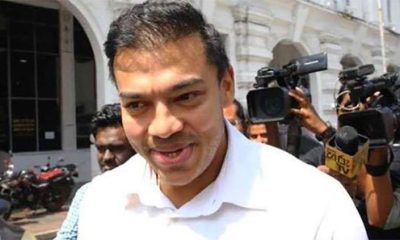
Naval officer testifies Yoshitha received Rs. 5.15 mn in salaries during SLN service