
News
The genesis of the Radio Society of Sri Lanka

Cecil de Mel
The Radio Society of Sri Lanka (RSSL) existed as an as association since 1950, but it was a very closed group and membership was restricted only to invitees. That was entirely due to its colonial past, as it was started by the white planters who wanted to contact Colombo, at a time when telephone communications were not advanced and one had to wait sometimes up to eight hours for a trunk call.
Licenses to operate and call signs were given to white men and others of social standing with links to the white rulers. After World War II, things began to change, as war surplus equipment, unused and in their original packing, began to be available on the pavements, at unbelievable prices. Our veterans say that a Colins transceiver could be bought for 50 rupees and 807 valves at a mere five cents each.
This created an avenue for locals to take an interest in radio, firstly as short wave listeners, which led to experiments in transmitting. But it was still illegal to operate without a valid license and call sign. This was the biggest obstacle, as membership of the society was by invitation, although by then an examination structure was in place.
An entrant had to pass the technical examination, pass a Morse Code test in sending and receiving at 12 words per minute, after which a security clearance was mandatory, before considering you for the grant of a license and call sign.
Those were the hurdles before us and many who had licenses obliquely prevented others from getting it, by restricting access to the fraternity of radio hams. There have even been instances of petitioning against some who had passed the examinations, on grounds of social standing and family backgrounds and alleged connections with anti – government organizations.
That was the background and various attempts even to register the Society were opposed by those opinion makers as it would have led to a demolition of their grip on the Society. As time went by things began to change with the arrival of the D A R C, (of West Germany) Who conducted a 21 day residential course in Electronics & Amateur Radio, at the Sri Lanka Foundation Institute.
I had the fortune to participate in this course and many others at different levels of competence received certificates. Still, we had to pass the technical examinations conducted by the Telecommunications Department, in order to receive our licenses. That was the situation in 1978, when I received my 4S7CD call sign.
From 1980 to 1984, I was employed at the Bahrain National Gas Company, ‘BANAGAS’ Bahrain, and obtained a reciprocal license and call sign A9XDH / A92DH. I can remember picking up a brand new 807 transmitting valve from the Junk box of ARAB, for future experimentation with older devices, which became very useful later on
Sometime in 1990, when OM Ernie 4S7EP became President, he persuaded me to take an active part in RSSL. I was appointed Treasurer, and assigned the task of Incorporating RSSL as a legal entity. Some say that he roped me in to provide him transport for attending meetings as by that time I had a four wheeler.
It took one whole year to deliberate on every clause, letter, comma, and full-stop to reach achieve a unanimous consensus, and that was the day I breathed a sigh of relief, as I had never toiled in this manner as a Chartered Company Secretary.
The opposition came not for want of skill or competence, but from the needs of some, with twisted minds to throw a spanner in the works and make it crash altogether. I had to steer clear of every such individual, or pressure group, and fortunately we had a long standing past President, OM John 4S7JA, who gave me every encouragement.
The final document of incorporation was greatly acclaimed as a perfect blueprint for future expansion of the amateur service, by professional observers. I have taken all steps to record accurately what took place after 1999, when Ranjit 4S7RR ceased to be President.


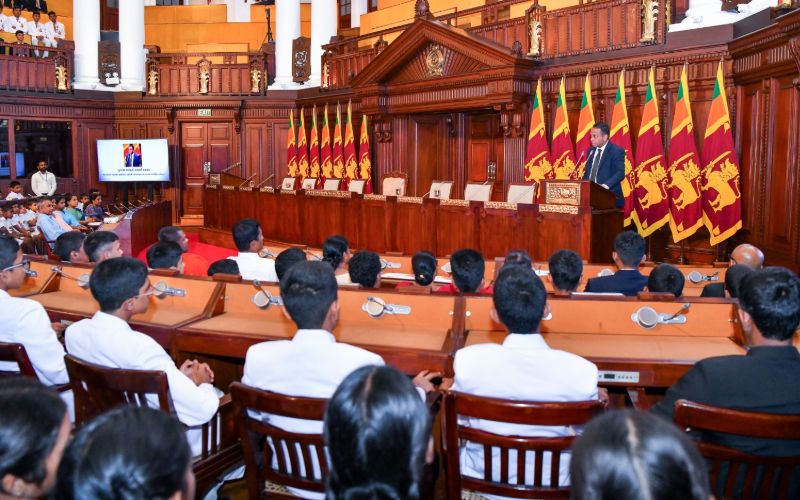
Marking the completion of two years of the ‘Vision’ Programme, students from Pinnawala Central College and Matale Siri Seevali College were given an opportunity on Thursday (24) to visit the Presidential Secretariat.
The ‘Vision’ Programme was launched for schoolchildren jointly by the Presidential Secretariat, the Ministry of Education and the Department of Communication of the Parliament of Sri Lanka.
Following a visit to the former Parliament building at the Presidential Secretariat, the students were also briefed on the history of Parliament.
The role of the President’s Fund and its importance to schoolchildren were explained by Senior Additional Secretary to the President Roshan Gamage.
The ‘Vision’ commemorative book, featuring the two-year journey of the ‘Vision’ Programme and its special activities, was also presented to the participating schools.
As part of the programme, valuable plants were also presented to the schools as a symbolic gesture underscoring the importance of environmental conservation.
Director General of Public Relations Dharmasiri Gamage, the Director and Assistant Director of the Tri-Services Security Coordination Unit, the principals and teaching staff of Pinnawala Central College and Matale Siri Seevali College, and students were among those present on the occasion.
President’s Media Division (PMD)

Opposition and SJB Leader Sajith Premadasa yesterday vowed that an SJB government would repeal the 22nd Amendment (22A) to the Constitution.Premadasa made the pledge while addressing thousands of SJB supporters who gathered near Parliament to protest against 22A.
Addressing the rally at Polduwa Junction, Battaramulla, Premadasa said the proposed constitutional amendment would undermine democracy and judicial independence and enable the concentration of political power in the Executive.
“Even if they pass it, under an SJB government we will scrap it,” Premadasa told the gathering, claiming that 22A was aimed at paving the way for a one-party state and placing the State under the control of a single political party.
Braving the rain, Premadasa said they had gathered there peacefully and had no intention of resorting to violence.
“We have gathered here to protect democracy,” he said, challenging the government to hold Provincial Council elections if it was confident of facing the people.
Premadasa said the SJB was prepared to work with any democratic and clean political force committed to the country’s progress and public welfare, amid ongoing discussions on cooperation among Opposition parties, including the United National Party.
Premadasa also accused groups aligned with the government of attempting to discourage people from attending the protest through statements and other measures.
SJB General Secretary Ranjith Madduma Bandara said the protest had been organised against the proposed amendment, which the party had opposed on the grounds that it could pave the way for authoritarianism.
The demonstration began around 9 a.m. at Polduwa Junction and coincided with Parliament taking up the proposed 22nd Amendment for debate. Proceedings on the Bill are scheduled to continue today (25).
The Supreme Court has determined that the proposed amendment does not require approval at a referendum and could be passed with a special majority in Parliament.
Meanwhile, traffic congestion was reported on roads surrounding Parliament and Polduwa Junction following the demonstration.
Security was also tightened in and around the Parliamentary complex, with a heavy police presence observed at Polduwa Junction and near the main entrance to Parliament.

Two retired female Navy petty officers were ordered to be remanded until October 5 over their alleged involvement in the abduction and disappearance of two women in Trincomalee during the war.
Trincomalee Chief Magistrate M.S.M. Samsudeen yesterday ordered that the two suspects be remanded and directed that they be produced for an identification parade on October 5.
The suspects, residents of Chilaw and Haputale, were arrested after appearing before the CID in connection with another court case. They were subsequently produced before the Trincomalee Magistrate’s Court.
The court was informed that the investigation concerned the alleged abduction of Sasikumar Thenmoli and Mary Delsia, residents of Paalaiyootru, Trincomalee, on or around May 13, 2008.
The CID told court that information uncovered during its investigations indicated that the two women had allegedly been detained at an underground location known as the “Gun Site” at the Trincomalee Naval Base while the two suspects were serving in the Navy. The women were subsequently reported missing.
Further investigations into the alleged abduction and disappearance of the two women are continuing.

‘Vision’ Programme Marks Two Years

Costa Rica minister fired for unapproved meeting with Trump in US

At least 41 die as boat capsizes in DRC’s Lake Tanganyika

Showers will occur at times in the Western, Sabaragamuwa, Southern, Central and North-western provinces

Sajith vows to scrap 22A under future govt.

Two retired female Navy officers remanded over disappearance of two women during war

‘Dates have the highest sugar content to fight Coronavirus’

Sunday Island 27 December – Headlines

#SundayIsland 17th December – Headlines

Sunday Island – 28th March

Sunday Island Headlines – 21 March

Sunday Island – 21st February – Headlines
-

 News6 days ago
Shanakiyan urges urgent action over reported death sentence for Lankan in Saudi Arabia
-

 News5 days ago
Namal Rajapaksa Buddhist gambit fails, bail denied
-

 Features5 days ago
Why the spelling Sri Lankan names in English vary
-

 Features5 days ago
Three bands, a new identity: Sri Lankan wolf snake recognised as distinct species
-

 Business5 days ago
SLIIT holds largest-ever convocation
-

 News5 days ago
Govt monitors reported Saudi death sentence – Foreign Ministry
-

 News5 days ago
Vehicle prices drop by up to Rs. 1 mn, says importers’ body
-

 Business5 days ago
All-new Bolero MaXX Pik-Up unveiled in Lanka