
Business
Sri Lanka and the SDGs: Impacts of COVID-19 and the Economic Crisis

From IPS’ flagship publication, ‘Sri Lanka: State of the Economy 2022’
COVID-19 reversed Sri Lanka’s progress across several SDGs, particularly on poverty, inequality, and decent work. Similarly, the economic crisis is likely to adversely affect the SDG progress and pose several new challenges to their achievement by 2030.Financing SDGs has become the biggest challenge for Sri Lanka, becoming even tighter following Sri Lanka’s inability to access international bond markets after the sovereign default in April 2022.Given the enormous challenges to achieving the SDGs, those related to poverty and inequality; food security; economic growth and decent work; health and education; and energy must be prioritised.Resource mobilisation to secure both traditional and non-traditional SDG financing, including attracting private investments to SDGs, is vital.
Since adopting the 2030 Agenda for Sustainable Development in 2015, successive Sri Lankan governments have taken measures to achieve the 17 Sustainable Development Goals (SDGs) and 169 targets. Before COVID-19 struck, Sri Lanka recorded progress across several SDG targets, most notably: ending poverty and hunger (SDGs 1 and 2); improving access to health and education (SDGs 3 and 4); promoting gender equality and decent work, and reducing inequalities (SDGs 5, 8 and 10). The pandemic, however, reversed these advances, particularly on the SDGs related to poverty, inequality, and decent work. Similarly, the economic crisis is likely to adversely affect the SDG progress and pose several new challenges to their achievement by 2030. Against this backdrop, this Policy Insight discusses the impacts of the pandemic and the implications of the current financial crisis on SDGs in Sri Lanka, paying special attention to the SDGs related to poverty and inequality.
Impacts of COVID-19 and the Economic Crisis
The COVID-19 pandemic has impacted many of the 17 SDGs, with some goals including SDG 1 on poverty backsliding the progress made over the past decade. As with other countries, Sri Lanka also reported notable adverse effects of the pandemic on the lives and livelihoods of its population, especially the poor and the vulnerable. While the pandemic has impacted many SDGs, and all three dimensions of sustainable development – economic, social, and environmental – the adverse effects on some SDGs, especially those related to poverty, food security, health, education and employment are more prominent.
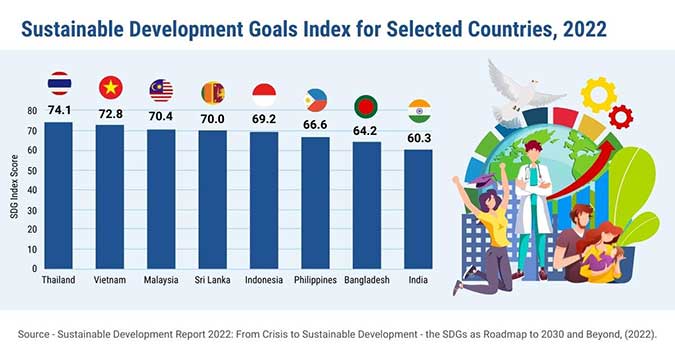
Despite the setbacks during the pandemic (2020-2021), Sri Lanka has improved its overall SDG performance since 2016, as indicated by the SDG Index. As per the Sustainable Development Report 20222, Sri Lanka, with an SDG Index of 70, is ranked 76 among 163 countries. This is close to the overall SDG performance of Malaysia (SDG Index of 70.4) and ahead of countries like the Philippines, India, Bangladesh and Indonesia (see Figure 1). Moreover, the SDG Index for Sri Lanka is only slightly lower than the average for upper-middle countries (71.5%) and considerably higher than the average for lower-middle-income countries (61.8%), as well as the East and South Asian average (65.9%).
However, the progress of individual SDGs indicates major challenges to achieving several SDGs, including SDG 2 (zero hunger), SDG 3 (health), SDG 6 (water and sanitation), SDG 7 (energy) and SDG 9 (industry, innovation, and infrastructure), despite their moderate performance. Furthermore, SDG 8 on decent work and SDG 5 on gender equity and SDGs 15-17 have been stagnant in their progress, indicating significant challenges to achieve them by 2030. Only a few SDGs, such as those on education (SDG 4) and climate change (SDG 13), are shown to be still on track to achieve the goals on time. Nevertheless, Sri Lanka’s economic crisis will adversely affect the SDG progress and pose several new challenges to their achievement by 2030.
A combination of many factors caused the economic crisis, including the lack of foreign reserves, disruptions to the tourism industry starting from the Easter Sunday attacks in 2019 and the pandemic in 2020, tax cuts that resulted in a significant decline in government revenue and rising crude oil prices partly related to the Russia-Ukraine War and associated sanctions. While the economic crisis has affected the country’s entire population in some way or another, the poor and the ‘near poor’ are the most hit by the crisis. With high inflation, shortage of food and other essentials, and loss of livelihoods, the economic crisis is likely to reverse progress on the SDGs.
Poverty and Inequality
A World Bank study estimates that 500,000 people have fallen into poverty due to the pandemic.3 This has led to an increase in the USD 3.20 poverty rate from 9.2% in 2019 to 11.7% in 2020, implying a reversal in progress made towards poverty reduction in Sri Lanka since 2016. The study further finds that the extreme poverty level nearly doubled in 2020 from its 2019 levels (from 0.7% to 1.2%), and the poverty gap too has increased, indicating that the poor have become even poorer due to the pandemic. The study stresses the impact on employment such as job losses and a fall in earnings as the main contributory factors to the increased poverty rates.
Further, the World Bank’s Macro Poverty Outlook for Sri Lanka (2022) estimates poverty levels to have fallen slightly in 2021 from their 2020 level, but the forecast remains above the 2019 level for the next few years.4 However, the current economic crisis, especially soaring prices of food, fuel and other essential goods, along with adverse impacts on the livelihoods of many workers – particularly, the informal sector workers – means the risks of higher poverty are high. The poverty level can be expected to rise further in 2022, reversing the much-achieved progress in poverty reduction seen over the years.
Financing SDGs is Key Challenge
Financing SDGs has become the biggest challenge for Sri Lanka. On the domestic front, government expenses increased with the pandemic while revenues plummeted, primarily due to tax cuts introduced in 2019. On the external front, foreign income earnings from remittances and tourism dropped. Economic shocks such as the Russia-Ukraine crisis continue to disrupt the global economy, worsening the global macroeconomic climate. Other inflows, such as FDI into the country, have also reduced post-COVID-19 as the economic uncertainties have mounted. Financing has become even tighter following Sri Lanka’s inability to access international bond markets after the selective default of foreign debt payments in April 2022. All these issues have widened the financing gap to achieve SDGs.
Conclusions and Policy Implications
Given the complexity of SDGs and the enormous challenges to achieving them, it is desirable to prioritise the targets that are deemed most important. Prioritisation must be based on the country’s development needs and trade-offs between the targets. Given the enormous financial constraints and adverse implications of the economic crisis, it would be essential to prioritise SDGs related to poverty and inequality (SDG 1 and 10), food security (SDG 2), economic growth and decent work (SDG 8), health (SDG 3) education (SDG 3) and energy (SDG7). While various goal-specific measures are required to accelerate the progress of SDGs, some key steps are:
Securing Financing
Sri Lanka needs to prioritise resource mobilisation for traditional and non-traditional SDG financing.Traditional SDG Financing: Domestic resource mobilisation is essential if Sri Lanka is to progress on SDGs. Generally, traditional SDG financing includes government financing and ODA from foreign governments. In Sri Lanka’s case, ODA has also been on a declining trend as it moved up the income ladder, while foreign aid now rightly focuses on covering the essential needs of the people first (e.g. food security, social protection, healthcare, power/fuel). In the medium term, however, there needs to be more emphasis on financing other SDGs, especially those related to education, employment, industry, innovation, and infrastructure. Attracting private investment to SDGs, too, will be vital.
Non-traditional SDG Financing: The Roadmap for Sustainable Finance in Sri Lanka, developed by the Central Bank of Sri Lanka (CBSL), highlights some non-traditional instruments in SDG financing. These include green bonds specific to development projects based on environmental protection and climate change. Capital markets have recently become a driving force towards a sustainable future. Sri Lankan companies can explore the Environmental, Social and Governance (ESG) bonds market. However, green bonds and ESG financing focus on the environment. Sri Lanka needs to expand spending on critical areas such as poverty alleviation (SDG 1), food security (SDG 2) and healthcare (SDG 3). Strengthening multilateral and bilateral partnerships would be crucial, particularly given the lack of fiscal space.
Strengthening Partnerships
Multistakeholder engagement – including government agencies, the private sector, and civil society organisations – is key to achieving SDGs and ensuring an inclusive process. Moreover, enhancing regional and global partnerships to mobilise and share knowledge, expertise, technology, and financial resources is crucial to supporting the achievement of SDGs.
South-South cooperation is also an avenue that needs to be further explored by Sri Lanka. Regional cooperation can help accelerate the progress of several SDGs, in particular, SDGs related to food security (SDG 2), health (SDG 3), energy (SDG 7), decent work (SDG 8) and climate action (SDG 13).5
Addressing Data Deficits
While Sri Lanka has made much progress in terms of liaising with the relevant agencies to compile the required data, the lack of more up-to-date data at regular intervals (e.g. annual basis) and lack of disaggregated data (by gender, location, age, etc.) for many SDGs is a significant drawback for monitoring. Given these data gaps, improving the availability of high-quality, timely, reliable, and appropriately disaggregated data for SDGs is important. This requires enhancing the capacity of relevant agencies as well as strengthening partnerships among various stakeholders. There is also some scope for enhancing regional cooperation to improve statistical capacity in Sri Lanka and share knowledge and experience among these countries.
*This Policy Insight is based on the comprehensive chapter “Crises and Recovery: Meeting the 2030 Agenda on SDGs” in the ‘Sri Lanka: State of the Economy 2022’ report – the annual flagship publication of the Institute of Policy Studies of Sri Lanka (IPS). The complete report can be purchased from the Publications Unit of IPS located at 100/20, Independence Avenue, Colombo 07 and leading bookshops island-wide. For more information, contact 011-2143107 / 077-3737717 or email: publications@ips.lk.To download more POLICY INSIGHTS from IPS, visit: https://www.ips.lk/publications/policy-insights.

Business
Inflation curbed by govt. fuel subsidy introduction and surcharge on vehicle import tax – CBSL Governor


By Hiran H. Senewiratne
The government’s decision to introduce the fuel subsidy and the surcharge on the vehicle import tax helped curb inflation to a great extent, Central Bank Governor Dr. Nandalal Weerasinghe said.
‘The government this week approved a Rs. 40 billion fuel subsidy for the next three months on top of Rs. 57 billion provided from April-June, Governor Weerasinghe told the media yesterday at the Central Bank head office in Colombo at the CBSL’s monthly monetary policy review meeting.
‘If not for fuel subsidy and surcharge on the vehicle import tax, the inflation would have been higher than the current level, the Governor said.
‘There could have been higher imports and reserve building up would have been difficult. Inflation has risen beyond the Central Bank’s upper band of 7 percent since July, he said.
‘The country’s inflation hit a 37-month high of 8 percent in August after the government raised fuel prices more than 50 percent following the Middle Eastern escalation by end February, Dr Weerasinghe said.
The Central Bank’s inflation target for the past three years have been 5 percent with lower band of 3 percent and higher band of 7 percent, Governor said.
The Governor added: ‘The government provided Rs.57 billion as a fuel subsidy mainly for diesel. The latest Rs.41 billion has been allocated only for diesel as it is used for public transport.
‘The government also imposed a temporary 50 percent surcharge on Customs Import Duty on new personal vehicles on May 16 and has extended it until December 31, a move that will help to prevent outflow of foreign currency.
‘The Central Bank also tightened the monetary policy in May, raising the key monetary policy rate by 100 basis points, to curb excess demand in the economy to control demand-driven inflation.’
Meanwhile, head of the CBSL’s Economic Research Department L.R.C. Pathberiya said, ‘Credit growth has slowed to 24.5 percent year on year in August from a higher level of 30 percent a few months ago, after the Central Bank’s monetary policy tightening in May.
‘However, the Central Bank is optimistic about the current credit growth, he explained.
Pathberiya added: ‘The credit to the private sector from commercial banks has slowed, but we believe it is sufficient for economic growth.
‘The nation’s economic growth slowed to 4.2 percent year-on-year, its lowest in 11 quarters’’.
By Ifham Nizam
Prime Minister Dr. Harini Amarasuriya warned that Sri Lanka’s worsening waste-management crisis, particularly the uncontrolled accumulation of plastic waste and poorly managed landfills, was a “disaster waiting to happen”, urging scientists, researchers and policymakers to help the government find practical solutions before the problem reaches a critical point.
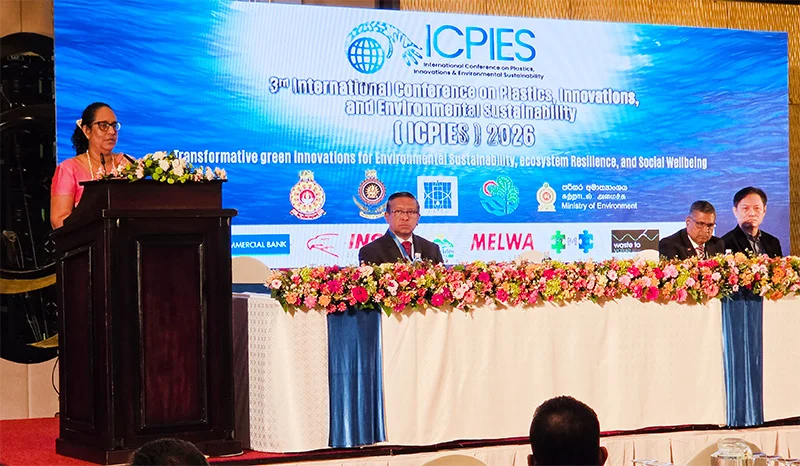
Addressing the launching of the Open University of Sri Lanka organized, ‘International Conference on Plastics, Innovations and Environmental Sustainability’ (ICPIES 2026) as Chief Guest, at the Cinnamon Lakeside Hotel yesterday she said waste management, waste reduction and recycling had become national priorities, with the government placing greater emphasis on the issue in its preparations for the 2027 Budget.
‘This is becoming a critical issue and something that, at any moment, if we don’t manage it properly, could become a huge disaster. It’s a disaster waiting to happen, Dr. Amarasuriya said.
She said unregulated and poorly managed landfills, particularly in and around Colombo, posed serious environmental and public risks, while increasing urbanisation was extending the waste-management challenge beyond the capital to other parts of the country.
‘As a member of Parliament for the Colombo District, I can tell you that one of the biggest challenges we are facing is waste management and actually managing the recycling of waste, and particularly of plastic products. This is something that we are battling every day, she said.
The Prime Minister said the government could not regard economic development as meaningful if it came at the expense of the country’s environment and natural resources.
‘If we are to speak of a beautiful life, we must first ensure that the air we breathe, the water we drink, the soil on which we live, the food we eat is clean and secure, she said.
She pointed to the scale of the global plastics crisis, noting that around 400 million tonnes of plastic waste are generated worldwide each year, while between 19 and 23 million metric tonnes of plastic waste enter natural ecosystems annually.
Plastic waste eventually breaks down into microplastics, which can enter aquatic organisms and subsequently the human food chain, she said.
Dr. Amarasuriya also linked plastic consumption and environmental degradation to the wider climate crisis, warning that the consequences of climate change were already being experienced by communities around the world.
She referred to devastating floods and landslides in the Himalayan region and said the impacts of climate change demonstrated that environmental damage could have consequences far beyond national boundaries.
Coastal clean-up projects and other waste-separation and recycling initiatives are also being implemented, while the government is working with the Western Provincial Council on a refuse-derived fuel project at Karadiyana.
The third ICPIES, held under the theme “Eco-Driven Innovations,” brings together researchers, policymakers, industry representatives and other stakeholders to examine plastic pollution, microplastics, circular-economy approaches, waste-management policy, technological innovation, artificial intelligence and smart environmental monitoring. The conference ends today.
Senior Professor P. M. C. Thilakarathne, Vice Chancellor of the Open University of Sri Lanka, was the Guest of Honour.

By Hiran H. Senewiratne
Stock investors were worried yesterday following Central Bank Governor Dr. Nandalal Weerasinghe’s mention at the CBSL monthly monetary policy review meet of possible future inflation pressures that may impact the economy.
The All Share Price Index went down by 4.89 points, while the S and P SL20 rose by 16.1 points. Turnover stood at Rs 1.55 billion with four crossings.
Those crossings were; Access Engineering crossed 1.5 million shares to the tune of Rs 119.8 million; its shares traded at Rs 79.60, Sampath Bank 450,000 shares crossed tfor Rs 63 million; its shares sold at Rs 140, Sunshine Holdings 750,000 shares crossed to the tune of Rs 21.4 million; its shares traded at Rs 28.50 and Softlogic Life 290,000 shares crossed for Rs 20.4 million; its shares sold at Rs 70.40.
In the retail market companies that mainly contributed to the turnover were: Access Engineering Rs 150 million (1.9 million shares traded), JKH Rs 113 million (six million shares traded), Softlogic Life Rs 80 million (one million shares traded), Softlogic Capital Rs 64.7 million (6.7 million shares traded), Lanka Realty Rs 64.3 million (1.3 million shares traded), Colombo Dockyard Rs 53.7 million (452,000 shares traded) and Sierra Cables Rs 50 million (1.43 million shares traded). During the day 58.9 million share volumes changed hands in 13536 transactions.
It is said that mixed market reactions were noted especially in manufacturing while banking, insurance and FMCG sectors performed well. Further, construction sector counters, especially Access Engineering, and banking sector counters, especially Sampath Bank, performed well.
People’s Leasing & Finance PLC announced its allotment basis for 100 million listed debentures it issued to raise Rs 10 billion, after receiving applications for the full amount.
Yesterday the rupee was quoted at Rs 330.68/75 to the US dollar in the spot market from Rs 330.70/90 the previous day, while bond yields were quoted steady to lower, dealers said.
An auction of Rs 80,000 million Treasury bills was ongoing.

Trump hints US could strike Iran, warns time coming

Showers or thundershowers will occur at most part of the island after 1.00 p.m.

US-assisted ‘Ice’ detection: NPC to examine IGP’s move to transfer drug-busting team

2027 Budget to be held from 12 Nov. to 14 Dec.

CB Governor confident over timely disbursement of next IMF tranche; hands post-2027 programme decisions to govt.

Cabinet spokesman explains why Thileepan statue was removed

‘Dates have the highest sugar content to fight Coronavirus’

Sunday Island 27 December – Headlines

#SundayIsland 17th December – Headlines

Sunday Island – 28th March

Sunday Island Headlines – 21 March

Sunday Island – 21st February – Headlines
-

 Editorial5 days ago
Birth of a bad law
-

 Features6 days ago
Beyond traditional jobs: Why Sri Lanka needs to facilitate the gig economy
-

 News3 days ago
Police remove Thileepan statue in Jaffna
-

 Latest News6 days ago
Kusal, Wellalage star as Sri Lanka defend 322 in Headingley thriller
-

 News5 days ago
TIN mandatory for key transactions from Nov. 1
-

 Features3 days ago
The 22nd Amendment, constitutional recovery and illiberal slippage
-

 Features3 days ago
Of foreigners as CEOs of Lankan ventures
-

 News3 days ago
Sajith rejects Jt. Opp. protest sabotage claim; SJB TU chief demands remedial action