
Business
Sri Lanka and the SDGs: Impacts of COVID-19 and the Economic Crisis

From IPS’ flagship publication, ‘Sri Lanka: State of the Economy 2022’
COVID-19 reversed Sri Lanka’s progress across several SDGs, particularly on poverty, inequality, and decent work. Similarly, the economic crisis is likely to adversely affect the SDG progress and pose several new challenges to their achievement by 2030.Financing SDGs has become the biggest challenge for Sri Lanka, becoming even tighter following Sri Lanka’s inability to access international bond markets after the sovereign default in April 2022.Given the enormous challenges to achieving the SDGs, those related to poverty and inequality; food security; economic growth and decent work; health and education; and energy must be prioritised.Resource mobilisation to secure both traditional and non-traditional SDG financing, including attracting private investments to SDGs, is vital.
Since adopting the 2030 Agenda for Sustainable Development in 2015, successive Sri Lankan governments have taken measures to achieve the 17 Sustainable Development Goals (SDGs) and 169 targets. Before COVID-19 struck, Sri Lanka recorded progress across several SDG targets, most notably: ending poverty and hunger (SDGs 1 and 2); improving access to health and education (SDGs 3 and 4); promoting gender equality and decent work, and reducing inequalities (SDGs 5, 8 and 10). The pandemic, however, reversed these advances, particularly on the SDGs related to poverty, inequality, and decent work. Similarly, the economic crisis is likely to adversely affect the SDG progress and pose several new challenges to their achievement by 2030. Against this backdrop, this Policy Insight discusses the impacts of the pandemic and the implications of the current financial crisis on SDGs in Sri Lanka, paying special attention to the SDGs related to poverty and inequality.
Impacts of COVID-19 and the Economic Crisis
The COVID-19 pandemic has impacted many of the 17 SDGs, with some goals including SDG 1 on poverty backsliding the progress made over the past decade. As with other countries, Sri Lanka also reported notable adverse effects of the pandemic on the lives and livelihoods of its population, especially the poor and the vulnerable. While the pandemic has impacted many SDGs, and all three dimensions of sustainable development – economic, social, and environmental – the adverse effects on some SDGs, especially those related to poverty, food security, health, education and employment are more prominent.
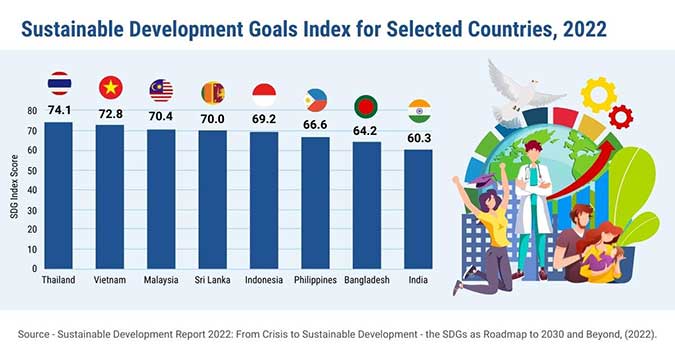
Despite the setbacks during the pandemic (2020-2021), Sri Lanka has improved its overall SDG performance since 2016, as indicated by the SDG Index. As per the Sustainable Development Report 20222, Sri Lanka, with an SDG Index of 70, is ranked 76 among 163 countries. This is close to the overall SDG performance of Malaysia (SDG Index of 70.4) and ahead of countries like the Philippines, India, Bangladesh and Indonesia (see Figure 1). Moreover, the SDG Index for Sri Lanka is only slightly lower than the average for upper-middle countries (71.5%) and considerably higher than the average for lower-middle-income countries (61.8%), as well as the East and South Asian average (65.9%).
However, the progress of individual SDGs indicates major challenges to achieving several SDGs, including SDG 2 (zero hunger), SDG 3 (health), SDG 6 (water and sanitation), SDG 7 (energy) and SDG 9 (industry, innovation, and infrastructure), despite their moderate performance. Furthermore, SDG 8 on decent work and SDG 5 on gender equity and SDGs 15-17 have been stagnant in their progress, indicating significant challenges to achieve them by 2030. Only a few SDGs, such as those on education (SDG 4) and climate change (SDG 13), are shown to be still on track to achieve the goals on time. Nevertheless, Sri Lanka’s economic crisis will adversely affect the SDG progress and pose several new challenges to their achievement by 2030.
A combination of many factors caused the economic crisis, including the lack of foreign reserves, disruptions to the tourism industry starting from the Easter Sunday attacks in 2019 and the pandemic in 2020, tax cuts that resulted in a significant decline in government revenue and rising crude oil prices partly related to the Russia-Ukraine War and associated sanctions. While the economic crisis has affected the country’s entire population in some way or another, the poor and the ‘near poor’ are the most hit by the crisis. With high inflation, shortage of food and other essentials, and loss of livelihoods, the economic crisis is likely to reverse progress on the SDGs.
Poverty and Inequality
A World Bank study estimates that 500,000 people have fallen into poverty due to the pandemic.3 This has led to an increase in the USD 3.20 poverty rate from 9.2% in 2019 to 11.7% in 2020, implying a reversal in progress made towards poverty reduction in Sri Lanka since 2016. The study further finds that the extreme poverty level nearly doubled in 2020 from its 2019 levels (from 0.7% to 1.2%), and the poverty gap too has increased, indicating that the poor have become even poorer due to the pandemic. The study stresses the impact on employment such as job losses and a fall in earnings as the main contributory factors to the increased poverty rates.
Further, the World Bank’s Macro Poverty Outlook for Sri Lanka (2022) estimates poverty levels to have fallen slightly in 2021 from their 2020 level, but the forecast remains above the 2019 level for the next few years.4 However, the current economic crisis, especially soaring prices of food, fuel and other essential goods, along with adverse impacts on the livelihoods of many workers – particularly, the informal sector workers – means the risks of higher poverty are high. The poverty level can be expected to rise further in 2022, reversing the much-achieved progress in poverty reduction seen over the years.
Financing SDGs is Key Challenge
Financing SDGs has become the biggest challenge for Sri Lanka. On the domestic front, government expenses increased with the pandemic while revenues plummeted, primarily due to tax cuts introduced in 2019. On the external front, foreign income earnings from remittances and tourism dropped. Economic shocks such as the Russia-Ukraine crisis continue to disrupt the global economy, worsening the global macroeconomic climate. Other inflows, such as FDI into the country, have also reduced post-COVID-19 as the economic uncertainties have mounted. Financing has become even tighter following Sri Lanka’s inability to access international bond markets after the selective default of foreign debt payments in April 2022. All these issues have widened the financing gap to achieve SDGs.
Conclusions and Policy Implications
Given the complexity of SDGs and the enormous challenges to achieving them, it is desirable to prioritise the targets that are deemed most important. Prioritisation must be based on the country’s development needs and trade-offs between the targets. Given the enormous financial constraints and adverse implications of the economic crisis, it would be essential to prioritise SDGs related to poverty and inequality (SDG 1 and 10), food security (SDG 2), economic growth and decent work (SDG 8), health (SDG 3) education (SDG 3) and energy (SDG7). While various goal-specific measures are required to accelerate the progress of SDGs, some key steps are:
Securing Financing
Sri Lanka needs to prioritise resource mobilisation for traditional and non-traditional SDG financing.Traditional SDG Financing: Domestic resource mobilisation is essential if Sri Lanka is to progress on SDGs. Generally, traditional SDG financing includes government financing and ODA from foreign governments. In Sri Lanka’s case, ODA has also been on a declining trend as it moved up the income ladder, while foreign aid now rightly focuses on covering the essential needs of the people first (e.g. food security, social protection, healthcare, power/fuel). In the medium term, however, there needs to be more emphasis on financing other SDGs, especially those related to education, employment, industry, innovation, and infrastructure. Attracting private investment to SDGs, too, will be vital.
Non-traditional SDG Financing: The Roadmap for Sustainable Finance in Sri Lanka, developed by the Central Bank of Sri Lanka (CBSL), highlights some non-traditional instruments in SDG financing. These include green bonds specific to development projects based on environmental protection and climate change. Capital markets have recently become a driving force towards a sustainable future. Sri Lankan companies can explore the Environmental, Social and Governance (ESG) bonds market. However, green bonds and ESG financing focus on the environment. Sri Lanka needs to expand spending on critical areas such as poverty alleviation (SDG 1), food security (SDG 2) and healthcare (SDG 3). Strengthening multilateral and bilateral partnerships would be crucial, particularly given the lack of fiscal space.
Strengthening Partnerships
Multistakeholder engagement – including government agencies, the private sector, and civil society organisations – is key to achieving SDGs and ensuring an inclusive process. Moreover, enhancing regional and global partnerships to mobilise and share knowledge, expertise, technology, and financial resources is crucial to supporting the achievement of SDGs.
South-South cooperation is also an avenue that needs to be further explored by Sri Lanka. Regional cooperation can help accelerate the progress of several SDGs, in particular, SDGs related to food security (SDG 2), health (SDG 3), energy (SDG 7), decent work (SDG 8) and climate action (SDG 13).5
Addressing Data Deficits
While Sri Lanka has made much progress in terms of liaising with the relevant agencies to compile the required data, the lack of more up-to-date data at regular intervals (e.g. annual basis) and lack of disaggregated data (by gender, location, age, etc.) for many SDGs is a significant drawback for monitoring. Given these data gaps, improving the availability of high-quality, timely, reliable, and appropriately disaggregated data for SDGs is important. This requires enhancing the capacity of relevant agencies as well as strengthening partnerships among various stakeholders. There is also some scope for enhancing regional cooperation to improve statistical capacity in Sri Lanka and share knowledge and experience among these countries.
*This Policy Insight is based on the comprehensive chapter “Crises and Recovery: Meeting the 2030 Agenda on SDGs” in the ‘Sri Lanka: State of the Economy 2022’ report – the annual flagship publication of the Institute of Policy Studies of Sri Lanka (IPS). The complete report can be purchased from the Publications Unit of IPS located at 100/20, Independence Avenue, Colombo 07 and leading bookshops island-wide. For more information, contact 011-2143107 / 077-3737717 or email: publications@ips.lk.To download more POLICY INSIGHTS from IPS, visit: https://www.ips.lk/publications/policy-insights.

Frames crypto investing as a ‘measured journey rooted in knowledge and security’
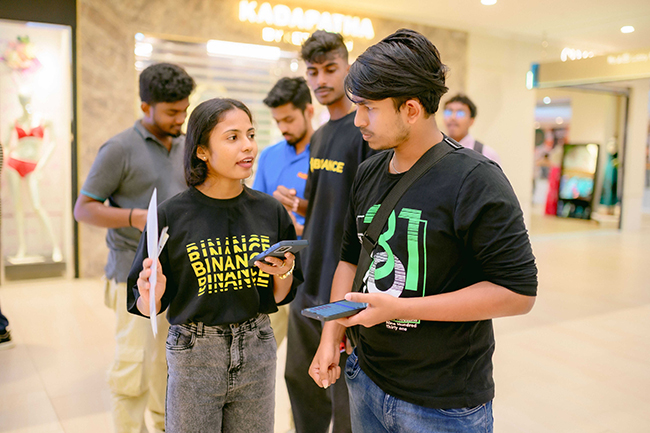
In an industry often characterised by velocity, volatility and viral marketing, Binance’s latest community activation in Sri Lanka suggested a deliberate recalibration of its investor messaging.At its #BinanceHODLove event held at One Galle Face Mall, the world’s largest crypto exchange by trading volume chose a Valentine’s-themed slogan that stood out for its restraint: “Real Love Doesn’t Rush, Neither Should Crypto: A Valentine’s Message for Smart Investors.”
Behind the seasonal branding lies a more strategic theme – one that aligns with the crypto industry’s post-cycle shift toward compliance, literacy and risk awareness.
Sri Lanka’s retail investor base has demonstrated periodic interest in digital assets, particularly during phases of currency pressure and global crypto rallies. Yet market participation has also exposed gaps in financial literacy and susceptibility to high-yield promises.
Binance’s messaging at the event leaned heavily into investor caution. Participants were reminded to scrutinise unsolicited offers, avoid guarantees of quick returns, and protect sensitive information such as private keys and passwords. In a market where informal crypto schemes have occasionally surfaced, such emphasis reflects reputational risk management as much as community engagement.
The company also spotlighted Binance Academy, its educational platform, positioning knowledge acquisition as foundational to long-term participation in blockchain ecosystems.
While the event featured raffles and consumer electronics giveaways to drive footfall, the broader objective appeared to be brand consolidation at the grassroots level. Physical activations in high-traffic urban centres suggested a hybrid strategy: digital scale complemented by localised trust-building.
For a global exchange operating in increasingly scrutinised regulatory environments, nurturing responsible retail participation is both a defensive and expansionary move. By framing crypto investing as a “measured journey rooted in knowledge and security,” Binance is aligning itself with the industry’s pivot toward sustainability rather than speculative exuberance.
The subtext of the campaign was clear: growth in emerging markets like Sri Lanka will depend less on price momentum and more on credibility.
Binance’s Valentine’s message, therefore, may be less about romance and more about risk calibration. In that sense, the slogan captured a broader industry truth: endurance, not impulse, will define the next phase of digital asset adoption.
By Sanath Nanayakkare

Morning gains on the Colombo Stock Exchange (CSE) evaporated sharply in afternoon trade yesterday, as a wave of nervous selling swept through the market triggered by speculation that the government is mooting a fresh 10-15 percent tax on unlisted corporates. Although the proposed levy is currently targeted at entities outside the CSE purview, market participants grew wary that the measure could signal a broader shift in fiscal policy, stoking fears of future tax hikes that may eventually engulf listed companies and dent corporate earnings.
Amid those developments, the turnover was capped at a mere Rs 369 million despite fourteen crossings.
The top seven crossings mainly contributed to the turnover were Commercial Bank 1.60 million shares crossed to the tune of Rs 359.7 million and its share price traded at Rs 223, Renuka Foods 2.7 million shares crossed to the tune of Rs 179.6 million and its share price traded at Rs 63.50, LOLC Holdings 300,000 shares crossed to the tune of Rs 171.9 million and its share price traded at Rs 573, Sampath Bank 821,000 shares crossed to the tune of Rs 132 million and its share price traded at Rs 161, Commercial Bank (Non-Voting) 484,000 shares crossed to the tune of Rs 98.9 million and its share price traded at Rs 204, Sierra Cables two million shares crossed to the tune of Rs 69.6 million and its share price traded at Rs 34.80 and Citizens Developments Business Bank (Non-Voting) 200,000 shares crossed to the tune of Rs 62.9 million and its share price traded at Rs 324.
In the retail market top seven companies that have mainly contributed to the turnover were Renuka Agri Rs 1.14 billion (82.4 million shares traded), Softlogic Finance Rs 653.9 million (115 million shares traded), Sampath Bank Rs 270.8 million (1.65 million shares traded), Softlogic Capital Rs 230 million (19.3 million shares traded), JKH Rs 201 million (nine million shares traded) ,LOLC Holdings Rs 171.9 million (297,000 shares traded) and LMF Rs 171 million (1.8 million shares traded). During the day 369 million shares volumes changed hands in 39059 transactions.
It is said that banking and agriculture related companies performed well. In the banking sector Sampath Bank and Commercial Bank performed well. Further manufacturing sector especially JKH also significantly active in the market.
By Hiran H Senewiratne

The Commercial Bank of Ceylon achieved another performance milestone in 2025, becoming the first private sector bank in the country to expand its loan book beyond Rs. 2 Tn., with a growth of Rs. 541 Bn. over 12 months at a monthly average of over Rs. 45 Bn., demonstrating its commitment to national economic resurgence.
Recording the highest annual loan growth in absolute terms in the history of the institution, the Bank said gross loans and advances for the year ending 31st December 2025 grew by 36.37% to Rs. 2.028 Tn., taking total assets to Rs. 3.258 Tn. This reflected an increase of Rs. 468 Bn. or 16.78% and demonstrated more than double the growth recorded in 2024. The Bank’s net assets value per share improved to Rs. 198.30 from Rs. 170.94 at end 2024.
Deposits grew by 16.65% or Rs. 372 Bn. over the 12 months to end the year at Rs. 2.6 Tn., reflecting an average deposit growth of over Rs. 30 Bn. per month despite relatively lower interest rates, the Bank said. The CASA ratio of the Bank, which is considered to be the industry’s best, stood at 39.65% from 38.07% as at 31st December 2024.
Sharhan Muhseen, Chairman of Commercial Bank said: “We remain focused on the fundamentals that sustain shareholder value: earnings resilience, balance sheet strength, disciplined risk management and a strategy that is responsive to evolving customer and market needs. Our 2025 performance affirms the value of that focus.”
Sanath Manatunge, Managing Director/CEO of Commercial Bank said: “In 2025, we proved that scale and discipline can move together, growing lending and accelerating digital activity while strengthening asset quality and balance sheet resilience.”
In a filing with the Colombo Stock Exchange (CSE) the Bank said it recorded gross income of Rs. 354.81 Bn. for the year ending 31st December 2025 reflecting growth of 13.70% over the normalised figure for 2024, after adjusting for the impacts of restructuring of Sri Lanka International Sovereign Bonds (SLISBs) accommodated in that year, in order to avoid potential distortion of growth figures. Net gains / (losses) from derecognition of financial assets in the Income Statement for 2024 (as reported) included a derecognition loss on restructuring of SLISBs amounting to Rs. 45.108 Bn.

In a virtual knockout, a fight of reputation and expectation

Iran launches attacks across Middle East after US and Israel strikes on leadership sites

A committee will be appointed to formulate a national policy on medical education – PM

South Africa vs Zimbabwe, this time for Africa

ICC monitoring Middle East conflict as airspace closure hits travel plans

Sri Lanka make two changes and bowl; Pakistan drop Babar and Ayub

‘Dates have the highest sugar content to fight Coronavirus’

Sunday Island 27 December – Headlines

#SundayIsland 17th December – Headlines

Sunday Island – 28th March

Sunday Island Headlines – 21 March

Sunday Island – 21st February – Headlines
-
 Features7 days ago
Why does the state threaten Its people with yet another anti-terror law?
-
 Features7 days ago
Reconciliation, Mood of the Nation and the NPP Government
-

 Features7 days ago
Victor Melder turns 90: Railwayman and bibliophile extraordinary
-

 Features6 days ago
LOVEABLE BUT LETHAL: When four-legged stars remind us of a silent killer
-
 Features7 days ago
Victor, the Friend of the Foreign Press
-

 Business6 days ago
Bathiya & Santhush make a strategic bet on Colombo
-

 Business6 days ago
Seeing is believing – the silent scale behind SriLankan’s ground operation
-

 Features7 days ago
Barking up the wrong tree