
Latest News
South Africa vs Zimbabwe, this time for Africa


Geopolitics have given cricketing neighbours, particularly in South Asia, a bad name in recent times. But not in Africa.
The continent’s two Full Members, South Africa and Zimbabwe, are enjoying successful T20 World Cups and will finally cross paths in Delhi on Sunday, which is expected to be a celebration of their journeys so far.
South Africa are already through to the semi-finals and more than likely to top their group. Though Zimbabwe are out of the running, they have achieved their best T20 World Cup finish and will avoid going through the qualifiers for the next edition. Neither have any worries – certainly not the kind that will take place in another part of the country, Kolkata, where India take on West Indies with qualification for the semi-finals still unresolved – and the mood is jovial.
There have been coffee and drinks dates, not least because Zimbabwe’s coach Justin Sammons used to be South Africa’s batting coach and there would have been some reminiscences about Zimbabwe’s role in helping South Africa prepare for the World Test Championship. Last June, Zimbabwe extended their time in England to play a tour match against the South Africans in Arundel. The most exciting thing to happen then was Kagiso Rabada breaking Ben Curran’s hand, but Curran is back on the circuit and there’s no bad blood.
Then South Africa, fresh off their Test mace win, had no time for a trophy tour at home because they had a series scheduled in Zimbabwe, which included Tests for the first time in 11 years. Hosting the champions, who happen to be the guys next door, was a treat in a bumper year for Zimbabwe and it barely mattered that Craig Ervine’s side was humbled. Wiaan Mulder retiring on 367* to avoid overtaking Brian Lara’s Test record was as much about his respect for a great of the game as it was for the game itself: South Africa had enough runs and there was no need to rub the neighbours’ noses in it.
South Africa went on to beat Zimbabwe in both fixtures in a T20I series but lost the final to New Zealand. Castle Corner, Zimbabwe’s life-of-the-party supporters, was cheering for South Africa, which tells you all you need to know about the feelings between these two sides.
The current relationship is cuddlier than ever, especially as they are two of the three co-hosts of the 2027 ODI World Cup (Namibia is the third) and there is no tension in the contest. Apart from Zimbabwe’s win over South Africa in the 1999 ODI World Cup – a result which had massive ramifications as it played its part in South Africa missing out on the final – South Africa’s path has run completely differently to Zimbabwe’s. For years, they didn’t play each other and as South Africa’s domestic game has creaked under its own financial pressures, Zimbabwe are no longer as involved as they were in the 1990s.
The recent thaw in relations comes as the Africa Cricket Association tries to resurrect itself – or just get going – and there are whispers of continental T20 tournaments. But only whispers. There’s also the rumour of an ODI tri-series in August, when South Africa and Namibia could travel to Zimbabwe to inaugurate the new stadium at Victoria Falls. South Africa did the same when they took a team to Windhoek to open the Namibia Cricket Ground, and were stunned by a plucky Namibia team that brat them. Considering the run South Africa are on now, maybe that was just another case of the guys next door being the firestarters.
But for all the goodwill, there are still some hostilities between South Africa and Zimbabwe, particularly at a social level. As a nation, South Africa struggles with a brand of xenophobia that is trained on migrants from elsewhere on the continent – it’s so acute it has been dubbed Afrophobia. As Zimbabweans make up the largest expat population in South Africa and run much of the country’s service industry by working in hospitality and homes, they often find themselves as targets of violent attacks. It’s a stain on a South Africa that owes Zimbabwe a great debt for the role it played in the anti-Apartheid struggle and the fight for freedom.
South Africa may argue it pays that in other ways and does its bit where it can for Zimbabwe. One example is in football. Because none of Zimbabwe’s football stadiums are FIFA sanctioned, they play their home games in South Africa, on world-class pitches. And that was also handy when South Africa and Zimbabwe were drawn in the same qualification group for this year’s football World Cup. South Africa beat Zimbabwe 3-1 in their first meeting and then needed to win the return match to secure qualification. In what was a Zimbabwe “home” fixture in Durban, Zimbabwe’s Warriors proved pesky and held South Africa to a goalless draw. Ultimately, it only delayed South Africa’s progression to the main tournament by three days so no major damage was done, so to speak.
Zimbabwe won’t be at the tournament, which will feature nine African sides (and possibly a tenth after playoffs are decided) but will be at next year’s rugby World Cup for the first time in 36 years. They are also now guaranteed a spot at the 2028 T20 World Cup, which creates the opportunity for two other African sides to qualify and removes some of the pressure that has sat on Zimbabwe for the last eight years. They have ridden all the emotions of nearly and not quite getting to the 2019 and 2023 ODI World Cups and 2024 T20 World Cup and suffered the financial consequences of missing out, sometimes tragically.
The late Heath Streak and his entire coaching staff was sacked after Zimbabwe missed out on qualification in 2019 and Streak was later banned for breaching the anti-corruption code. While serving his time, he was diagnosed with cancer and died in September 2023. How he would have loved to see the turnaround of a team he gave everything for, to know of the redemption of Brendan Taylor, who also fell foul of the ACSU, and see the rise of a new crop of Zimbabwe fast bowlers.
Streak’s story and particularly his death affected me deeply, mostly because he was always a presence in my coverage of Zimbabwe cricket, which ESPNcricinfo readers will know is quite personal. So do allow me a moment here:
I was first sent to Zimbabwe in 2011, to cover their Test comeback after six-and-a-half years out of the longest format, and fell in love with everything there. I was welcomed with open arms into a cricket community that felt familiar, almost like the clubs I used to keep score for as a teenager, but was also a fully-fledged international set-up. Reporting on their progress and setbacks was complicated and interesting. I went back more times than I need to count and Zimbabwe became a second home and a safe haven.
Between 2013 and 2016, Cricket South Africa cut two reporters off from what they called “special privileges”, which included basic things like receiving press releases or any game-related information. I was one of them. I was still fairly young in my career and was already fighting against the status quo as a woman in a male-dominated field and the extra challenge threatened to become too much. I considered walking away many times but one of the only things that kept me in it was the relationship I built with Zimbabwe and the stories I got to tell from there. I never got to thank them but I hope I can now.
For bringing joy, and reminding me – and everyone – of our resilience as people, thank you Zimbabwe.
At the same time, it has never been a better time to be a sports reporter in South Africa. The recent and regular excellence of all our sporting codes (have I mentioned yet that South Africa are four-time rugby world champions?) has been thrilling. I have seen sport unite our country across gender, race and class lines in a way I had never imagined possible. For showing that we are truly stronger together, thank you South Africa. This time for Africa.
[Firdose Monda for Cricinfo]

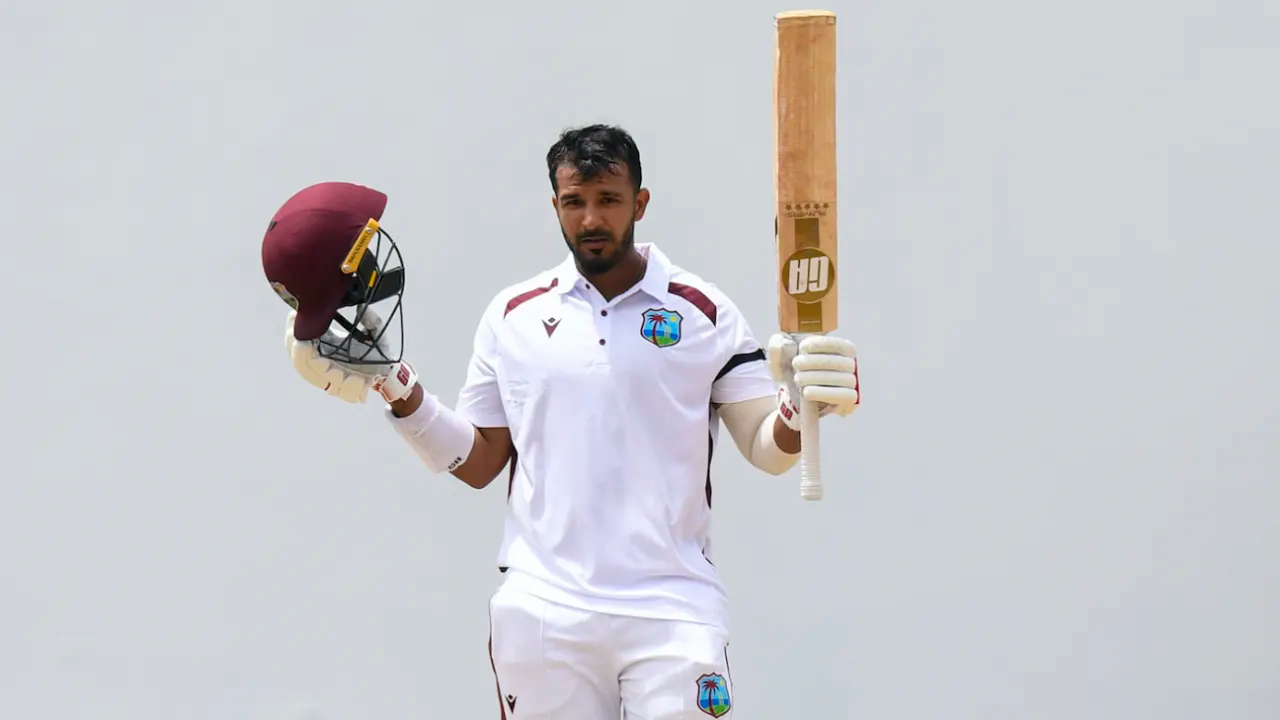
Amir Jangoo amassed 233, RostonChase hit 194, and through a record-breaking 401-run partnership, the pair slow-roasted Sri Lanka on day three in Antigua. Their gargantuan stand delivered West Indies to a position of extraordinary strength, securing them a 318-run first innings lead. That in the four overs they got to bowl at Sri Lanka, West Indies dismissed the dangerous Pathum Nissanka, and created other chances, buoying them further heading into day four.
Jangoo and Chase now not only have the highest sixth wicket stand in the history of Test cricket, they also have the second highest partnership for West Indies, behind only Garfield Sobers and Conrad Hunte. Both batters improved on their previous first-class high scores, Chase easily beating his 137 not out, and Jangoo surpassing his domestic 218.
That Jangoo produced a knock of such astonishing concentration, and expansive range, in just his third Test innings was especially impressive. Until he got out attempting to accelerate about midway through the last session, his innings was largely chanceless. He batted 373 deliveries on his own, and he and Chase batted 100.2 overs, seeing out three complete sessions together. Though they had begun slowly, both batters sped up through the day and were finding boundaries off both the quicks and spinners through the second and third sessions of the day.
Sri Lanka’s attack found the pitch utterly docile for most of day three. They were missing their fastest quick Lahiru Kumara, who went off the field with a hamstring niggle early the previous day. Their quicks were earnest in the first hour, but once Jangoo and Chase saw out the second new ball (the ball was four overs old when day three began) with a period of disciplined batting, Sri Lanka’s quicks lost some venom, and captain Dhananjaya de Silva went increasingly to his spinners – Sonal Dinusha in particular.
The one exception for Sri Lanka was Milan Rathnayaka, who was intense in each of his day three spells, and created chances even in a dreary second session, having Chase dropped by a diving wide slip for 108. Later in the day, it would be Rathnayaka who would break the enormous stand, and would go on to complete a well-deserved five-wicket haul, finishing with 5 for 124. Dinusha, the left-arm spinning allrounder, conceded 234 runs himself in this innings, though he did also pick up two wickets, including that of Chase.
Patience had defined Jangoo and Chase’s batting in the first hour. Jangoo, for example, didn’t score off the first 15 deliveries he faced on day three, while Chase was only marginally less defensive. When conditions began to ease after the first hour, however, they began to slip into more fluent modes of operation. In the afternoon session, when the pair really propelled West Indies into the ascendancy, they plundered 136 runs at a rate of more than five an over. Jangoo was especially strong square of the wicket on the offside and down the ground. Chase was excellent through the covers. Jangoo, additionally, would sometimes tonk the spinners over the straight boundary.
Right through the day the pair would notch up milestones – both for themselves, and the partnership. The milestone that drew the most raucous celebration came soon after tea, when Jangoo completed his double with a sweep through square leg, leaping in the air as he took off for the run. Although only hundreds were in attendance, the house was on its feet for him, coach Daren Sammy and the West Indies dressing room giving him an especially warm ovation. Having come into the XI only as a replacement player for the injured Shai Hope, Jangoo has essentially made himself undroppable for the second Test.
After tea the pair took the scoring up even one further gear, Jangoo hitting some memorable sixes over square leg, while Chase continued to drive powerfully. Jangoo was out attempting to repeat a pulled six though the ball was not quite short enough for that shot. The resultant top-edge was gobbled up by the wicketkeeper. Chase was out much later, under-edging Dinusha into his stumps when a sweep went awry. He was six short of what would also have been his first double century.
Rathnayake would take two further wickets before West Indies declared the innings. Nissanka was out caught behind feeling for a Jayden Seales away-swinger first ball of the second over. Nightwatcher Kasun Rajitha could have been out too, had Jangoo at short leg held a sharp, low chance off the bowling of Kemar Roach.
Scores:
Scores: Day 3 Stumps
Sri Lanka 308 and 15 for 1 (Kasun Rajitha 4*, Nishan Madushka 2*; Jayden Seales 1-5) trail West Indies 626 for 9 dec (Amir Jangoo 233, Roston Chase 194; Milan Rathnayaka 5-124) by 303 runs
[Cricinfo]

For a second day in a row, the United States has launched strikes against Iran, once again citing an attack against a commercial vessel as a motivation.
Saturday’s renewed attacks are the latest indication that a regional Middle East ceasefire, established as part of a June 17 memorandum of understanding (MOU), might be at a breaking poInt.
In a statement, the US Central Command (CENTCOM), which directs military action in the Middle East, explained that the latest attacks came “at the Commander in Chief’s direction”.
“CENTCOM forces launched strikes today in direct response to continued Iranian aggression against commercial shipping,” it wrote.
“U.S. military aircraft targeted Iranian military surveillance infrastructure, communication systems, air defense sites, drone storage facilities, and minelayer capabilities.”
[Aljazeera]

India suffered a potential injury scare ahead of the Test series in Sri Lanka, with their No.3 B Sai Sudarshan retiring hurt on 7 while playing for India A against Sri Lanka A during the third day of the first four-dayer in Galle. After scoring a century in the first innings, Sai Sudharsan retired hurt in the fourth over of India A’s second innings. By the end of the day’s play, however, India A had stretched their lead to 170.
Chhattisgarh opener Aayush Pandey and Devdutt Padikkal were unbeaten on 20 each at stumps.
India A had claimed a first-innings lead of 122 after dismissing Sri Lanka A for 330 in their first innings. Resuming from an overnight 113 for 2, they were guided by half-centuries from captain Sahan Arachchige (72) and Ashen Bandara (70). Nuwandi Fernando, who had passed his own fifty on day two, had his innings cut short on 84 on day three.
For India A, Auqib Nabi, who was the top wicket taker in the previous Ranji Trophy season and was a net bowler during India’s one-off Test against Afghanistan in New Chandigarh, was the pick of the bowlers, returning 4 for 58 in 19.4 overs. Sri Lanka A lost their last five wickets for 30 runs, with Nabi taking four of those.
Left-arm fingerspin-bowling allrounder Harsh Dubey and Vidarbha fast bowler Yash Thakur picked up two wickets apiece. India A then closed out the day on 48 for 0.
Scores:
India A 48 for 0 in 17 overs (Devdutt Padikkal 20*, Ayush Pandey 20*) and 452 for 6 dec in 111.4 overs [Sai Sudarshan 132, Dhruv Jurel 141, Shaik Rasheed 63; Chamika Gunasekera 3-64, Dilum Sudeera 2-143] lead Sri Lanka A 330 in 101.4 overs (Nuwanidu Fernando 84, Ashen Bandara 70, Sahan Arachchige 72; Aaqib Nabi 4-58, YashThakur 2-51, Harsh Dubey 2-84) by 170 runs
[Cricinfo]

Zafar, Feroza lead Pakistan to consolation win

Jangoo 233, Chase 194 put West Indies in commanding position

Showers will occur at times in the Western, Sabaragamuwa and North-western provinces and in Galle, Matara, Kandy and Nuwara-Eliya districts

Venezuelans dig for earthquake survivors as death toll rises to 1,430

Chemmani mass graves: Govt to seek international forensic help

ADB approves $57.4 million package to boost Lanka’s rooftop solar drive

‘Dates have the highest sugar content to fight Coronavirus’

Sunday Island 27 December – Headlines

#SundayIsland 17th December – Headlines

Sunday Island – 28th March

Sunday Island Headlines – 21 March

Sunday Island – 21st February – Headlines
-

 Features7 days ago
Sri Lanka developing independent hydrographic capabilities
-
 Opinion6 days ago
Ranasinghe Premadasa: The man who would not take ‘No’ for an answer
-
 News1 day ago
Another 1,132 Sri Lankan Personnel to be deployed for United Nations Peacekeeping Missions
-

 Opinion5 days ago
Sri Lanka’s national security: Justice, reconciliation, and forward-looking vigilance
-

 News5 days ago
US Assistant Secretary of State for South and Central Asian Affairs meets President
-

 News3 days ago
Kelaniya emerges as highest ranked Lankan uni in Times Higher Education Sustainability Impact Ratings
-
 Opinion4 days ago
A triumph for Pakistan’s skilled diplomacy at Iran-US talks
-

 Business7 days ago
University of West London opens Sri Lanka’s first full UK university branch campus