
Sports
Sri Lanka’s fans, its establishment, and the growing distance between them

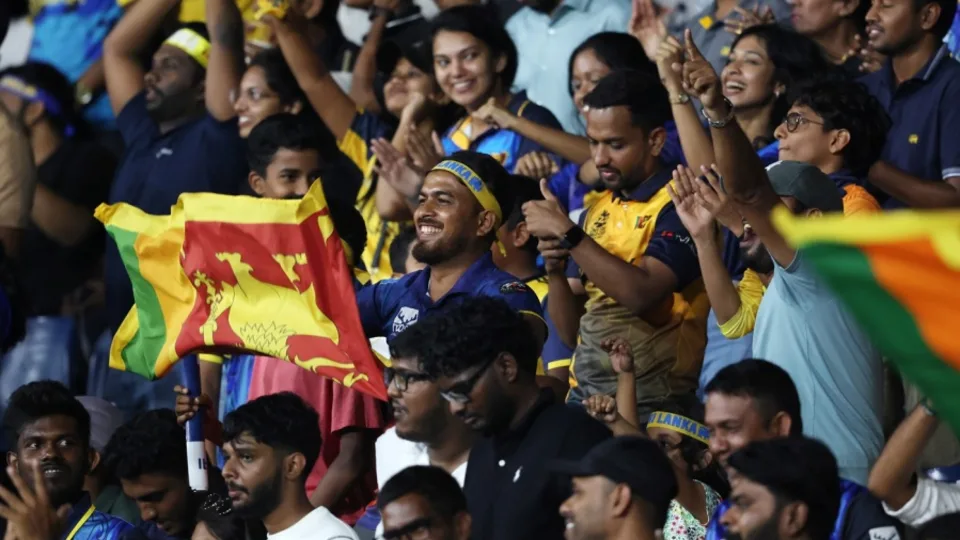
As Sri Lanka were tanking their must-win Super Eights match of the men’s T20 World Cup 2026 at Khettarama, fans in a packed Khettarama stadium began ironically chanting for New Zealand.
Irony tends to come naturally to Sri Lanka fans, like sarcasm, and self-deprecation, as well as supporting other teams now, because for 12 years no senior national side from Sri Lanka has made a global tournament final, and if you like watching cricket you have no choice but to find another outlet for your hopes. “I’m happy, obviously,” said one woman leaving Khettarama when she was asked how she felt after Sri Lanka’s humbling at the hands of New Zealand. “Why, I’m a New Zealand supporter, no?” She and her group were decked out in Sri Lanka gear and she was speaking entirely in Sinhala. She laughed as she slipped out of frame.
Sri Lanka fans could switch off cricket entirely. This would be the rational choice. And yet they are helplessly, addictedly, devoted.
Other sports, bless them, have tried to break through on the island. As a spectator experience, Premier League football has infiltrated the urban English-speaking classes, but on the playing front Sri Lanka’s own football remains as modestly-supported as it has always been. Rugby – always popular among Sri Lanka’s wealthy – had a flutter in the 21st century, when it was patronised by the once-powerful Rajapaksa political dynasty. But its fandom mostly remains locked in the higher echelons of Sri Lankan society.
On almost any journey through Sri Lanka, you are likely to find 50 softball cricket games to every tap-rugby or football match. You’ll find kids who can mimic Jasprit Bumrah’s action, but don’t so much as know who Cristiano Ronaldo or Richie McCaw is. Cricket is, without question, the game of Sri Lanka’s masses.
Through the course of the three successive Sri Lanka defeats that saw them crash out of the World Cup, many Sri Lanka fans claimed to television news reporters that they will never spend money to come to another match as they angrily left stadiums. Social media was rife with disavowals of Sri Lankan cricket.
But we have the long-view data on Lankan fans. Whenever the men start to win, the stadiums pack out. When in 2024, the women made a charge to the Asia Cup final, a raucous full house exulted in Dambulla when they won. In this tournament, a single win over Australia was enough for Sri Lanka fans to buy out all three of their Super Eight fixtures.
Where West Indies’ decline in the longer formats has partially been put down to the infiltration of American sports in the Caribbean, Sri Lanka’s public loves cricket to such an extent that it has shown no serious ambition to develop an alternative passion. Their problem is there is no way to turn their anger at the national teams’ failures into change at the administrative level. They have no means through which to hold this system accountable.
****
Sri Lankan cricket’s financial reality is that on a global scale, a country of 22 million (the population is possibly shrinking) barely registers in comparison to its neighbours’ economic heft. This is especially true in the last few years, when Sri Lanka has run into cataclysmic economic trouble, the 2022 meldtown depressing advertising revenues for years.
But geographically the island sits in the most-profitable time zone for cricket. Broadcasters know that even if the Sri Lankan market is limited, they can sell ads from Sri Lanka matches in Indian prime time, where revenue streams are strong. Sri Lanka’s cricket board has been awake to this shift in the past dozen years, and now understands that it is foreign viewership that generates the majority of its income. This is partly why, over the last several years, Sri Lanka Cricket (SLC) has leapt into the lap of the BCCI, when as recently as 2014, SLC had been a dissenter to the Big Three programme at the ICC. Looking after the home market is useful, if only to maintain the perception of cricketing health to a global audience. But it is the neighbour who looks after the bottom lines.
This dynamic lets SLC treat Sri Lankan cricket with surprising disdain. Take their extraordinary suspension from the ICC in late 2023, for instance. Soon after Sri Lanka’s men crashed out of the 2023 World Cup, SLC president Shammi Silva had asked for his own board to be temporarily be cast out by the ICC due to political intereference, in order to win a domestic battle against then sports minister Roshan Ranasinghe. Silva never admitted that he himself had asked for the suspension, but he never denied it either, joking only that if his powers of diplomacy were so impressive, he deserves a higher position than just Sri Lanka cricket’s head honcho.
That this move cost Sri Lanka hosting rights to the Under 19 Men’s World Cup in early 2024 caused little distress at the board, but did create problems for Sri Lanka’s Under-19 cricketers, who had trained for months for a home World Cup, only to have to eventually travel to South Africa for the event. The Sri Lankan spectators that may have turned up to this World Cup were barely an afterthought. Local businesses also had potential revenue whisked away. But in having the sports minister sacked through the course of all this high-level hijinx, SLC achieved its major objective, however.
There is also the Lanka Premier League (LPL) in which, incredibly, home audiences have also been an afterthought. What is supposed to be SLC’s flagship T20 product has been little more than franchise-owner roulette, owners almost uniformly uninterested in sticking around for more than a couple of seasons, and even less bothered with developing local fanbases, as any number of IPL, or PSL teams have done.
In the first season of the LPL, Jaffna Stallions had begun to engage fans in the northern city which for decades had been cut off from Sri Lankan cricket by war. By the beginning of the next season, Stallions – who had won the first tournament – had been tossed out by SLC largely for business reasons with a higher bidder poised to come in. The Dambulla franchise has been Dambulla Viiking one year, Dambulla Giants the next, Dambulla Aura for two years, then rebranded as Dambulla Thunders until one of its potential owners was arrested under Sri Lanka’s sports corruption law, and then Dambulla Sixers the last time the LPL was played.
Building a tournament brand season-on-season, ensuring a high level of competition through which players may hone skills, attracting quality overseas talent both on the coaching and playing fronts – these are all secondary and tertiary considerations to picking up the next franchise cheque. This tournament has now not been played since July 2024, SLC’s official reason for cancelling it in 2025 having been the unavailability of grounds, which were getting upgrades ahead of this T20 World Cup. Even by SLC’s own logic this is an admission of dizzying incompetence. SLC had known it was hosting this World Cup years ago. On top of which, canceling the nation’s top men’s T20 competition precisely in the same season the team is due to compete in a home World Cup is almost glorious in its stupidity.
In fact, stadium upgrades were not the real reason for the LPL’s cancellation – grounds at Khettarama and Pallekele did not require substantial overhauls, and venues in Dambulla and Hambantota (which were not used in this T20 World Cup, but have both hosted LPL games in the past), were unused in any case. The real reason for its cancellation is perhaps more embarrassing: the tournament’s brand had become so toxic, that it was struggling to attract even the substandard franchisees it had previously drawn. No firm dates have been announced for a 2026 LPL.
SLC has also crowed about its financial health over the past several years, publishing audited accounts while holding press conferences to advertise its solvency. And yet the men’s Test team has only four matches on its schedule this year. The women’s team (who while the men have crashed out of the World Cup, have just won a bilateral series in the Caribbean), had also seen their schedule obliterated during the Covid-19 years, Sri Lanka’s one remaining superstar cricketer – Chamari Athtapaththu – losing 24 prime run-making months from her career.
In the 12 years since a senior Sri Lanka team last reached the knockouts of an ICC final (the men didn’t even qualify for last year’s Champions Trophy), there has been significant turnover in coaching personnel – Marvan Atapattu, Graham Ford, Chandika Hathurusingha, Mickey Arhtur, Chris Silverwood, and now Sanath Jayasuriya now all having failed in various attempts to return the men’s side to a modicum of its former glory. In that stretch, Sri Lanka has had at least 10 T20I captains, ranging from Lasith Malinga, to Charith Asalanka, to Angelo Mathews, to Kusal Mendis. Selectors, like players, have been tried and discarded.
At the highest levels of the board, Silva is currently serving his fourth consecutive term as president of SLC, having been voted in uncontested yet again by a compliant body of members. The board’s key positions continue to be filled by Silva loyalists, while CEO Ashley de Silva has been in situ for more than a decade.
Among the public, the Sri Lankan board has long been among the most reviled public-facing institutions in the country, a consensus having developed that SLC is little more than a den of sycophants and profiteers, and that only root-and-stem removal will bring lasting positive change. But why should their ire matter to the board? Even on the financial front, the local cricket supporter is increasingly irrelevant to Sri Lanka’s cricketing governance.
****
“No matter how we as cricketers try to stay positive, there is negativity outside” said Sri Lanka captain Dasun Shanaka, after his team collapsed against New Zealand and became the first Super Eight team to be eliminated from the T20 World Cup. “That’s a big loss for Sri Lankan cricket. This is the only sport we have, and I don’t know if we’ll be able to protect it. If you look outside the stadium, you’ll see how many people are standing outside with mics, and people will say stuff without having watched the match.”
Having complained about how fans were treating the team, he went on to make a suggestion that was astoundingly tone-deaf: “We will play and leave, but if for the players who will come in the future, if the government can even stop it [the negativity] that’s better for their mental health.”
Shanaka is merely the latest log to be fed into the woodchipper of Sri Lankan cricket, so perhaps his comments do not deserve to be taken especially seriously, particularly as Sri Lanka cricketers face significantly fewer challenges in their day-to-day lives than do cricketers elsewhere in South Asia, and the media environment is not especially malicious by global standards. But the comments do reveal something else: so long has the men’s team been in decline, that some players have begun to develop loathing towards their own supporters.
Supporters, meanwhile, have also begun to clock that top cricketers’ lifestyles – often as advertised on social media – are out of step with their achievements for the national side. Comments sections bear this out. A classic top comment on a player’s post about the restaurant he visited, or a watch he has just bought might go, in Sinhala lokka, velaavak thibunoth vitharak cricketuth poddak gahanna. Essentially: “boss if you have some time between all this, please also play some cricket”. Irony, as mentioned up top, comes naturally.
It might be simpler for all parties if they merely refused to show up to these matches. Players will still earn their salaries and match fees, the source of these monies now increasingly foreign, particularly if they play in the leagues. SLC can continue to strike lucrative deals without having to contend with the island’s own hurting audiences.
And still, kids still race home from school to play cricket at the local ground with their friends, parents around the island still load up kit-bags into trishaws to take kids to training, and the moment either the men’s or women’s team shows even a glimmer of promise, the nation finds itself hopelessly gripped.
They will likely turn up to Pallekele for their final match of the World Cup, having bought out the fixture soon after Sri Lanka qualified for the Super Eight. What will they do there? Hate-watch? This particular fanbase-board-cricketer dynamic is perhaps unlike anything else in the cricketing world, and in the past Pallekele crowds have not been shy to make their displeasure felt. We are in uncharted territory on this one.
Whatever happens on Saturday, both players and board will fear the crowd’s ire, because for one more night at least, the world’s eyes are here. The players will have to show up of course, but Silva, the SLC president, may not ask to be shown on television and talked about, as he often does when the team is winning. Through their unyielding affection for the game, Sri Lanka’s fans have become a thorn in the establishment’s side.
[Cricinfo]


Ireland Women 118/9 in 20 overs (Alana Dalzelle 14, Orla Prendergast 26, Leah Paul 10, Alice Tector 10, Louise Little 26*; Lauren Bell 1-39, Linsey Smith 1-20, Sophie Ecclestone 3-22, Charlie Dean 2-11, Dani Gibson 2-10) lost to England Women 119/6 in 17.3 overs (Dani Wyatt Hodge 16, Nat Sciver-Brunt 48, Heather Knight 26; Aimee Maguire 2-23, Orla Prendergast 2-17) by 4 wickets
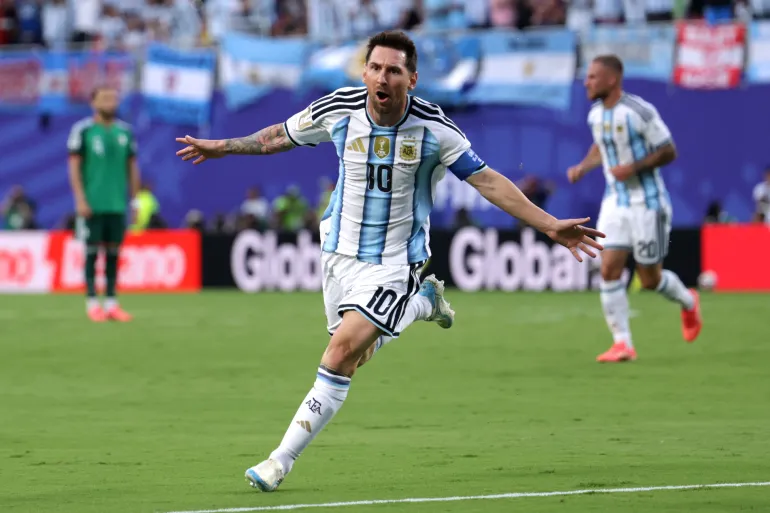
Lionel Messi marked his record sixth World Cup appearance with his first hat-trick at a FIFA tournament as Argentina beat Algeria 3-0 to open the defence of their global crown, he also became the joint highest scorer at World Cups with the feat.
The former 38-year-old forward thought he had opened the scoring in the eighth minute in Kansas City on Tuesday when he slotted home from close range, but the offside flag was raised.
The dream start to his record-setting appearance, which will be matched by Cristiano Ronaldo for Portugal against DR Congo on Wednesday, was not to be denied for long though.
A trademark, mazy run was capped by a drive on the edge of the box from that famed left foot. The power too much for Algeria keeper Luca Zidane, son of World Cup winner with France, Zinidine.
Messi doubled his tally on the hour mark with a simple tap in from a rebound off the keeper following a drive from Alexis Mac Allister.
The moment that even a player as decorated as Messi came in the 76th minute when he drilled low past the keeper from just outside the box.
The strike took Messi level with former Germany striker Miroslav Klose on 16 World Cup goals.
His substitution came just three minutes later to a standard ovation, even old maestro seemed disappointed to be removed – and most likely rested for Argentina’s tilt at becoming only the third side to defend a World Cup title.
Algeria – the 2019 Africa Cup of Nations winners – offered little, but were themselves denied an early goal when Fares Chaibi’s ninth minute strike was ruled out for offside.
Messi saw to it that there was no opening game upset to be had tat this edition, having lost their opening game at Qatar 2022 to Saudi Arabia.
Messi, who spent the majority of his club career in Spain with Barcelona before moving to French giants Paris-Saint Germain, plys his trade in US football’s Major League Soccer with Inter Miami.
Jordan and Austria open their account in the group later on Tuesday in San Francisco.
[Aljazeera]
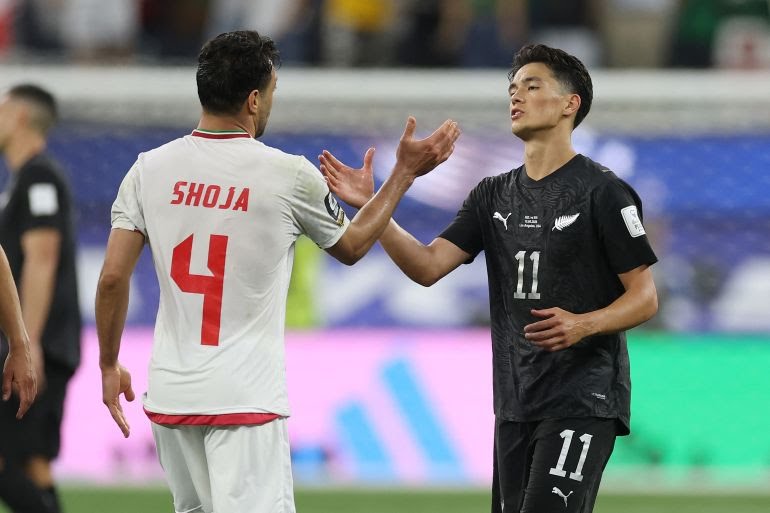
Iran twice came from behind to draw 2-2 with New Zealand in an exciting World Cup clash at Los Angeles Stadium as protests against Tehran’s government and a peace deal signed to end the US-Iran war formed a charged backdrop to the match.
High security presence and protests outside the venue were among the off-field concerns surrounding the match on Monday.
And when New Zealand took an early lead through Elijah Just’s volleyed shot from inside the box, after being set up by Chris Wood, some fans critical of the Iranian government celebrated with New Zealand supporters.
Many of these anti-regime spectators also carried Iran’s pre-Islamic Revolution Lion and Sun flag, against FIFA’s rules. Several also booed Iran’s national anthem before kickoff.

But most of the crowd of more than 70,000 appeared firmly behind Team Melli, chanting “Ir-ran! Ir-ran!” and erupting when Ramin Rezaeian equalised shortly after the half-hour mark.
Rezaeian, one of several Iran players who had not played club football since February after the domestic league was suspended amid US and Israeli air strikes, reacted quickest to a blocked shot and poked the ball past the advancing goalkeeper.
Wood and Just combined again early in the second half, the New Zealand captain sliding a precise pass into the 26-year-old forward’s path before Just hammered home to restore the All Whites’ lead.
Iran responded 10 minutes later with a superb goal from Mohammad Mohebbi, who headed Rezaeian’s perfect cross in off the far post to make it 2-2.

The stalemate means all the teams in Group G have one point after Belgium drew 1-1 with Egypt earlier on Monday.
New Zealand, making their third appearance at the tournament, remain without a win at a World Cup after seven matches. Iran are looking to reach the knockout round for the first time.
The match laid bare divisions among Iranian American fans, many of whom said they felt torn between pride at seeing Iran on the sport’s biggest stage, anger over Tehran’s crackdown on protesters and concern over Washington’s bombing campaign.
Before kickoff, about 300 to 500 protesters gathered outside the stadium, waving anti-government signs and flags.
Some Iranian Americans had said attending the match would imply support for Iran’s government, while others said they wanted to set politics aside and support the players.
Iran will next return to Los Angeles to face Belgium on Sunday when New Zealand take on Egypt in Vancouver.
[Aljazeera]

Spinners make it two in two for England

Messi hat-trick fires holders Argentina to win over Algeria at World Cup

‘Dancing girl’s’ bare torso restored in Indian textbook after backlash

Tehran selling deal with US as victory – but for Iranians it was necessity

Plans to open underutilised state land for new investment opportunities

National Export Development Plan (2026–2030) presented to the President

‘Dates have the highest sugar content to fight Coronavirus’

Sunday Island 27 December – Headlines

#SundayIsland 17th December – Headlines

Sunday Island – 28th March

Sunday Island Headlines – 21 March

Sunday Island – 21st February – Headlines
-
 News5 days ago
CIABOC summons Yoshitha over his participation in British Navy training programme
-

 Sports2 days ago
Tharanga set for high-profile javelin clash in Ostrava
-

 News5 days ago
Justice Minister responds to social media claims he represented Easter Sunday ringleader
-

 News4 days ago
Commonwealth lawyers urge Lanka to uphold rule of law
-

 Features3 days ago
Politics of protected species
-

 News2 days ago
Theft of USD 2.5 mn from Treasury: CoPF accused of complicity in NPP cover-up
-

 News1 day ago
Beijing Capital Airlines to resume flights to Colombo signalling boost to tourism
-

 News2 days ago
Release of 2025 O/L results likely to be delayed