
Latest News
Sheikh Hasina wins fifth term in Bangladesh amid turnout controversy

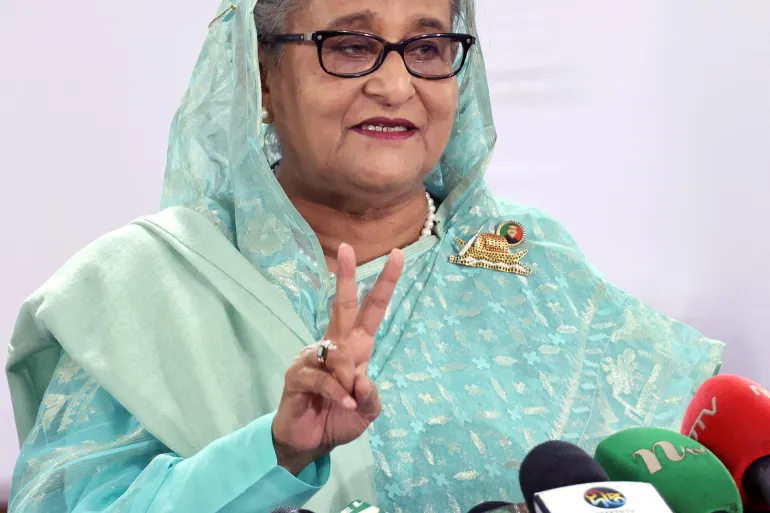
Sheikh Hasina has secured her fifth term as Bangladeshi prime minister in an election whose outcome was decided the moment its schedule was announced in early November when the main opposition boycotted the poll.
The surprise was who came second.
Instead of any political party, independent candidates secured a total of 63 seats, the second highest after Hasina’s Awami League (AL), which won 222, creating a problem of finding a parliamentary opposition.
The current opposition, the Jatiya Party, managed to secure just 11 of the 300 parliamentary seats, according to the Elections Commission.
Almost all the winning independent contenders were people who had been rejected by the AL but were asked by the party leadership to stand as “dummy candidates” to give the election a competitive veneer in front of the world.
“This is a bizarre outcome of a bizarre election,” Shahidul Alam, a renowned Bangladeshi rights activist and photographer, told Al Jazeera. “Dummy candidates in a dummy election will now lead to a dummy parliament.”
Shunned by the Bangladesh Nationalist Party (BNP) – the AL’s main political opponent – which wanted the balloting held under a neutral entity instead of Hasina’s administration, Sunday’s “one-sided election” was just a “mere formality” to put Hasina back in power again, analysts say.
The only suspense, they added, was voter turnout, after Western governments put pressure on Hasina’s government to ensure a free, fair and participatory poll.
After polling closed at 4pm (10:00 GMT on Sunday), the Election Commission (EC) said turnout was 40 percent. But many were doubtful it was even that high. “I don’t know about the rest of the country but I think I have not seen such an empty Dhaka in years,” Abdullah Yusuf, an engineer in the Dhanmondi area of the capital, told Al Jazeera. “It felt like the initial COVID days. I crossed two polling centres midday and didn’t see many people besides Awami League activists who were wearing badges. EC’s claim of 40 percent is quite absurd.”
Some analysts, meanwhile, pointed to confusion at the EC announcement. “It’s hard to believe the turnout was 40 percent, especially given the fact that the chief election commissioner himself uttered 28 percent first while briefing the media and then changed it to 40 percent all of a sudden,” said Sakhawat Hossain, a former election commissioner.
The turnout figure, which was shown on the dashboard at the EC headquarters hours after the briefing, was 28 percent, and a photo of it was widely circulated in the country’s social media and received criticism. Al Jazeera checked and verified that figure. EC earlier declared at an hour before the poll closing that the turnout was about 27 percent. Al Jazeera visited at least 10 polling stations across the capital Dhaka in the last hour and did not see any voters.
Sharmin Murshid, the head of the reputed election observer organisation Brotee, told Al Jazeera that a jump from 27 to 40 in a span of an hour or so was “ridiculous” and had “tainted the EC reputation severely”. “It was a sure way to further lose the confidence of the people and credibility which it did not have to start with,” she said. “This was not an election, rather it was an exercise in casting votes by one party for one party,” she added.
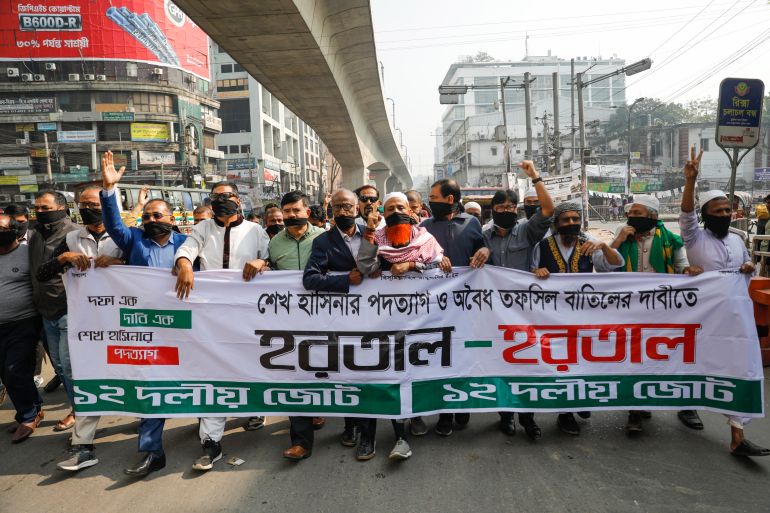
BNP leaders, meanwhile, termed even 28 percent very high, saying that most of the polling booths across the country had been empty throughout the day. The opposition party earlier declared a 48 hour ‘hartal’, equivalent to a total strike, from Saturday morning, which it believed also reduced turnout.
“In most pictures and footage shared in media and social platforms, you would find photos of dogs standing, lying down and basking in the sun along with police and a few Awami League activists,” said Abdul Moyeen Khan, a senior BNP leader, while briefing journalists after the election, “But no voters.”
Khan said people had heeded their call to boycott ballots and show a “red card” to the election. “Even Awami League supporters didn’t bother to go to booths to cast their votes because they knew their candidates would win anyway,” he added.
Concerns on legitimacy
AL leaders, however, said the BNP’s plan to foil the election through “hartal” and “arson attacks” had not paid off because people did turn out to vote.
“This is a victory for our democracy,” Obaidul Quader told the media after finding a clear lead in poll results, “People give BNP’s terrorism befitting reply through balloting.”
Quader also said most people voted for their preferred candidates without any intimidation or interference in voting. “This was one of the most peaceful elections of the country,” he said.
While the last two national elections were tainted with dozens of deaths and severe violence, Sunday’s poll saw only one death and very few clashes, making it one of the most peaceful polls in the South Asian nation’s history.
“People of your country should be proud of holding such a peaceful election,” Hisham Kuhail, the CEO of the Central Election Commission of Palestine, one of several foreign observers of the poll, told a media briefing afterwards.
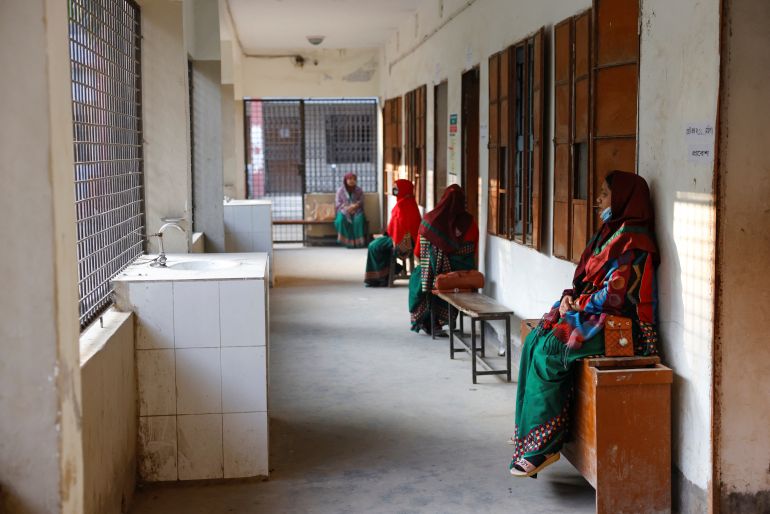
Kuhail, however, avoided questions about voter turnout and said he was assessing only the technicalities of the voting process – whether voters were allowed access and whether voting took place systematically. “I cannot comment on the political scenario here. For that I need to stay at least a month,” he added.
Russian observer Andrei Shutov also said the voting process was systematic and peaceful. “This election is legitimate,” he added.
AKM Wahiduzzaman, the information and technology affairs secretary of the BNP, said there was no question it was peaceful because “there were no voters”. “But it is obviously not legitimate,” he said. The Awami League’s victory, he added, was “illegal and illegitimate” because people did not “legitimise them through votes”.
(Aljazeera)








The Cabinet of Ministers approved the resolution furnished by the Minister of Agriculture, Livestock, Lands and Irrigation to appoint Ms. P. M. Jayadeera (Engineer) in the Special Grade of Sri Lanka Engineering Service serving at present as the Additional Secretary (Water Resources Development) of the Ministry of Agriculture, Livestock, Lands and Irrigation to the post of Director General which will be vacant from 06.10.2026.
Approval has been granted at the meeting of the Cabinet of Ministers held on 08.06.2026 to prepare a draft bill for restructuring Sri Lanka Cricket.
Accordingly, the Legal Draftsman has formulated Sri Lanka draft bill providing legal provisions for the administration of Sri
Lanka Cricket, control, regulation, promotion, establishment of Sri Lanka Cricket for the development and administration, through the concepts of better governance, integrity, transparency, accountability, inclusiveness and providing equal opportunities for the betterment of the cricket sport, establishment of Sri Lanka Cricket for securing the wellbeing of all participants and securing cricket from corruption and other mal practices.
Clearance of the Attorney General has been received for the said draft bill. Approval of the Cabinet of Ministers has been received for the resolution furnished by the Minister of
Youth Affairs and Sports to publish the said draft bill in the government gazette notification and thereby forward the same to the Parliament for its concurrence.
Latest News
Appointment of Cabinet Sub-Committee for the Organization of 79th Independence Day Commemoration
The Cabinet of Ministers has approved the resolution furnished by the Minister of Public Administration, Provincial Council, and Local Government to appoint a Cabinet Sub-Committee chaired by the Prime Minister and with the participation of relevant Ministers, to organize and direct the affairs of the country’s 79th Independence Day Commemoration
Ceremony, which falls on 2027-02-04.

A Joint Regional Initiative to Ensure the Digital Safety of Children

PM meets with IMF delegation

Ms. P. M. Jayadeera (Engineer) appointed Director General of Irrigation
Sri Lanka Cricket Draft Bill to be gazetted
Cabinet approves purchase of machinery for the Sri Lanka Land Development Corporation
Cabinet approval for Project to Build Secure, Skilled, and Empowered Community for families resettled at the at Kalinga Mawatha, housing scheme

‘Dates have the highest sugar content to fight Coronavirus’

Sunday Island 27 December – Headlines

#SundayIsland 17th December – Headlines

Sunday Island – 28th March

Sunday Island Headlines – 21 March

Sunday Island – 21st February – Headlines
-

 News6 days ago
US embassy won’t comment on IGP’s probe into joint drug raid
-

 News4 days ago
Shanakiyan urges urgent action over reported death sentence for Lankan in Saudi Arabia
-

 News5 days ago
Bid for Basil’s extradition nears final stage: Police
-

 News3 days ago
Namal Rajapaksa Buddhist gambit fails, bail denied
-

 Business6 days ago
All-new Bolero MaXX unveiled in Sri Lanka
-

 Features3 days ago
Why the spelling Sri Lankan names in English vary
-

 Opinion6 days ago
A journalist who wrote across the divide
-

 Features3 days ago
Three bands, a new identity: Sri Lankan wolf snake recognised as distinct species