
Business
RPCs put the ball in trade unions’court

Rs. 1,000 minimum daily wage demand
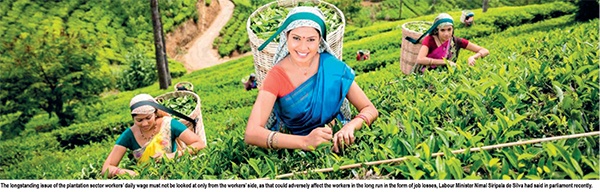
During a meeting last Friday between Minster of Labour Nimal Siripala de Silva and Chairmen of all Sri Lankan Regional Plantation Companies (RPCs), a final proposal was submitted towards ensuring a ‘sustainable’ earnings model for tea estate workers, making it the trade unions’ responsibility to take the next action on the long-standing pain point of the industry.
This proposal takes into consideration the sustainability of both the industry and livelihoods of plantation workers, RPCs said.
“After a very productive meeting with the minister, RPCs have arrived at a final consensus on what we can sustainably offer, while providing the highest possible earnings potential for our workers. Our final offer amounts to a 30% increase in earnings on the fixed model, and there is no upper limit to what workers can earn under the productivity-linked components. This is the first step to modernising our entire industry, and moving beyond a basic daily wage system which is a relic of the colonial era and long overdue for an update,” they said.
“We have gone well beyond the Rs. 1,000 daily wage demand of Trade Unions, and this follows a 40% increase from just two years ago. At a time when others in the apparel and leisure sector are slashing wages and retrenching workers, ours is one of the precious few export industries which has shielded our employees from the negative impacts of the pandemic, and is actively pursuing a wage increase. This is no easy feat, and without improvements in productivity, it will still be extremely difficult for any RPC to remain financially sustainable. There is clear understanding from the government on our position, and it is now up to Trade Unions to make the right decision,” Chairman, Plantation Services Group, Employers’ Federation of Ceylon said.
Under the final proposal, RPCs are offering a fixed daily wage of Rs. 1,105, with the re-introduction of attendance and productivity incentives – a feature which Trade Unions had strongly and consistently opposed in the past, but have since reversed their position in the most recent negotiations.
The breakdown is as follows: Basic Wage – Rs. 700, EPF/ETF – Rs. 105, Attendance Incentive – Rs. 150 and Productivity Incentive – Rs. 150. Under the new proposal, workers will receive a substantial Rs. 6,250 increase to their monthly earnings.
Further to the revised daily wage model, RPCs also propose the implementation of productivity-linked earning components to ensure that workers are finally provided effective incentives and are rewarded for increasing their productivity.
The proposed fixed daily wage model will be implemented 3 days a week, and on the remaining days, RPCs have called for one of two productivity-based models to be implemented based on how suitable they would be to each RPC’s unique capacity – enabling workers to earn far more than the fixed Rs. 1,105.
Under the productivity-linked component, employees can earn Rs. 50 (inclusive of EPF/ETF) for every kilo of tea leaf plucked. In the case of Rubber, this would amount to Rs. 125 (inclusive of EPF/ETF) for every kilo of rubber latex.
Alternatively, employees will be remunerated based on a revenue share model, offering greater earnings, similar to what has long been practiced with success in the smallholder sector in Sri Lanka. Companies who do not wish to continue with either of these models, will reserve the right (at their sole discretion), to continue with the standard daily wage system.
Currently, the Cost of Production (COP) of tea amounts to Rs. 615 a day, higher than any other tea producing nation in the world. Out of this, cost of labour accounts for 63% of the total cost of production. With the proposed increase in daily earnings to Rs. 1,105, the COP will increase up to Rs. 730 a day. Unfortunately, increasing cost of production is expected to be met with stagnant prices in local and international markets, further annihilating the economic viability of the industry.
Previously, the auction price of RPC tea reached an all-time high of Rs. 601 per kg on average (USD 3.99) in 2017 and has since plunged to Rs. 581/kg (USD 3.16). However, Sri Lanka’s global market price for tea has become increasingly uncompetitive, especially in comparison to USD 1.94 for tea at the Mombasa auction in Kenya. Competitors like Kenya have seen a significant increase – as much as 50% – in crop output which has resulted in an oversupply in the global tea market, forcing the market price of tea to reduce further.



HNB FINANCE PLC has strengthened its Board with the appointment of four Independent Non-Executive Directors, effective September 8, 2026.
The new directors are Renuke Wijayawardhane, Shanti Gnanapragasam, Nabiha Mohamed and Dr. Thisuri Wanniarachchi, who collectively bring extensive experience in financial regulation, banking, risk management, corporate finance, investment strategy, development finance and public policy.
Wijayawardhane, an Attorney-at-Law and capital market professional, retired in July 2025 as Chief Regulatory Officer of the Colombo Stock Exchange after more than 31 years with the Exchange. His experience covers securities regulation, corporate governance, market infrastructure and compliance.
Gnanapragasam has over four decades of banking experience spanning treasury, risk management, credit and trade finance. She currently serves as an Independent Non-Executive Director of Cargills Bank, Wealth Trust and Vision Fund Lanka.
Mohamed is a corporate finance and investment professional who previously served as Lead Transaction Advisor at the State-Owned Enterprise Restructuring Unit of the Ministry of Finance, where she led five divestiture transactions worth over US$600 million.
Dr. Wanniarachchi brings over a decade of experience in development finance, institutional reform and social protection, including work with the World Bank and the Government of Sri Lanka.

Prime Lands Residencies PLC has completed and officially handed over The Palace Gampaha, described as the largest planned gated residential community in Gampaha, to its homeowners.
The development, which commenced construction in 2021, is located two kilometres from Gampaha town and 100 metres from the Colombo-Kandy main road.
Spread across 13.5 acres, The Palace Gampaha comprises 480 two- and three-bedroom apartments in a ground-plus-three-floor development, with prices starting from Rs. 27.5 million.
The project allocates about 80% of its land to landscaped areas and common facilities, while the remaining 20% is used for apartment development. Facilities include a swimming pool, gymnasium, clubhouse, library, community kitchen, laundry, mini-mart and a daycare centre managed by the Lyceum Group.
The fully gated community also incorporates solar power for common areas, underground electricity cabling and a sewage treatment plant with water recycling facilities.
Prime Residencies said all statutory approvals required for the handover had been secured, including certifications from the Condominium Management Authority and registration of the Condominium Plan and Deed of Declaration.
Prime Group Chairman Premalal Brahmanage said the project reflected the company’s vision of creating large-scale residential communities designed to enhance the quality of life of Sri Lankan families.
The project is the latest addition to Prime Group’s portfolio of more than 70 gated community and apartment developments.

Sri Lanka’s Non-Vessel Operating Common Carrier (NVOCC) sector is losing ground despite the expansion of the industry in several regional markets, Sri Lanka Association of NVOCC Agents (SLANA) Chairperson Swabha Wickramasinghe said.
Wickramasinghe, re-elected for a third consecutive term at SLANA’s ninth Annual General Meeting last week said the continued difficulty in collecting Colombo Terminal Handling Charges (THC) as a separate land-based cost was among the key challenges facing the industry.
She said the practice placed Sri Lanka at a competitive disadvantage as principals consider the overall economics of operating through Colombo.
“When Sri Lanka becomes less commercially attractive compared with other regional destinations, the consequences eventually reach our members,” she said.
Wickramasinghe said a committee had been proposed at a recent meeting with the Minister and Deputy Minister to evaluate the THC issue, urging the authorities to expedite its appointment and review.
She also called for an early solution to the problem of uncleared salt containers at the Port of Colombo, which has resulted in delays in releasing empty containers.
With more than 75 NVOCC lines operating in Sri Lanka, she stressed the sector’s importance to regional trade, particularly links with India and China.
Ports Minister Anura Karunathilaka said Sri Lanka should expand regional business while exploring areas such as bunkering, freight forwarding and e-commerce logistics.

Gnanasara Thero absconding after SC ruling

House to debate 22A, Judicature Bill next week

Wrong house targeted in underworld grenade attack: Two children killed

Gota questioned over MiG deal

DLB launches ‘Wasi’ digital lottery with Rs. 1m jackpot

The NPP’s Dilemma: Arresting Politics and Unarresting Progress

‘Dates have the highest sugar content to fight Coronavirus’

Sunday Island 27 December – Headlines

#SundayIsland 17th December – Headlines

Sunday Island – 28th March

Sunday Island Headlines – 21 March

Sunday Island – 21st February – Headlines
-

 Sports2 days ago
DDS set to lose Test captaincy
-

 Features6 days ago
After the parade: What a traffic OIC’s walk-out tells us
-

 Editorial6 days ago
Arrests as theatre
-

 News5 days ago
Thailand shuts door on undesirables from Sri Lanka
-

 Latest News6 days ago
Harshitha’s composed knock seals Sri Lanka’s semi-final berth
-

 News6 days ago
‘Choka Malli’ slips out of country before travel ban
-

 Business5 days ago
CEB successor company breaks into top three in competitive BESS tender
-

 News2 days ago
Sri Lanka faces new grid challenge as rooftop solar surges: former CEB GM