
Editorial
No quick fix


That there is no quick fix to the globally raging Covid-19 pandemic is now all too clear. Countries worldwide seek to protect their populations as best as they could by inoculating them with vaccines hurriedly developed in some of the best scientific laboratories in the world. Billions of dollars have been poured into this research effort, thankfully marked by some significant successes, and the vaccination process is ongoing in most parts of the world including this small backwater called Sri Lanka. But the global supply of vaccine falls far short of demand and how this gap is to be bridged is a yet unanswered question.
However, it is very well known that untapped manufacturing capacity is available in many parts of the world. How such capacity can be harnessed to meet the crying need of humanity is not rocket science. The heart of the problem lies in the reluctance, nay unwillingness, of the world of commerce to share the research gains already made in an equitable manner and relax patents to enable maximum utilization of available manufacturing capacity, particularly in the Indian subcontinent, to break the back of if not significantly dent this problem that continues to confront mankind.
The global pharmaceutical industry, throughout its long history, has poured vast funds and resources, both material and human, to develop wide ranges of medicines to treat and protect living beings – human and animal – from the many illnesses that have always been a part of life. Many notable successes, ranging from penicillin to the various drugs and medicines that have defeated numerous scourges that have confronted humanity over the course of history, have marked this effort. It is well known that when new drugs are developed, their manufacturers recover the huge investments made in the research and development efforts to achieve the various outcomes, in pricing the various products they market. These are patent protected and such patents, most often ironclad, are zealously protected.
Unarguably, industry must be permitted to recover investments made in developing products and processes benefiting humanity. But this can, and often does, lead to profiteering and unjustifiable ripoffs of consumers. However that be, the immediate problem confronting the whole world is to find ways and means of relaxing the various patents and devices in force to maximize the production and availability of supplies of vaccines to fight the pandemic. It has been reported that the new head of the World Trade Organization has joined calls for pharmaceutical companies to share their coronavirus vaccine know-how and technology more broadly in the developing world. Whether this will happen or not, and the profit motive will remain the overriding consideration as has always happened in the past, remains to be seen.
The Associated. Press (AP), one of the world’s biggest news agencies, a non-profit organization owned by newspapers and broadcasters in the U.S., recently reported its findings in three continents that established pharmaceutical manufacturers could start producing hundreds of millions of doses of COVID-19 vaccines at short notice if they only had the necessary blueprints and know-how to get started. But that knowledge belongs to the large pharmaceutical companies that have produced the first three vaccines authorized in many countries both in the developed and developing world including Sri Lanka. These vaccines now in use in countries that include Britain, the European Union, and the U.S. are products of Pfizer, Moderna and AstraZeneca. Responses from the patent holders to requests to enable more broad based manufacture, are awaited.
The WHO which is supplying countries in need, including our own, with free vaccine to inoculate a proportion of their population, has called on manufacturers to share their know-bow to “dramatically increase global supply” to stop the virus before it mutates into deadlier forms. This issue must be obviously looked at from a non-commercial perspective. The vaccine was not developed utilizing only private resources. Billions of dollars of taxpayer funds, largely from the U.S. and European countries, were injected into the R&D efforts of pharmaceutical manufacturers to develop now patented vaccines. Such money came out of the pockets of ordinary people in some of the world’s richer countries. There is no debate that the benefits of such efforts must also be shared with people in poorer countries.
These vaccines were developed at unprecedented speed after the disease, first seen in China and thereafter in many parts of the globe, spread like wildfire worldwide. However, sharing the knowledge discovered has unfortunately not happened as speedily. Although contracts and licensing deals are being negotiated with producers on individual case-by-case basis on the logic that the intellectual property of the vaccine developers must be protected, manufacturing capacity worldwide is not being boosted at the needed pace. All over the world, the supply of coranavirus vaccines is falling short of demand. Much of the limited supplies that are available are going to rich countries. The AP report said that nearly 80 percent of the vaccine thus far administered had been used in just 10 countries. WHO is on record saying that more than 210 countries and territories with 2.5 billion people have not received a single shot by the end of last month.
The shortcomings in getting the urgently needed results of boosting the supply and distribution of the vaccine to parts of the world most in need have been highlighted ad infinitum. Winnie Byanyima, Executive Director of UNAIDS recently said that “what we are seeing today is a stampede, a survival of the fittest approach, where those with the deepest pockets, with the sharpest elbows, grabbing what is there and leaving others to die.” The AP report said that governments and health experts have offered two potential solutions to the vaccine shortage. One, supported by WHO is a ‘patent pool’ modeled on a platform set up to fight HIV, tuberculosis and hepatitis. The other is is to suspend intellectual property rights during the pandemic. But no progress in either direction is visible.


Wednesday 14th October, 2026
Sri Lankan political leaders never miss an opportunity to moralise, and their oratory often helps them win elections. But their words are rarely matched by deeds, so much so that they have come to be dubbed NATO (no action, talk only) leaders. These self-righteous characters portray themselves as paragons of virtue while condemning their political rivals as rogues.
Leaders of the previous government wrapped themselves in the flag and branded their critics as traitors. Their successors are treating key Opposition figures as rogues who deserve to be thrown behind bars. President Anura Kumara Dissanayake has declared that drug money is used to finance media outlets and protests as part of a strategy to unsettle the government, which has taken on the drug Mafia with might and main. Addressing a recent public rally, the President said some sinister characters with links to drug cartels were all out to derail the government’s efforts to eliminate organised crime.
If President Dissanayake has credible evidence that drug barons are funding any media organisation, he should initiate legal action against it, shouldn’t he? Similarly, if there is irrefutable evidence that drug dealers are behind any protest campaign, legal action must be instituted against its organisers. However, no witch-hunts must be launched on the basis of unsubstantiated allegations, with arrests being prematurely made even before investigations get underway.
One may recall that last year President Dissanayake reportedly said he had credible information that some local government members had been funded by drug dealers. He said he had directed the law enforcement authorities to launch an investigation. It is believed that Kudu Lal, a drug dealer operating from overseas, backed a group of independent candidates at the 2025 local government polls in Colombo and some of them were elected. Have the police failed to find out who benefited from drug barons’ largesse? If the JVP/NPP had allowed all local council heads to be elected by open ballot, the public would have been able to see whether it was the government or the Opposition that had benefited from the support of the councillors with alleged narcotic links.
We also have former ‘NATO’ leaders claiming the moral high ground. Former Speaker Mahinda Yapa Abeywardena has gone on record as saying that he thwarted an attempt by an influential Colombo-based foreign diplomat and some religious leaders to persuade him to assume the presidency following Gotabaya Rajapaksa’s resignation at the height of the Aragalaya protests in 2022. He claimed that those behind the move wanted to establish an unconstitutional government and plunge the country into anarchy. He has not made any official complaint about that serious incident. During a discussion at a national conference of the Chartered Accountants of Sri Lanka in Colombo, in 2024, former President Chandrika Bandaranaike Kumaratunga said she had been offered a US$5 million bribe by the husband of a junior minister in her Cabinet and a foreign businessman, when she was the Prime Minister. She said she had rejected the offer out of hand and threatened to have them arrested. Why she did not carry out the threat is the question. In 2013, the then Health Minister Maithripala Sirisena claimed the tobacco industry had offered him a huge bribe and he had turned it down. He did not take any action against the culprits.
Refusing a bribe is the minimum expected of a public representative. Reporting such an attempt is what helps ensure that the person who offers a bribe is held accountable. Anyone cannot credibly claim to be fighting corruption while treating an attempt to bribe him or her as a private matter. Whatever the law may say, the ethical obligation is clear; a political leader who is offered a bribe should document the incident and report it promptly to the appropriate investigative authority so that the matter can be investigated. Those who do not do so undermine the rule of law.
Meanwhile, President Dissanayake’s claim that drug dealers are using protesters and media outfits against his government reminds us of a similar claim made by President Maithripala Sirisena in 2019 after the Easter Sunday terror attacks. He claimed that drug cartels he had taken on had orchestrated the terror strikes to discredit him and scuttle his anti-narcotics drive.
Political leaders who claim to have rejected bribes or possess credible information of conspiracies by drug dealers against governments must resort to legal action. They must fish or cut bait.
Tuesday 13th October, 2026
The Opposition and the government engaged in an interesting thrust and parry over secret political deals in Parliament the other day. SJB MP Mujibur Rahman lashed out at the JVP, accusing it of having struck a deal with what he described as the corrupt political forces and helped them rise to power in 2005. He argued that the JVP’s political history was replete with similar deals.
Prime Minister Dr Harini Amarasuriya promptly stuck her oar in to defend the JVP, arguing that even if the SJB’s points were conceded for the sake of argument, the JVP had never struck secret political deals under cover of darkness, unlike its critics in the Opposition. But history tells a different story. The JVP has failed to distinguish itself from other political parties when it comes to deal-making. Like its rivals, it has shown that it does not scruple to subjugate principle to political expediency in pursuit of its own interests.
The JVP-led NPP government has faced severe criticism over ‘deals with foreign governments’, particularly its failure to make public the full texts of several agreements and memoranda of understanding (MoUs) signed with India, China and the United States. Critics have questioned whether the current administration is living up to its promises of transparency and accountability, especially where the agreements concern defence, national security, foreign policy and the media. This wall of secrecy, as it were, has made a mockery of the government’s much-advertised commitment to upholding transparency and accountability.
Can the JVP-NPP government reconcile what it describes as legitimate confidentiality requirements with its stated commitment to transparency? Signing international agreements is an ordinary function of any government, but withholding their terms can undermine public confidence when the arrangements may affect national security, economic interests or even sovereignty.
Founding Leader of the JVP Rohana Wijeweera would turn in his grave if he knew of the agreements between India and the JVP-led government. It was during a violent anti-India campaign that Wijeweera met a tragic end in 1989.
The JVP has struck deals with both the SLFP and the UNP. Adversity and expediency are said to make strange bedfellows. In 1970, the JVP actively took part in the election campaign of the SLFP-led United Front (UF), with its stalwarts like Mahinda Wijesekera leading the propaganda campaign of the UF. It took up arms against the UF government in 1971. In 1977, it gravitated towards the UNP. The Batalanda Commission report, which the JVP is using against former President Ranil Wickremesinghe, has revealed that “by the time the 1977 General Elections were declared, the peripheral organizers of the JVP were active, and in fact went to the extent of directly supporting the United National Party, which had been during that period classified as a right-wing capitalist political force” (p. 14). Following its abortive second uprising, the JVP entered into what could be described as a political deal with the SLFP in 1994. Ten years later, it coalesced with the SLFP-led United People’s Freedom Alliance, obtained 39 seats and secured Cabinet posts. It left the UPFA government the following year. However, it campaigned hard for SLFP presidential candidate Mahinda Rajapaksa, playing a crucial role in ensuring his victory in 2005. Thereafter, it closed ranks with the UNP-led political alliances at the 2010 and 2015 presidential elections, and had representation on the National Executive Council of the Yahapalana government.
It is popularly said in this country that when floods strike, even mongooses and cobras forget their enmity and cling to floating logs to stay afloat. When the floodwaters recede, however, their fights resume. This is precisely what we are witnessing on the political front. In Sri Lanka, there is hardly a political party that has not played the role of either the mongoose or the cobra, depending on the circumstances. One may recall that the vociferous SJB bigwigs now berating their JVP counterparts were prominent members of the UNP-led Yahapalana government, which enjoyed a political honeymoon with the JVP between 2015 and 2019.


Monday 12th October, 2026
Fifty-one government MPs have proposed a parliamentary select committee (PSC) probe into the 1983 anti-Tamil violence, known as Black July, and make recommendations to Parliament. Their call has come close on the heels of a private member’s motion presented by Democratic Tamil National Alliance MP Selvam Adaikalanathan, demanding that a Presidential Commission of Inquiry be appointed to establish the truth about the 1983 ethnic violence, assess the damage and recommend measures to prevent its recurrence. The government has argued that a parliamentary select committee will be a far more effective mechanism than a presidential commission to examine the tragic events, enforce accountability and promote reconciliation.
There is no reason why the government cannot appoint a Presidential Commission to probe Black July. The calls for fresh probes into the 1983 anti-Tamil pogrom indicate that questions about the adequacy of previous investigations have remained unresolved for more than four decades. Those efforts did not result in a comprehensive, independent and effective process for holding the organisers and perpetrators of the violence criminally accountable.
The problem with parliamentary probe committees is that the ruling party can manipulate them by appointing a majority of their members. How the UPFA government used a PSC in 2012 to harass the then Chief Justice Dr. Shirani Bandaranayake before clearing the way for her ‘impeachment’ is a case in point.
The current government led by the JVP should have launched an investigation into the 1983 anti-Tamil pogrom much earlier. A thorough probe may shed light on hitherto undisclosed aspects of organised anti-Tamil violence, and the survivors of the pogrom and the families of the victims deserve justice. The Jayewardene government falsely blamed the JVP, the Communist Party and the Nava Sama Samaja Party for the pogrom and proscribed them. The JVP could not have its proscription removed and remained underground. The Jayewardene regime created conditions for the second JVP uprising, which plunged the country into a bloodbath.
Several other campaigns of violence, including mass killings, have not been properly investigated. The JVP’s terror campaign in the late 1980s and the equally brutal counter terror operations conducted by two UNP governments, under Presidents Jayewardene and President Ranasinghe Premadasa, claimed tens of thousands of lives. Those crimes must also be investigated. The incumbent government promised to launch a probe into the Batalanda torture chamber, but baulked at doing so. Maybe it did not want to open a can of worms. The JVP-led government has taken steps to reopen or expedite investigations into high-profile assassinations and other crimes under previous governments. But it has not ordered a probe into the extrajudicial execution of its own founding leader, Rohana Wijeweera, while in state custody, in 1989.
In June 2014, the Retired Senior Police Officers’ Association requested the Presidential Commission to Investigate Complaints Regarding Missing Persons to investigate the massacre of approximately 600 policemen by the LTTE in the Eastern Province in 1990. The commission identified the massacre as one of several grave incidents requiring further investigation by a special probe team with a view to gathering evidence for criminal proceedings. The police personnel surrendered to the LTTE on the orders of the Premadasa government. It is believed that many of them may have survived if they had been allowed to fight. SJB MP Chaminda Wijesiri has been sentenced to an 18-month jail term for obstructing, threatening and assaulting a group of police officers, but the massacre of 600 policemen has not been probed. This contrast raises an uncomfortable question: why do the police act decisively in individual cases while the 1990 massacre of their own personnel remains uninvestigated.
Any future PSC probe into the 1983 ethnic violence should focus on the findings of previous investigations, their inadequacies, why their recommendations were not fully implemented, whether fresh evidence could be ascertained, and, most all, what practical steps could be taken to address the continuing demand for truth and accountability.
One can only hope that the proposed PSC probe is not intended to distract public attention from the government’s failure to fulfil its election pledge to hold the Provincial Council elections within one year of assuming office.

Heavy showers above 100 mm are likely at some places in the Western, Sabaragamuwa, Southern, Central, and North-western provinces and in Anuradhapura district.

Sri Lanka, India caught in US-Iran ship crisis

Namal further remanded

IMF projects Lankan economic growth to moderate amidst mounting global uncertainties

Major Gen Pushpakumara assumes command of 56 Infantry Division

Dickwella axed, Bandara earns maiden Test call up

‘Dates have the highest sugar content to fight Coronavirus’

Sunday Island 27 December – Headlines

#SundayIsland 17th December – Headlines

Sunday Island – 28th March

Sunday Island Headlines – 21 March

Sunday Island – 21st February – Headlines
-

 Features7 days ago
The Sri Lankan who made Scottish history
-

 Sports7 days ago
Nissanka absence opens door for Sri Lanka’s young guns
-

 News6 days ago
NDB fraud Rs 60mn more than reported
-

 News6 days ago
Removing monk’s robes matter for Sangha to decide: Mahanayake Theras
-
 News7 days ago
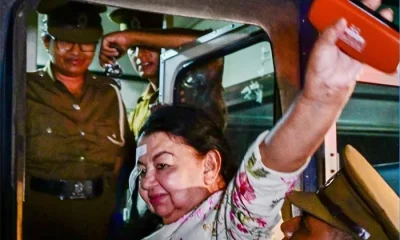
Shiranthi R remanded until 13 Oct.
-

 Features7 days ago
Future of Sri Lanka’s state university system: Should it be shut down and reopened?
-

 News4 days ago
Sri Lanka escalates anti-graft drive with Shiranthi’s jailing
-

 News5 days ago
NPP govt. reminded of its responsibilities as US warship leaves Colombo