
News
LSSP blames neoliberal policies for present crisis


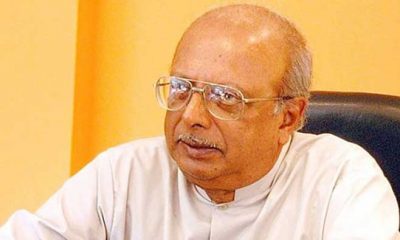
Leader of the Lanka Sama Samaja Party (LSSP) Prof Tissa Vitarana says that the current crisis is due to a shrinking economy and high inflation.
“There is a lack of both dollars and of rupees. The lack of dollars is a result of the neoliberal policies of successive governments, since 1978, which raised our foreign debt to US$ 52 billion and brought down our foreign exchange (forex) reserves from US$ 8 billion to a few millions. The worst offender was the “Yahapalana” government of 2015, led by Ranil Wickremesinghe, which borrowed $ 12.5 billion,” Prof Vitarana says, in a message to mark the LSSP anniversary that falls tomorrow (20)
“When the LSSP is commemorating its 87th Anniversary, I send this message to our friendly people with a feeling of deep sadness. Most of the people of Sri Lanka are facing great hardships at this time of severe economic, social and political crisis. More than 65 % of families, whose income is below the poverty line, are going hungry, the parents having one meal a day so that the children can have two. This too is lacking in protein, vitamins and essential elements Even if they manage to get rice, only about 50% of their protein needs are obtained. This mainly affects the children and the malnutrition levels among them exceed 20%, so that the future generations, too, will suffer with poor physical and mental development. Due to the contraction of the economy many small and medium industries are closing down or cutting staff. Unemployment is rising steeply. Everyone is suffering due to the electricity power cuts, the shortage and high prices of food, fuel, gas and medicines. Thousands of educated youth that the country needs are leaving our shores. Many who remain are enticed to become drug addicts and prostitutes.
“Action taken by Dr.N.M.Perera of the LLSSP, as Finance Minister, to solve the severe 1972/3 crisis provides the basis for a solution. Then the shortage of essential imports and the price rise was higher than today (e.g. the import of a ton of sugar rose from 43 British pounds to 600). He prevailed on the PM, Sirimavo Bandaranaike, to impose severe restrictions on imports and promoted exports to solve our adverse balance of payments situation. He imposed high taxes (75%) on the rich who did not invest their capital for development so that the Government could play a leading role in overcoming the crisis, reduce poverty and develop the country. He promoted science and technology to develop a national economy that would be self-sufficient and increase exports. There were no indirect taxes like VAT that passed the burden of the crisis on to the people, specially the poor. He brought down inflation by strengthening and linking the producer and consumer cooperatives, and strengthened the role of the food and marketing departments, eliminating exploitation by the traders and middlemen. By 1975 he produced a surplus Budget and raised the Foreign Exchange Reserve from USD 1 billion to nearly 4 billion, and restored normalcy, overcoming the crisis.
“The current crisis is due to a shrinking economy and high inflation. There is both a lack of Dollars and of Rupees for the Government. The lack of Dollars is a result of the neoliberal policies of successive governments since 1978 which raised our foreign debt to US$ 52 billion and brought down our foreign exchange (forex) reserves from US$ 8 billion to a few millions. The worst offender was the “Yahapalana” government of 2015, led by Ranil Wickremasinghe, which borrowed $ 12.5 billion. The dollar crisis is due to an annual debt servicing cost, which last year was $ 6.3 billion. It was not due to an adverse foreign trade balance, as our forex earnings in 2021 were $ 21 billion, exceeding our import cost of $ 20 billion by one billion. I am glad that the SLPP Government stopped the import of vehicles and the present Government has banned the import of a large list of non-essential imports. If this is properly done there will be no need to borrow further from the multilateral donors, led by the IMF, and get further into debt, and also have to sell our valuable assets. We can escape the debt trap and have the dollars to get the fuel, fertiliser, gas, food and medicines that the people need, keeping the price down, by properly run Sathosas, Cooperatives, etc. A five-year moratorium on debt will give us $ 35 billion to develop value-added industries using our agricultural and natural resources (ilmenite and graphite) to provide jobs for our youth. The technology will be provided to SMEs through the Vidatha Centres at Divisional level and Hi-Tech at central level e.g. SLINTEC nanotechnology) with emphasis on exports.
“Immediate action must be taken to bring down the cost of living. Left Government policies must be combined with empowerment of the people. Properly elected producer and consumer Co-operatives will ensure that the producer gets a proper price while the consumer cost is minimized. The middlemen exploitation is eliminated. Low interest credit for farmers and entrepreneurs from the Central Bank Fund could be made available through the Rural Banks and Vidatha Centres. The problem of rural microcredit at high interest must be overcome. Farmers will be supported to practice ecoagriculture. All failed state and private institutions could be run under the “solidarity economy” principle, where the lease/ ownership will be in the hands of the workers, who alone get the profits, having one share each in the company. Through these and other measures it will be possible to recover from this crisis, as Dr. N M Perera did in 1972/3. Sri Lanka can emerge from this crisis, eliminate poverty and become a developed country if a progressive Government which implements the above LSSP policies comes to power. I invite all honest people who accept these policies to join us to get rid of poverty and make Sri Lanka a developed country.
“The LSSP was formed in 1935 and led the fight for national independence. The LSSP was banned and its leaders like Dr N M Perera and Dr. Colvin R de Silva jailed. They broke jail and escaped to India where they joined the independence struggle led by Gandhi and Nehru, as part of the Congress Socialist Party. They returned at the end of the war in 1945 and led the General Strike of 1947 in which the Police fired at Dr. N M Perera, but comrade Kandasamy who was by his side died. The Great Hartal of 1953 was led by the LSSP against the raising of the price of rice by the UNP Government from 25 cents a measure to 72 cents. When anti-Tamil racism was at its worst and Sinhala only was made the official language the LSSP fought for Tamil also to be made official. Yhis was finally granted in 1957. Sri Lanka became a truly independent sovereign state with the passing of the Republican Constitution drafted by Dr. Colvin R de Silva in 1972.”



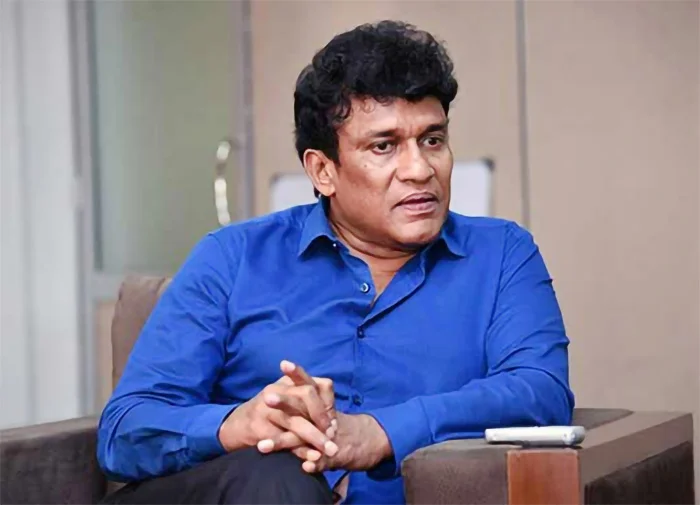
Leader of the Tamil Progressive Alliance (TPA), Mano Ganeshan, MP, said that India shouldn’t intervene here regarding the long-delayed Provincial Council polls.
The former Yahapalana Minister of National Co-existence, Dialogue and Official Languages (2015-2018), Ganeshan, who represents the main Opposition Samagi Jana Balawegaya (SJB) in the current Parliament, stressed that New Delhi’s intervention wouldn’t do any good for them or for us.
Lawmaker Ganeshan said so when The Island asked him whether the TPA would ask India to pressure the NPP government to conduct PC polls, last held in 2014, during Mahinda Rajapaksa’s second term. Ganeshan said: “India shouldn’t get involved in the issue at hand . Such a strategy is also in their interest, particularly in the context of the evolving global order. India should not be perceived as a pro-Tamil state, but rather as a state that supports Sri Lanka as a whole.”
Ganeshan said that the Indian state bears a moral responsibility in this matter. “That responsibility arises from the fact that India’s diplomacy and military intervention played a decisive role in neutralising the Tamil armed struggle in Sri Lanka. Although India’s mission remained unfinished, it nevertheless lost nearly two thousand soldiers in the process. There was also a prelude to this involvement, when Tamil militant groups received training in India. Consequently, the Indian connection became a sensitive issue for both the Sinhalese and Tamils of Sri Lanka.”
But, whatever had happened, the national issue should be settled among us. ” The solution must be found and settled within Sri Lanka itself. We do not need Western interventions in this regard.”
” In recent years, whenever we in the Tamil Progressive Alliance (TPA) have met Indian dignitaries—including the Prime Minister, the External Affairs Minister, and, most recently, the Vice President—the subjects of the 13th Amendment and Provincial Councils have never featured on our agenda.”
The 13th Amendment is part of Sri Lanka’s Constitution. Therefore, it is for Sri Lankans themselves to decide whether to retain, improve, fully implement, reform, or even repeal it, Ganeshan said.
MP Ganeshan found fault with those who represented the Northern and Eastern provinces for failing to utilise the goodwill and influence India enjoyed with successive Governments of Sri Lanka to pursue an amicable political settlement. The parliamentarian said that they should acted after the end of the war in May, 2009. Unfortunately, they failed to effectively use the Provincial Council framework to consolidate their political position and advance further, thereby earning the confidence of both India and successive Sinhala-majority governments, MP Ganeshan said.
Responding to another query, MP Ganeshan said: “
We should keep the ethnic issue separate from bilateral relations with India, while deepening economic connectivity and cooperation on the basis of mutual benefit and a win-win partnership.”
By Shamindra Ferdinando
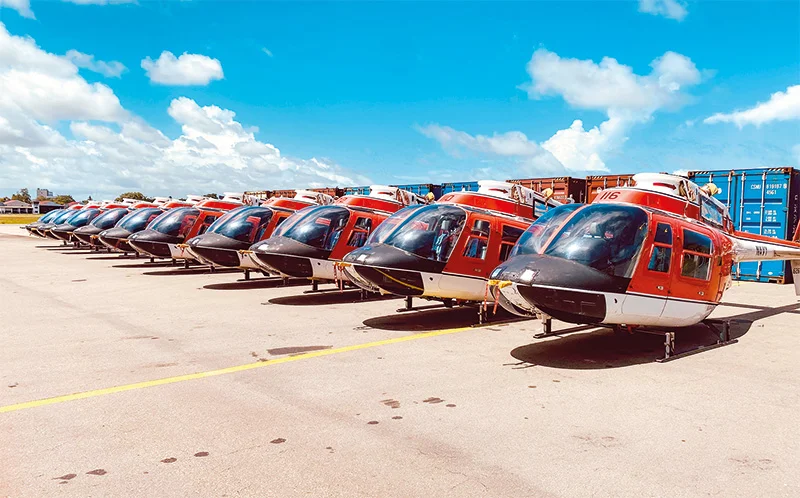
Sri Lanka has taken delivery of 10 TH-57 ‘Sea Ranger’ multi-role helicopters provided by the United States of America to the Sri Lanka Air Force. Air Forces headquarters said that the helicopters arrived here by sea.
The SLAF has said: “The arrival of these aircraft marks a significant milestone in the longstanding defence cooperation between Sri Lanka and the United States and represents a valuable contribution towards enhancing the operational and training capabilities of the Sri Lanka Air Force.
“The helicopters are currently undergoing configurations and technical preparations at SLAF Base Ratmalana. Following the completion of requisite inspections, acceptance procedures and test flights, the aircraft will be inducted into service and deployed for operational duties.
“The TH-57 fleet is expected to significantly strengthen the Air Force’s aviation training capacity while enhancing the ability to support a broad spectrum of national requirements. The aircraft will primarily be employed for pilot training, humanitarian assistance and disaster response (HADR) operations, search and rescue (SAR) missions and other public service commitments undertaken by the Sri Lanka Air Force.”
News
TPA demands House committee to probe Tilvin’s claim PC polls cannot be held due to fund constraints


Referring to the recent declaration made by JVP General Secretary Tilvin Silva that the Provincial Council elections couldn’t be held this year as funds allocated for that purpose were utilised to provide Ditwah cyclone relief, Tamil Progressive Front (TPA) leader Mano Ganeshan, MP, has asked Dr. Harsha de Silva, MP Chairman, Committee on Public Finance, to inquire into the issue at hand and take action deemed appropriate.
The text of MP Ganeshan’s letter: “I write with reference to a statement reportedly made by Tilvin Silva, General Secretary of the Janatha Vimukthi Peramuna (JVP), the principal constituent party of the National People’s Power (NPP) Government.
According to media reports, Silva stated, in substance, that funds allocated and set aside for the conduct of Provincial Council Elections had been utilised by the Government for disaster-rebuilding and related purposes.
While he is reported to have made further remarks, I confine my attention to the above statement, which raises a serious matter concerning public finance and parliamentary oversight.
To the best of my knowledge, Parliament has not approved any transfer or reallocation of funds, earmarked for Provincial Council Elections, to any other expenditure head or purpose. If the statement, attributed to Mr. de Silva, is accurate, it may indicate that such funds have been utilised without the requisite parliamentary authorisation.
In view of the above, I respectfully request that the Committee on Public Finance inquire into this matter and ascertain whether any transfer, reallocation, or expenditure of funds allocated for Provincial Council Elections has occurred in a manner inconsistent with parliamentary approval and financial regulations.
I would be grateful if the Committee could examine the facts and take any action deemed appropriate within its mandate.”

Thailand cracks down on foreign companies using fig leaf of local ownership

US strikes Iran’s Qeshm, says Tehran attacks Kuwait, Bahrain

Heavy showers likely at some places in the Western and Sabaragamuwa provinces and in Galle, Matara, Kandy and Nuwara-Eliya districts.

Trump berated Netanyahu? Analysts question US-Israel feud rumours

India should be kept out of PC polls, matters related to 13 A – Mano

US boost for SLAF

‘Dates have the highest sugar content to fight Coronavirus’

Sunday Island 27 December – Headlines

#SundayIsland 17th December – Headlines

Sunday Island – 28th March

Sunday Island Headlines – 21 March

Sunday Island – 21st February – Headlines
-
 News4 days ago
IMF urges Lanka not to meddle with exchange rate
-
 Business5 days ago
Sri Lanka’s construction industry losing ground while no one watches
-
 Business2 days ago
IMF’s unstated rate:Sri Lanka’s $695m loan costs about 5.33% per annum
-
 News4 days ago
State of emergency extended
-
 Features5 days ago
The Division Bell Mystery
-
 News2 days ago
UNP challenges NPP move to amend Vihara – Devalagam Act
-
 Features3 days ago
Are threats to Buddha Sasana external or from within?
-
 News6 days ago
RTI query of Ditwah funds: Presidential Secretariat mum on key questions