
News
Lanka and the Netherlands consolidate bilateral cooperation

he inaugural session of the bilateral political consultations between Sri Lanka and the Netherlands at Foreign Ministry level was convened on Tuesday 05 April, 2022 on a virtual platform, the Foreign Affairs Ministry said.
The consultations coincided with a year-long program jointly organized by the Embassies of Sri Lanka and the Netherlands in Colombo and in The Hague to commemorate 70 years of diplomatic relations between the two countries.
The two sides engaged in productive discussions on a multitude of areas of bilateral and multilateral interest comprising political cooperation and the exchange of high-level visits; trade, investment and tourism; air connectivity; climate change; capacity building and training of the public service; women’s empowerment; cooperation in defense, education and agriculture; as well as cultural cooperation.
The two sides reiterated their mutual interest in further consolidating trade and prosperity through engagement in the Indian Ocean.
Sri Lanka apprised the Netherlands of progress in reconciliation including the PTA reform process. The discussion identified a number of areas of follow up, with particular attention to development cooperation.
Sri Lanka appreciated the support extended in multiple spheres by the Netherlands through its development cooperation portfolio, as well as the market access provided for Sri Lanka’s exports to the Netherlands via the EU GSP plus scheme.
Recalling historical relations spanning 400 years, Sri Lanka and the Netherlands deliberated on enhancing cultural cooperation through technical assistance in the restoration of Dutch heritage sites, cooperation between museums and the national archives and discussions on ongoing on the restitution of artifacts.
Sri Lanka acknowledged the support rendered by countries in Europe through the European Union and bilaterally, in addressing the shared challenges posed by Covid-19.
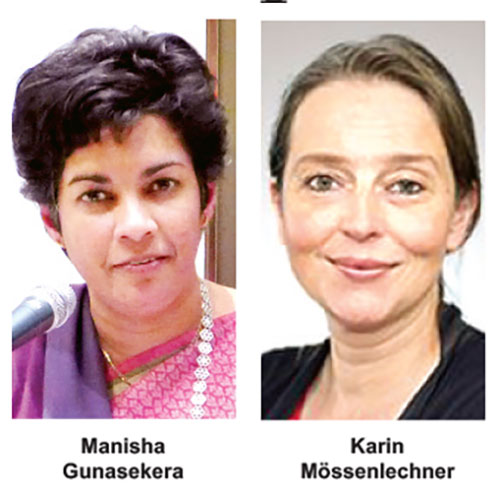
The Consultations were co-chaired by the Additional Secretary/ Bilateral (West), Ministry of Foreign Affairs of Sri Lanka Manisha Gunasekera and the Director General/Asia and Oceania (DAO), Ministry of Foreign Affairs of the Netherlands Karin Mössenlechner.
The Netherlands delegation included the Ambassador of the Kingdom of the Netherlands to Sri Lanka Tanja Gonggrijp, the Head of South Asia and South-East Asia/ Department for Asia and Oceania Max Valstar and senior officials from the Netherlands Foreign Ministry. The Sri Lankan delegation included the Ambassador of Sri Lanka to the Kingdom of the Netherlands Aruni Ranaraja, Director General Europe/ Varuni Muthukumarana and senior officials from relevant line Ministries/agencies and the Foreign Ministry.
The second session of bilateral political consultations between Sri Lanka and Netherlands will be held in The Hague, the Netherlands in 2024.



The commissioning ceremony of the deep-sea patrol vessel as Samudravijaya, gifted to the Sri Lanka Navy by the United States Coast Guard to enhance the Navy’s operational capabilities, was held under the patronage of Commander-in-Chief of the Armed Forces, President Anura Kumara Dissanayake, on Thursday afternoon (04) at the Eastern Terminal premises of the Port of Colombo.
The vessel was officially handed over to Sri Lanka by the United States Coast Guard on 2 December 2025. Following modifications to meet the operational requirements of the Sri Lanka Navy, the vessel commenced its voyage to Colombo on 20 February 2026 from the United States Coast Guard Yard in Baltimore, Maryland.
The induction of the vessel marks a significant step towards further strengthening the operational capabilities of the Sri Lanka Navy and enhancing the country’s maritime and national security. The vessel is expected to make an important contribution to maritime surveillance, search and rescue operations, protection of fisheries resources, environmental monitoring and the enforcement of international maritime laws and conventions. In particular, it will serve as a vital asset in combating narcotics trafficking and other transnational maritime crimes, which remain major challenges for both Sri Lanka and the wider region.
During the ceremony, President Dissanayake presented the official commissioning warrant to the vessel’s Commanding Officer, Captain Gayan Wickramasuriya. The President subsequently unveiled the vessel’s name board and official insignia before undertaking an inspection tour of the ship. The Commander of the Navy briefed those present on the vessel’s operational readiness, systems and capabilities.
President Dissanayake also signed the vessel’s Distinguished Visitors’ Book and was presented with a commemorative plaque featuring a replica of the vessel.
Among those present were Minister of Ports and Civil Aviation Anura Karunatilaka. Deputy Minister of Defence, Major General Aruna Jayasekara (Retd.), Secretary to the Ministry of Defence, Air Vice Marshal Sampath Thuyacontha (Retd.), Admiral of the Fleet Wasantha Karannagoda, Commander of the Army, Lieutenant General Lasantha Rodrigo, Commander of the Air Force, Air Vice Marshal Vasu Bandu Edirisinghe. Commander of the Navy, Vice Admiral Kanchana Banagoda, Inspector General of Police, Attorney-at-Law Priyantha Weerasooriya, Charge d’affaires to the U.S. Embassy Ms. Jayne Howell, Senior Defence Official and Defence Attache with Spouse Lieutenant Colonel Matthew House, representatives of the Embassy and senior officers of the Sri Lanka Navy.
(PMD)

Death toll rises to 12: Director remanded
Some residents were allegedly chained
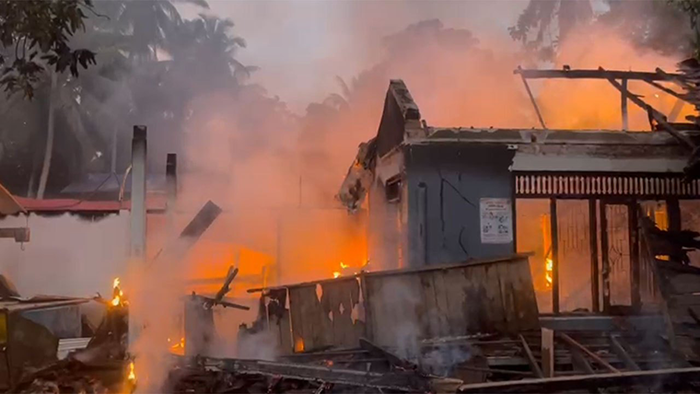
Police have come under public pressure to investigate allegations of inhumane treatmenf the residents at an elders’ home in Batagoda, which was also reportedly used as a care centre for persons with special needs, following a devastating fire that has so far claimed 12 lives.
Eyewitnesses who were among the first responders told the media that several residents had been chained inside rooms at the Senehase Kedella Elders’ Home when the fire broke out on Wednesday. They claimed that rescue efforts were hindered as iron chains could not be removed, and that some residents died while being restrained.
Authorities have not yet verified these claims, and Police said investigations are continuing.
Police spokesman ASP F.U. Wootler, contacted for comment, said there were rumours to that effect, but the Police were not in a position to verify the claims until a report from the Government Analyst was received. He said eight survivors with burn injuries were being treated in hospital.
Meanwhile, the Director of the facility had been arrested and was due to be produced before the Horana Magistrate’s Court, Police said adding that he was remanded till June 11.
The death toll from the fire has risen to 12 as of Thursday morning following the recovery of additional charred remains during ongoing forensic examinations at the site. Six others sustained serious injuries and are being treated at the Horana Base Hospital.
Police said 72 residents were inside the facility at the time of the blaze. Of them, 10 died inside the building, seven were injured and hospitalised, while 51 were rescued and relocated.
Survivors were initially housed at Batagoda Junior School before being transferred with Army assistance to another branch of the same care network in Galpatha.
A magisterial inquiry was conducted on Thursday morning. Horana Magistrate Lakmini Vidanagamage visited the scene. The burnt remains were examined and removed under judicial supervision.
Separately, allegations have emerged that residents were required to pay an admission fee of Rs. 75,000, along with a monthly charge of Rs. 35,000 to the centre. Police have not commented on these claims.
The director was taken to the scene as part of ongoing investigations, while forensic experts continue examinations to determine the cause of the fire, which remains undetermined.Anguruwatota Police are conducting investigations.
By Norman Palihawadane and Nishan S Priyantha

Sri Lanka CERT has issued a public warning over the circulation of artificial intelligence (AI)-generated videos falsely depicting President Anura Kumara Dissanayake, Prime Minister Harini Amarasuriya and several other prominent personalities to promote fraudulent investment schemes online.
According to complaints received by the national cyber security agency, the videos have been created using deepfake technology and are being used as part of attempts to defraud members of the public through financial scams.
The images of famous sports personalities and other public figures have also been misused in the deceptive content.
The agency has warned that similar AI-generated material has been used to spread false information relating to investment opportunities, employment offers, as well as matters concerning the country’s economy and tax policies.
According to Sri Lanka CERT, the videos are being widely shared across online platforms and frequently contain links urging viewers to make investments in return for purported profits.The agency has cautioned that these links may redirect users to fraudulent websites designed to steal personal information, financial data and money from unsuspecting victims.
Sri Lanka CERT has urged the public to exercise extreme caution when encountering such content online and advised against clicking on suspicious links or sharing personal information through unverified websites.
“The public should remain vigilant and avoid becoming victims of false information and online fraud schemes,” the agency said.
Sri Lanka CERT has also encouraged internet users to verify information through official sources before acting on any investment, employment or financial offers circulated via social media or other online platforms.

President Commissions Offshore Patrol Vessel ‘Samudra Vijaya’ into Sri Lanka Navy

Shreyas Iyer to replace Suryakumar Yadav as India’s T20I captain

Pakistan hold their nerve to take series in low-scoring scrap

Robinson routs New Zealand top-order as England hit back on 16-wicket day

Rumesh Tharanga shatters Rome Diamond League record

Showers about 100 mm are likely at some places in the Western and Sabaragamuwa provinces and in Galle, Matara, Kandy and Nuwara-Eliya districts

‘Dates have the highest sugar content to fight Coronavirus’

Sunday Island 27 December – Headlines

#SundayIsland 17th December – Headlines

Sunday Island – 28th March

Sunday Island Headlines – 21 March

Sunday Island – 21st February – Headlines
-
 News6 days ago
IMF urges Lanka not to meddle with exchange rate
-

 News3 days ago
Lankan duo emerge winners in Latin dance championship held in Blackpool, UK
-

 Business4 days ago
IMF’s unstated rate:Sri Lanka’s $695m loan costs about 5.33% per annum
-
 News6 days ago
State of emergency extended
-

 Features5 days ago
Are threats to Buddha Sasana external or from within?
-

 Business4 days ago
Sri Lankan scientist-innovator Milinda Edirisinghe introduces AI-integrated gem testing system to gemological world
-
 News4 days ago
UNP challenges NPP move to amend Vihara – Devalagam Act
-
 Latest News1 day ago
Kusal Mendis, Pathum Nissanka, bowlers put Sri Lanka 1-0 up