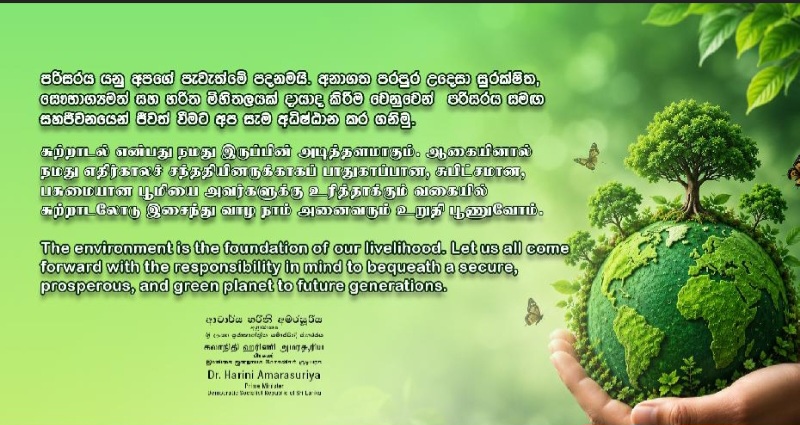
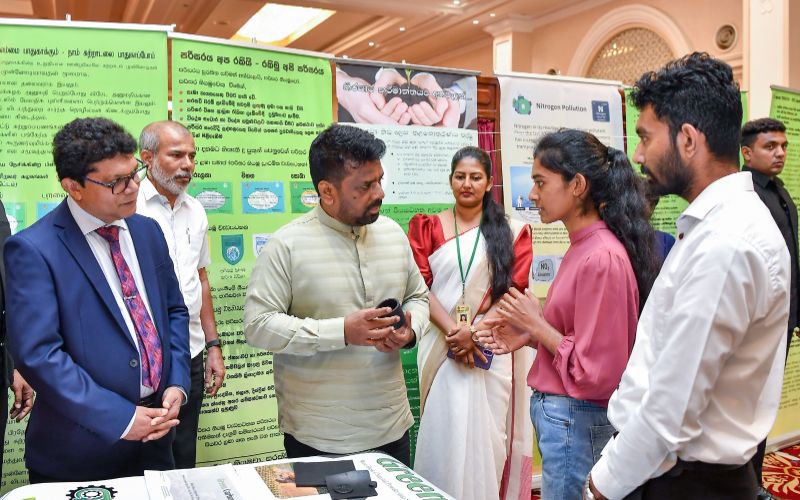
The National commemoration of World Environment Day 2026, held under the theme “Let us take action to mitigate the impacts of climate change”, was held this morning (05) at the Temple Trees under the patronage of President Anura Kumara Dissanayake.
The environmental policy of the present Government, which is guided by a vision of a sustainable environment that ensures the survival and well-being of all living beings, prioritises maintaining a balance between socio-economic development and environmental protection, with a view to fostering a healthy society and a balanced ecosystem. Accordingly, within the framework of sustainable development and in line with the principles of the United Nations Framework Convention on Climate Change, Sri Lanka is actively contributing to global efforts to reduce greenhouse gas emissions.
In line with this programme, a “Climate Week” was declared from 30 May to 05 June in conjunction with the 2026 World Environment Day National commemoration. A series of environmental programmes were organised across the country with the participation of the “Clean Sri Lanka” initiative and contributions from the public sector, private sector and civil society organisations.
Furthermore, in conjunction with this year’s World Environment Day commemoration, five forests, Ritigala, Aliyawetunuwewa, Mulagala, Konkatiyawa and Kallanchiya were declared reserved forests by the Department of Forest Conservation under the patronage of the President.
The introduction of the enhanced National Green Reporting Guidelines, the declaration of the Magama Sand Dunes as a sensitive area by the Department of Coastal Conservation and Coastal Resources Management, the clearance of the Elephant crossings by the Department of Wildlife Conservation and the designation of the Kuda Bubula Spring and Kapurella Hot Water Wetland as protected areas were also announced.
In addition, the first issue of the environmental magazine “Soba” for 2026, the “Soba Ketha” environmental publication and a resource book on plastic waste management were officially launched.
A certificate confirming that the World Environment Day national commemoration had been conducted as a carbon-neutral programme was also formally presented to the President.
The President also participated in the presentation of prizes and certificates to the winners of the art competition organised by the Climate Change Division, as well as to the winners of the eco-friendly innovations and designs competition organised by the Central Environmental Authority under the World Environment Day theme.
President Anura Kumara Dissanayake also joined a group photograph with environmental researchers.
Addressing the event, Minister of Environment, Dr. Dammika Patabendi stated that…
The United Nations designated World Environment Day in 1972. Today marks the second World Environment Day being commemorated under the National People’s Power Government. In collaboration with the Department of Forest Conservation, five forests have been declared as protected areas in conjunction with this year’s World Environment Day under the “Vanaspati” programme. These include Ritigala, Aliyawetunuwewa, Mulagala Reserve, Konkatiyawa Reserve and Kallanchiya five forests located in the Anuradhapura District. The Government began designating protected areas from World Environment Day 2025, when Nilgala, Kottawa, Thulhiri Kanda, Weerawila and Udaliyadda forests were declared as reserves.
The “Vanaspati” programme was officially launched on 15 June last year. Through this initiative, the Ministry of Environment and the Department of Forest Conservation successfully declared 29 forests as protected areas in 2025. In 2026, a further 50 reserves were declared on World Forest Day, focusing primarily on four districts including Ampara, Nuwara Eliya and Badulla. In addition, two more forests were declared protected in conjunction with the recent ‘Ehi Passiko’ Peace Walk. With today’s declaration of five additional forests, a total of 86 forests have been declared as protected areas within one year, which is a significant achievement.
We have made significant efforts to address human–elephant conflict. One of our key aspirations has been to create designated corridors that allow elephants to move safely through their natural habitats. Today, we have succeeded in opening three elephant corridors in the Hambantota and Monaragala districts. In addition to this, substantial work has been undertaken in recent years to establish elephant management reserves and facilitate the opening of such corridors. Although an elephant management reserve was declared in Hambantota several years ago, the necessary legal regulations and operational mechanisms had not been put in place. We have now gazetted the required regulations and appointed an operational committee and implementation work is currently underway. During this process, we identified shortages in human and physical resources within institutions such as the Department of Wildlife Conservation and the Department of Forest Conservation. As a solution, we have taken steps to fill existing vacancie.
Furthermore, arrangements have been made to strengthen institutional capacity by providing essential infrastructure, including the procurement of motorcycles, tractors, mini-tractors, and cab vehicles to support field operations and improve efficiency.
We are currently working on formulating a policy for the management of tame elephants. In addition, efforts are underway to develop the Pinnawala Elephant Orphanage into an elephant breeding and research centre, addressing a key gap in the country’s conservation infrastructure. In the context of environmental protection, it is evident that many of the existing laws and regulations are outdated. Accordingly, steps are being taken to amend and modernise these legal frameworks.
Deputy Minister of Environment ,Anton Jayakody, Acting Secretary of the Ministry of Environment , R.H.M.P. Abeykoon, Chairman of the Central Environmental Authority , Professor Thilak Hewawasam, Director General of the Department of Wildlife Conservation S.M.L.R.P. Marasinghe, along with environmentalists, researchers, university and school students, were among those present on the occasion.
(PMD)