
News
FM accuses UNHRC of resorting to punitive, politicised, divisive, unhelpful action against Lanka for extraneous reasons

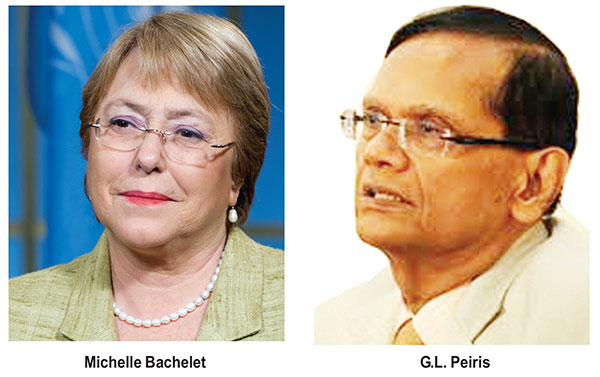
The Foreign Ministry has accused the UNHRC of resorting to punitive, politicised, divisive, unhelpful action against Sri Lanka due to extraneous reasons.
The OHCHR has now established a “Sri Lanka Accountability Project” citing resolution 46/1, in a situation where the language of OP6 (Operative Paragraph) in resolution 46/1 only sought to “strengthen the capacity of the OHCHR to collect, consolidate, analyse and preserve…evidence.” Thus, what was supposed to be only an internal capacity building exercise, within the OHCHR, has arbitrarily been elevated to the level of a project and listed with other external mechanisms of the UNHRC, the Foreign Ministry alleged in a statement that dealt with the 49th session of the UNHRC.
Text of the statement issued yesterday: “The delegation from Colombo that attended the 49th session of the Human Rights Council, in Geneva, was led by the Minister of Foreign Affairs, Professor G.L. Peiris, and comprised the following members: Minister of Justice Ali Sabry, State Minister of Production Supply and Regulation of Pharmaceuticals Prof. Channa Jayasumana, Foreign Secretary Admiral Prof. Jayanath Colombage, and Additional Solicitor General Nerin Pulle.
The 49th session of the Human Rights Council was held in a backdrop where a written update on Sri Lanka was to be presented to the Council by the UN High Commissioner for Human Rights in pursuance of resolution 46/1 which was adopted in March 2021, without the consent of Sri Lanka as the country concerned, and with only 22 of the 47 Council members voting in favour of it.
Operative Paragraph 6 of this resolution set a very dangerous precedent by requiring the Office of the High Commissioner to take on the role of collecting criminal evidence with a view to future prosecution. Due to its fundamentally flawed nature, even countries that voted in favour of resolution 46/1, in their ‘explanation of the vote’ expressed reservations regarding this new task assigned to the OHCHR which is not consistent with its founding document GA resolution 48/141.
The OHCHR has now established a “Sri Lanka Accountability Project,” citing resolution 46/1, in a situation where the language of OP6 in resolution 46/1 only sought to “strengthen the capacity of the OHCHR to collect, consolidate, analyse and preserve…evidence.” Thus, what was supposed to be only an internal capacity building exercise, within the OHCHR, has arbitrarily been elevated to the level of a project and listed with other external mechanisms of the UNHRC.
Furthermore, all this adversarial action is taking place in Geneva in a situation where the Government of Sri Lanka is vigorously engaged in initiating and implementing a series of national processes, aimed at advancing reconciliation and human rights for all our people. In this context, it was important for Sri Lanka to explain to the stakeholders in Geneva, including the Council, UN Member States and other relevant actors, our position on this matter and to present before them the significant progress that Sri Lanka has achieved, in this regard, even amidst COVID 19 – related challenges.
The Minister of Foreign Affairs addressed the High Level Segment of HRC49 on 1 March 2022 highlighting Sri Lanka’s longstanding profile as an active participant in the multilateral framework, the national Constitutional, legal and institutional frameworks that are in place for the realisation of human rights, including the right to development, and our achievements in this regard. The Minister also stressed the importance of the HRC being guided by the principles of impartiality, objectivity and non-selectivity, based on the principle of the sovereign equality of Member States, and raised objections to punitive, politicised, divisive, unhelpful action, initiated due to extraneous reasons.
The Minister of Foreign Affairs made a statement, on behalf of Sri Lanka, as the country concerned at the interactive dialogue that followed the introduction of the written update on Sri Lanka on 4 March 2022, pointing out among other things, that resolution 46/1 on Sri Lanka was directly contrary to the founding principles of the HRC. He also pointed out to the Council, the aspects of the High Commissioner’s written update that were discriminatory and intrusive.
At the Interactive Dialogue on the High Commissioner’s written update, Sri Lanka received cross-regional support and solidarity from a large number of countries of the Global South, who appreciated the Government’s significant efforts towards reconciliation and reiterated the importance of objective and constructive cooperation as the fundamental basis for multilateral engagement. Of the 45 countries that delivered statements at the interactive dialogue, 31 spoke in support of Sri Lanka. These speakers represented a broad spectrum of states from South, South East and Central Asia, Latin America and the Africa.
The 31 countries that spoke in favour of Sri Lanka, at the interactive dialogue, were Saudi Arabia, Egypt, the Philippines, Nepal, Kenya, Ethiopia, Maldives, China, Cuba, Japan, Syrian Arab Republic, Viet Nam, DPRK, Venezuela, Nigeria, Pakistan, Cambodia, the Russian Federation, Lebanon, Uganda, Belarus, Zimbabwe, Eritrea, South Sudan, Lao PDR, Yemen, Iran, Niger, Kazakhstan, Bangladesh and Azerbaijan.
In addition, in its statement, at the General Debate on Item 2 that followed, the interactive dialogue on Sri Lanka, South Korea also recognised Sri Lanka’s efforts at reconciliation and at initiating legal reforms.
The interventions from the States of the Global South recognised Sri Lanka’s commitment to promoting reconciliation and human rights through national processes, including through legislative reform, and the progress achieved in this regard, irrespective of COVID 19 – related challenges. They also underscored the importance of the Human Rights Council and the international community supporting voluntary national processes, as well as upholding the core principles of impartiality, non-selectivity and non-politicisation.
Among the matters stressed by the intervenient delegations were concerns over the micro-management of Sri Lanka’s internal constitutional and governance matters, and the imperative of strict adherence to the provisions of UN Charter and relevant UNGA and HRC resolutions. It was also stressed that cooperation with international human rights mechanisms should be without any external pressure from outside, with states having the power to determine its priorities and areas for international assistance and that only cooperative action will be truly effective and contribute to the real strengthening of human rights in a country.
Certain intervenient delegations also disagreed with the role being set for the OHCHR in collecting evidence, noting that the decision of the OHCHR to establish an “accountability project” is a breach of its mandate. The exorbitant cost of this mandate, in the region of US$ 3 million, was also commented on.
The delegation from Colombo held bi-lateral meetings with the following foreign delegations on the sidelines of HRC49 listed in the order in which they took place. – Lord Tariq Ahmed, Minister of State for South and Central Asia, UN and the Commonwealth accompanied by Rita French Ambassador/DPR of the UK. – Baroness Patricia Scotland, Commonwealth Secretary General – Minister of Foreign Affairs and Cooperation of Timor-Leste Mrs. Adaljiza Magno – Mrs. Nassima Baghli, Ambassador, Permanent Observer, Permanent Delegation of the Organization of Islamic Cooperation – Mr. Daren Tang, Director General, World Intellectual Property Organization (WIPO) – Mr Abdulaziz M.O. Alwasil, Permanent Representative of Saudi Arabia – Foreign Minister of Palestine Rizad Al Maliki and Mr Ibrahim Khraishi, Permanent Representative of Palestine to the UN in Geneva – Federal Minister for Human Rights of Pakistan, Ms Shireen M Mazari and the Permanent Representative of Pakistan in Geneva Mr Khalil Hashmi. – Minister of International Relations and Cooperation of South Africa, Dr Naledi Pandor – Vice Minister of Foreign Affairs for Human Rights and Humanitarian Affairs of Egypt Khaled El Bakry, and Mr. Ahmed Ihab Abdelahad Gamaleldin, Permanent Representative of Egypt – Permanent Representative of the USA in Geneva Ms.Bathsheba Nell Crocker – Permanent Representative of the UK Mr. Simon MANLEY, and Mrs. Amanda GORELY, Permanent Representative of Australia – Deputy Head of the Judiciary of the Islamic Republic of Iran Dr Kazem Gharibabadi, and H.E. Mr. Esmaeil Baghaei Hamaneh, Permanent Representative of Iran – Permanent Representative of Turkey Mr. Sadik Arslan – UN High Commissioner For Human Rights Michelle Bachelet – President of the Human Rights Council Mr. Federico Villegas, Permanent Representative of Argentina – Permanent Representative of Bangladesh Md. Mustafizur Rahman, and Febrian Ruddyard, Permanent Representative of Indonesia.
In addition to the above, State Minister of Production Supply and Regulation of Pharmaceuticals Prof. Channa Jayasumana held the following bi-laterals with – Dr Tedross Adhanom Ghebreyesus, Director General, World Health Organization – Mr Santiago Cornejo, Director of COVAX’s Country Engagement Team.

Latest News
Sun directly overhead Kokkuvil, Nallur, Kodikamam and Nagar Kovil at about 12.11 noon today (28)


The sun is going to be directly over the latitudes of Sri Lanka during 28th of August to 07th of September due to its apparent southward relative motion.
The nearest places of Sri Lanka over which the sun is overhead today (28) are Kokkuvil, Nallur, Kodikamam and Nagar Kovil about 12.11 noon.


Police to arrest and question four former ministers, others over links to Basik
By Norman Palihawadane
Police are investigating alleged links between suspected major drug trafficker Shiran Basik and a number of prominent politicians, with eight of them due to be arrested and questioned as investigators widen their probe into his financial dealings and network of associates, police headquarters, according to a senior police officer.
Among those set to face questioning include a sitting MP, four former ministers, and at least one of them is a female. Police are also investigating allegations that Basik provided large sums of money to politicians during election campaigns and extended other financial and material benefits to political figures.
Investigators are also looking into claims that two politicians were provided with facilities to construct houses and hotels, while efforts are under way to establish the extent of political support and assistance allegedly provided to Basik.
The Colombo Central Crime Investigation Bureau (CCIB) is expected to question the politicians based on information reportedly disclosed by Basik during interrogation. Two electoral organisers are also expected to be taken into custody as part of the ongoing investigation, according to police sources.
Meanwhile, statements are being recorded from managers and employees of several businesses allegedly linked to Basik, while investigators continue to examine information and records recovered from his mobile phone.
Basik, 48, was brought back to Sri Lanka on August 14 after being arrested in Dubai and deported. He was taken into custody by officers of the Criminal Investigation Department’s Airport Unit at Bandaranaike International Airport and subsequently handed over to the CCIB for further investigation.
Police initially obtained a 72-hour detention order to question Basik before securing approval to detain him for 90 days.
Basik, a resident of Dehiwala, is facing investigations over alleged large-scale drug trafficking as well as firearms, and unlawful assembly of weapons-related offences. Police are also examining whether he had any involvement in recent prison-related incidents and have said information has emerged linking him to the 2012 Welikada Prison riot.
The investigation has also expanded to Basik’s alleged assets and business interests in Sri Lanka and overseas.
Police have said information uncovered during questioning indicates that Basik had claimed ownership of five hotels along Colombo’s Marine Drive. Investigators have also identified two houses and two mobile phone shops in Boralesgamuwa allegedly linked to him.
A court has ordered a comprehensive examination of bank accounts linked to Basik, with the Financial Intelligence Unit of the Central Bank of Sri Lanka to conduct a review of his financial accounts. A separate investigation into his wealth and properties is being conducted by the Illegal Assets Investigation Division.
Investigators are also examining claims that Basik owns properties, including hotels and vehicles, in several European countries, as well as a high-value vehicle in Dubai. These claims remain subject to further investigation.
Basik had left Sri Lanka for Dubai in 2018, where police said he lived a lavish lifestyle while operating businesses. He was arrested by UAE authorities before being deported to Sri Lanka.
During initial questioning, Basik told investigators that Dubai police had stopped and searched him at a shopping mall and examined his mobile phone. He claimed that footage relating to Iranian missile and drone attacks was found on the device and that he was subsequently questioned over alleged links to Iran.
Police are continuing to examine the circumstances surrounding his arrest and deportation, as well as the information contained in his mobile phone and other evidence gathered during the investigation.
The ongoing probe is being conducted under the supervision of Senior DIG Ranmal Kodituwakku and SSP Kamal Ariyawansa.The allegations against Basik and the politicians named in connection with the investigation have not been established in court, and the investigations remain ongoing.

The Bar Association of Sri Lanka (BASL) has opposed the proposed “Twenty-Second Amendment to the Constitution”, saying it raises serious concerns over judicial independence and the rights and interests of the public.
In a statement signed by BASL President Rajeev Amarasuriya and Secretary Nalin De Silva, the association said it had challenged the constitutionality of the proposed amendment before the Supreme Court.
The BASL noted that the Chief Justice would be the first Supreme Court judge to benefit from the proposed amendment if it becomes law. It also referred to widespread speculation that the amendment was being expedited to facilitate an extension of the incumbent Chief Justice’s tenure, which is due to end on December 1, 2026.
Full text of the statement:
“The Bar Association of Sri Lanka (BASL) has taken a principled position opposing the Bill titled the “Twenty-Second Amendment to the Constitution” on the basis that it raises serious concerns regarding the independence of the Judiciary and the rights and interests of the people. Accordingly, the BASL has challenged the constitutionality of the proposed amendment before the Supreme Court.
“It is observed that it will be the Honourable Chief Justice who will be the first Judge of the Supreme Court who will benefit from the 22nd Amendment, if this Bill is enacted into Law.
There is widespread belief that this amendment is being rushed to facilitate the extension of the tenure of the Honourable Chief Justice which would otherwise complete on 1st December 2026. In this backdrop, in the recent past, we have witnessed allegations being made in Parliamentary Proceedings as well as on Social Media concerning the Judiciary including the incumbent Chief Justice.
“During this period, the BASL has also been subjected to unfounded attacks on social media and other platforms.
“The Judiciary, like every other institution exercising public power, must remain subject to legitimate scrutiny and accountability. Judgments, judicial conduct and the administration of justice may properly be subjected to fair, informed and responsible criticism. Where credible concerns or allegations arise regarding any member of the Judiciary, including the Chief Justice, they should be examined objectively and addressed through the appropriate constitutional and parliamentary processes which are in place, with due regard to fairness and due process.
“At the same time, everyone must exercise responsibility when making allegations concerning individual judges, lawyers and others. Personal attacks based upon unsubstantiated allegations can undermine public confidence in the administration of justice and affect the independence and integrity of the judicial process and the system of justice
“Judicial independence is not intended to shield any individual from legitimate scrutiny or accountability. It is a safeguard for the people, ensuring that disputes are determined impartially and that individual rights, the Rule of Law and the constitutional order are protected.
“The BASL therefore calls upon all organs of the State, all parties concerned and the media to respect the role of the Judiciary and the system of administration of justice, while ensuring that any genuine concerns are addressed fairly, responsibly and through the procedures established by the Constitution and the law.”

‘Dates have the highest sugar content to fight Coronavirus’

Sunday Island 27 December – Headlines

#SundayIsland 17th December – Headlines

Sunday Island – 28th March

Sunday Island Headlines – 21 March

Sunday Island – 21st February – Headlines
-

 Business7 days ago
SriLankan Airlines makes ShakthiSAT Mission possible for talented Sri Lankan student
-
 Features6 days ago
My secondary schooling after Royal Primary
-
 Features6 days ago
From the First to the 22nd: A short history of Amendment Politics and Reform Frustrations
-

 News4 days ago
Missing doctor’s body found in Mahiyanganaya
-

 Latest News7 days ago
Tharanga edges out Chopra in 88m javelin battle
-
 Features6 days ago
How Shelton Kodikara became first Professor of International Relations
-
 Features6 days ago
How St. John’s College Shaped Panadura for 150 Years
-
 News4 days ago
Australia declines to release Finance Secy Suriyapperuma’s citizenship details