
Foreign News
Dozens killed as fire engulfs Turkish ski hotel

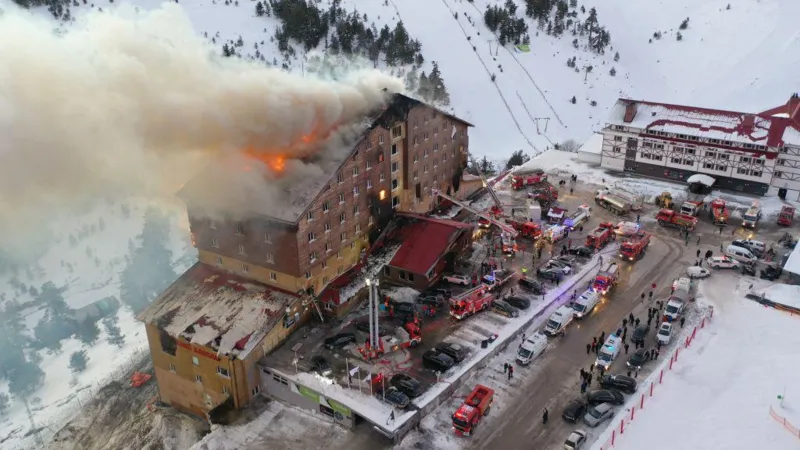
At least 76 people have been killed in a fire that engulfed a popular Turkish ski resort hotel, leaving some to jump out of windows.
The fire broke out at the wooden-clad 12-storey Grand Kartal Hotel in Bolu at 03:27 local time (00:27 GMT) during a busy holiday period when 234 people were staying there.
An initial toll of 10 dead was raised significantly in the hours after the fire by Turkey’s interior ministry. At least two people died after trying to jump to safety.
It took 12 hours for the fire to be put out. Nine people have been arrested, including the owner, the justice minister says.
The identities of all 76 are yet to be confirmed, but among those released so far are Vedia Nil Apak, a 10-year-old swimmer with Fenerbahce Sports Club in Istanbul, and her mother Ferda. The club said it had learned of the news with “deep sorrow” in an Instagram post on Tuesday.
Eslem Uyanik, a young chef at the hotel, died along with Ceren Yaman Dogan, the daughter of a well-known local businessman, and her 17-year-old daughter Lalin.
Nedim Turkmen, a writer for Sozcu newspaper, his wife Ayse Neva, and their two children aged 18 and 22 were also named, along with Prof Atakan Yalcin, who was dean of Ozyegin University Business School.
Dilara Ermanoglu, 24, was among the victims, and her father who had gone to Bolu to look for her was treated by health workers for a heart attack.
Health minister Kemal Memisoglu said that of the 51 injured people, one was receiving treatment in intensive care, and 17 people had been discharged.
Footage circulating in Turkey showed linen hanging from windows which was used by those trying to escape the burning building.
Ski instructor Necmi Kepcetutan told the BBC he was on the second floor of the hotel when the fire broke out and managed to get out via the ski room. He then helped with relief efforts.
Eyewitnesses said the family that owned the hotel had been there at the time of the fire and Mr Kepcetutan said he saw some of the family outside.
The cause of the fire has not yet been found, but Bolu governor Abdulaziz Aydin said initial reports suggested it had broken out in the restaurant section of the hotel’s fourth floor and spread to the floors above.
Aydin said the distance between the hotel, in Kartalkaya, and the centre of Bolu, paired with the freezing weather conditions, meant it took more than an hour for fire engines to arrive. Emergency services sent 267 workers to the site.
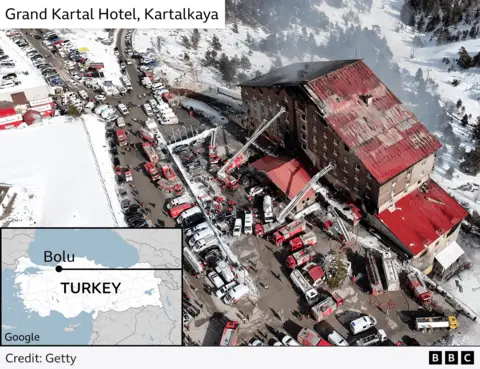
The hotel was investigating whether guests, including children, were trapped in their rooms as the fire spread.
The hotel had two fire escapes, according to the interior minister, and one hotel worker said they had managed to rescue 30-35 people.
Justice Minister Yilmaz Tunc said prosecutors had been allocated to investigate the blaze.
The hotel was last inspected in 2024, and the tourism minister said there had been no concerns regarding the hotel’s fire safety prior to Tuesday’s disaster.
However, the Union of Chambers of Turkish Engineers and Architects (TMMOB) said that according to regulations, an automatic fire extinguisher system is needed.
“In the photos on the hotel’s website, it is seen that the automatic sprinkler system, which was supposed to be installed in 2008, was not installed,” the union said in a statement.
It added that it was unclear if other regulations had been complied with, but based on the statements of survivors, “it is understood that the detection and warning systems did not work and the escape routes could not be determined”.
The Turkish president Recep Tayyip Erdogan said those responsible for negligence leading to the fire “will be held accountable”.
A day of national mourning has been declared and the Turkish flag will be flown at half-mast until sunset on Wednesday, he added in a statement on X.
The Bolu mountains are popular with skiers from Istanbul and Turkey’s capital Ankara, which is roughly 170km (105 miles) away, and the hotel was operating at high occupancy at the start of two-week school holidays.
Former UK ambassador to Turkey Sir Peter Westmacott told the BBC he had stayed in the area in the past, and that the fire “feels very personal”.
“The fact that so many people have lost their lives is just devastating news for those of us who care about Turkey,” he said.
[BBC]

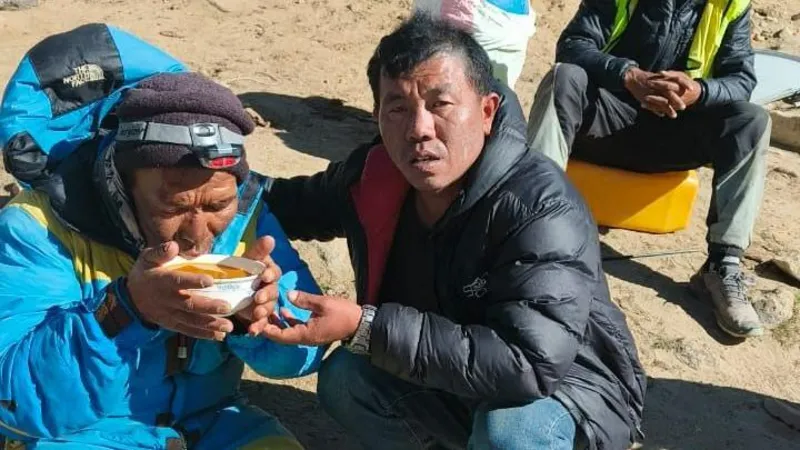
The Nepali guide discovered crawling down Everest six days after he was last seen alive has told the BBC he survived by “chewing ice” and eating a few chocolates he found in his pocket.
Dawa Sherpa was adamant he did not “go missing” on the descent down, but instead was forced to “stay behind” after his oxygen ran out.
It had been assumed Dawa Sherpa had perished on the mountain, with his family back in Nepal’s capital Kathmandu starting to perform last rites before he was spotted by a clean up team “sliding” down the mountain towards Base Camp.
He was airlifted to hospital in Kathmandu, where he spoke to the BBC while receiving treatment for dehydration, frostbite and a fractured bone.
“I didn’t think I would be alive,” he told BBC Nepali on Friday. “I thought I would perish this way.”
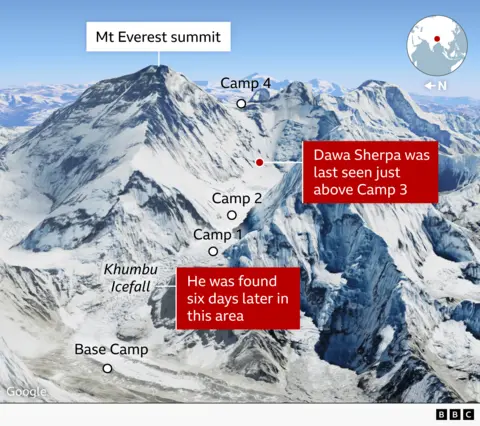
Climber Chris Thrall was the last person known to have seen Dawa Sherpa alive before he was rescued near the Khumbu Icefall on Thursday.
The former British soldier said the 57-year-old was sitting on his backpack just above Camp 3 – around 7,500m (24,600ft) – “as he had done hundreds of times before to take a short rest”.
Thrall continued to descend alone for what he estimated to be about 50-100m before he came across another member of their group, a “Polish climber with no oxygen, battling fairly severe frostbite”.
“So immediately my attention turned to the weakest member of the trio. And that was that,” he told the BBC’s Newshour programme.
“As I look back up the mountain, as I helped this guy descend, Hillary Dawa didn’t appear to have moved, and certainly wasn’t descending, because we would have seen his head torch.”
Up above, Dawa Sherpa told the BBC he had found himself in trouble.
“As the oxygen ran out, I couldn’t walk,” he explained.
“I didn’t eat anything for the first two days. Then I began chewing ice. It pained my teeth. I chewed the ice hard.”
Then he discovered some chocolates in his pocket, and managed to get some melted ice to drink.
He made his way down slowly – only to fall into a crevasse, according to two different people who spoke to Dawa Sherpa about his ordeal.
For two-and-a-half days he was trapped, they said, unable to find a way out.
Then an avalanche sent snow tumbling into the crevasse – and gave him the first hope he had had in days.
“Stepping on the snow, I stood up and looked above… It felt I could get out from there,” he told the BBC.
Once he had scrambled out, he found ropes nearby which helped his manoeuvre further down the world’s tallest mountain.
Another avalanche threatened his progress, but he was determined to keep going.
“I got through the snow and moved downwards. I walked throughout that night.
“Then, I came close to the base camp.”
It was there he saw the first people he had seen in almost a week.
“Its boys were going up to collect the waste. I met them. They carried me down.”
News of his survival was met with shock and delight by the wider sherpa community, the climbers he had been with, and his own family.
Five people have died during this year’s climbing season, with more than 300 dying since records began in the 1920s.
Pemba Sherpa, executive director of 8K Expeditions which was overseeing search efforts, called it a “true self-rescue”.
“Dawa managed to survive against all odds for days. It’s nothing short of a miracle,” he said.
When Thrall first saw comments on social media saying Dawa Sherpa, also known as Hillary Dawa Sherpa after famed mountaineer Edmund Hillary, had been found alive, he said he thought it was “spam”.
“It’s kind of crazy one minute to be fighting back tears with his daughter, and then the next minute to see him crawling into town,” Thrall told BBC’s Newshour. “It’s absolutely amazing, beyond words.”
His wife, Damu Sherpa, told news agency AFP she had given up hope, until seeing a picture of her husband.
“We thought he was no more, and had already begun his last rites,” she said as she waited to meet him at the hospital.
“I was so surprised when I saw the photos and recognised him – he was still wearing a cap I knitted for him.”
“He recognised me … is good and speaks,” his daughter Mhendo Lhamo Sherpa told Reuters news agency later, after visiting him. “We are happy.”
Doctors at Kathmandu’s HAMS Hospital say Dawa Sherpa has been “receiving comprehensive medical care in the intensive care unit”, but is stable and his “dehydration is showing significant improvement”.
More than 1,000 have summited Everest summit this season, making it the busiest on record.
[BBC]
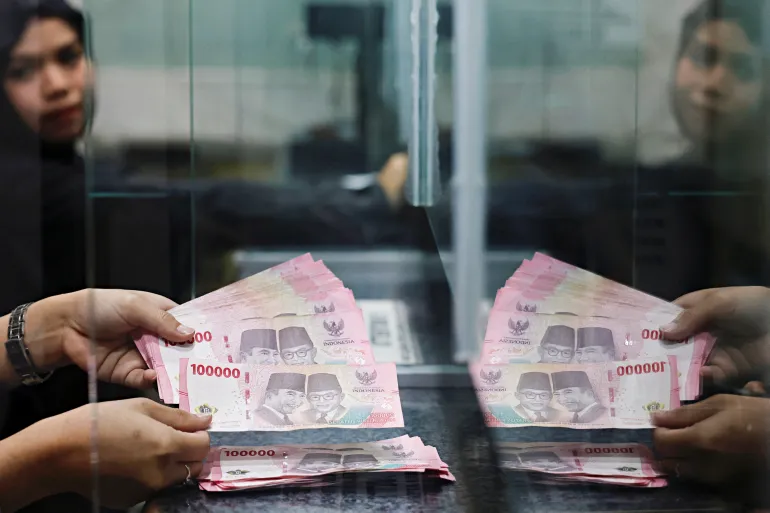
Indonesia’s rupiah has hit its weakest level ever against the US dollar, breaching the psychological 18,000 threshold amid surging energy costs.
The currency hit 18,028 against the greenback on Thursday, despite recent central bank efforts to provide support.
The energy shock driven by the US-Israel war on Iran has placed a significant strain on energy-importing Southeast Asian economies, particularly Indonesia and the Philippines.
The resulting pressure on trade balances has contributed to capital outflows and weaker currencies.
Gulf hostilities flared again on Wednesday, sending oil prices up more than 1 percent.
Adding to regional uncertainty, the United States has proposed additional import duties of 10 percent or 12.5 percent on goods from 60 economies, including Indonesia, Malaysia and Singapore, over alleged forced labour failures.
Permata Bank chief economist Josua Pardede said that an exchange rate of 18,000 was a “psychological threshold” for market investors.
The weakening, he told the AFP news agency, was fuelled by high dollar demand caused by the spike in oil prices and a narrowing trade surplus.
Indonesia is a net oil importer and is particularly affected by the rising crude costs, though the government insists it will leave subsidised fuel prices unchanged.
The country’s trade surplus has been hammered, narrowing to just $89m in April, from $3.3bn a month before, further reducing dollar supply in the Indonesian market, Josua said.
“Dollar supply from goods trade is dwindling, while dollar needs for energy imports, raw materials, dividends, foreign debt payments and seasonality needs remain significant,” he said.
“This is why the increase in the BI [Bank Indonesia] lending rate and intervention is not enough to reverse the rupiah’s [depreciation].”
The central bank hiked rates by 0.5 basis points to 5.25 percent last month – the first increase in two years – as it looked to stabilise the rupiah and keep inflation in check.
The central bank’s spokesman, Ramdan Denny Prakoso, said on Wednesday that it continued to use “all available policy instruments” to “maintain adequate foreign exchange liquidity”.
Bank Indonesia also tightened rules for dollar purchases.
Since May, buyers of more than $25,000 in a given month have been required to provide supporting documents to justify their need for US currency.
[Aljazeera]
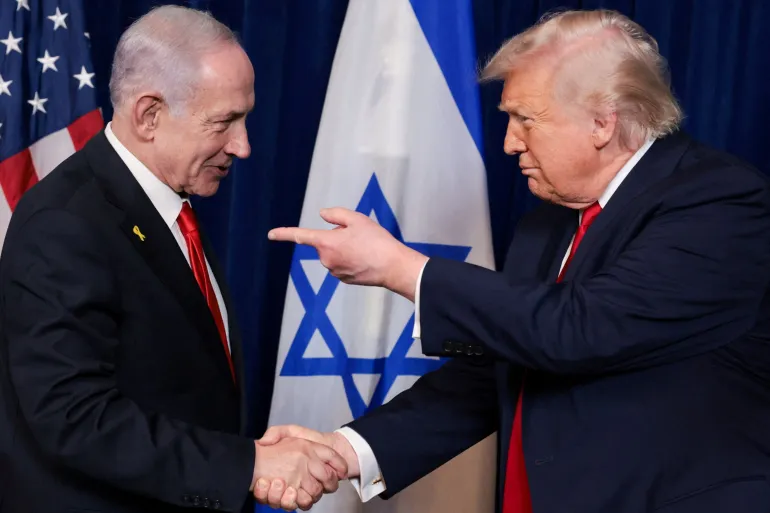
Benjamin Netanyahu has played down reports of a rift with Donald Trump after the United States president confirmed that he recently called the Israeli prime minister “f****ing crazy”.
Asked during an interview with CNBC on Wednesday, Netanyahu rejected the idea his ties with Trump have shifted: “No, this has been this has been a great relationship because he’s been the greatest friend that Israel has ever had in the White House.”
Netanyahu — who is wanted by the International Criminal Court (ICC) for war crime charges in Gaza — added that the two leaders have mutual respect for each other.
“We have common goals. Sometimes, we have, as in the best of families, you have these tactical disagreements,” he said.
“We always find a way to work them out, and we do so as great friends. We can disagree in the morning, and by the afternoon, we have common action.”
The comments came after Trump told the New York Post that he berated Netanyahu during a call earlier this week over Israel’s escalation in Lebanon.
“I was a little bit perturbed at his constantly fighting with Lebanon,” Trump said.
Israel’s attacks in Lebanon, including an announcement that the Israeli military would bomb the capital, Beirut, have risked derailing the talks between the US and Iran.
Tehran has suggested that it may respond militarily to Israel’s assault in Lebanon.
Trump said on Monday that he spoke to Netanyahu and a representative from Hezbollah, and both sides agreed to hold fire.
But the fighting in southern Lebanon, where Israel has displaced hundreds of thousands of people and razed entire towns to the ground, has continued.
The Israeli military, however, did hold off its attacks against Beirut.
Despite the apparent disagreement over Lebanon, Trump lauded the Israeli prime minister on Wednesday, saying that he “works well” with him.
“I like Bibi a lot,” he said, using Netanyahu’s nickname.
For his part, Netanyahu stressed that he and Trump are on the same page in Lebanon and share the objective of disarming Hezbollah.
“I think he understands that Lebanon has been taken hostage by Hezbollah,” Netanyahu said.
Hezbollah, which is allied with Iran, says it is fighting against Israel’s aims to expand into Lebanon and ethnically cleanse the south of the country.
The Lebanese group argues that its fighting is legitimate under the United Nations Charter, which grants the right to self-defence to states and individuals.
After Israel and the US attacked Iran without direct provocation on February 28, fighting spilled over into Lebanon. Two days into the conflict, Hezbollah launched rockets against Israel in what it said was a response to the daily Israeli ceasefire violations and the killing of Iranian Supreme Leader Ali Khamenei.
Since the start of the regional war, several Israeli politicians have openly called for indefinitely capturing southern Lebanon and building settlements there.
In March, Israeli Defence Minister Israel Katz outlined a plan to occupy the south of the country and prevent hundreds of thousands of residents from returning to their homes.
Katz has also said he ordered “an acceleration in the destruction of Lebanese homes in contact-line villages”, admitting that the policy follows the model of the annihilation of Rafah and Beit Hanoon in Gaza.
But Netanyahu said on Wednesday that he wants “peace” with Lebanon.
“If we want to save Lebanon and if we want to get a Lebanese-Israeli peace, as I do, we have to disarm Hezbollah, and we have to demilitarise Lebanon,” the Israeli prime minister said. “I know that this is a goal that the president and I share.”
The demilitarisation of the entire country appears to be a new Israeli demand that would require preventing the Lebanese Armed Forces from acquiring weapons that could pose a threat to Israel.
Since April, Lebanese and Israeli officials have held several rounds of talks in the US, but the negotiations have failed to produce a ceasefire or halt Israel’s systemic destruction of Lebanese towns.
[Aljazeera]

Workshop Explores Integration of Enterprise Development Programmes with the “Prajashakthi” National Movement

England make inroads after New Zealand set 254 to win

Rusty West Indies face upbeat Sri Lanka with series on the line

Pakistan naval trio leaves Colombo after goodwill visit

PEOTV secures media rights for FIFA World Cup

Anthropic urges AI labs to pause, warns humans risk losing control

‘Dates have the highest sugar content to fight Coronavirus’

Sunday Island 27 December – Headlines

#SundayIsland 17th December – Headlines

Sunday Island – 28th March

Sunday Island Headlines – 21 March

Sunday Island – 21st February – Headlines
-

 News5 days ago
Lankan duo emerge winners in Latin dance championship held in Blackpool, UK
-

 Business6 days ago
IMF’s unstated rate:Sri Lanka’s $695m loan costs about 5.33% per annum
-
 Latest News3 days ago
Kusal Mendis, Pathum Nissanka, bowlers put Sri Lanka 1-0 up
-
 News3 days ago
New US tariffs proposed on 60 countries, including Sri Lanka
-

 Business6 days ago
Sri Lankan scientist-innovator Milinda Edirisinghe introduces AI-integrated gem testing system to gemological world
-

 Features7 days ago
Are threats to Buddha Sasana external or from within?
-
 News6 days ago
UNP challenges NPP move to amend Vihara – Devalagam Act
-
 Features2 days ago
Power crept into the Sangha and is now tearing it apart