
Business
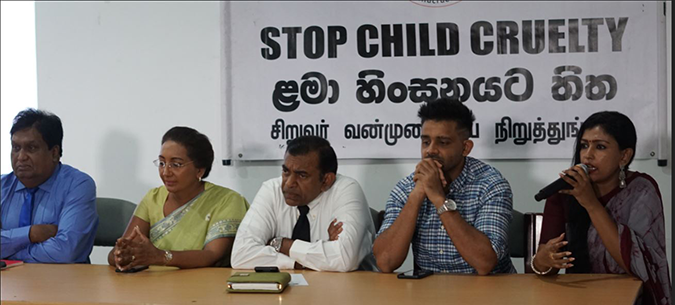
Children unite across the nation to appeal to parliament on Children’s Day

-
= Children are urging all 225 Members of Parliament to include child protection at the heart of their political agendas
-
= The child protection crisis is deepening in Sri Lanka, with an unprecedented rise in child murders; from July
Stop Child Cruelty Trust (SCC) together with Child Protection Alliance (CPA) will recommence the ‘Lama Surakum Yathra’ (Child Protection Tour) in celebration of Children’s Day to spread love to the people and children of the Northern Province. The intensive public awareness campaign will begin in Colombo Fort and will reach Jaffna on 1st October, Kandy on 15th October, Batticaloa on 29th October and Anuradhapura on 12th November.
The grand finale of Yathra is scheduled, for the 18th November 2022, with a walk in support of #NOguti and Sri Lanka’s first Children’s Convention on 18th November to celebrate Universal Children’s Day at the Open Air Theatre at Vihara Maha Devi Park, Colombo.
Speaking about the initiative, the Founder Chairperson of SCC, Dr Tush Wickramanayaka, said, “Although many protested on the streets insisting upon a better country for our children, they were silent about raising better, unwounded children for our country. Yathra is a journey of love to protect and promote children’s rights. In every key city, there will be a day of activities for children, focused on empowering them as rights holders and equal citizens, distributing essential educational material and sanitary pads for children with economic hardships and feeding the hungry via a community kitchen.”
The #NOhit zone school program launched in February 2022 was interrupted by the Aragalaya. “The violent oppression perpetrated by the Authorities is a poignant reminder that ending corporal punishment against children is a pressing need towards the dawn of a new era without violence and establish the just and peaceful country we envisage. We hope to introduce a beacon school in every province we visit on Yathra that promotes Happier and Safer Education”, expressed Dr Wickramanayaka. “A study on school disciplinary methods conducted by National Child Protection Authority in 2017 revealed that 80% of students reported having experienced corporal punishment in the past term. Cases of cruelty reported to NCPA have tripled in the past decade. The Supreme Court of Sri Lanka passed a historic verdict in February 2021 banning corporal punishment of children unequivocally, and it is critically urgent that the Government of Sri Lanka implements these directives to protect our children”, said Pof Prathiba Mahanamahewa, Former Commissioner of Human Rights Commission of SL and former Dean Law and Professor, University of Technology Jamaica.
Saranga Disasekara, Actor and Child Protection Ambassador said, “Our schools are supposed to be a safe space where children and educators can adopt pro-social behaviours that can prevent iolence within the school and in the community. However, if teachers and primary education providers are not aware of alternative punishment methods, the problem will remain and generation upon generation will be conditioned to normalize this heinous crime. I am happy to be part of the SCC’s #NOguti campaign that aims to change this behaviour.” Retd Senior DIG Priyantha Jayakody, speaking on the police’s reaction to child abuse said, “Most of the police officers are not concerned about the privacy of either victim or suspect. It is the responsibility of the police and the media to ensure that the correct approach is used when it comes to the basic rights of citizens irrespective of their involvement, specially to ensure that a child’s rights are always safeguarded. Therefore, I believe it is essential that long-term programs are created and implemented where we educate both the police and media on a strong code of ethics in this area.”
Niranjani Shanmugarajah, Actor and Child Protection Ambassador, speaking at the event said, “A child without love and support will never grow up with the attitude of caring for others or giving love to others. Let’s give love and nurture, let’s change the child’s world with love.”
The indefatigable efforts of SCC in ending violence against children have paved the path at the forthcoming UNHRC sessions to represent 5.2 million children in Geneva as the only Civil Society Organization committed to child rights. Child Protection is a collective social responsibility and SCC will continue its collaborative efforts to raise public awareness, training and advocacy. Those interested in getting involved in the cause can visit the website at www.stopchildcruelty.com and the Facebook page at ww.facebook.com/stopchildcruelty or email info@stopchildcruelty.com.



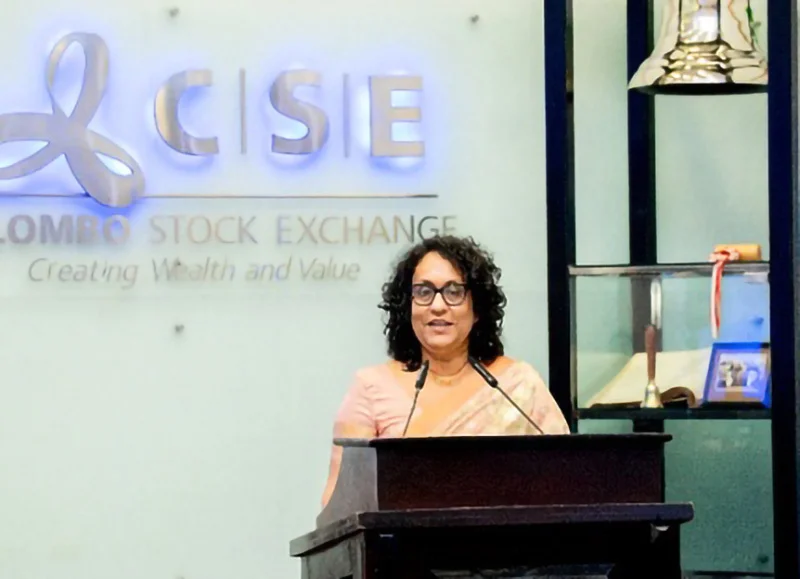
As part of World Investor Week (WIW) 2026, the Securities and Exchange Commission of Sri Lanka (SEC) and the Colombo Stock Exchange (CSE) joined stock exchanges around the world in ringing the market opening bell for financial literacy on 5 October 2026, under the patronage of Dr. Harini Amarasuriya, Prime Minister of the Democratic Socialist Republic of Sri Lanka.
World Investor Week is an annual global campaign led by the International Organization of Securities Commissions (IOSCO) to raise awareness of the importance of investor education and investor protection. The “Ring the Bell for Financial Literacy” initiative, pioneered by the World Federation of Exchanges (WFE), brings together stock exchanges and other stakeholders worldwide to promote greater financial literacy and encourage individuals to make informed financial decisions.
The ceremony also marked the 40th anniversary of the CSE and the joint launch by the SEC and the CSE of the Stock Market Game, an online stock market simulation based on the ATrad trading system.
The Stock Market Game enables participants to gain practical experience of how the stock market works, make investment decisions and construct portfolios of listed shares without using real money. The platform is accessible through the websites of the SEC and CSE and is expected to serve as an important practical tool for promoting financial education. It is envisaged that the Stock Market Game will also be used to conduct simulation competitions among universities and the 100 Capital Market Clubs established in schools across the country.
The ceremony also featured the commemorative issuance of a stamp and First Day Cover to mark the 40th anniversary of the CSE. Issued in collaboration with the Department of Posts and the Philatelic Bureau of Sri Lanka, the commemorative stamp and First Day Cover were presented to Prime Minister Dr. Harini Amarasuriya, by the SEC Chairman Snr. Prof. D.B.P.H. Dissabandara and Ray Abeywardena, Director CSE and Chairman of Central Depository Systems (CDS).
Welcoming the gathering, Rajeeva Bandaranaike, Chief Executive Officer of the CSE, highlighted the importance of obtaining reliable information when making investment decisions.
“We operate in a digital world where a vast amount of information and data is disseminated through social media. While some of this information is factual, some may be inaccurate or misleading. When investing in the stock market, it is essential to make informed and prudent investment decisions. Therefore, investors should obtain information and data from reliable and responsible sources and persons before making investment decisions.”
Addressing the gathering, SEC Chairman Snr. Prof. D.B.P.H. Dissabandara emphasised that the SEC’s role extends beyond regulation to facilitating the further development of the capital market.
“The SEC needs to determine how best to introduce the stock market to Generation Alpha, Generation Beta and generations beyond. When it comes to investors, we need to build confidence in the market, because people will invest only when they have confidence in the market.’’
Business
Rs. 5 million worth of prizes to be given at 8th edition of CSE Masterminds Quiz Competition


The Colombo Stock Exchange (CSE) has announced that the eighth edition of the CSE Masterminds Quiz will be held on 9th October 2026, from 3.00 p.m. onwards, at the Main Ballroom, Shangri-La Colombo.
Recognised as Sri Lanka’s premier capital market quiz competition, CSE Masterminds brings together teams from the public and private sectors. Participants will be tested across international business, global markets, current affairs, the Sri Lankan economy and business, the Sri Lankan stock market, and sports and entertainment, before a concluding rapid-fire round.
This year the winning team can win up to Rs. 2,000,000, the runners-up up to Rs. 1,000,000, and the second runners-up Rs. 750,000. Sector awards will also be presented to the highest-performing team from each participating sector. Guest participants will also be able to compete in rounds of Audience questions, and will have the opportunity to participate a raffle draw for three free return tickets provided by Fits Aviation (Pvt) Ltd.
The evening will also include an exclusive after-party with live music provided by the band ‘Doctor’ featuring guest performer Umara Sinhawansa, fine food and beverages, providing an opportunity for networking and celebration. Every participant will receive a premium goodie bag made possible by the support of the event’s sponsorship partners. Collectively, the event will feature over Rs. 5 million worth of prizes, rewards, and giveaways, encompassing championship prizes, sector awards, audience engagement prizes, raffle draw offerings, and goodie bags.
Sponsorship partners include:
Platinum Sponsors: Hatton National Bank PLC and Bartleet Religare Stockbrokers (Pvt) Ltd.
Gold Sponsors: Ex-Pack Corrugated Cartons PLC, Asha Securities Ltd., and Lanka Securities (Pvt) Ltd.
Silver Sponsors: Barista Coffee Lanka (Pvt) Ltd., Capital Trust Holdings (Pvt) Ltd., LOLC Holdings PLC, Arpico Ataraxia Asset Management (Pvt) Ltd., IronOne Technologies (Pvt) Ltd., and LankaPay (Pvt) Ltd.
Co-Sponsors: Access Engineering PLC, Bank of Ceylon, Commercial Bank of Ceylon PLC, CryptoGen (Pvt) Ltd., Deloitte Lanka (Private) Limited, Dialog Finance PLC, Efutures (Pvt) Ltd., People’s Leasing & Finance PLC, Senfin Asset Management (Pvt) Ltd., and Softlogic Stockbrokers (Pvt) Ltd.
Business
NCCSL to conduct practical workshop on food labelling and advertising regulations in Sri Lanka

The National Chamber of Commerce of Sri Lanka (NCCSL) is organizing a one-day practical workshop on “Food Labelling & Advertising Regulations in Sri Lanka” on Thursday, 8th October 2026 from 9.00 a.m. to 4.30 p.m. at the National Chamber of Commerce, Colombo 10. The workshop has been organised to provide a practical understanding of the latest regulatory requirements governing the food products labelling and advertising of food products in Sri Lanka, with particular attention to regulatory developments applicable in 2026, compliance requirements, and the potential legal and financial implications of non-compliance.
As food products increasingly compete not only with quality and price but also on packaging, labelling and promotional claims, businesses must ensure the information they communicate to consumers is accurate, transparent and consistent with applicable regulatory requirements. Understanding these requirements is therefore essential for businesses seeking to protect their brands, maintain consumer confidence, and minimize regulatory and legal risks.
The practical workshop will go beyond an overview of regulations and focus on how businesses can apply regulatory requirements in their day-to-day operations. Participants will be guided through key areas of food regulatory compliance, including the national food regulatory framework, recent food labelling regulations and key changes, mandatory approvals and prohibitions relating to food labelling, and the litigation process associated with regulatory violations. The programme will also cover several areas of growing importance to the food industry, including the EU EMPCO Directive, food colour coding regulations, regulations relating to food trans-fatty acids and the importance of compliance in the use of food additives. Practical exercises will further enable participants to apply their knowledge to real-world compliance situations and strengthen their ability to identify potential regulatory concerns.
For further information and registration, please contact the National Chamber of Commerce of Sri Lanka on 011 4741788 – Nethmi or Udula – 071 403 4775.

Former first lady Shiranthi Rajapaksa arrested by CIABOC

U.S. Navy ship USS Tulsa arrives in Colombo for replenishment visit

Smriti Mandhana appointed India captain across formats

Ronaldo apologizes for Portugal walkout; says Jesus broke promise

Showers in the Western, Sabaragamuwa, Central, Uva, North-western and Southern provinces and in Anuradhapura and Mannar districts

Fuel crunch looms

‘Dates have the highest sugar content to fight Coronavirus’

Sunday Island 27 December – Headlines

#SundayIsland 17th December – Headlines

Sunday Island – 28th March

Sunday Island Headlines – 21 March

Sunday Island – 21st February – Headlines
-

 News7 days ago
US-assisted ‘Ice’ detection: NPC to examine IGP’s move to transfer drug-busting team
-

 Editorial6 days ago
Colombo Port drug bust: The plot thickens
-

 Editorial7 days ago
Drug busting, transfers and trust deficit
-

 Features4 days ago
The first woman in the foreign service or Ceylon Overseas Service it was then called
-

 News7 days ago
Sri Lankan facing death penalty in Saudi Arabia: Mano G appeals to Crown Prince
-

 Editorial5 days ago
Fuelling discontent and protest
-

 News3 days ago
Geneva takes up Sallay’s case and govt. ignores opportunity to answer accusations
-

 Latest News4 days ago
Tharindu Rathnayake, bowlers secure Asian Games Bronze for Sri Lanka