
Editorial
A sinister move

Saturday 10th July, 2021
A sinister attempt is being made in certain quarters to trigger a run on banks if some social media posts are anything to go by. Several self-appointed financial experts have urged the public to withdraw their money in local banks immediately as there is the likelihood of all accounts being frozen. Thankfully, their efforts have not yielded the intended results because the public has not taken their claim seriously. This may be the reason why the government has not reacted yet, but there is no guarantee that the people will continue to act rationally.
The Sri Lankan public is literate but notorious for whipping itself into collective hysteria, and, therefore those who are striving to cause a bank run might succeed in their endeavour. It may be recalled that there have been several instances of people responding to false tsunami alarms and running away. They no longer panic in that manner because reliable information about seaquakes is made available to them. Some years ago, thousands of people gathered near Buddha statues, believing in a rumour that rays were emanating from them. Then there was the much-publicised claim that juice made from the leaves of a certain fruit tree was a surefire cure for dengue. Many were the poor dengue patients who were made to swallow it, but their recovery was due to medical science. Hundreds of thousands of Sri Lankans fell for a carpenter turned native physician’s claim that he had found a cure for Covid-19 with the help of a goddess. Among them were the Health Minister, the Speaker of Parliament, several Cabinet ministers, and even some doctors. A national university granted the herbal concoction ethical clearance, and the quack made a killing. He is no longer in the news.
The public recently fell hook, line and sinker for a social media claim, and resorted to panic buying of salt in the aftermath of the X-Press Pearl disaster. That was their reaction to someone’s warning that there would be a shortage of salt. Now, the people have stocked up salt sufficient for many more months!
Thus, it may be seen that the attempts being made on social media to cause mass withdrawals from banks should not be taken lightly. The disruptive netizens base their claims about the banking system, on the condition of the national economy. Some independent economists have assessed the situation dispassionately and accurately, but their views are not widely known to the ordinary people, who know only what the ruling party politicians and their Opposition counterparts say about the economy.
Both the government and doomsayers are not telling the truth about the country’s economic situation. The latter would have the public believe that the collapse of the economy is imminent, and the former is making light of the situation. The truth is equidistant from these two extreme positions; the economy is in bad shape, but it can be revived if a serious attempt is made.
As for the irresponsible members of the public and the anarchical elements who love chaos, social media have become something like a straight razor in the hands of a mad monkey. They are all out to dupe the people, most of whom easily work themselves up into a lather. Social media have also become a weapon for certain external forces bent on destabilising countries, as evident from the manner in which the Arab Spring was engineered with leaderless mass protests sweeping across some states. The Arab Spring has turned out to be a winter of despair.
It is hoped that some decisive official action will be taken to counter the false claims being made on social media about the local banking system. What needs to be done is to educate the public on the real economic situation and the action being taken to overcome the problem, so as to allay their fears, before it is too late.



Friday 5th June, 2026
The Opposition’s propaganda mill is in overdrive, manufacturing various stories about a split in the JVP-NPP government. Mighty governments collapse not because their political enemies regain lost ground and turn the tables on them. They fall largely because the arrogance of power blinds their leaders to reality while their members dare not speak truth to power. Government members sing hosannas to their leaders and even defend the latter’s wrongdoing, committing collective political hara-kiri in the process. The incumbent JVP-NPP government has its fair share of acolytes who try to defend the indefensible.
Former Public Security Minister Sarath Weerasekera (SW), in his response to a recent editorial in this newspaper, has sought to lay the blame for the failure of the Gotabaya Rajapaksa (GR) government on others. In his letter published on the opposite page, today, he insists that the Rajapaksas had the national interest at heart. He implies that they never engaged in dynastic politics, and the 2022 economic crisis was due to factors other than the mismanagement of the economy.
The economy went into a tailspin during the GR government not solely due to the economic consequences of the Covid-19 pandemic and the repayment of foreign loans obtained by the Yahapalana government. Economists have pointed out that the pandemic did not cause bankruptcy on its own, but it acted as a major trigger that exposed pre-existing weaknesses such as high debt, weak foreign reserves, and overdependence on exports and tourism. All governments pay back loans obtained by their predecessors.
The GR government should have sought IMF help at the first signs of trouble. One may recall that acting on Central Bank (CB) advice, the Mahinda Rajapaksa (MR) government (2005-2010) secured IMF assistance and managed an emerging forex crisis, which would have derailed the war effort. If the GR government had heeded CB advice and taken action to increase tax revenue and shore up the country’s foreign currency reserves with IMF help, the 2022 economic crisis could have been averted.
Sri Lanka had to opt for a soft default and seek IMF assistance in 2022. The choice it had was between a soft default and a hard default, which would have ruined its chances of borrowing from external sources again. Sri Lanka was bankrupt, and that fact had to be announced.
The UPFA and SLPP administrations during MR’s second presidential term (2010-2015) and GR’s presidency (2019-2022) were in fact governments of the Rajapaksas by the Rajapaksas for the Rajapaksas. In the GR government, the number of key ministries held by the Rajapaksas increased to five. The share of government expenditure linked to the ministries controlled by them was more than 50% between 2010 and 2015 and between 2019 and 2022, according to political commentators. The other members of the MR government (2010-2015) became so disgruntled that a group of prominent UPFA MPs including ministers voted with their feet in 2014, and General Secretary of the SLFP Maithripala Sirisena went on to challenge MR in the 2015 presidential contest and secure the presidency. As many as 41 SLPP MPs broke ranks with the GR government in early 2022.
Aragalaya,
which crippled the Rajapaksa rule, began as a genuine, leaderless protest campaign against economic hardships, especially prolonged fuel shortages and power cuts. Some political forces infiltrated it subsequently, but it was losing steam when a group of SLPP goons set upon peaceful protesters at Galle Face in May 2022, and triggered a spree of retaliatory violence, which led to the ouster of the Rajapaksas, and paved the way for the 2024 regime change.
As for reconciliation, a retired Major General known for his distinguished military career and respected leadership, writing under a pseudonym––‘Old Soldier’––recently had this to say in his letter critical of the way the government handled this year’s War Heroes’ commemoration, which was the topic of the editorial comment under discussion: “Reparations are claimed by the winners in wars between nations. After civil conflicts there should be reconciliation. There should be no humiliation. When will commemoration of the dead be national in Sri Lanka?”
If the SLPP is to make a comeback, its leaders and their apologists must shed their aversion to self-criticism. The same applies to their equally self-righteous counterparts in other Opposition parties.

Thursday 4th June, 2026
The government has locked horns with private bus operators, who are demanding a fare hike amidst soaring fuel prices. The former has rejected the fare hike demand out of hand, claiming that it is unfair. President of the Lanka Private Bus Owners’ Association Gemunu Wijeratne has threatened to launch a bus strike unless a fare increase is granted forthwith. He has claimed that there is legal provision for the annual bus fare revision due in July to be advanced. The government and the irate private bus owners are now playing a game of chicken.
School vehicle operators have warned that they will have to increase fees. Trishaw owners have also demanded a fare hike. Container truck operators have already increased freight charges by 5% to offset surging operating expenses, primarily driven by higher diesel prices, inflated costs of tyres and spare parts.
A brutal one-two combination—fuel price hikes and rupee depreciation—has sent all vehicle owners, save a few, to the canvas, so to speak. The prices of spare parts, lubricants and tyres have also skyrocketed. It is only natural that transport operators are demanding fare revisions. The government should stop making political statements and address the issues facing the transport sector. The public cannot take any more shocks, and another fare hike is something everyone needs like a hole in the head. It may not be feasible to grant the bus operators’ request for a fuel subsidy, but the government may be able to help them lower costs in some other way.
It will not be possible to overcome Sri Lanka’s balance of payments woes, strengthen the rupee and shore up foreign currency reserves without a proper strategy to reduce the national fuel bill, which accounts for more than 20% of the total value of imports. President Anura Kumara Dissanayake has pointed out that the country’s monthly fuel import expenditure has surged nearly six-fold. Driven by escalating tensions in West Asia, the fuel import bill rose from USD 98 million in February to USD 522 million in May, according to him. There is no gainsaying that drastic measures need to be adopted to reduce fuel consumption urgently. However, increasing fuel prices is not the only way to achieve this goal.
A country does not need a government to curtail the demand for fuel through price hikes. The JVP-NPP administration should be able to strategise to reduce fuel consumption through other means if it is to be considered worth its salt. Minister Anura Karunathilake and Ceylon Petroleum Corporation Chairman D. J. A. S Rajakaruna have gone on record as saying that action will be taken to have the QR-based fuel rationing system strictly regulated. Why didn’t the government care to do so earlier? If the fuel quota system is to be effective, the practice of motorists sharing the QR codes must be brought to an end. If the national fuel consumption has reached an unmanageable level, as President Dissanayake has said, will the government explain why fuel quotas were increased.
President Dissanayake and his government should learn from India’s efforts to reduce fuel consumption and adopt a top-down national austerity approach to conserve foreign exchange amidst external economic pressures. India’s strategy emphasises reducing official fuel use, adopting digital alternatives to travel, and promoting public transportation to manage energy consumption. After all, the JVP-led NPP came to power, promising austerity measures, which it must now adopt to curtail state expenditure while reducing the burgeoning import bill.
The JVP-NPP government is slow in responding to emergencies. Its disaster response following the landfall of Cyclone Ditwah was woefully tardy. It ignored warnings and waited until the country’s fuel reserves were almost depleted to introduce the QR-based rationing. It cannot wish away the threat of a private bus strike. It must get the bus owners around the table and have a serious discussion on how to resolve the transport sector woes instead of bellowing rhetoric.
Wednesday 3rd June, 2026
Opposition Leader Sajith Premadasa is reported to have lamented that in Sri Lanka, politicians who are adept at lying succeed at the expense of those who work really hard. He never misses an opportunity to project himself as a hardworking politician, and therefore his political rivals may claim that his lament smacks of self-promotion. Nevertheless, his argument is not untenable. During the last several decades, we have heard zillions of lies uttered by numerous political leaders, who have overtaken Machiavelli, Goebbels and even Matilda, who told “such dreadful lies” as made “one grasp and stretch ones’ eyes”. Opposition parties are lucky that people lose interest in their campaign lies after elections.
Lying is the name of the game in Sri Lankan politics. False promises made by politicians out of power should also be considered lies, for they are intended to deceive the public. What are usually described as the incumbent government’s lies are the false promises contained in the NPP manifesto or made by JVP/NPP politicians before the 2024 elections.
It has now become clear that the JVP/NPP leaders lied to the public when they said they were opposed to the manner in which debt was restructured and, if voted into office, they would renegotiate the bailout agreement signed between the IMF and the previous government. But after forming a government they opted to keep the agreement intact, and wisely so. The SJB has been saying something similar about the IMF programme, and it would have been exposed for lying if it had been able to form a government.
Some Opposition parties that have banded together to challenge the government claim that they would have handled the current energy crisis differently and granted relief to the people by reducing taxes on fuel. Accusing its political rivals of lying to garner favour with the public, the government insists that there is no way the fuel prices can be slashed. It finds itself in an IMF straitjacket, and has to fulfill the bailout conditions or lose IMF assistance. It is required to increase state revenue and ensure that energy prices are cost reflective, the JVP/NPP says. So, the only way the Opposition can disprove the government’s claim that it has to increase fuel prices to recover costs is to obtain a detailed cost breakdown and prove that the fuel prices are way above costs. The Opposition politicians shedding copious tears for the public ought to present facts and figures to support their claim that the government is jacking up fuel prices to meet the cost of extra diesel stocks purchased to operate the oil-fired power plants to make up for the Norochcholai generation loss caused by fraudulently procured low-grade coal. Mere rhetoric won’t do. Parliament is the best forum where the Opposition should pressure the government to reveal how fuel prices are determined.
Meanwhile, an SJB spokesman has said something that is construed in some quarters as an unwitting admission that the Opposition’s claim that the JVP-NPP government is not on the right course to strengthen the economy is false. Likening the JVP-NPP government, which is making a frantic effort navigate a host of vexed issues to straighten up the economy, to the proverbial bullocks pulling loaded carts up the steep slope of Haputale, SJB MP Mujibur Rahman has said the SJB is waiting until that task is completed to capture power. It is advisable to get the JVP-led administration to tackle the current economic issues because the JVP/NPP, after losing its hold on power, will never allow a future government to do so, he has said. He may have sought to make his party out to be smarter than the JVP/NPP, but what was intended as a back-handed compliment became an unintended compliment for the government besides exposing the Opposition’s hypocrisy. What one gathers from his statement is that the SJB is waiting to enjoy the fruits of the JVP-NPP government’s labour while criticising the ongoing economic recovery programme. In other words, the SJB knows that the government is doing what is necessary to strengthen the economy. If it is as patriotic as it claims to be, it should subjugate its political agenda to the national interest and help strengthen the economy.

Let us all come forward with the responsibility in mind to bequeath a secure a secure, prosperous and green planet to future generations – PM

Everest guide survived six-day ordeal by eating chocolate and ‘chewing ice’

Nasa astronauts return to ISS after sheltering during air leak repair attempt

World Environment Day marked by National Celebration under President’s Patronage

Qualifier Chwalinska sets up final against Andreeva

Zelensky proposes face-to-face talks in open letter to Putin

‘Dates have the highest sugar content to fight Coronavirus’

Sunday Island 27 December – Headlines

#SundayIsland 17th December – Headlines

Sunday Island – 28th March

Sunday Island Headlines – 21 March

Sunday Island – 21st February – Headlines
-

 News4 days ago
Lankan duo emerge winners in Latin dance championship held in Blackpool, UK
-
 News7 days ago
IMF urges Lanka not to meddle with exchange rate
-

 Business5 days ago
IMF’s unstated rate:Sri Lanka’s $695m loan costs about 5.33% per annum
-
 News7 days ago
State of emergency extended
-
 Latest News2 days ago
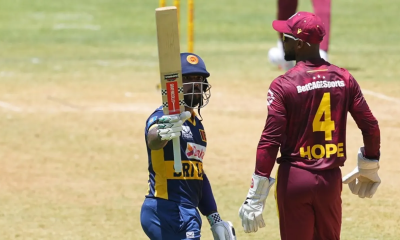
Kusal Mendis, Pathum Nissanka, bowlers put Sri Lanka 1-0 up
-
 News2 days ago
New US tariffs proposed on 60 countries, including Sri Lanka
-

 Business5 days ago
Sri Lankan scientist-innovator Milinda Edirisinghe introduces AI-integrated gem testing system to gemological world
-
 Features6 days ago
Are threats to Buddha Sasana external or from within?