
Features
MyVicarious Football Life

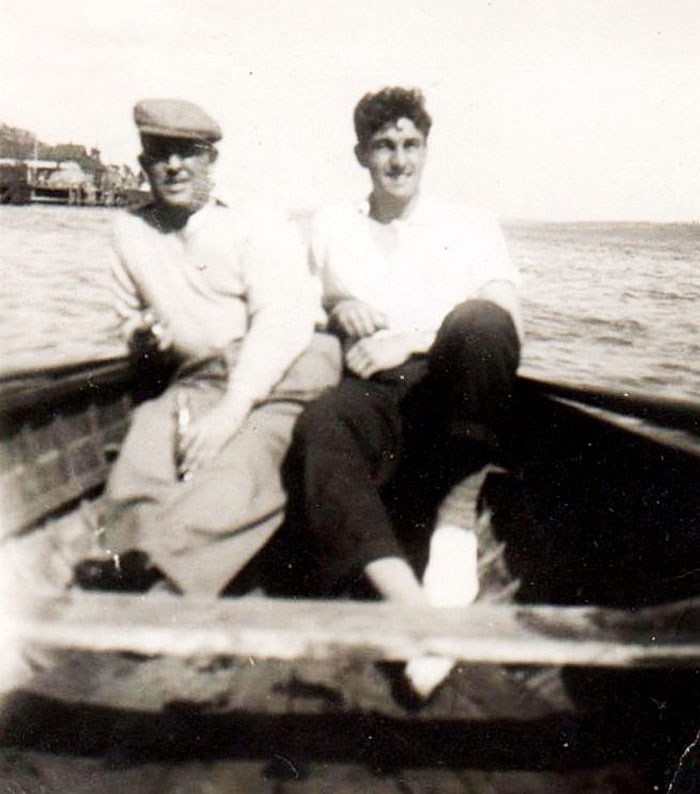
By Michael Patrick O’Leary
“Who could have known, who could have guessed that Cristiano Ronaldo was in fact a wildly solipsistic (theory that only self exists) egomaniac?” Barney Ronay in the Guardian.
Gloucester City played its home games at Longlevens from 1935 to 1964. The ground was within easy walking distance from my home. Walking back from a game on foggy November evenings in the early 1950s, I looked forward to a tea of hot toast with salted and peppered beef dripping, possibly salted from a runny nose.
Football was different in the early 1950s. The ball was a heavy leather thing which got even heavier on a wet day and was a great health risk to those heading it. The players wore baggy shorts and looked older than their years. I recall the smells of Gloucester City football ground. My father knew some of the players and took me into the dressing room, which was full of naked men and reeked of embrocation. There was a player called Hardisty who looked very hard and also very old with a shiny bald head. There was another called Beatty who bore a resemblance to an actor who was in a lot of films at the time, Robert Beatty. The actor was a Canadian based in Britain. He had a thick head of dark hair heavily Brylcreemed. Beatty the footballer, a Scotsman, also had a fine head of dark hair generously Brylcreemed. My father used to make a strange joke, pointing at the greasy looking pillow on the bed beside my mother, “I see Beatty’s been here.” My father also had a fine head of auburn hair, lavishly Brylcreemed.
There were some younger players in the dressing room, including the brothers Etheridge. Dick Etheridge was manager in 1967 (also in 1970 and 1980) and brother Bobby did a stint in 1985. Frank Tredgett was a player who became manager in 1960. Phil Friel was a nippy little Scottish winger who became interim manager in 1960. In 1956 there was a capacity crowd for the second leg of the Southern League Cup Final and I was close to Phil Friel on the touchline as he performed miracles to bring Gloucester a famous victory over Yeovil Town. In 1959, the manager was Ollie Norris, a Northern Irishman who had played for Middlesbrough.

Norris had achieved some notoriety as a curly-haired inside forward trying to stop Spurs’ captain Danny Blanchflower taking throw-ins by jumping up and down in front of him. That was before an economist stole Danny’s identity and became ubiquitous as a financial pundit. Amid a financial crisis at the club in January 1960 Norris was dismissed as full–time player/manager and offered, as an alternative, a part–time role as player/coach – an offer Norris rejected. Occasionally there were charity games which gave the Gloucester stalwarts the chance to defeat conglomerations of international stars – I remember seeing the legendary Jackie Milburn play at Longlevens.
Watching the games I got smells of wet turf, Woodbine cigarettes, Smiths potato crisps (with the blue twist of salt) and Niblets, American Cream Soda.
My father and I went upmarket in 1955 when we started going to Birmingham on the train to New Street to see Aston Villa when Pat Saward joined the club from Millwall. As a kind of shorthand, I tend to refer to Pat as my cousin. We were not related by blood – but we shared an uncle by marriage. His Uncle Thomas married my father’s sister, Peggy. Pat was born in Cobh, County Cork but brought up mainly in Croydon ( lived in Croydon after getting married at the same register office as Camille Pissarro) after spending time in Singapore and Malta (Pat’s accent was strongly Croydon rather than County Cork). His transfer from Millwall was finalized on Paddington Station and the price on his head was £7,000. He was part of the team when Villa beat Manchester United in the 1957 FA cup final. (I have held his medal in my hand.) There was controversy when a “robust challenge” by Villa’s Peter McParland broke the jaw of United keeper Ray Wood. (Danny Blanchflower’s brother, Jackie, took over in goal). McParland and his wife visited my Aunty Peg’s Albert Terrace home in Cobh. His wife’s skirt dropped off as she got out of the car.
Eddie Cochran was killed on April 17, 1960, when the taxi carrying him from a show in Bristol, England, crashed en route to the airport in London, where he was to catch a flight back home to the States. I was standing on the terrace at the Holte End of Villa Park when I heard the news. I was also there when Derek Dougan made his debut appearance for Villa on Saturday, 19 August 1961 aged 23. Villa had signed Dougan from Blackburn Rovers on 1 July 1961 for a fee of £15,000. He was signed by manager Joe Mercer as a replacement for Gerry Hitchens, who had been sold to Inter Milan earlier in the summer for £85,000. Teammate Peter McParland later commented that “when Derek came to us at Aston Villa I think it was at a time when he was not taking the game particularly seriously”. I well recall seeing Dougan run on to the pitch with a shaved head. Shaved heads and tattoos were not commonplace in 1961 Birmingham.
Pat became Villa captain in the 1959-60 season, during which the club won the second division championship and reached the semi-final of the FA Cup. By the time of his move to Villa Park, Saward was an Ireland international, winning his first cap against Luxembourg in 1953. He was also captain of the Republic of Ireland for whom he made 18 appearances. He told me that for each international appearance he was paid £50.
My father and I would report to the players’ gate at Villa Park before a game and Pat would come out and hand us two complimentary tickets for VIP seats in the stand, sometimes sitting with the directors and the players’ wives. My 10-year-old self would hand over an autograph book. After the game we would return to the players’ gate and Pat would hand back my autograph book enriched with the signatures of the home and visiting teams. He would then take us into Birmingham for a chat and a coffee. In the early days, he would take us on one of those cream-coloured double-deckered Birmingham buses. I remember being seated on the top deck of a bus accompanied by many members of a first division team, some of them internationals. One of them was Jackie Sewell, who gained six caps for England, scoring three goals, one in England’s historic defeat against Hungary in 1953. Sewell joined Aston Villa in December 1955 for £20,000. Can one imagine Ronaldo travelling on a bus? Later Pat acquired a car in which he drove us into the centre of Birmingham. I still blush at the thought of me falling down the stairs in the Kardomah.
In 1962, when I was 15, I spent six weeks in the summer at my Aunt Peg’s house in Albert Terrace, Cobh. For part of the time, Pat was staying there too. Every morning, he would get up early and immerse himself in the rain barrel in the back yard. When he strolled into town, many young (and old) ladies’ hearts went a-fluttering. I recall that one of his favourite haunts was the Horizon Bar at the foot of the precipitous East Hill.

After retiring as a player, Saward joined the youth team coaching staff at Coventry City, before becoming assistant manager to Jimmy Hill. From 1973 to 1988, Hill was host of the BBC’s Match of the Day – the Gary Lineker of those days (Lineker gets £450,00 per year from the BBC). Hill regularly attracted 12 million viewers but only earned £50,000 — which is £130,000 in today’s money. In 1957, Hill became chairman of the Professional Footballers’ Association (PFA), the players’ trade union, and campaigned to have the Football League’s £20 maximum wage scrapped, which he achieved in January 1961, when Fulham teammate Johnny Haynes became the first £100-a-week player. In those far off pre-Beckham days Haynes made a side-living from advertising Brylcreem. (The cream, which originated in Birmingham in 1928, is an emulsion of water and mineral oil stabilised with beeswax.)
I enjoyed the film The Damned United, in which the versatile Michael Sheen played the mercurial football manager Brian Clough. I was disappointed that there was no mention of Pat Saward. In July 1970, Saward was appointed manager of Brighton & Hove Albion, winning promotion to the Second Division in 1972. “With his extrovert personality, attacking style of play and infectious good humour, he was immensely popular at the Goldstone Ground”, wrote one fan. In October 1973, Saward was sacked and replaced by Brian Clough. Club captain Eddie Spearritt said that Saward was backed by the players and they did not want him to leave. Clough was in charge at Brighton on a match-playing basis for six months, 32 games, from the beginning of November 1973 to the end of April 1974 before moving to Leeds where he lasted 44 days, like Liz Truss’s premiership.
Following his spell at Brighton, Saward coached in Saudi Arabia, as well as managing Emirati club Al-Nasr. He also had a property in Minorca. After retiring, he stayed in Dubai until health issues necessitated a return to the UK to be near family. He died in September 2002, aged 74, as a result of Bronchial pneumonia, although I have seen Alzheimer’s’ mentioned.
Cristiano Ronaldo made $115 million between May 2021 and May 2022, making him the third-highest-earning athlete in the world, according to Forbes. It means the 37-year-old, has now earned well over $1 billion during his illustrious career.
I do not resent celebrities amassing shed-loads of money. I am brimming over with muditha. Marina Hyde writes mordantly and brilliantly in the Guardian on the hypocrisy of politicians. She used to be a sports columnist and knows the subject of football. She will have none of politicians carping about rich footballers getting “involved in politics”. Manchester United’s Marcus Rashford forced the UK government to U-turn on its free school meals policy. “So we are left with a 22-year-old footballer having to point out the realities to men whose job it is supposed to be to know.” Rashford came from very humble beginnings to achieve his riches and he is very conscious of his responsibilities. Hyde asks, “how many Gavin Williamsons would you have to amass before you were even close to the value of one Marcus Rashford? How many Matt Hancocks? How many Boris Johnsons?”.
That said, I can find no empathy for today’s glitzy, global, blingy football. Dreary winter afternoons shivering with a cup of Bovril on the terraces at Maine Road watching the magic of Rodney Marsh and Colin Bell when Joe Mercer was manager (he previously managed Aston Villa) are long gone. Manchester City are now hugely successful and their home is the Etihad Stadium. Aston Villa is currently owned by the NSWE group, a company owned by the Egyptian billionaire Nassef Sawiris and the American billionaire Wes Edens. My first sighting of Roy Keane, who had transferred from Cobh Ramblers (their home ground was called Villa Park) to Nottingham Forest under Brian Clough was at Arsenal’s Highbury Stadium. There were some people from Cobh sitting behind me. Arsenal now play at the Emirates Stadium. On 7 October 2021, Newcastle United was bought for £300 million by a consortium led by the sovereign wealth fund of Saudi Arabia
The World Cup is being played in Qatar with no expense spared in money or human lives. I will not be watching. Paul Waugh asked in the i-paper, “Will you be watching the Qatar World Cup?” Just 13 per cent said yes, 74 per cent said no and 13 per cent were undecided.


 It may be some time before the full impact of food inflation is felt in the West. Until such time the world would continue to keep itself in suspense over whether the Trump administration is in earnest when it seeks to convey the impression that it is backing a negotiated solution in West Asia.
As is usually the case, consumer stress would be one of the final determinants of political change. To the degree to which the average US consumer somehow ‘muddles through’ and puts the food on the table, to the same extent would the Republican sections of the US public in particular be tolerant of the Trump administration’s inconsistent handling of the West Asian war and the main issues stemming from it. That is, there would be no grave popular disaffection and a demand for political change in the short term.
However, the indications are that the Trump administration’s support base is suffering some erosion in the wake of the current economic crisis. While reports indicate that Democratic sections are firming-up their opposition to the political centre, Republican support for Trump is also showing signs of waning, we are given to understand.
The above developments are probably why Trump is on record as having given Israeli Prime Minister Benjamin Netanyahu a ‘dressing down’ recently on his seeming intransigence on the question of giving negotiations a chance in West Asia. The show of displeasure could be really aimed by Trump at containing the impatience of the American public.
However, the current ground situation in the Middle East, particularly the uncontained bloodshed, is likely to impress on the thinking sections of the world that more than temporary political change is needed in West Asia and the US.
A well thought out political solution that addresses all the contentious issues at the heart of the Middle East conflict is what enlightened opinion would demand, and very rightly. Right now, the ‘peace efforts’ initiated by the Trump administration give the impression of being piecemeal solutions at best.
There have been, of course, numerous initiatives in the past aimed at bringing permanent peace to the Middle East. These failed mainly because they did not address in full the root causes of the conflict.
At bottom the Middle East conflict is mainly about race and religious hate bred by socio-economic and material inequalities. For instance, if the Palestinian people were not displaced and deprived of land occupied by them at the time of the founding of the Israeli state, ethnic enmities would not have grown to the current unmanageable proportions.
When addressing the above questions, though, it must be remembered that the Israelis too were a displaced people who were entitled to land and a state of their own in the Middle East. Basically, out of these seemingly irreconcilable and conflicting demands have grown the Middle East imbroglio.
Middle East peace is considerably about reconciling these demands and arriving at a solution that would ensure the creation of two states that would opt for peaceful co-existence thereafter.
As long as the US does not see the need for a non-partisan solution that addresses the needs of both ethnicities and religions and goes all-out, as it were, to have it implemented, the Middle East would continue to bleed.
However, staunching the blood flow through the creation of two states would be only half the job done, though a very important part of it. More pernicious, pervasive and difficult to remedy are the inter-ethnic and inter-religious hatreds that have been unleashed over the decades.
However, if substantial, long-lasting peace is to be fostered in the region the latter ‘demons’ would need to be exorcised from the hearts and minds of the communities concerned. No doubt an uphill task but one that must be undertaken by those who wish the region well.
The UN would need to put its ‘best foot forward’ in such undertakings but it is time that it dawned on the international community and other caring quarters that Middle East peace, and all other such uphill challenges, require proactive peacemaking on the part of all civilized sections for their effective management. That is, public involvement in peacemaking too is a must.
Since hatreds are harboured in the human consciousness the enmities embedded in the latter need to be managed and defused judiciously alongside other undertakings in a peace process. In the case of West Asia, such enmities could be even spread globe-wide besides being multi-dimensional. For instance, it ought to be thought-provoking that Iran is insistent on a peace initiative that would also include Lebanon.
Besides security considerations it is also ethnic and religious affiliations that account for Iran making this demand. For instance, the Shias are a numerically important religious community in Lebanon and they provide a significant number of Hizbollah fighters, who are in a vital sense carrying out a ‘proxy war’ for Iran. It also needs to be factored in that Iran is a Shia-majority country.
Thus trans-border religious affiliations could add to the complexities and enormity of ethno-religious conflicts. However, the task of managing centuries-long enmities needs to be launched and prodded on with by peacemakers since a downing of arms alone would not guarantee substantive peace.
It is not realized sufficiently that the process of ending hatreds begins with mutual apologies by antagonists to a conflict for the harm inflicted on each other. This would be anathema in some ears but there is no getting away from the requirement. It is the vital first step to permanent peace anywhere.
In fact there could be no reconciliation worth speaking of without such mutual apologies. It is a point worth re-iterating in these times when even the government of Sri Lanka is voicing the need for national reconciliation. Well, without the words, ‘I am sorry’, there could be no permanent end to enmities – they would do well to remember.
The above requirements may not go down very well with governments, but they resonate in the hearts and minds of most people, since they are inheritors of religious traditions of some kind.
This is a principal reason why peacemaking works well when publics too are involved in them. The effectiveness of such campaigns increases several fold when they have a Mahatma Gandhi or a Jawaharlal Nehru at their helm. A strong proactive involvement by the public in peace could lead to the emergence of such leaders at some point in these campaigns.
Official Digital Partner of the 2026 ‘Dakshina Prabha’ National Vesak Zone
Dialog Axiata PLC, Sri Lanka’s #1 connectivity provider, collaborated with the Ministry of Buddha Sasana, Religious and Cultural Affairs to bring one of Sri Lanka’s largest and most technologically advanced Vesak experiences to the ‘Dakshina Prabha’ National Vesak Zone. The three-day celebration, in Matara attracted more than hundred thousand visitors, who engaged with a series of innovative digital activities powered by Dialog 5G Ultra, including Artificial Intelligence (AI) and Virtual Reality (VR) experiences, digital pandols and a Data Dansala. The opening ceremony was attended by Hon. Sunil Handunnetti, Minister of Industry and Entrepreneurship Development and Hon. Saroja Savithri Paulraj, Minister of Women and Child Affairs, along with distinguished guests and Dialog’s senior management.
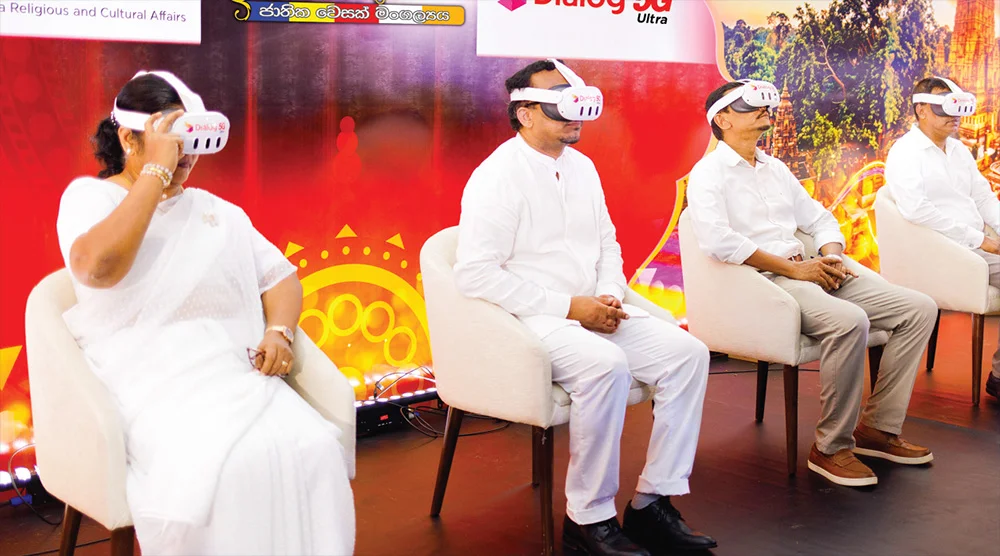
One of the key attractions at the venue was the Dialog 5G Ultra-powered Virtual Reality (VR) experience, which attracted more than 35,000 participants. The activation enabled devotees to virtually visit and pay homage to sacred Buddhist sites, including the Jaya Sri Maha Bodhi in India and the Atamasthana in Anuradhapura, directly from the Vesak zone in Matara.

Visitors receive complimentary mobile data through Dialog’s QR-powered Data Dansala.
Dialog also conducted an AI Digital Vesak Greeting Card Competition from 21 May to 01 June 2026, attracting numerous entries from across the country. The shortlisted designs were showcased across 20 large LED screens throughout the venue and across Matara City, and were also made available for download via mobile devices. Further, through the use of AI, traditional Jathaka Katha were reimagined in a digital format, demonstrating how technology can be used to preserve and enhance cultural and religious heritage. Together, these initiatives blended traditional Vesak celebrations with emerging technologies, offering visitors a unique and immersive way to engage with Vesak traditions.
Extending the spirit of Vesak through connectivity, Dialog conducted a special Data Dansala powered by its QR Reload platform, enabling visitors to receive complimentary mobile data by scanning QR codes placed across the venue. In addition to the Matara National Vesak Zone, similar Data Dansala activations were also conducted at the Gangaramaya and Bauddhaloka Vesak zones in Colombo.Visitors also had the opportunity to create personalised Vesak-themed digital photos through an AI Photo Booth, generating AI-enhanced portraits using their own photographs and adding a contemporary digital element to the Vesak celebrations.
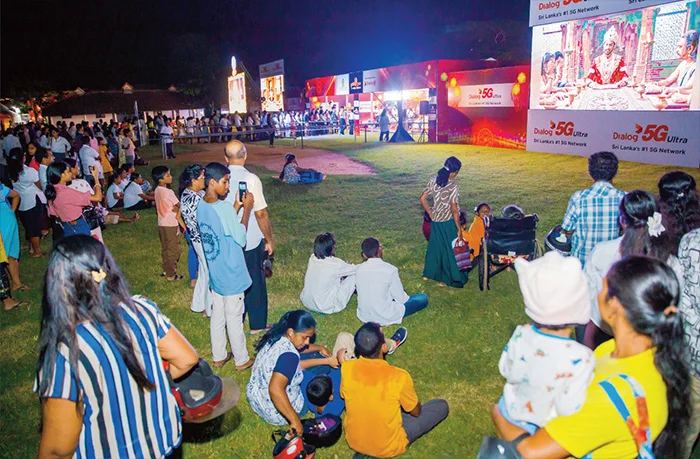
Visitors watch AI-generated Jathaka Katha
Commenting on the initiative, Hon. Sunil Handunnetti, Minister of Industry and Entrepreneurship Development, said, “The 2026 Dakshina Prabha Vesak Festival marked the first time AI-powered digital innovations were incorporated into a National Vesak Festival in Sri Lanka. Presenting Buddhist stories and teachings through technology created a new and engaging way for visitors to connect with these traditions. We thank Dialog for supporting this initiative and for working closely with us to bring our vision to life. Their contribution played an important role in making this first-of-its-kind event a reality.”
Lasantha Theverapperuma, Group Chief Marketing Officer of Dialog Axiata PLC said, “We thank the Government of Sri Lanka for the opportunity to support the 2026 Dakshina Prabha National Vesak Festival and for embracing technology as part of this year’s celebrations. As the Official Digital Partner, we were privileged to contribute through our Dialog 5G Ultra and AI capabilities, creating new ways for visitors to engage with Vesak traditions while preserving their cultural significance for future generations.”
Beyond supporting the National Vesak Zone in Matara, Dialog also enhanced the Gangaramaya and Bauddhaloka Vesak zones through a range of digital activations during the Vesak season. The company additionally continued its sustainability initiatives, including the Thirasara Aloka Poojawa, which illuminated rural places of worship through solar-powered lighting solutions.

Universal Woman is an international pageant focused on “beauty, elegance, and talent” for women, positioning itself as a platform to shape global ambassadors. The 2026 edition will be held in Cambodia, and Sri Lanka will be there, as well.
According to reports coming my way, contestants, at the international event, will work with industry trailblazers, under international standards.
Sri Lankan supermodel, runway and pageant trainer Chulpadmendra Kumarapathirana, is the National Director for Universal Woman Sri Lanka 2026.
With over two decades in the industry, Chula was crowned Miss Sri Lanka 2006, and has since shaped the next generation of titleholders through her Colombo-based Chulpadmendra Catwalk Studio, widely regarded as one of the country’s leading modelling academies.

The team behind Universal Woman Sri Lanka 2026
A former host of Derana Miss Sri Lanka for Miss World 2008 and a judge for Miss Universe Sri Lanka 2025, Chula now serves as National Director for Universal Woman Sri Lanka 2026, leading the franchise’s search for Sri Lanka’s delegate to the international final in Cambodia.
Applications for Universal Woman Sri Lanka 2026 are being taken, via WhatsApp: 077 659 4994, says Chula.
The judging panel for Universal Woman Sri Lanka 2026 includes Senaka De Silva, Pageant Aesthetic Advisor & Chairperson of the Judging Panel, Angela Seneviratne, Caroline Jurie, Rozelle Plunkett, and Suraj Mapa.
Universal Woman Sri Lanka 2026 officially began its journey with a first round of auditions, held in Colombo, marking the start of an exciting new chapter in Sri Lanka’s pageant industry.

Launching the first round of auditions
The platform aims to empower women while selecting an intelligent, confident, and inspiring representative to compete at the Universal Woman International Pageant 2026 in Cambodia, this September.
Universal Woman Sri Lanka now moves forward with the vision of creating one of the country’s most prestigious and empowering pageants while preparing to crown a queen who will proudly represent Sri Lanka on the international stage.

SLC name squads for Tri-Nation ‘A’ series and Four-Day series
SLC name squads for West Indies Emerging Tour of Sri Lanka 2026

ICC delegation visits Bangladesh to ‘review developments linked to the BCB’

Indonesia’s rupiah falls to record low against US dollar

INS Airavat makes port call in Colombo

Netanyahu downplays US-Israel rift after Trump confirms criticism

‘Dates have the highest sugar content to fight Coronavirus’

Sunday Island 27 December – Headlines

#SundayIsland 17th December – Headlines

Sunday Island – 28th March

Sunday Island Headlines – 21 March

Sunday Island – 21st February – Headlines
-
 News6 days ago
IMF urges Lanka not to meddle with exchange rate
-

 News3 days ago
Lankan duo emerge winners in Latin dance championship held in Blackpool, UK
-
 Business7 days ago
Sri Lanka’s construction industry losing ground while no one watches
-
 Business4 days ago
IMF’s unstated rate:Sri Lanka’s $695m loan costs about 5.33% per annum
-
 News6 days ago
State of emergency extended
-
 Features7 days ago
The Division Bell Mystery
-

 Features5 days ago
Are threats to Buddha Sasana external or from within?
-

 News4 days ago
UNP challenges NPP move to amend Vihara – Devalagam Act