
Features
JRJ begins to lose control, gets me back to Colombo and some inside stories of the day

(Excerpted from volume ii of the Sarath Amunugama autobiography)
This was about the nadir of JRJ’s administration. He was beginning to lose control. On one side the JVP which was sent underground by his fiat, realized that the parliamentary road was not immediately open to them. Wijeweera is reputed to have said that it would take the JVP 50 years to win a popular election. Unlike in 1971 they succeeded in unleashing a reign of terror after the signing of the Indo-Lanka accord which paralyzed the country.
JRJ could not fight on two fronts – the north and south – which Premadasa compared to a fire at both ends of a `flambeau’ [Vilakku] used in Sinhala healing rituals. The northern situation was reaching a stalemate since India was exerting strong diplomatic pressure which crippled the efforts of the armed forces. When the army under Lalith Athulathmudali had the LTTE encircled in Vadamaradchi, they were forced to call off the assault by the President.
The LTTE was armed and trained by Indian irregulars. The West that JRJ turned to had comforting words but was not willing to take India to task. The socialist block saw no reason to come to the aid of a leader who claimed to ‘roll back socialism’. It was in those bleak circumstances for JRJ that Indira Gandhi was killed by her Sikh bodyguard, which led to another twist in the fate of the Sri Lankan government.
In Paris we were glued to our TV sets as pictures from the funeral ceremony of Indira in Delhi were beamed on ‘real time’ to our drawing rooms. The nation was in shock and the vast concourse that assembled in ‘Shand Vana’ saw Rajiv Gandhi not only taking the leading role in the ceremony but being positioned by the power brokers of the Congress to succeed his mother, even though he was initially uncertain.
But if the power brokers thought they could continue with business as usual, they were mistaken. After a short while a new generation of tech savvy advisors came to the fore. Businessmen like Tatas, of Parsee origins like the new Prime Minister, replaced the Gujeratis like the Ambanis and a new pro-West shift replaced Indira’s ingrained hostility to the West, which was also a contributory factor for her jaundiced view of JRJ and his government.
In Tamil Nadu affairs Parathasarathy as advisor was replaced by Romesh Bandari. I felt this immediately in Paris as GP lost his clout and was replaced as head of the Indian delegation by Foreign Service officers like Dixit and Kaul. Gamini Dissanayake, who was backed strongly by the Maharaja Group, now entered the scene in a big way because as the head of the Board of Control of Cricket he could interact freely with the Indian elite who were cricket fanatics.
At that time we were knocking on the door to be recognized for test cricket and Gamini with his charm and ample financial backing, was determined to gain entry. The key to unlocking this conundrum was Indian support and that was obtained by Gamini with his customary flair. A favourable factor, which can be now disclosed, was Gamini’s links with the Balfour Beatty company, a British giant which was the contractor for the Victoria Reservoir project. This company threw its weight behind our application.
The Head of the company in the UK was the chief fund raiser for Thatcher’s Conservative Party. Gamini used the clout of Balfour — Beatty to twist the arm of the MCC. I once went with Gamini and High Commissioner Monerawela to view an early match between England and Sri Lanka at Lords. We were welcomed to the distinguished visitors’ gallery and served champagne and wafer thin smoked salmon as well as cucumber sandwiches ordered from Fortnum and Mason. By that time Sri Lanka was in the select group with test status and in that match Wettimuny, if my memory serves, scored a century.
Another of Gamin’s `coup’s was to get Sir Garfield Sobers as a coach. He was at the height of his fame and his involvement was a great inspiration for our boys. Arjuna Ranatunga who is a fearless leader, brought the World cup won by our team straight from the airport to Gamini’s house and presented it to Srima in gratitude for her husband’s superb contribution, even though Gamini was dead by then and his rival Chandrika was President. It stands to Chandrika’s credit that she took this act of grace with dignity.
Cricket brought Gamini into contact with Ram of the Hindu newspaper group and they became firm friends. I can attest to this since I too was brought into the circle of Ram’s friends. When Gamini was killed, Ram flew down from Chennai for the funeral and I took him in my car to the cremation ground. An aside I can reveal that Ram gifted high class Labrador to both Gamini and Chandrika. Though they were rivals the Presidency their favourite dogs came from the same source.
Chandrika’s dog was well known when she was President pet would follow her everywhere and was a signal that CBK was near. Chandrika was congenitally late and we would anxiously await the entry of the dog, particularly at Cabinet meetings, we could prepare ourselves for the discussion as soon as the four-footed herald ambled in and curled itself under the President’s chair. It was the custom for us to get up when the President entered the room. However, one lady minister known for sycophancy would shoot up as soon as she saw the dog much to our amusement. When Chandrika left office this minister was the first to abandon her heroine and literally fall at the feet of Mahinda Rajapakse.
Unexpected deaths
By the end of 1985 our group of friends in Paris had to two shocks. They were the unexpected deaths of Sarath Muttetuwegama and Esmond Wickremesinghe. Both were close to me and had stayed with us in Paris and the news their deaths was extremely disturbing. Sarath M. who was longtime friend and relative, had lived with his family on Siripa road just a few houses away from ours. His children – Ramani and Maitri – and ours were the closest of friends and were in and am of our respective homes.
On our invitation the Muttetuwegama children spent their long vacation with us visiting the tourist sites in France. They flew to Paris via Moscow by Aeroflot and their-return journey to Colombo, again through Moscow, led is a hilarious misunderstanding by the USSR officials. In typical bureaucratic style information had been conveyed by the Russian embassy in Colombo that Mr. and Mrs. Muttetuwegama were in transit. Officials had prepared a warm welcome to the rising star of the Ceylon Communist Party and his wife.
Imagine their surprise when two kids came down the gangway answering to the name of Muttetuwegama. To make matters worse young Maithri Muttetuwegama was waving the cowboy hat I had bought for him in Paris. I was told that the officials, loath to admit their error, had wined and dined the two children not forgetting to propose several toasts with good wishes for Sri Lanka-USSR friendship. Not long after, Sarath was killed in a road accident in Ratnapura and we lost a brilliant and incorruptible politician. His role as a brave Opposition Parliamentarian in the era of JRJ, as the lone Marxist voice, has entered the stuff of legend and is a lesson to all young politicians of today.
Esmond’s death was equally shocking. We had looked forward to his regular visits to Paris and the inside information about Sri Lankan politics that he freely provided. He was always conscious of his family’s proclivity to heart disease. His father and two younger brothers, Tissa and Lakshman, had died at a comparatively young age. In typical style he had studied the literature on heart disease, consulted his physician Dr. Thenuwara and selected Dr. de Bakey of Houston, who was the world’s best known heart surgeon, to perform a surgical procedure on him. On his way to Texas, he stayed with us in Rue Jean Daudin and a few of us took him to the airport for his flight to the US. He was in the best of spirits, and we knew that he was very keen to regain his vitality and get back to Colombo to resume his backroom involvement as JRJ’s chief political advisor and hatchet man.
Unfortunately, everything started going wrong in the US. De Bakey was planning to leave on a holiday and was ready to operate immediately without regard to an old man’s-tired condition after coming halfway across the world. By the time Esmond began to come to after his operation De Bakey had left on his holiday. When his kidneys began to fail there were no kidney specialists on call. Dr. Thenuwara was at his wits end but there was nothing he could do. Esmond held on for a few days.
Ranil managed to reach his father’s bedside after a marathon flight but Esmond breathed his last not long after. We were saddened by this misadventure, which in our estimation, could have been avoided had he sought treatment in an Asian hospital. Manu, Premachandra and I and several of the embassy minor staff organized a ‘dane’ in his memory at the Paris Vihara and I conveyed our condolences to Ranil when I met him at his home sometime later.
While these deaths cast a pall of sorrow on our group in Paris, the news from Sri Lanka was equally bad. The ethnic conflict had now transformed itself into a shooting war. Whenever I met my friends Gamini Dissanayake, and Wickreme Weerasooria I was told that in addition to the military debacles we were also losing the media war. As the Biafra and Belfast insurrections showed, the media could be manipulated by rebels to portray state forces as merciless killers – particularly child killers – and occupy moral high ground in the face of international opinion. In fact the Biafran war drew attention to the role of western advertising agencies who launched expensive global media campaigns to gain political support and funds for their rebel clients.
Today it is axiomatic that anti-state fighters need to use propaganda as much as guns in their battles, The LTTE with its tentacles in the Tamil diaspora and assiduous wooing of western journalists was winning the propaganda war. The Government information apparatus and the Foreign Service were no match for the fanatical LTTE propagandists, many of them having personal knowledge of the terror of July 1983.
Anandatissa de Alwis the Minister of Information, was ill and beset with family problems. He was also demoralized by what he perceived as JRJ’s unwillingness to recreate what had earlier been a ‘special relationship’ between the two of them.
Time had passed and new aspirants to leadership like Gamini and Lalith had overtaken him. In the Ministry, my batchmate in the CCS, Buddhin Gunatunga, who was my dear friend, was the Permanent Secretary. He was a laid-back bureaucrat who was not particularly interested in media affairs.
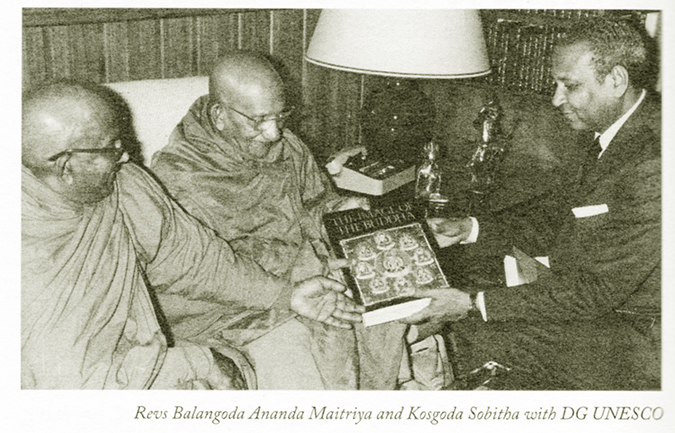
The Ministry had yet to play a positive role in the ethnic crisis. Buddhin may not have been in the best of health either as he was to die a few years later. In this background the President wanted me to come back and help him in the field of information at this crucial juncture. He wrote the following letter to M’Bow the DG of UNESCO and my employer in Paris on April 22, 1986.
“I am writing this letter to you to seek your assistance in a matter of considerable importance to Sri Lanka. As you may perhaps be aware, we have had to face many difficulties in the last few years due to terrorist activities in certain parts of the country.
My government has tried its utmost to find ways of settling this issue through negotiation with the different groups involved. It is clear to me that in order to assist this process of negotiation and conciliation it is necessary to inform the public both of my country and abroad of the issues involved and to create an environment conducive to a peaceful settlement. For this purpose, I intend to reorganize the information services of Sri Lanka in the near future.
“I will be greatly assisted in this task if I could obtain the services of Mr. Sarath Amunugama, Director of the International Programme for the Development of Communication of UNESCO, for a period of six months beginning June 1986. Prior to his joining UNESCO Mr. Amunugama was the Secretary to the Ministry of State which is responsible for Information and Broadcasting. He has established good working relations with the local and foreign media which can play a very important role in the present context of Sri Lanka. I sincerely hope it would be possible for you to release Mr. Amunugama for the period requested by me”.
M’Bow had extended my tenure for another four years in a letter dated August 11, 1986, which thanked me for my services and looked forward to a continuing association. I had only to respond positively to carry on in Paris with an enhanced salary. My two children were well settled in University and the overseas British school respectively. My wife was keen to continue in Paris where the family would be together and enjoy all the creature comforts.
On the other hand if I continued in Paris I would have ended up as a permanent resident in a foreign land. All my friends who remained behind were reconciled to their children marrying locals and settling down to a life in France. As parents they did not come back home after retirement or came back much later in time in their lives when they were ill or infirm. I was averse to the idea of coming back only to die in my motherland as some of my colleagues had done.
M’Bow helped me defer taking a decision when he responding to JRJ’s letter gave me a month’s paid leave to get back to Sri Lanka. This was a great gesture since the preparatory work for the annual General Meeting of IPDC had begun and my input was necessary at that juncture. I thought that a month-long visit to Sri Lanka would help me to clarify my situation and chart my future course of action. I made ready to leave for Colombo.
Rajiv and Romesh Bhandari
The death of Indira Gandhi and the succession of her son Rajiv as PM of India brought about a sea change in India’s approach towards the Sikhs as well as the Tamils in Sri Lanka. Most of the Tamilian officials principally Parathsarathy and Venketeshwaran were moved out and his personal loyalists like Romesh Bhandari, Chidambaram and Ram became his advisors on the Sri Lanka issue. Having won the Parliamentary election following Indira’s death, with an unprecedented majority, Rajiv had the freedom to change policies as well as infuse a sense of urgency in foreign -Affairs.
He was not dependent on the Tamil vote in the Lok Sabha. His tilt towards an open economy and closer relations with the west, a departure from his mother’s outdated socialism, summarized in her slogan ‘Garibi Hatao’ [Abolish Poverty], which proved to be a failure, made him a favourite of western governments and the media. I was in Paris when he made a successful state visit to France. Its high point was the pouring of Ganges water Rajiv had brought with him, into the Seine highlighting the confluence of their cultures and aspirations.
But what most impressed the Europeans was the shifting of arms procurement from the Russian arsenal to French, Italian and Swedish products. Thus French attack airplanes like the Dassault and long range guns from Bofors of Sweden entered the weaponry of the burgeoning Indian armed forces. This led to much criticism from the left leaning politicians and media practitioners who were constantly harping on the Italian birth nationality of Sonia, the PM’s assertive wife. They launched an attack on Rajiv’s purchase of modern long range guns from Bofors but could not deflect him from following modern economic policies.
This shift helped Rajiv to get western support for his initiatives in both Punjab and Sri Lanka. After the bloodbath of Sikhs living outside the Punjab following Indira’s assassination, a compromise was worked out and the Khalistan issue was laid to rest, at least for a long time. Rajiv then turned to the Sri Lanka issue with the same philosophy of cooperation, maximum devolution and a good neighbour policy. This approach held much promise and all in India and Sri Lanka were enthusiastic about giving it a chance.
His point man in this effort was Romesh Bhandari, a senior Foreign Service officer who was an amiable person unlike the dour Tamils who were Indira’s advisors. Accordingly, both Rajiv and his Foreign Secretary struck up a cordial relationship with JRJ. Rajiv called JRJ ‘uncle’ and I was aware that our wily leader reminisced about his friendship with the PM’s grandfather Nehru and his experiences with the Congress leaders of his youth when he participated in the Ramgarh Congress meeting prior to independence.
JRJ referred to his correspondence with Nehru is the pre-Independence period. At my urging he wrote an article about his links with the Congress leaders of that time. He wanted it published in India. I contacted my friend Dilip Padgoankar who was an advisor to the Jain family, the owners of the Times of India group of newspapers. Later Dilip became the Editor of the Times of India. We decided that the article should be published in the Illustrated Weekly of India which also was owned by the Jain group.
The article was published by the magazines editor Rafik Zakaria. This magazine was very popular among top elite and we were able to position JRJ as ‘a lover of India’ in the context of much anti Sri Lanka feeling generated during the time of Indira Gandhi. The fly in the ointment was Zakaria’s unhelpful headline which read “An Old Fox Remembers”.
I spent quite some time in brushing up JRJ’s image prior to the SAARC meeting to be held in Bangalore in November 1986. At this meeting the two leaders were to discuss the ethnic issue on the sidelines of the meeting which according to its mandate did not formally discuss bilateral matters. In consultation with JRJ, I decided that we should make a special media effort to woo Rajiv. I also, in discussion with my friend Gamini Dissanayake on whom JRJ was depending more on and more to handle the ethnic issue, decided to come back to my home country and assist him and JRJ in a more sustained manner. Accordingly, I terminated my employment with UNESCO with the following letter to M’Bow:
“I thank you for your letter in which you kindly inform me of your decision to extend the engagement of my services to UNESCO. I would have been very happy to accept but the President of Sri Lanka has requested me to return so that he could make use of my services in a very crucial area of his Government. In these circumstances I have decided, reluctantly, that I will not seek an extension of my contract. May I thank you most sincerely for the courtesy, understanding and friendship you have extended to me during my tenure of office. I look forward to working closely with you in the future.”









A prominent feature of the first year of the NPP government is that it has not engaged in the institutional reforms which was expected of it. This observation comes in the context of the extraordinary mandate with which the government was elected and the high expectations that accompanied its rise to power. When in opposition and in its election manifesto, the JVP and NPP took a prominent role in advocating good governance systems for the country. They insisted on constitutional reform that included the abolition of the executive presidency and the concentration of power it epitomises, the strengthening of independent institutions that overlook key state institutions such as the judiciary, public service and police, and the reform or repeal of repressive laws such as the PTA and the Online Safety Act.
The transformation of a political party that averaged between three to five percent of the popular vote into one that currently forms the government with a two thirds majority in parliament is a testament to the faith that the general population placed in the JVP/ NPP combine. This faith was the outcome of more than three decades of disciplined conduct in the aftermath of the bitter experience of the 1988 to 1990 period of JVP insurrection. The manner in which the handful of JVP parliamentarians engaged in debate with well researched critiques of government policy and actions, and their service in times of disaster such as the tsunami of 2004 won them the trust of the people. This faith was bolstered by the Aragalaya movement which galvanized the citizens against the ruling elites of the past.
In this context, the long delay to repeal the Prevention of Terrorism Act which has earned notoriety for its abuse especially against ethnic and religious minorities, has been a disappointment to those who value human rights. So has been the delay in appointing an Auditor General, so important in ensuring accountability for the money expended by the state. The PTA has a long history of being used without restraint against those deemed to be anti-state which, ironically enough, included the JVP in the period 1988 to 1990. The draft Protection of the State from Terrorism Act (PSTA), published in December 2025, is the latest attempt to repeal and replace the PTA. Unfortunately, the PSTA largely replicates the structure, logic and dangers of previous failed counter terrorism bills, including the Counter Terrorism Act of 2018 and the Anti Terrorism Act proposed in 2023.
Misguided Assumption
Despite its stated commitment to rule of law and fundamental rights, the draft PTSA reproduces many of the core defects of the PTA. In a preliminary statement, the Centre for Policy Alternatives has observed among other things that “if there is a Detention Order made against the person, then in combination, the period of remand and detention can extend up to two years. This means that a person can languish in detention for up to two years without being charged with a crime. Such a long period again raises questions of the power of the State to target individuals, exacerbated by Sri Lanka’s history of long periods of remand and detention, which has contributed to abuse and violence.” Human Rights lawyer Ermiza Tegal has warned against the broad definition of terrorism under the proposed law: “The definition empowers state officials to term acts of dissent and civil disobedience as ‘terrorism’ and will lawfully permit disproportionate and excessive responses.” The legitimate and peaceful protests against abuse of power by the authorities cannot be classified as acts of terror.
The willingness to retain such powers reflects the surmise that the government feels that keeping in place the structures that come from the past is to their benefit, as they can utilise those powers in a crisis. Due to the strict discipline that exists within the JVP/NPP at this time there may be an assumption that those the party appoints will not abuse their trust. However, the country’s experience with draconian laws designed for exceptional circumstances demonstrates that they tend to become tools of routine governance. On the plus side, the government has given two months for public comment which will become meaningful if the inputs from civil society actors are taken into consideration.
Worldwide experience has repeatedly demonstrated that integrity at the level of individual leaders, while necessary, is not sufficient to guarantee good governance over time. This is where the absence of institutional reform becomes significant. The aftermath of Cyclone Ditwah in particular has necessitated massive procurements of emergency relief which have to be disbursed at maximum speed. There are also significant amounts of foreign aid flowing into the country to help it deal with the relief and recovery phase. There are protocols in place that need to be followed and monitored so that a fiasco like the disappearance of tsunami aid in 2004 does not recur. To the government’s credit there are no such allegations at the present time. But precautions need to be in place, and those precautions depend less on trust in individuals than on the strength and independence of oversight institutions.
Inappropriate Appointments
It is in this context that the government’s efforts to appoint its own preferred nominees to the Auditor General’s Department has also come as a disappointment to civil society groups. The unsuitability of the latest presidential nominee has given rise to the surmise that this nomination was a time buying exercise to make an acting appointment. For the fourth time, the Constitutional Council refused to accept the president’s nominee. The term of the three independent civil society members of the Constitutional Council ends in January which would give the government the opportunity to appoint three new members of its choice and get its way in the future.
The failure to appoint a permanent Auditor General has created an institutional vacuum at a critical moment. The Auditor General acts as a watchdog, ensuring effective service delivery promoting integrity in public administration and providing an independent review of the performance and accountability. Transparency International has observed “The sequence of events following the retirement of the previous Auditor General points to a broader political inertia and a governance failure. Despite the clear constitutional importance of the role, the appointment process has remained protracted and opaque, raising serious questions about political will and commitment to accountability.”
It would appear that the government leadership takes the position they have been given the mandate to govern the country which requires implementation by those they have confidence in. This may explain their approach to the appointment (or non-appointment) at this time of the Auditor General. Yet this approach carries risks. Institutions are designed to function beyond the lifespan of any one government and to protect the public interest even when those in power are tempted to act otherwise. The challenge and opportunity for the NPP government is to safeguard independent institutions and enact just laws, so that the promise of system change endures beyond personalities and political cycles.
by Jehan Perera

 A new batch arrived at our Faculty again. Students representing almost all districts of the country remind me once again of the wonderful opportunity we have for promoting social and ethnic cohesion at our universities. Sadly, however, many students do not interact with each other during the first few semesters, not only because they do not speak each other’s language(s), but also because of the fear and distrust that still prevails among communities in our society.
General education reform presents an opportunity to explore ways to promote social and ethnic cohesion. A school curriculum could foster shared values, empathy, and critical thinking, through social studies and civics education, implement inclusive language policies, and raise critical awareness about our collective histories. Yet, the government’s new policy document, Transforming General Education in Sri Lanka 2025, leaves us little to look forward to in this regard.
The policy document points to several “salient” features within it, including: 1) a school credit system to quantify learning; 2) module-based formative and summative assessments to replace end-of-term tests; 3) skills assessment in Grade 9 consisting of a ‘literacy and numeracy test’ and a ‘career interest test’; 4) a comprehensive GPA-based reporting system spanning the various phases of education; 5) blended learning that combines online with classroom teaching; 6) learning units to guide students to select their preferred career pathways; 7) technology modules; 8) innovation labs; and 9) Early Childhood Education (ECE). Notably, social and ethnic cohesion does not appear in this list. Here, I explore how the proposed curriculum reforms align (or do not align) with the NPP’s pledge to inculcate “[s]afety, mutual understanding, trust and rights of all ethnicities and religious groups” (p.127), in their 2024 Election Manifesto.
Language/ethnicity in the present curriculum
The civil war ended over 15 years ago, but our general education system has done little to bring ethnic communities together. In fact, most students still cannot speak in the “second national language” (SNL) and textbooks continue to reinforce negative stereotyping of ethnic minorities, while leaving out crucial elements of our post-independence history.
Although SNL has been a compulsory subject since the 1990s, the hours dedicated to SNL are few, curricula poorly developed, and trained teachers few (Perera, 2025). Perhaps due to unconscious bias and for ideological reasons, SNL is not valued by parents and school communities more broadly. Most students, who enter our Faculty, only have basic reading/writing skills in SNL, apart from the few Muslim and Tamil students who schooled outside the North and the East; they pick up SNL by virtue of their environment, not the school curriculum.
Regardless of ethnic background, most undergraduates seem to be ignorant about crucial aspects of our country’s history of ethnic conflict. The Grade 11 history textbook, which contains the only chapter on the post-independence period, does not mention the civil war or the events that led up to it. While the textbook valourises ‘Sinhala Only’ as an anti-colonial policy (p.11), the material covering the period thereafter fails to mention the anti-Tamil riots, rise of rebel groups, escalation of civil war, and JVP insurrections. The words “Tamil” and “Muslim” appear most frequently in the chapter, ‘National Renaissance,’ which cursorily mentions “Sinhalese-Muslim riots” vis-à-vis the Temperance Movement (p.57). The disenfranchisement of the Malaiyaha Tamils and their history are completely left out.
Given the horrifying experiences of war and exclusion experienced by many of our peoples since independence, and because most students still learn in mono-ethnic schools having little interaction with the ‘Other’, it is not surprising that our undergraduates find it difficult to mix across language and ethnic communities. This environment also creates fertile ground for polarizing discourses that further divide and segregate students once they enter university.
More of the same?
How does Transforming General Education seek to address these problems? The introduction begins on a positive note: “The proposed reforms will create citizens with a critical consciousness who will respect and appreciate the diversity they see around them, along the lines of ethnicity, religion, gender, disability, and other areas of difference” (p.1). Although National Education Goal no. 8 somewhat problematically aims to “Develop a patriotic Sri Lankan citizen fostering national cohesion, national integrity, and national unity while respecting cultural diversity (p. 2), the curriculum reforms aim to embed values of “equity, inclusivity, and social justice” (p. 9) through education. Such buzzwords appear through the introduction, but are not reflected in the reforms.
Learning SNL is promoted under Language and Literacy (Learning Area no. 1) as “a critical means of reconciliation and co-existence”, but the number of hours assigned to SNL are minimal. For instance, at primary level (Grades 1 to 5), only 0.3 to 1 hour is allocated to SNL per week. Meanwhile, at junior secondary level (Grades 6 to 9), out of 35 credits (30 credits across 15 essential subjects that include SNL, history and civics; 3 credits of further learning modules; and 2 credits of transversal skills modules (p. 13, pp.18-19), SNL receives 1 credit (10 hours) per term. Like other essential subjects, SNL is to be assessed through formative and summative assessments within modules. As details of the Grade 9 skills assessment are not provided in the document, it is unclear whether SNL assessments will be included in the ‘Literacy and numeracy test’. At senior secondary level – phase 1 (Grades 10-11 – O/L equivalent), SNL is listed as an elective.
Refreshingly, the policy document does acknowledge the detrimental effects of funding cuts in the humanities and social sciences, and highlights their importance for creating knowledge that could help to “eradicate socioeconomic divisions and inequalities” (p.5-6). It goes on to point to the salience of the Humanities and Social Sciences Education under Learning Area no. 6 (p.12):
“Humanities and Social Sciences education is vital for students to develop as well as critique various forms of identities so that they have an awareness of their role in their immediate communities and nation. Such awareness will allow them to contribute towards the strengthening of democracy and intercommunal dialogue, which is necessary for peace and reconciliation. Furthermore, a strong grounding in the Humanities and Social Sciences will lead to equity and social justice concerning caste, disability, gender, and other features of social stratification.”
Sadly, the seemingly progressive philosophy guiding has not moulded the new curriculum. Subjects that could potentially address social/ethnic cohesion, such as environmental studies, history and civics, are not listed as learning areas at the primary level. History is allocated 20 hours (2 credits) across four years at junior secondary level (Grades 6 to 9), while only 10 hours (1 credit) are allocated to civics. Meanwhile, at the O/L, students will learn 5 compulsory subjects (Mother Tongue, English, Mathematics, Science, and Religion and Value Education), and 2 electives—SNL, history and civics are bunched together with the likes of entrepreneurship here. Unlike the compulsory subjects, which are allocated 140 hours (14 credits or 70 hours each) across two years, those who opt for history or civics as electives would only have 20 hours (2 credits) of learning in each. A further 14 credits per term are for further learning modules, which will allow students to explore their interests before committing to a A/L stream or career path.
With the distribution of credits across a large number of subjects, and the few credits available for SNL, history and civics, social/ethnic cohesion will likely remain on the back burner. It appears to be neglected at primary level, is dealt sparingly at junior secondary level, and relegated to electives in senior years. This means that students will be able to progress through their entire school years, like we did, with very basic competencies in SNL and little understanding of history.
Going forward
Whether the students who experience this curriculum will be able to “resist and respond to hegemonic, divisive forces that pose a threat to social harmony and multicultural coexistence” (p.9) as anticipated in the policy, is questionable. Education policymakers and others must call for more attention to social and ethnic cohesion in the curriculum. However, changes to the curriculum would only be meaningful if accompanied by constitutional reform, abolition of policies, such as the Prevention of Terrorism Act (and its proxies), and other political changes.
For now, our school system remains divided by ethnicity and religion. Research from conflict-ridden societies suggests that lack of intercultural exposure in mono-ethnic schools leads to ignorance, prejudice, and polarized positions on politics and national identity. While such problems must be addressed in broader education reform efforts that also safeguard minority identities, the new curriculum revision presents an opportune moment to move this agenda forward.
(Ramya Kumar is attached to the Department of Community and Family Medicine, Faculty of Medicine, University of Jaffna).
Kuppi is a politics and pedagogy happening on the margins of the lecture hall that parodies, subverts, and simultaneously reaffirms social hierarchies.
by Ramya Kumar

Certain songs become ever-present every December, and with Christmas just two days away, I thought of highlighting the Top 10 Most Popular Festive Songs.
The famous festive songs usually feature timeless classics like ‘White Christmas,’ ‘Silent Night,’ and ‘Jingle Bells,’ alongside modern staples like Mariah Carey’s ‘All I Want for Christmas Is You,’ Wham’s ‘Last Christmas,’ and Brenda Lee’s ‘Rockin’ Around the Christmas Tree.’
The following renowned Christmas songs are celebrated for their lasting impact and festive spirit:
* ‘White Christmas’ — Bing Crosby
The most famous holiday song ever recorded, with estimated worldwide sales exceeding 50 million copies. It remains the best-selling single of all time.
* ‘All I Want for Christmas Is You’ — Mariah Carey
A modern anthem that dominates global charts every December. As of late 2025, it holds an 18x Platinum certification in the US and is often ranked as the No. 1 popular holiday track.

Mariah Carey: ‘All I Want for Christmas Is You’
* ‘Silent Night’ — Traditional
Widely considered the quintessential Christmas carol, it is valued for its peaceful melody and has been recorded by hundreds of artistes, most famously by Bing Crosby.
* ‘Jingle Bells’ — Traditional
One of the most universally recognised and widely sung songs globally, making it a staple for children and festive gatherings.
* ‘Rockin’ Around the Christmas Tree’ — Brenda Lee
Recorded when Lee was just 13, this rock ‘n’ roll favourite has seen a massive resurgence in the 2020s, often rivaling Mariah Carey for the top spot on the Billboard Hot 100.
* ‘Last Christmas’ — Wham!
A bittersweet ’80s pop classic that has spent decades in the top 10 during the holiday season. It recently achieved 7x Platinum status in the UK.
* ‘Jingle Bell Rock’ — Bobby Helms
A festive rockabilly standard released in 1957 that remains a staple of holiday radio and playlists.
* ‘The Christmas Song (Chestnuts Roasting on an Open Fire)’— Nat King Cole
Known for its smooth, warm vocals, this track is frequently cited as the ultimate Christmas jazz standard.

Wham! ‘Last Christmas’
* ‘It’s the Most Wonderful Time of the Year’ — Andy Williams
Released in 1963, this high-energy big band track is famous for capturing the “hectic merriment” of the season.
* ‘Rudolph the Red-Nosed Reindeer’ — Gene Autry
A beloved narrative song that has sold approximately 25 million copies worldwide, cementing the character’s place in Christmas folklore.
Other perennial favourites often in the mix:
* ‘Feliz Navidad’ – José Feliciano
* ‘A Holly Jolly Christmas’ – Burl Ives
* ‘Let It Snow! Let It Snow! Let It Snow!’ – Frank Sinatra
Let me also add that this Thursday’s ‘SceneAround’ feature (25th December) will be a Christmas edition, highlighting special Christmas and New Year messages put together by well-known personalities for readers of The Island.

Implementation of the loan scheme, “Sustainable Agriculture Program”

Cabinet nod to implement ‘Suraksha’ Student Insurance Programme in the year 2025 / 26
Establishment of Consultancy Boards for strengthening and promoting local production industries.

Match fees more than doubled for women’s domestic cricketers in India

National progress can be achieved only when everyone fulfills the responsibilities entrusted to them with steadfast determination, unity of purpose and resilience in the face of any challenge – President

Indonesia’s Gede Priandana becomes first to pick five wickets in an over in T20Is

‘Dates have the highest sugar content to fight Coronavirus’

Sunday Island 27 December – Headlines

#SundayIsland 17th December – Headlines

Sunday Island – 28th March

Sunday Island Headlines – 21 March

Sunday Island – 21st February – Headlines
-

 Midweek Review7 days ago
How massive Akuregoda defence complex was built with proceeds from sale of Galle Face land to Shangri-La
-
 News6 days ago
Pope fires broadside: ‘The Holy See won’t be a silent bystander to the grave disparities, injustices, and fundamental human rights violations’
-

 News6 days ago
Pakistan hands over 200 tonnes of humanitarian aid to Lanka
-

 News13 hours ago
Members of Lankan Community in Washington D.C. donates to ‘Rebuilding Sri Lanka’ Flood Relief Fund
-

 Business5 days ago
Unlocking Sri Lanka’s hidden wealth: A $2 billion mineral opportunity awaits
-

 News7 days ago
Burnt elephant dies after delayed rescue; activists demand arrests
-

 Editorial7 days ago
Colombo Port facing strategic neglect
-

 News5 days ago
Army engineers set up new Nayaru emergency bridge