
Features
Prosecutorial Vs. Victim-based approaches to accountability

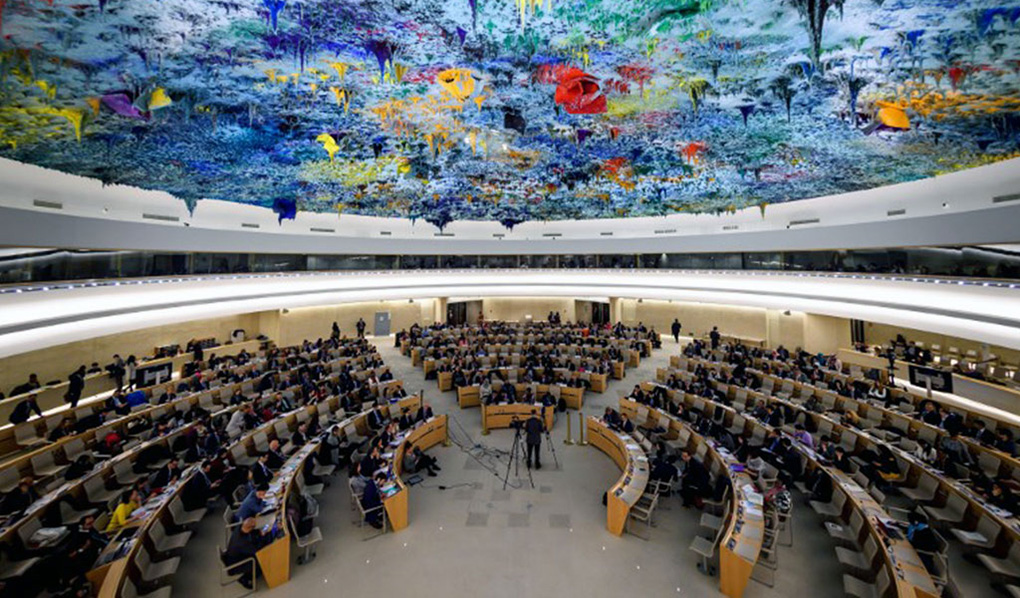
by Neville Ladduwahetty
A report in The Island (May 20, 2024) states that the UN human rights office has “criticised the Sri Lankan government’s failure to acknowledge and hold accountable the perpetrators of tens of thousands of enforced disappearances … Authors of the report also accuse the Liberation Tigers of Tamil Eelam of “engaging in abductions” which were described as “tantamount” to enforced disappearances” (May 20, 2024). Continuing, the report adds that the UN. The High Commissioner for Human Rights had stated: “Accountability must be addressed. We need to see institutional reform for reconciliation to succeed”.
In the meantime, the Secretary General of Amnesty International (AI) had “called for Sri Lanka to be referred to the UN Security Council and subjected to international war crimes inquiry when she participated to pay tribute to those who perished at Mullivaikkal. While the call for Sri Lanka to be referred to the Security Council may have pleased those who came to pay tribute, the reality is that such a referral would inevitably be vetoed. However, the fact remains that AI along with the UN Human Rights is advocating a prosecutorial approach to Accountability.
For instance, the Nuremberg Trial was strictly prosecutorial. In contrast, the Marshall Aid Plan was Victim based. While the objective of the former was to seek justice for the victims by prosecuting the perpetrators of the crimes, it was the latter that enabled Germany to recover and join the community of nations as a powerful and respected member.
The question that divides scholars and others who pursue accountability is; which approach to adopt. Should it be prosecutorial or victim based? While some, such as the UN report cited above advocate a prosecutorial approach for the sake of justice, others such as the High Commissioner are non-committal as to which approach to adopt. Yet, others want some aspects of both approaches. Therefore, the first question to be addressed is which approach to adopt, taking into account the particularities of the Sri Lankan society and the background that led to the armed conflict.
ESTABLISHING the CONTEXT
At a fundamental level, the raison d’etre for the armed conflict was the deep sense of grievance felt by the Tamil community; a circumstance they believed could only be overcome by resorting to an armed conflict to establish a separate state for themselves. For those representing the State of Sri Lanka, their bounden duty was to protect and preserve the territorial integrity of their cherished unitary state in keeping with Article 3 of Protocol II that state: “Nothing in the Protocol shall be invoked for the purpose of affecting the sovereignty of a State or the responsibility of the government by all legitimate means to maintain or re-establish law and order in the State or to defend the national unity and territorial integrity of the State”. The only means by which these vastly contending positions could be resolved was through an armed conflict; a fact recognized by the UN Human Rights Commission in paragraph 182 and 183 of their OISL report of 2015.
Pargraph 182 states: “Article 3 common to the four Geneva Conventions relating to conflicts not of an international character is applicable to the situation in Sri Lanka, with all parties to the conflict bound to respect the guarantees pertaining to the treatment of civilians ….”
Paragraph 183 states: “In addition, the government and armed groups that are parties to the conflict are bound alike by the relevant rules of customary international law applicable in non-international armed conflict”.
Therefore, if both the Sri Lankan State and the LTTE “are bound alike” by the relevant rules of customary international law applicable in non-international armed conflict”, why is all the attention to address accountability ONLY fixated on the Sri Lankan State and none on the LTTE. Since most of those who perished in Mullivaikkal were victims of the policy adopted by the LTTE to take civilians hostage, and continue to endanger the security of hundreds of thousands taken hostage by continuing to engage in hostilities, should NOT the LTTE also be held accountable? This being the case, would the evidence gathering that is currently being undertaken by the UNHRC in order to exercise Universal Jurisdiction, also apply to policies such as hostage taking and shooting escapees?
PROSECUTORIAL APPROACH
Judging from the attention given ONLY to the government of Sri Lanka by the UNHRC and by entities such as AI, the outcome of any judicial processes would be skewed, which means NO justice, despite the fact that the Sri Lankan Government and the LTTE “are bound alike” by relevant rules of customary international law as in common Article 3 and Protocol II; a fact confirmed below.
INTERNATIONAL COURT OF JUSTICE, Judgment of 27 June 1986,
(NICARAGUA v. UNITED STATES OF AMERICA), MERITS
Judgment – para. 215 to 292
“The conflict between the contras’ forces and those of the Government of Nicaragua is an armed conflict which is “not of an international character”. The acts of the contras towards the Nicaraguan Government are therefore governed by the law applicable to conflicts of that character; whereas the actions of the United States in and against Nicaragua fall under the legal rules relating to international conflicts. Because the minimum rules applicable to international and to non-international conflicts are identical, there is no need to address the question whether those actions must be looked at in the context of the rules which operate for the one or for the other category of conflict. The relevant principles are to be looked for in the provisions of Article 3 of each of the four Conventions of August 12, 1949, the text of which, identical in each Convention, expressly refers to conflict not having an international character” (ICJ Judgment, Nicaragua v. U.S para 215 – 292)
“In the Military and Paramilitary Activities in and against Nicaragua, the International Court of Justice observed that the acts of the Contras, fighting against the Nicaraguan Government, were governed by the law applicable to armed conflict not of an international character i.e. Common Article 3. Similarly, in the Tublada case, the Inter-American Commission considered”: Common Article 3’s mandatory provisions expressly bind and apply equally to both parties in internal conflicts, i.e. government and dissident forces. Moreover, the obligation to apply Common Article 3 is absolute for both parties and independent of the obligation of the other. Therefore, both the MTP attackers [the armed opposition group fighting in the conflict under consideration] and the Argentina armed forces had the same duties under humanitarian law” (Zegveld, Accountability of Armed Opposition Groups in International Law, p.21, ICJ Judgment Nicaragua v. US para 119 and Case No. 11/137).
Judging from the ICJ opinions cited above, it is certain that not only violations by the Sri Lanka Government but also violations perpetrated by the LTTE should be reviewed in the course of a Judicial Trial, since they are “bound alike”. Therefore, although violations by the Government forces and LTTE would be judged by Common Article 3, the fact remains that the leadership of the LTTE who ordered the taking of 300,000 plus civilians, hostage is not among the living or has disappeared, and cannot be subjected to a trial despite the fact that the act of taking civilians hostage amount to a war crime and a crime against humanity. Thus, the exercise of gathering evidence against Government perpetrators pales in significance compared with endangering the security of 300,000 plus civilians that were taken hostage. Despite this, a prosecutorial process would mean a skewed outcome of any trial because of the strong possibility that violations perpetrated by the Sri Lankan Government would dominate the trial.
Thus, while a few of those associated with the LTTE would have to face prosecution, the majority cannot be located or identified since they have acquired new identities and are domiciled in foreign countries. Also, others who were in positions to exercise command responsibility, but are no longer among the living cannot be prosecuted for the crimes committed, e.g. taking 300,000 civilians hostage and killing those who attempted to escape.
Under circumstances where it would be next to impossible to identify and prosecute former members of the LTTE because they are dispersed primarily in the West with fresh identities, a prosecutorial approach would lead to an asymmetric outcome resulting in the polarization of the two communities to a degree that could give cause for instability and even resumption of hostilities since the numbers associated with successive Governments who could be identified and prosecuted would significantly be more.
Furthermore, while it would be possible to identify those associated with the Government responsible for command, it is NOT possible to identify the leaders of the LTTE who were responsible because they are no longer among the living.
The net effect of such an asymmetric outcome following a prosecutorial process would permanently damage the efforts advocated and undertaken to bring about reconciliation.by successive Governments. For the UNHRC to include the provision in several of its Resolutions that “a credible justice process should include independent judicial and prosecutorial institutions….”, is because their perception is based on the premise that prosecuting the guilty would foster reconciliation.
While such a premise may be applicable to normal law and order situations, it is NOT applicable to Sri Lanka’s armed conflict that spanned three decades involving two communities if the prosecutorial process causes disproportionate outcomes as referred to above. Furthermore, if the outcome is such that more from the Sinhala majority community is prosecuted than from the minority Tamil community for whatever reason, the consequences would be to seriously setback the reconciliation processes; an outcome that defeats what the UNHRC hopes to achieve.
VICTIM BASED APPROACH
The real possibility of such serious outcomes, requires that the scope of the investigation is limited to such a degree that legal prosecution is not possible in the context of Sri Lanka. However, the scope of the investigation could be such that it is possible to establish the body of evidence associated with a particular incident There is strong evidence that the security forces targeted temporary hospitals despite being aware of their location. However, there is also counter evidence that the LTTE directed artillery fire from such locations and moved their ordinance soon after, thus tempting the security forces to target these make-shift hospitals. The investigation would then be limited to what each party to the conflict did in a given situation and not go beyond as to who was culpable to warrant prosecution under the relevant laws. Investigations would thus be a record of actions taken by respective parties to the conflict without delving further to establish which party was responsible for which violation of which laws, Human Rights or Humanitarian.
While this concept takes root, the leadership of both communities should jointly develop mechanisms to address the needs of victims and take joint responsibility for their implementation, instead of depending solely on the elected Government for Reconciliation to be effective and unity restored.
CONCLUSION
In light of the hard reality associated with prosecutorial processes cited above, and the ruling by the International Court of Justice in the case. Nicaragua v. U.S the “acts of the Contras fighting against the Nicaraguan Government were governed by the law applicable to armed conflict not of an international character i.e. Common Article 3…”. Therefore, the approach should be to limit investigations, not with the intent of prosecution because it would be skewed for reasons cited above. but with the intent of recording the events that occurred during the armed conflict, and which party to the armed conflict could be identified with the respective violations with a view to use this body of evidence to institute reforms to prevent recurrence.
It is indeed a matter of serious concern that successive Sri Lankan Governments have failed to acknowledge that the Sri Lankan Security Forces and the LTTE are bound alike by the laws applicable to the armed conflict in Sri Lanka. This has seriously dented addressing issues of accountability in a balanced manner.
At the end of such investigations the present leadership of the parties to the conflict should acknowledge the serious omissions and commissions committed by both parties and move on by declaring the broadest possible amnesty to all who were associated with the conflict as stated in Section 5 of Article 6 of the Additional protocol II of 1977.
Article 6 Section 5 States: “At the end of hostilities, the authorities in power shall endeavor to grant the broadest possible amnesty to persons who have participated in the armed conflict, or those deprived of their liberty for reasons related to the armed conflict, whether they are interned or detained”.
Since such amnesties and pardons have been instituted starting with the release of child soldiers and nearly 11,000 plus former LTTE combatants and more recently the release of prisoners, the practice has been in operation from time to time. This process would have gained momentum if not for the clamour for prosecutorial processes locally and resolutions of UNHRC that are tantamount to External intervention. The need therefore, is to regularize this practice and bring closure to an issue whose time has come.










by Jehan Perera
The death sentence on Sivarasa Anojan, a Sri Lankan citizen convicted of blasphemy in Saudi Arabia has taken a central place in national consciousness for the past several weeks. It has been in the headline news since it was first reported last month. There have been many initiatives taken locally to get a more lenient sentencing by the Saudi authorities. There is also an undercurrent that is critical of both the culture and religion from which this sentencing emanates. This also sustains the widespread publicity being given nationally to the issue. By way of contrast, the controversy caused by the forcible removal of the Thileepan statue in Jaffna has not significantly impacted upon the national consciousness. There was only passing mention of the incident in the national media which has been overtaken by other events.
However, in the north and east of the country, and in the diaspora, the removal of the Thileepan statue has become a major issue. It has led to protest marches led by university students and widespread condemnation by civil society and political groups. The issues underlying the Thileepan statue have deep undercurrents in the Tamil consciousness particularly in the north and east which time is unlikely to dispel. The real test of harmony in a multi-ethnic, multi-religious society like Sri Lanka is not whether communities coexist peacefully when nothing controversial is at stake. Rather, the test is how they respond when an event touches their identities and grievances. The death sentence imposed on Anojan in Saudi Arabia and the removal of the Thileepan statue in Jaffna carry the risk of becoming grievances to entire communities.
In the case of Anojan, a young Tamil migrant worker, he was first sentenced to five years imprisonment and a fine of three million Saudi riyals over a Facebook comment. Both he and the Saudi prosecution appealed, with the appeal court raising the sentence to death. This has led to public sympathy for him in Sri Lanka.
Appeals for clemency have come from the President, government and opposition leaders, clergy of all faiths and Muslim political leaders. At the same time there is a need to reject attempts to turn the case into a source of anti-Muslim sentiment or collective blame. Peacebuilding therefore has to be within Sri Lanka as well as diplomatic. Religious leaders and civil society in the country should be ready to quell rumour, even as Muslim, Buddhist, Hindu and Christian leaders stand together publicly.
Thileepan Statue
The Thileepan controversy has had a different trajectory. Many Tamils admire Thileepan, the LTTE name of Rasaiah Parthipan, who died on 26 September 1987 after a twelve-day fast. His demands were addressed to India but included matters pertaining to the Sri Lankan government including the release of detainees held under the Prevention of Terrorism Act. The statue put up during this year’s commemoration was removed by police in the early hours of 27 September, a day after the commemoration ended. The government’s legal concern, as articulated by its spokesperson, was the LTTE remains a proscribed organisation and before removing the statue, police had presented facts to the court. But law and memory answer different questions and the depth of Tamil anguish cannot be disregarded.
For many Tamils, remembrance of Thileepan is connected to their sense of loss and historical memory. The memorial has been destroyed and rebuilt more than once, and each destruction has added to the meaning it carries. Many who mourn Thileepan are grieving a young man who died without violence and by his own fast. They also grieve an era of loss of the struggle for Tamil rights and self-determination for which Thileepan has become a symbol. The Office for Reparations Act, No. 34 of 2018, provides for collective reparations and gives the Office for Reparations a role in policies on memorialisation. This does not automatically permit any particular statue, nor does it override laws on public places or proscribed organisations. But it shows that memorialisation is recognised within Sri Lanka’s framework for reparations and reconciliation. There is also a wider question of equality.
The JVP that now leads the NPP government was itself once proscribed when it took up arms against the state in which tens of thousands died, later entered democratic politics, and now for many years has publicly commemorated its own fallen. The opportunity to remember those who died should not belong to one community alone.
A commitment to peacebuilding requires that the same trust that has been given to former militants of one community needs to be given to members of other communities if equal citizenship and equal rights are to have meaning. Further, the Office for Reparations Act provides for reparations through livelihood. It is today a fact that those former LTTE members who went through the government’s rehabilitation process find it difficult to get jobs in the private sector.
Private sector employers are reluctant to come under surveillance for employing former LTTE members. There needs to be equal access to employment and removal of unjustified barriers to reintegration, with targeted public programmes where necessary. Until this situation is realized on the ground, the government needs to consider employing those who went through the government’s rehabilitation process and still unable to find suitable employment.
Continuing Peace
The challenge that post-war Sri Lanka faces, a full 17 years after the end of war, is to strengthen the foundations of trust between communities rather than deepen existing suspicions. Anojan is an individual Sri Lankan citizen facing a severe sentence in another country. His case should not become a reason to blame Sri Lankan Muslims. Thileepan is remembered differently by different communities, but the dispute over his memorial should not become a reason to revive the communal divisions of the past. The cases are also mirror images in an important respect. In the Anojan case, the state is an advocate pleading before another government. In the Thileepan case, the state is the actor whose decision is being judged. The first calls for quiet diplomacy and restraint in public language. The second calls for fairness and explanation, and the burden on the state is heavier.
The common roots of the two cases lie in mistrust that does not belong to one community alone. It has been produced by experiences of discrimination, violence, insecurity and loss that have been interpreted differently by different communities. Grievances turn communal when an individual is seen as a representative of a community, when institutions seem to treat communities unequally, and when people feel their pain goes unacknowledged. Each of these can be addressed. The system change that the Sri Lankan people voted for in 2024 would need to include a government that rejects collective blame, acknowledges grief and explains its decisions openly. It also requires state institutions to act transparently and consistently, so that no citizen feels that the law protects some communities more than others.
This peacebuilding imperative requires enlightened leadership as much as legal authority. It requires leaders who will speak to their own communities against prejudice, even when this is politically inconvenient. It requires religious leaders who will demonstrate solidarity across religious boundaries. And it requires civil society to recognise that peacebuilding is not simply preventing violence after tensions have risen, but is addressing the mistrust and grievances that allow tensions to rise in the first place. Sri Lanka has learned, at great cost, that communal divisions can become much larger than the events that initially give rise to them. The Anojan and Thileepan cases give Sri Lanka an opportunity to demonstrate that it has learned from its past. The test of Sri Lanka’s continuing peace is whether we can address difficult grievances without turning them into communal ones.
By Sarath S. Kodithuwakku
President, Institute of Management of Sri Lanka; Senior Professor, University of Peradeniya
(Continued from yesterday)
Representation, Independence and Decision-Making
The membership-based electoral structure should provide representation without becoming a substitute for executive management. The seven Elected Directors would bring the perspectives of the SLC membership into the Board, while the seven Independent Directors would provide additional professional expertise and independence. The model’s effectiveness will, therefore, depend on whether the Board can integrate these perspectives into coherent strategic decisions while maintaining a clear boundary between governance and day-to-day management.
The equal division between Elected and Independent Directors also raises a governance-design question. An even-numbered Board can create a tie. The Bill addresses this directly: in the event of equality, the Chairperson has a casting vote; in the Chairperson’s absence, the Deputy Chairperson has a casting vote; and if both are absent, an Independent Director, elected to preside, has the casting vote. The issue is, therefore, not whether a tie can be resolved, but how this mechanism affects the balance between representation, independence and accountability.
The leadership structure reinforces this balance: the Chairperson is elected from among the Independent Directors and the Deputy Chairperson from among the Elected Directors. The casting-vote arrangement makes the Chairperson’s role and perceived independence particularly important, especially when a major strategic decision divides the two components of the Board.
The Bill’s committee provisions could support a disciplined model of delegation, but implementation will depend heavily on the terms of reference adopted by the new Board. The framework could be strengthened by requiring a published cricket-development strategy, a clear division of powers among the Board, executives and selection committees, transparent principles for major development allocations, and periodic reporting on outcomes across men’s, women’s, schools and domestic cricket. These measures would strengthen accountability without legislating the details of team selection or tournament scheduling.
From Measurement to Strategic Accountability
If the Board is to hold management accountable for strategy rather than simply for short-term results, it needs a performance framework that captures both outcomes and the capabilities that produce them.
SLC should consider requiring an explicit multi-year cricket-development strategy, supported by measurable objectives and an annual strategy review. Such a strategy should identify the development pathway from schools and grassroots cricket through domestic competitions to high performance; define major capability priorities such as coaching, sports science, data and analytics; set resource-allocation principles; and establish indicators against which progress can be assessed.
The purpose would not be to turn cricket into a bureaucratic exercise. Strategic accountability simply creates a disciplined basis for asking whether the organisation is doing what it said it would do, whether its assumptions remain valid, and whether resources are producing the intended results.
From Measurement to Organisational Learning
SLC should, therefore, consider adopting a formal Balanced Scorecard. Rather than measuring success solely through international match results or annual financial audits, the framework could track four interdependent perspectives:
Financial Sustainability:
commercial growth, financial discipline and compliance.
Internal Processes:
domestic tournament quality, development pathways and selector-process integrity.
Stakeholder Value:
grassroots development, school cricket and women’s cricket expansion.
Strategic Capability:
coaching quality, sports science, talent development, data and analytics capability, and the organisation’s ability to convert investment into sustainable performance.
The purpose of such a framework would not be to reduce cricket development to a collection of numbers. Rather, it would create a disciplined process for asking four fundamental management questions:
What did we expect to achieve?
What actually happened?
Why was there a difference?
What should we change as a result?
Evaluating these dimensions periodically would help SLC move beyond performance reporting towards genuine organisational learning.
ICC as a Stakeholder in Governance Reform
The ICC is another important stakeholder whose interests should be recognised in the reform process. SLC’s governance arrangements do not operate solely within Sri Lankan law; they also have to be compatible with the governance obligations associated with ICC membership. The ICC’s Articles of Association require each Member to provide for free and democratic elections (or nominees from outside its members) and to manage its affairs autonomously, without government or other public-body interference in the governance, regulation or administration of cricket.
International experience demonstrates that ICC engagement in member governance restructuring is not unusual. In the United States, after the ICC expelled the old national association for chronic governance failures, the ICC directly oversaw a multi-year project to design a new governance model. The ICC Board formally approved the constitution for a replacement body (USA Cricket) before it was adopted. The resulting structure combined elected constituent directors with independent directors, showing that an ICC-backed framework can accommodate both forms of representation.
In Nepal, the ICC established a Nepal Advisory Group comprising stakeholders from across the game to recommend constitutional amendments, with adoption of the revised constitution and subsequent elections forming part of the conditions for reinstatement of ICC membership.[8] The ICC subsequently facilitated an independent panel that included ICC nominees together with representatives of Nepal’s National Sports Council and the existing cricket administration to map the election process, guidelines and timelines.[9] More recently, in 2026, an ICC delegation visited Bangladesh to engage with stakeholders on governance and electoral matters.[10] The ICC has also reported that its Deputy Chair and another ICC Board representative visited Sri Lanka and met relevant stakeholders to assess ongoing developments, while the ICC Board reiterated the need for elections to be held as soon as possible.
These precedents make the ICC a legitimate stakeholder in considering the governance implications of the proposed Bill. This does not mean that the ICC should determine Sri Lanka’s domestic legislation, nor that every feature of the Bill requires prior ICC approval. It does, however, suggest that early and formal engagement with the ICC would be prudent, particularly where the proposed arrangements concern Board independence, elections, government involvement and the transition to the new governance structure.
This is particularly relevant because the Bill creates two institutional arrangements that deserve careful scrutiny from an autonomy perspective. The Transformation Committee is responsible for managing the transition until the First Board is constituted, while the Nomination Committee, although structurally independent of the SLC Board, includes representatives connected with the Sports Ministry and the National Sports Council. Neither arrangement, by itself, establishes government interference. However, taken together, they make it important that the independence of the incoming Board is demonstrable through transparent procedures rather than assumed from the structure alone.
Given the professional calibre and international exposure of the members of the Transformation Committee, it would be reasonable to expect that the importance of ICC engagement would have been recognised. Although any such consultation has not been evident in the public domain, it is therefore reasonable to expect that the ICC has either already been consulted or will be consulted before the Bill is enacted. Such engagement would allow potential incompatibilities to be identified before the new structure is enacted and implemented, rather than after the fact.
The Transition Is Itself a Governance Challenge
The transition provisions introduce a significant organisational-change challenge. Replacing the existing club- and association-based governance structure with a new hybrid Board and governance architecture is not simply a legal exercise; it is an organisational change programme. The Sri Lanka Cricket Transformation Committee is required to manage the transition until the First Board is constituted and, during that period, to establish rules covering matters including tournament structure, domestic governance, selection committee appointments, committee terms of reference, the Nomination Committee process and the election of the Elected Directors.
Structural reform on paper can encounter resistance from established interests, institutional habits and existing routines. The implementation phase will therefore require a clear change-management framework, including stakeholder engagement, transparent onboarding for Independent Directors, clarification of decision rights, alignment of legacy committees, and careful transfer of information and responsibilities.
Without attention to these organisational factors, cultural friction could undermine the intended administrative improvements. The success of the reform will therefore depend not only on the text of the legislation but also on the quality of the rules, appointments, delegation arrangements and organisational behaviours that follow it.
From Governance Reform to a Cricket Strategy
The Bill deserves credit for addressing how SLC is constituted and for creating places for specialist advice. It should not be dismissed simply because it does not prescribe a batting order or a domestic fixture list. Those are not appropriate tasks for legislation.
Its limitation is more precise: the proposed governance arrangements do not, by themselves, assure the strategic capability of the Board or the quality, independence and accountability of the decisions made beneath it. They establish the architecture. The future Board and management must supply the strategy, capabilities, discipline and learning mechanisms that make the architecture work.
A stronger reform would connect four elements: a Board selected for collective strategic capability; professional cricket management with clear delegated authority; transparent but non-mechanical selection and investment processes; and systematic evaluation of development outcomes. Within the first of these, information technology and computer science should be recognised as distinct from the broader capability to understand and govern data science, analytics and emerging AI-enabled decision support.
Ultimately, the governing question is not only who gets a seat at the SLC Board table. It is whether that Board can build, fund, execute and learn from a credible strategy for Sri Lankan cricket.
References
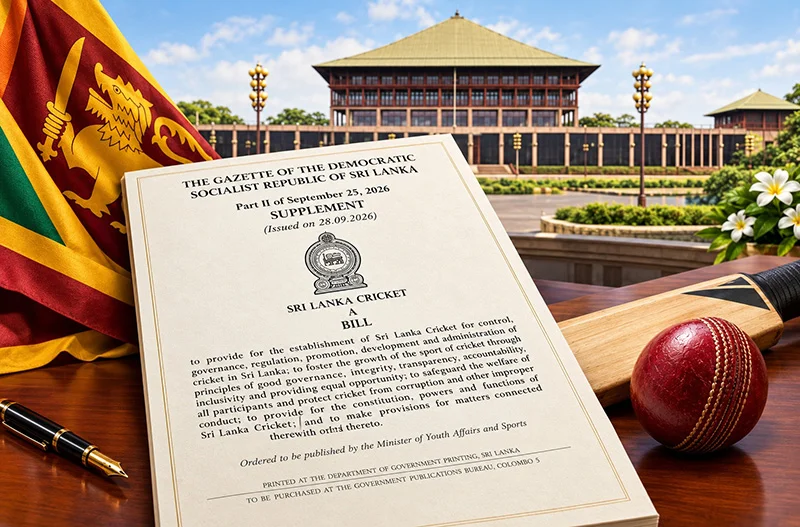
1. Department of Government Printing, Sri Lanka. Sri Lanka Cricket Bill, Gazette Supplement, Part II of September 25, 2026, issued on 28 September 2026.
2. International Cricket Council. Media release, 15 July 2026, reporting the ICC Board discussion of Sri Lanka Cricket and the need for elections to be held as soon as possible.
3. Sport New Zealand – Ihi Aotearoa. Nine Steps to Effective Governance, particularly Step 1: Define and Agree the Board’s Role; Step 4: Provide Strategic Leadership; Step 5: Employ and Support a Chief Executive; and Step 8: Get the Right People on Board.
4. Cricket South Africa. Governance and management frameworks, including the delegation-of-authority framework, Board committees, Cricket Committee, Cricket Pipeline Committee and CEO accountability.
5. International Cricket Council. ICC Articles of Association, provisions requiring free and democratic elections and autonomous administration without government or other public-body interference. ICC. https://images.icc-cricket.com/image/upload/prd/f7vm88yw1933dc38cgtg.pdf
6. International Cricket Council. “ICC outlines proposed USACA constitution.” ICC, 2017. https://www.icc-cricket.com/news/icc-outlines-proposed-usaca-constitution
7. International Cricket Council. “Approved constitution marks historic landmark for cricket in USA.” ICC, 2017. https://www.icc-cricket.com/media-releases/approved-constitution-marks-historic-landmark-for-cricket-in-usa
8. International Cricket Council. “ICC welcomes Nepal Special General Meeting to adopt revised constitution.” ICC, 2018. https://www.icc-cricket.com/media-releases/icc-welcomes-nepal-special-general-meeting-to-adopt-revised-constitution
9. International Cricket Council. “Independent Panel meet to progress Nepal elections under revised constitution.” ICC, 2018. https://www.icc-cricket.com/media-releases/independent-panel-meet-to-progress-nepal-elections-under-revised-constitution
10. International Cricket Council. “ICC delegation visits Bangladesh to engage with stakeholders on governance and electoral matters.” ICC, 2026. https://www.icc-cricket.com/media-releases/icc-delegation-visits-bangladesh-to-engage-with-stakeholders-on-governance-and-electoral-matters
11. International Cricket Council. “ICC Board approves governance, membership and member support decisions.” ICC, 2026; see also “ICC Board Meeting,” 2026, reporting ICC representatives’ meetings with stakeholders in Sri Lanka. https://www.icc-cricket.com/media-releases/icc-board-approves-governance-membership-and-member-support-decisions
(Concluded)
by Viran Maddumage
Assistant Lecturer & PhD (Reading) Macquarie University Australia
Sanduni Rathnayake
Lecturer (Probationary) General Sir John Kotelawala Defence University
The Mediterranean is not merely a border between two continents. It is also a reminder of a relationship between Africa and Europe that was built over centuries; and whose consequences have not disappeared.
There are some borders that people cross with passports. Others are crossed by people who have run out of alternatives.
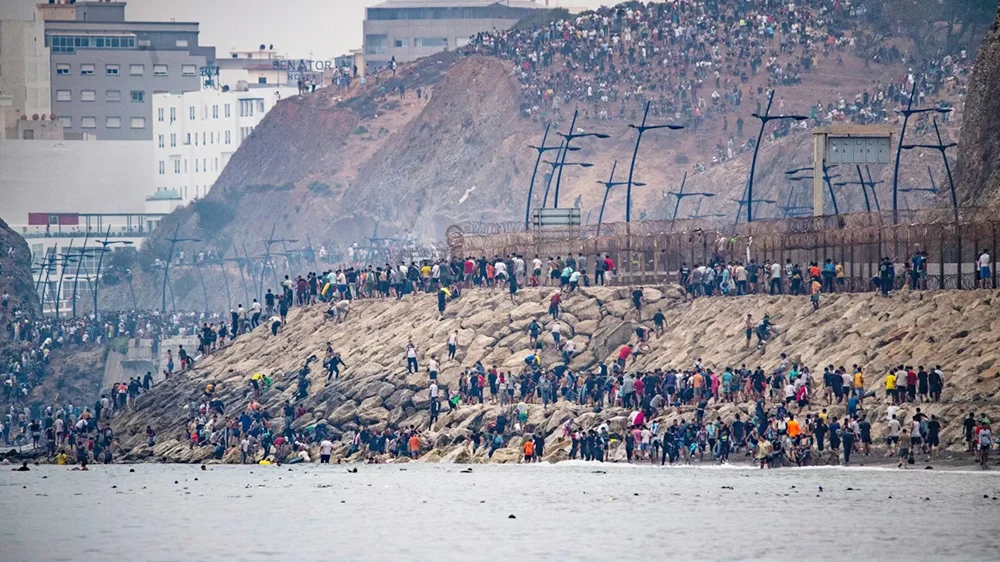
In the early hours of 30 July, 2026, thousands of people attempted to enter Ceuta, the Spanish territory on the northern coast of Africa. Spanish authorities reported that between 50,000 and 60,000 people entered the enclave irregularly during the crisis. The episode followed a Spanish Supreme Court ruling concerning the immediate rejection at the border of people who arrived by sea. Spanish authorities subsequently moved to restore the situation, while Morocco and Spain intensified their cooperation to prevent further crossings.
Ceuta is a strange place to contemplate migration. It is geographically in Africa but politically part of Spain; and therefore, part of the European Union. Its border is not simply a line separating two states. It is a physical manifestation of a much older relationship between two continents.
And perhaps the most important question is not simply: Why are people trying to enter Europe?
It is: Why does Europe remain sufficiently attractive that people are willing to risk their lives trying to reach it?
From extraction to aspiration
The contemporary migration story cannot be reduced to colonialism. Africans migrate for many reasons: employment, education, family reunification, conflict, insecurity, political conditions, environmental pressures and personal aspirations. Much African migration also takes place within Africa itself.
Yet history matters.
European colonialism profoundly reshaped African economies. In many territories, economic structures were organised around the extraction and export of primary commodities. Roads and railways were frequently constructed to connect areas of agricultural, or mineral production, to ports and external markets rather than to create integrated domestic economies. World Bank historical analyses have documented the extent to which colonial economies were dependent on a limited number of primary commodities and external markets.
This was not merely an economic arrangement. It affected what economies produced, where infrastructure was built, how labour was organised and where the value generated by production was realised.
The Congo Free State ,under King Leopold II, offers one of history’s starkest examples. The territory was subjected to a system of forced labour and violent extraction, particularly around rubber and ivory. Forced labour was legally authorised and coercive systems were used to secure production.
But Leopold’s Congo should not be presented as a metaphor for every African country or every European colonial experience. Colonial rule differed substantially across the continent. The broader point is narrower; and perhaps more consequential: colonial economies frequently connected African land, labour and resources to European markets on terms that privileged extraction and external trade.
Modern scholarship continues to examine the long-term effects of these structures. Research on colonial cash-crop economies, for example, has found that colonial production and infrastructure created lasting patterns of economic organisation, while the benefits of these systems were often geographically concentrated and domestic production linkages remained weak.
The question, then, is not whether colonialism single-handedly caused contemporary African migration.
It is whether a history in which Europe was deeply involved in shaping African economies also helped produce the unequal relationship from which today’s migration patterns emerged.
The language of migration
There is another legacy that is easy to overlook because it has become so ordinary: language.
French is spoken across substantial parts of West and Central Africa. Portuguese remains an official language in several African states. English is widely used in countries whose histories are connected to the British Empire.
These are not simply linguistic accidents.
Colonial rule created institutional, educational and administrative connections that survived independence. Those connections later became migration networks.
France, Belgium, Portugal and other European countries are, therefore, not random destinations for African migrants. Their migration relationships with particular African states have been shaped by history, including colonial connections and post-war labour recruitment. The OECD notes that the composition of immigrant populations in several European countries continues to reflect colonial legacies; France, Belgium, Portugal and the Netherlands, for example, have substantial African-born populations.
This creates something more powerful than a shared language. It creates familiarity.
A young person in an African country may have a cousin in Paris, an uncle in Brussels, a former schoolmate in Lisbon or a friend in Milan. Europe ceases to be an abstract geographical destination. It becomes a place where somebody they know already lives.
Diaspora networks can, therefore, function as social infrastructure for migration. They provide information, contacts, accommodation, employment leads and emotional reassurance. The journey may be dangerous, but the destination is no longer entirely unknown.
Why Europe?
There is an uncomfortable paradox at the heart of this story.
For centuries, European powers travelled to Africa in search of land, labour, markets and resources.
Today, Africans travel towards Europe in search of employment, security, education and opportunity.
The direction of movement has changed.
The unequal relationship has not necessarily disappeared. That does not mean Europe is uniformly prosperous while Africa is uniformly poor. Africa is a continent of 54 states with enormous differences in wealth, governance, opportunity and living standards. Nor is Europe free from unemployment, inequality or social exclusion.
But migration decisions are comparative. People do not need to believe that Europe is perfect. They need to believe that their prospects there are better than their prospects at home. That distinction matters.
A person crossing the Mediterranean may not be chasing luxury. They may be chasing a job, a university place, safety, family, dignity or simply the possibility of building a future that appears increasingly difficult to build at home.
Research on West African migration similarly identifies economic opportunity, employment, governance, development conditions and existing migration networks among the factors shaping movement.
The Mediterranean as a graveyard
The tragedy is that the Mediterranean has become not merely a migration route, but a graveyard.
The International Organisation for Migration recorded 5,305 deaths or disappearances on migration routes to Europe in 2016. More than 5,000 deaths and disappearances were recorded in the Mediterranean that year alone.
The danger has never meant that people stop moving.
Instead, when legal routes narrow, journeys can become more dangerous.
That is the central paradox of irregular migration: the more difficult it becomes to cross safely, the greater the incentives for smugglers and increasingly dangerous routes can become for people who are determined to leave.
Ceuta illustrates this geography particularly vividly. Spain and Morocco have spent years reinforcing physical barriers and security arrangements around the enclave. Yet the geographical proximity remains. Africa is only a few kilometres from Europe at its closest points.
A fence can prevent a person from crossing.
It cannot, by itself, erase the reasons that person wanted to cross.
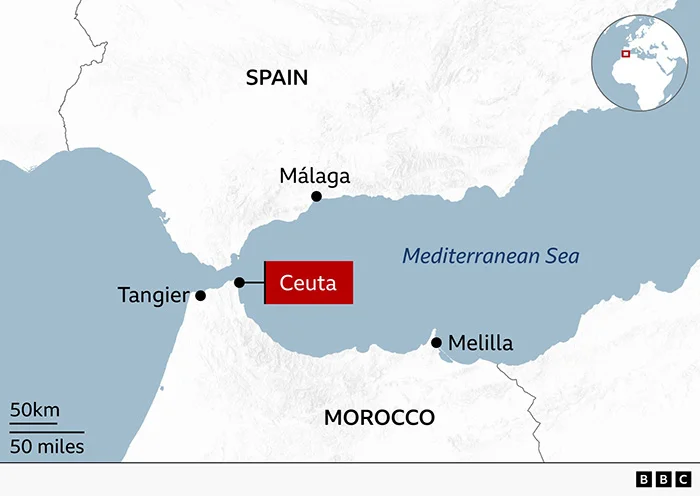
Map courtesy BBC
Europe responds with law
Europe is not without a legal response. Indeed, the European Union has spent years developing increasingly sophisticated mechanisms for managing migration and asylum. As of June 2026, the EU Pact on Migration and Asylum entered into application across EU Member States. It establishes common procedures for screening and registering irregular arrivals, asylum processing, responsibility-sharing and returns, alongside safeguards for fundamental rights.
The European Commission has simultaneously emphasised both stronger external borders and expanded pathways for legal migration, including the EU Talent Pool for workers from outside the Union.
The legal architecture, therefore, reflects competing imperatives.
States have a legitimate interest in controlling their borders.
People have rights when they cross borders.
States have obligations concerning asylum and fundamental rights.
And migrants have reasons; sometimes compelling reasons, for moving.
The challenge is that border control addresses the movement of people. It does not necessarily address the conditions that produce the desire to move.
That distinction should be at the centre of the migration debate.
The African dream of Europe
There is a phrase often encountered in discussions about African migration: that Europe represents a promised land, while Africa is left behind.
Such descriptions can be unfair to a continent that contains enormous economic, cultural and political diversity. But the aspiration itself should not be dismissed.
When a young person believes that their best chance of employment, education or security lies thousands of kilometres away, that tells us something about both the destination and the place they are leaving.
Migration, therefore, becomes a form of social commentary.
People vote with their feet; not because migration is always the right choice, but because their decisions reveal how they perceive the opportunities available to them.
This is also why migration matters for the sustainability of states.
If a country’s young people increasingly organise their lives around the possibility of leaving, the problem is larger than the loss of individual workers. Countries can lose skills, professionals, entrepreneurs, researchers and future leaders. Families may become transnational. Communities may depend increasingly upon remittances. And the political question becomes unavoidable:
What kind of country are we building if so many of our citizens imagine their future somewhere else?
Sri Lanka should understand this question.
The circumstances are obviously different from those of African states facing Mediterranean migration routes. Sri Lankan migration is shaped by its own economic, political and historical circumstances, and its principal destinations and migration channels differ considerably.
Yet the underlying question is familiar.
When leaving becomes the most attractive strategy for an ambitious young person, migration is no longer merely an individual phenomenon. It becomes a measure of confidence in the future of the country itself.
Beyond the border
Perhaps, then, Europe should not ask only how to stop people from crossing.
And African governments should not ask only how to persuade people to stay.
Both questions are too narrow.
The deeper question is why a world divided by such profound economic inequalities continues to expect people to remain content on one side of the divide while opportunity is concentrated on the other.
The answer cannot be an open border without regulation. Nor can it be a fortress surrounded by increasingly dangerous seas.
A more durable approach would require investment in economic opportunity, domestic industries, education, accountable institutions and safe and lawful avenues for migration. It would require European countries to recognise that migration management is not simply a security question. It is also an economic, historical and human-rights question.
And African states must confront an equally difficult reality: historical exploitation can explain part of today’s inequality, but it cannot become an excuse for indefinitely postponing the task of building states in which people want to remain.
The Mediterranean will continue to separate Africa from Europe geographically.
But history has already connected them.
The resources extracted from Africa helped build European economies. Colonial languages created enduring institutional links. Diaspora communities now connect African families to European cities. Labour moves in both directions. Capital moves in both directions. Ideas move in both directions.
What crosses the Mediterranean, therefore, is not merely a migrant.
It is history.
The person swimming towards Ceuta is carrying more than a small bag, if they have one at all. They may be carrying the expectations of a family, the memory of an economy shaped by generations of external relationships, the example of relatives who successfully migrated, and the belief that somewhere on the other side of the water there is a future worth risking everything to reach.
Perhaps, that is the question Europe should hear beneath the sound of the waves:
What would have to change so that crossing the sea was a choice rather than a necessity?
(The views expressed are those of the writers and do not necessarily represent those of the institutions with which the writers associated)

Introduction of Flora and Fauna (Regulation of actions of the Indigenous Community within the nominated areas) Regulations
M. M. D. J. Senarathne, appointed Director General of the Department of National Botanical Gardens

Harmanpreet Kaur steps down as India captain

Turkiye, Pakistan agree Saudi Arabia military deployment under Mecca pact

Rumesh Tharanga among nominees announced for World Athlete of the Year 2026
New Chancellor appointed to General Sir John Kotelawala Defence University

‘Dates have the highest sugar content to fight Coronavirus’

Sunday Island 27 December – Headlines

#SundayIsland 17th December – Headlines

Sunday Island – 28th March

Sunday Island Headlines – 21 March

Sunday Island – 21st February – Headlines
-

 Latest News7 days ago
Gold winner Tharanga gets brand-new Honda Vezel from SLAAJ
-

 News6 days ago
US-assisted ‘Ice’ detection: NPC to examine IGP’s move to transfer drug-busting team
-

 Features7 days ago
Why Sri Lanka needs an Inclusive Civic Nationalism – urgently
-

 Editorial5 days ago
Colombo Port drug bust: The plot thickens
-

 News7 days ago
Civil society activist accuses govt. of favouring Ven. Gnanasara
-
 Midweek Review7 days ago
Dappula’s Easter Sunday ‘grand conspiracy’ claim demolished
-

 Editorial7 days ago
When crime bosses rise above law and shrines
-
Editorial6 days ago
Drug busting, transfers and trust deficit