
News
Govt. urged to act fast against moves by India to stake claim to Lankan cobalt deposit


By Rathindra Kuruwita
The government must immediately convene the National Oceanic Affairs Committee (NCAC) and seek its advice on India’s bid to carryout research at the Afanasy Nikitin Seamount, an area that is claimed by Sri Lanka to be a part of its continental shelf, Dr. Ravindranath Dabare, Attorney-at-Law and Chairman, Environmental Committee of the Bar Association of Sri Lanka (BASL) has said.
Dabare has said that regional powers are using our economic woes to stake claim to Sri Lanka’s resources and as a sovereign nation Sri Lanka must protect its interests. The Sri Lankan public needs to be aware whether politicians and bureaucrats are doing the bidding of other nations, he said.
The Afanasy Nikitin Seamount is a 400-km long and 150-km wide undersea mountain range located in the equatorial Indian Ocean. It features a main plateau that rises 1,200 meters above the surrounding ocean floor, which is at a depth of 4,800 meters. Additionally, there are secondary elevated sea-mount highs, with two notable peaks situated at water depths of 1,600 meters and 2,050 meters.
“We are the closest to Afanasy Nikitin Seamount which is 1,050 kilometers from Sri Lanka. The Seamount is 1,100 kilometers from Maldives and 1,350 kilometers from India. There is speculation that there is USD 80 billion worth of cobalt deposited there. Our total debt is about 100 billion dollars,” Dabare said, adding that on 08 May 2009, Sri Lanka had presented a submission to the United Nations Commission on the Limits of the Continental Shelf (UNCLCS), seeking the extension of the country’s continental shelf beyond the Exclusive Economic Zone (EEZ). Usually, a country’s EEZ only extends to 200 nautical miles from its shores.
“We submitted our claims in 2009. The UNCLES started studying our submission in 2016 and in March 2024, India applied to the International Seabed Authority (ISBA), Jamaica, for rights to explore Afanasy Nikitin Seamount. This isn’t a part of India’s jurisdiction. The problem is what have we done after making the submission in 2009, it has been 15 years. We have waited while other regional powers are making moves into what is ours,” Dabare said.
Dabare said that under normal circumstances the EEZ was an area 200 nautical miles from a country’s shore. However, Sri Lanka’s geological features granted it special characteristics. Article 76 of the United Nations Convention on the Law of the Sea (UNCLOS) describes how a state can define its continental shelf, he said.
According to UNCLOS a country has “special characteristics” if the; a) the average distance at which the 200 metre isobath occurs is not less than 20 nautical miles; (b) the greater proportion of the sedimentary rock of the continental margin lies beneath the rise; (c) the mathematical average of the thickness of sedimentary rock along a line established at the maximum distance permissible in accordance with the provisions of paragraph 4(a)(i) and (ii) of Article 76 as representing the entire outer edge of the continental margin would not be less than 3.5 km; and (d) that more than half of the margin would be excluded by the application of such a line.
“Sri Lanka fulfils these, and we can seek the extension of the country’s continental shelf beyond the EEZ. The reason countries like us are given this chance is that when the seabed becomes suddenly deep a country will find it difficult to access the resources available. Apart from article 76, we can also use annex 2 of UNCLOS, i.e., Commission on The Limits of The Continental Shelf to stake a claim,” he said.
Thus, Sri Lanka is authorised to: ‘‘Establish the outer edge of its continental margin by straight lines not exceeding 60 nautical miles in length connecting fixed points, defined by latitude and longitude, at each of which the thickness of sedimentary rock is not less than one kilometer.”
“As mentioned above we made a submission to UNCLCS in 2009 based on these provisions. India, Bangladesh and Thailand objected to Sri Lanka’s claim back then. We should remember that 08 May 2009 was the day before the deadline set by UNCLES for countries to make these submissions. This is how we do things,” he said.
Dabare said that in March 2024, India placed a 500,000-dollar deposit at the ISBA and requested the ISBA to grant it the right to explore Afanasy Nikitin Seamount for 15 years.
“Now we are facing a great risk. Sri Lanka has access to great resources, but it is also bankrupt. Because of our situation, those who have no right to claim our resources have started to make their moves. In the end, we might have to share these resources with everyone who is now objecting. We don’t know how many people in Sri Lanka are experts on laws of the sea, we also don’t know how many of them are working with the state. We don’t know if our politicians and bureaucrats are aware of what’s going on. How many of them are under the control of other nations? We may be small, but we don’t need to be lackeys of so-called regional powers,” he said.
Dabare said that Sri Lanka must officially object to what India is doing and take the necessary procedural steps.
“We must lobby our officials to protect our resources. Should we bow down to other countries because they have given us some dry rations? I know regional powers want to influence us, but we too are a sovereign nation. The officials need to stand for people’s rights,” he said.
Dabare said Sri Lanka needs to come up with a clear foreign policy and a national policy on agreements with other countries.
“When there are no policies, rulers and bureaucrats take decisions that benefit them, not the country,” he said.
Sri Lanka has a National Oceanic Affairs Committee, but this has not met in years. The government needs to convene this committee and seek advice.
“This is an independent committee, but we urge the committee to tell the nation what the recommendation is. We shouldn’t be opaque and secretive when we take decisions that affects millions of people,” he said.



Former first lady Shiranthi Rajapaksa, wife of former President Mahinda Rajapaksa was produced before the Hulftsdorp court, after being arrested by officers of the Commission to Investigate Allegations of Bribery or Corruption (CIABOC) and produce
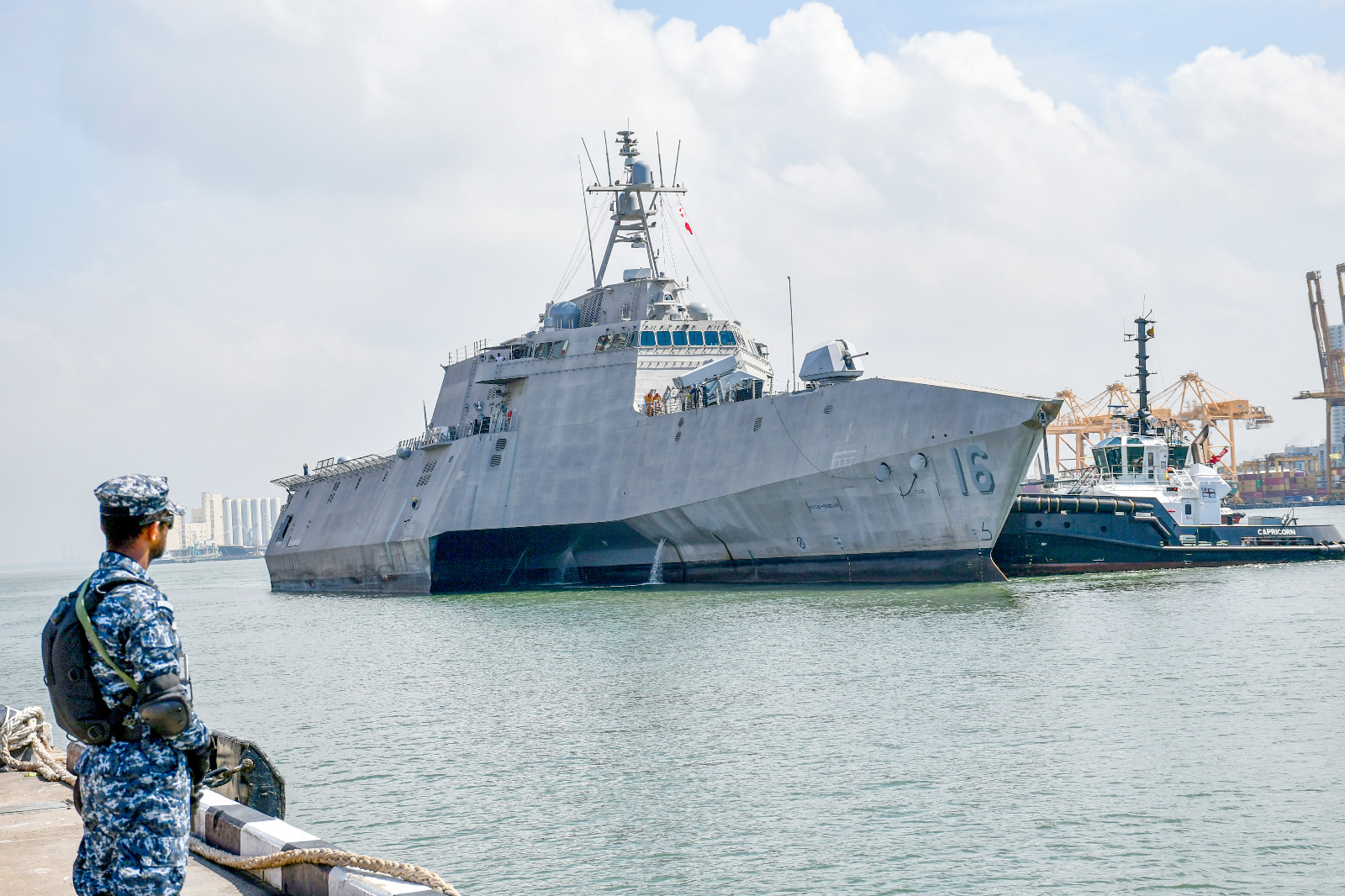
The U.S. Navy ship USS Tulsa (LCS 16) arrived at the Port of Colombo this morning, 7 October 2026 for replenishment purposes.
The visiting ship was welcomed by the Sri Lanka Navy in accordance with naval traditions.
The 127.7-metre-long platform is a Littoral Combat Ship commanded by Commander BM Wanier. Commissioned on 16 February 2019, USS Tulsa has since been in service with the US Navy.
The ship previously made a port call in Sri Lanka on 27 August 2025.

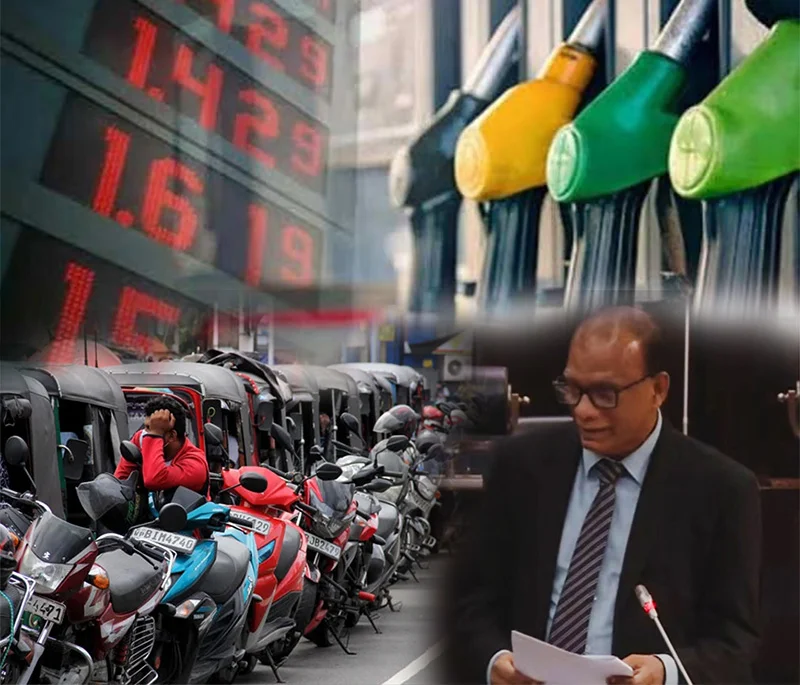
Govt. tells fuel distributors to maintain stocks to ensure uninterrupted supplies
by Saman Indrajith and Norman Palihawadane
The government had instructed private fuel distributors to maintain minimum stocks and ensure uninterrupted supplies to the market, Energy Minister Anura Karunathilaka told Parliament yesterday (06).
Karunathilaka said the Ministry of Energy Secretary had notified the relevant companies of the requirement, following a reduction in supplies by some private distributors, amid higher international fuel prices.
The Minister said private companies had informed the government that they were facing losses because international prices had risen while fuel was being sold, locally, at prevailing prices. As a result, some companies had reduced the volumes released to the market.
The reduced supplies had increased the burden on the Ceylon Petroleum Corporation (CPC), whose share of the diesel market had risen from about 54% to 82%, the Minister said.
“The CPC currently holds an 82% share of the market,” he said, adding that it had increased its supplies, compared with February, to compensate for the reduction by private distributors.
Karunathilaka said the government could not, under the existing agreements with private companies, specify the quantities they should supply to individual filling stations. However, it could require them to maintain minimum stocks in the country.
The Minister said the Energy Ministry had already instructed companies that had failed to maintain the required stocks to take steps to prevent supply disruptions.
The Minister attributed the queues reported at some filling stations to reduced supplies from private distributors, as well as normal variations in fuel distribution. He also said demand for CPC fuel had increased because private companies generally did not provide fuel to dealers on credit, while the CPC offered a three-day credit facility.
“We expect that, as the Ceylon Petroleum Corporation takes on this additional burden, the problem will ease to some extent by Wednesday or Thursday,” Karunathilaka said.
He said instructions had also been issued to increase supplies to CPC filling stations. A special discussion on the issue is scheduled for today (07), with officials of the Energy Ministry and CPC expected to participate,
along with President Anura Kumara Dissanayake.
Meanwhile, Petroleum Dealers’ Association officials have called for an early solution to the supply issue. Association Chairman D.V. Shantha Silva said queues had been reported at many filling stations, mainly those operated by private distributors.
He said the situation was not due to an overall shortage of fuel, but was linked to reduced orders by Lanka IOC, Sinopec and R.M. Parks amid concerns over losses incurred on fuel sales.
The Ceylon Petroleum Private Tanker Owners Association has urged motorists to refrain from panic buying, saying there was no nationwide disruption to fuel supplies.
The government earlier increased fuel prices and introduced a per-litre diesel subsidy following concerns raised by distributors over rising international prices.

Former first lady Shiranthi Rajapaksa arrested by CIABOC

U.S. Navy ship USS Tulsa arrives in Colombo for replenishment visit

Smriti Mandhana appointed India captain across formats

Ronaldo apologizes for Portugal walkout; says Jesus broke promise

Showers in the Western, Sabaragamuwa, Central, Uva, North-western and Southern provinces and in Anuradhapura and Mannar districts

Fuel crunch looms

‘Dates have the highest sugar content to fight Coronavirus’

Sunday Island 27 December – Headlines

#SundayIsland 17th December – Headlines

Sunday Island – 28th March

Sunday Island Headlines – 21 March

Sunday Island – 21st February – Headlines
-

 News7 days ago
US-assisted ‘Ice’ detection: NPC to examine IGP’s move to transfer drug-busting team
-

 Editorial6 days ago
Colombo Port drug bust: The plot thickens
-

 Editorial7 days ago
Drug busting, transfers and trust deficit
-

 Features4 days ago
The first woman in the foreign service or Ceylon Overseas Service it was then called
-
 News7 days ago
Sri Lankan facing death penalty in Saudi Arabia: Mano G appeals to Crown Prince
-

 Editorial5 days ago
Fuelling discontent and protest
-

 News3 days ago
Geneva takes up Sallay’s case and govt. ignores opportunity to answer accusations
-

 Latest News5 days ago
Tharindu Rathnayake, bowlers secure Asian Games Bronze for Sri Lanka