
Opinion
Future must be won


Excerpts from the speech of the Chairman of the Communist Party of Sri Lanka, D.E.W. Gunasekera, at the 23rd Convention of the Party
This is not merely a routine gathering. Our annual congress has always been a decisive moment in Sri Lanka’s political history. For 83 years, since the formation of our Party in 1943, we have held 22 conventions. Each one reflected the political turning points of our time. Today, as we assemble for the 23rd Congress, we do so at another historic crossroads – amidst a deepening economic crisis at home and profound transformations in the global order.
Our Historical Trajectory: From Anti-imperialism to the Present
The 4th Party Convention in 1950 was a decisive milestone. It marked Sri Lanka’s conscious turn toward anti-imperialism and clarified that the socialist objective and revolution would be a long-term struggle. By the 1950s, the Left movement in Sri Lanka had already socialized the concept of socialist transformation among the masses. But the Communist Party had to dedicate nearly two decades to building the ideological momentum required for an anti-imperialist revolution.
As a result of that consistent struggle, we were able to influence and contribute to the anti-imperialist objectives achieved between 1956 and 1976. From the founding of the Left movement in 1935 until 1975, our principal struggle was against imperialism – and later against neo-imperialism in its modernised forms,
The 5th Convention in 1955 in Akuressa, Matara, adopted the Idirimaga (“The Way Forward”) preliminary programme — a reform agenda intended to be socialised among the people, raising public consciousness and organising progressive forces.
At the 1975 Convention, we presented the programme Satan Maga (“The Path of Battle”).
The 1978 Convention focused on confronting the emerging neoliberal order that followed the open economy reforms.
The 1991 Convention, following the fall of the Soviet Union, grappled with international developments and the emerging global order. We understand the new balance of forces.
The 20th Convention in 2014, in Ratnapura, addressed the shifting global balance of power and the implications for the Global South, including the emergence of a multipolar world. At that time, contradictions were developing between the United People’s Freedom Alliance (UPFA), government led by Mahinda Rajapaksa, and the people, and we warned of these contradictions and flagged the dangers inherent in the trajectory of governance.
Each convention responded to its historical moment. Today, the 23rd must responded to ours.
Sri Lanka in the Global Anti-imperialist Tradition
Sri Lanka was a founding participant in the Bandung Conference of 1955, a milestone in the anti-colonial solidarity of Asia and Africa. In 1976, Sri Lanka hosted the 5th Summit of the Non-Aligned Movement (NAM) in Colombo, under Prime Minister Sirimavo Bandaranaike.
At that time, Fidel Castro emerged as a leading voice within NAM. At the 6th Summit in Havana in 1979, chaired by Castro, a powerful critique was articulated regarding the international economic and social crises confronting newly sovereign nations.
Three central obstacles were identified:
1. The unjust global economic order.
2. The unequal global balance of power,
3. The exploitative global financial architecture.
After 1979, the Non-Aligned Movement gradually weakened in influence. Yet nearly five decades later, those structural realities remain. In fact, they have intensified.
The Changing Global Order: Facts and Realities
Today we are witnessing structural Changes in the world system.
1. The Shift in Economic Gravity
The global economic centre of gravity has shifted toward Asia after centuries of Western dominance. Developing countries collectively represent approximately 85% of the world’s population and roughly 40-45% of global GDP depending on measurement methods.
2. ASEAN and Regional Integration
The Association of Southeast Asian Nations (ASEAN), now comprising 10 member states (with Timor-Leste in the accession process), has deepened economic integration. In addition, the Regional Comprehensive Economic Partnership (RCEP) – which includes ASEAN plus China, Japan, South Korea, Australia and New Zealand – is widely recognised as the largest free trade agreement in the world by participating economies.
3. BRICS Expansion
BRICS – originally Brazil, Russia, India, China and South Africa – has expanded. As of 2025, full members include Brazil, Russia, India, China, South Africa, Saudi Arabia, United Arab Emirates, Egypt, Ethiopia and Iran. Additional partner countries are associated through BRICS mechanisms.
Depending on measurement methodology (particularly Purchasing Power Parity), BRICS members together account for approximately 45-46% of global GDP (PPP terms) and roughly 45% of the world’s population. If broader partners are included, demographics coverage increases further. lt is undeniably a major emerging bloc.
4. Regional Blocs Across the Global South
Latin America, Africa, Eurasia and Asia have all consolidated regional trade and political groupings. The Global South is no longer politically fragmented in the way it once was.
5. Alternative Development Banks
Two important institutions have emerged as alternatives to the Bretton Woods system:
• The New Development Bank (NDB) was established by BRICS in 2014.
• The Asian Infrastructure Investment Bank (AIIB), operational since 2016, now with over 100 approved members.
These institutions do not yet replace the IMF or World Bank but they represent movement toward diversification.
6. Shanghai Cooperation Organisation (SCO)
The SCO has evolved into a major Eurasian security and political bloc, including China, Russia, India. Pakistan and several Central Asian states.
7. Do-dollarization and Reserve Trends
The US dollar remains dominant foreign exchange reserves at approximately 58%, according to IMF data. This share has declined gradually over two decades. Diversification into other currencies and increased gold holdings indicate slow structural shifts.
8. Global North and Global South
The Global North – broadly the United States, Canada European Union and Japan – accounts for roughly 15% of the world’s population and about 35-40% of global GDP.
The Global South – Latin America, Africa, Asia and parts of Eurasia – contains approximately 85% of humanity and an expanding share of global production.
These shifts create objective conditions for the restructuring of the global financial architecture – but they do not automatically guarantee justice.
Sri Lanka’s Triple Crisis
Sri Lanka’s crisis culminated on 12 April 2022, when the government declared suspension of external debt payments – effectively announcing sovereign default.
Since then, political leadership has changed. President Gotabaya Rajapaksa resigned. President Ranil Wickremesinghe governed during the IMF stabilization period. In September 2024, Anura Kumara Dissanayake of the National People’s Power (NPP) was elected President.
We have had three presidents since the crisis began.
Yet four years later, the structural crisis remains unresolved,
‘The crisis had three dimensions:
1. Fiscal crisis – the Treasury ran out of rupees.
2. Foreign exchange crisis – the Central Bank ran out of dollars.
3. Solvency crisis – excessive domestic and external borrowing rendered repayment impossible.
Despite debt suspension, Sri Lanka’s total debt stock – both domestic and external – remains extremely high relative to GDP, External Debt restructuring provides temporary could reappear around 2027-2028 when grace periods taper.
In the Context of global geopolitical competition in the Indian Ocean region, Sri Lanka’s economic vulnerability becomes even more dangerous,
The Central Task: Economic Sovereignty
Therefore, the 23rd Congress must clearly declare that the struggle for economic sovereignty is the principal task before our nation.
Economic sovereignty means:
• Production economy towards industrialization and manufacturing.
• Food and energy security.
• Democratic control of development policy.
• Fair taxation.
• A foreign policy based on non-alignment and national dignity.
Only a centre-left government, rooted in anti-imperialist and nationalist forces, can lead this struggle.
But unity is required and self-criticism.
All progressive movements must engage in honest reflection. Without such reflection, we risk irrelevance. If we fail to build a broad coalition, if we continue Political fragmentation, the vacuum may be filled by extreme right forces. These forces are already growing globally.
Even governments elected on left-leaning mandates can drift rightward under systemic pressure. Therefore, vigilance and organised mass politics are essential.
Comrades,
History does not move automatically toward justice. It moves through organised struggle.
The 23rd Congress of the Communist Party of Sri Lanka must reaffirm.
• Our commitment to socialism.
• Our dedication to anti-imperialism.
• Our strategic clarity in navigating a multipolar world.
• Our resolve to secure economic sovereignty for Sri Lanka.
Let this Congress become a turning point – not merely in rhetoric, but in organisation and action.
The future will not be given to us.
It must be won.

by N. A. de S. Amaratunga
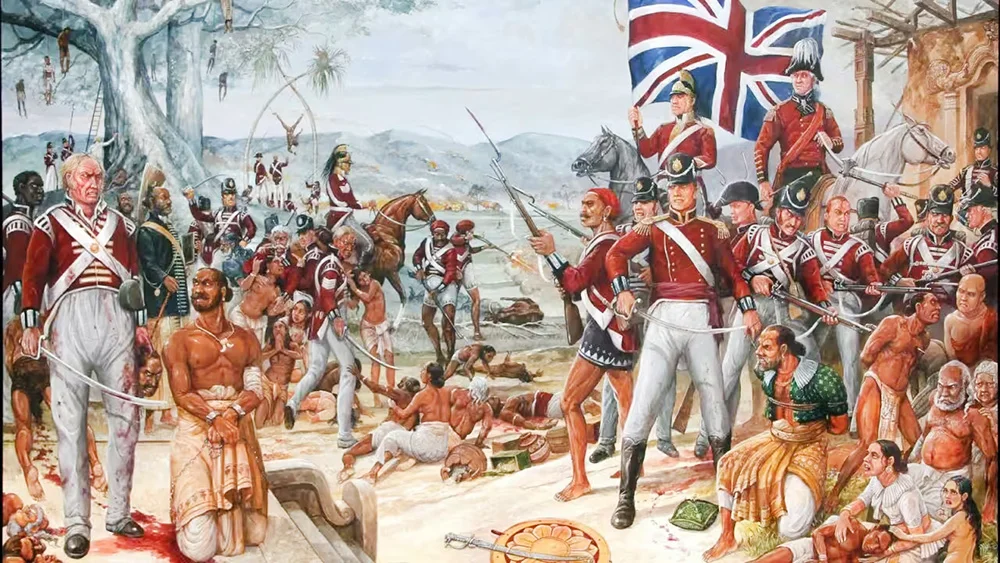
At a time when the word genocide is used with political motive and defensive war misconstrued as genocide, and a brutal genocide is taking place on a global scale with impunity, one should reflect on genocide committed by those who falsely accuse the Sri Lankan armed forces and the government for such crimes. The British who systematically annihilated people including “babies suckling”, in Uva-Wellassa in 1818 and the LTTE, which carried out numerous massacres to drive away the Sinhalese and Muslims in the so-called border villages are now shamelessly levelling unsubstantiated allegations of genocide against the Sri Lankan military. The British, jointly with the US, massacred about a million people, including children, in Iraq on a fabricated charge of possessing weapons of mass destruction. The British helped the LTTE continue their genocide of the Sinhalese and Muslims in the North and the East in an attempt to drive them away and grab their lands, and such crimes constitute genocide according to 1948 Genocide Convention.
“Slaughter every man, woman and child”
“Slaughter every man, woman, and child (including babies suckling at the breast)” was the order given by Governor Robert Brownrigg (3rd British Governor of Ceylon from 1813 – 1820) to Maj. Gen. Hay MacDowell in 1818. The British left the entire Uva-Wellassa region in a state of famine and starvation. The British used the scorched earth policy including mass murder and genocide of Sinhala civilians to crush the rebellion. British human rights campaigners now pointing accusing fingers at Sri Lanka have forgotten the Madulla Massacre, which led to razing and annihilating entire villages. In the entire Uva region members of the male population above the age of 18 were killed in revenge for resisting British imperial occupation under Governor Brownrigg.
Britain at present is leading a core group at the UNHRC Geneva, which bashes Sri Lanka for alleged human rights violations. Britain seems to have no remorse about its genocidal violence in Sri Lanka and happily leads the way in castigating Sri Lanka on unsubstantiated allegations of human right violations during the war against the LTTE. The US, which is the biggest war criminal in the world, is supporting these neo-colonial strategies to control and exploit the poor countries.
The Chemmani mass grave
The Chemmani mass grave has become a political tool liberally used by the pro-LTTE groups and their supporters in the West and also their local agents to pressure the government to take action against the war winning armed forces. Let the government be urged to get to the bottom of the mass graves found in the North and elsewhere. People of this country owe it to the armed forces who saved their country to ensure that the name of the national military is cleared. And if there are any war criminals among them, punish them after conviction. Sri Lanka is not Israel, the US or the UK.
The Genocide Convention was conceived largely in response to World War II, which saw atrocities such as the Holocaust that lacked an adequate description or legal definition. Polish-Jewish lawyer Raphael Lemkin, who coined the term genocide in 1944 to describe Nazi policies in occupied Europe and the Armenian genocide, campaigned for its recognition as a crime under international law. Lemkin also linked colonialism with genocide, mentioning colonial genocides outside of Europe in his writings. The Convention defines genocide as any of five “acts committed with intent to destroy, in whole or in part, a national, ethnic, racial or religious group.” These five acts include killing members of the group, causing them serious bodily or mental harm, imposing living conditions intended to destroy the group, preventing births, and forcibly transferring children out of the group. Victims are targeted because of their real or perceived membership of a group, not randomly.
Genocide in Gaza
However, Israel in collaboration with the United States, which has the worst record in genocidal warfare, has violated this Convention with impunity in Gaza, knowing that the rest of the world cannot act against it except condemn its actions. The UN has miserably failed to take any action against Israel, though it has the necessary tools like the Convention mentioned above. Its Commissioner for Human Rights Volker Turk visited the Chemmani mass grave and issued a strongly-worded statement calling for investigation under international supervision. He has not visited the place where genocide is currently taking place in broad daylight. Neither has the UNHRC made any worthwhile response in respect of Iraq, Syria, Libya and other parts of the world, where the US and Europe have been engaged in genocidal warfare. This type of double standards will further erode the credibility of the UNHRC, and if countries tend to ignore its writ, it has itself to blame.
We still don’t know the identities of the people whose skeletal remains have been found in the Chemmani mass grave. It was a prolonged war situation that created these graves. There were allegations of killings, including civilians, by both parties to the war.
The Office of Missing Persons has received about 10,000 complaints about missing persons from the north and east and investigations into these complaints are ongoing (source – reports of the OMP). Apart from verbal complaints there is very little incriminating evidence, if at all, against the armed forces. A few isolated incidents where excesses were committed have been investigated and action is being taken against the suspects.
Campaign by Pro-LTTE groups
Pro-LTTE groups are trying their utmost to connect the missing persons with the mass graves. They claim that the people who went missing were buried in the Chemmani mass grave. The Island journalist Shamindra Ferdinando dealt with this matter comprehensively in the Midweek Review on 9 September. He shows that the narrative built up by the pro-LTTE groups and the Western imperialists regarding the alleged disappearances could be more myth than fact.
The LTTE massacred hundreds of civilians in cold blood in many places, such as Sri Maha Bodhi, Aluth Oya, Aranthalawa (where the victims were Buddhist monks), Kattankudy mosque, Palliyagodella, Eravur, Gonagala and Kebethigollewa. Most of those killings, committed outside the war zone, were aimed at terrorising the ordinary people, and that amounts to genocide according to 1948 Genocide Convention. The LTTE carried out many bomb attacks on civilian targets, such as the Central Bus Station in Pettah, the Central Bank, crowded trains and buses. In the eastern villages people were bludgeoned and slashed to death so that ammunition could be saved.
Apart from killing and injuring, the LTTE chased away Muslims and Sinhalese from the Northern province, which amounted to ethnic cleansing, an act of genocide according to the above mentioned Convention. The people who were chased away have not yet returned to their homes and property, perhaps because of the memory of terror they had experienced in the North. Aren’t these acts of genocide ? The 1948 Convention defines genocide as any of five “acts committed with intent to destroy, in whole or in part, a national, ethnic, racial or religious group.”
Attacks on centres of worship like temples and mosques and killing of priests are unpardonable acts of terror aimed at destroying religious groups. Similarly murdering surrendered police officers is butchery of the worst kind. It was such acts of naked terrorism and insane mass murder that made the FBI label the LTTE “the most brutal terrorist organization in the world”.
Silence of UNHRC
Isn’t the UNHRC keen to ensure that justice is done for the victims of genocide committed by the LTTE? Perhaps, we should not make such a request to an organisation that keeps mum while genocide is rampant in the contemporary world ? Palestinians are being systematically murdered and driven away from their country with the UNHCR doing nothing to protect them. The US President is threatening the countries which support the Palestinians.
Sri Lanka must call for an international investigation into genocide committed by the LTTE.


‘Before I took this position, I knew so little about them that I didn’t even know their names. I had not met them in any context outside the present.’ (My translation.) President Dissanayake, recently speaking about judges of the Supreme Court and of the Appeals Court.
by Usvatte
Nothing announces more loudly the gaping distance between the social strata from which our rulers, prior to 2024 came, and those of the present government come. That response came from President Dissanayake when he was accused of raising the age of retirement of judges to help his favourites. He could not possibly have had favourites among persons wholly strangers to him. That charge, therefore, prima facie, must fail.
Those who ruled this country as politicians and senior public servants, judges, lawyers and other professionals, generally prior to 2024, commonly went to schools in Colombo or its neighbourhood. Leaders even from Jaffna, Anuradhapura, Kandy, Ratnapura and Galle had been educated in schools in Colombo or their equivalents in other urban centres. They had met each other either as relatives, friends, school mates, debaters or competitors on playgrounds. Three of four who were our first prime ministers attended S. Thomas’ College, Galkissa; the other Royal College, Colombo. Of the first four prime ministers, two went to Cambridge and one to Oxford. There, then followed a family, two of whom attended the highly reputed St. Bridget’s Convent, in Colombo, two others having attended S. Thomas,’ and Oxford, and one, the redoubtable Sciences Po in Paris. Two more came from Royal College, Colombo, and a third claimed that he attended St. Joseph’s, Maradana. So, did we spend the first near-half-century of an independent country. These ladies and gentlemen, together with many others, with roughly similar backgrounds, established a form of government new to our society. A part of the achievements of that leadership was an excellent (within the resources they had) public health scheme and a school system that, in time, reached almost every child.
Unlike the earlier rulers, Dissanayake attended government schools in Tambuttegama and Kelaniya University. He studied science and mathematics. He can differentiate an equation for you and speak intelligently about Paul Dirac and Higgs boson with the same felicity as accusations against former politicians. There is a Prime Minister who can talk to you impromptu on August Compte and Claude Le`vi-Strauss. She did go to prestigious schools in Colombo but decided to throw her lot with those that had not. (That was not uncommon in periods of radical change in several societies in the past.) There are ministers in this government who have travelled regularly by train, without snatching gold necklaces on women passengers. Others have pushed themselves into crowded buses, to get home before dark on roads unlit for miles. Many have taught in rural schools in Pooneryn or Nikaweratiya. Few have travelled by motor car to schools in major towns including Colombo and its environs. Few have lived in or have homes in major towns including the national capital. One MP says that she was born in a ‘line room’ in a tea plantation. One must know the poverty, squalor and violence of these habitats to measure the social distance she has travelled. The new political leaders are culturally very different from the old. (I avoid the term class because the term has connotations which are not seen here.) Those people are the salt of this earth, representative of common people in this country. We now have in Parliament a House of Representatives full of Commons. We look forward to them for leadership to move this society from the morass it is in.
A coterie of people from the deep south of the country, who were elected to office with much optimism, turned out to be a deep disappointment and turned this country into a kleptocracy and a haven for druggists and gangsters. The offspring of leading politicians in the group that went to those same good schools that I mentioned above, have been accused in our courts of heinous crimes. Some crowd our prisons. They evidently plundered the public purse, pushed the country into debt both local and foreign, corrupted processes of governance including the judiciary and let the country into a venomously poisonous murky backwater from which young people flee as soon as they can collect the airfare for a one way ticket to Dubai or obtain a visa to South Korea.
The present government was formed by young people who have yet to be tried. The electorate, by an overwhelming majority, elected them to Parliament. The President was elected by a thin margin. In my understanding, this government has yet to suffer sinking damage. They have faced several squalls and one or two have been thrown overboard but the ship has survived and plunged ahead in heavy seas. A major storm has been brewed and the government has been battered. But the rudder is in place, the engine room is dry, there is ample fuel and the crew is fresh and willing. On the radar, I read heavier storms developing ahead and these will severely test the skills of the captain and his mates. Despite loud and wide claims to the contrary, I do not see a sharper captain or more skilled and less tainted sailors who can guide this ship safely over choppy seas over the next few years. A capacity to speak English fluently, hold a firm handshake and wear a necktie neatly do make a good brown sahib (Tarzie Vittachi) but not necessarily a Manmohan Singh or a Zhu Rongji or, indeed, a Lee Kwan Yu. Those that batter the government, except for a few outstanding scholars and fine lawyers, are laden with so much foul lead that any vessel carrying them must instantly seek the bottom. The new politicians have not been tested with temptation. Who can, I certainly cannot, give them a carte blanche of good behaviour? Time will test them? The government has demonstrated competence ample to win that chance.
There is much talk that the government did not consult stakeholders when they introduced legislation to raise the age at which judges in courts will retire. Who expects a government to foresee every emergency and write it into its election manifesto? What indeed is at stake and who holds the stakes? The government holds forth that what is at stake is the administration of fair justice to both those who come to courts accused of crimes and those who seek redress for harm inflicted on them by those who broke the law. They are the janathava who hold the highest stakes. ‘Will my case be heard to a close and the accused be duly punished? And where is justice? Will the accused die before the case will be heard to a close in 2038, when I myself might be dead? Will those who plundered the government Treasury and their progeny live in splendid luxury while those who lost loved ones, limbs and all they possessed suffer both misery and penury? Is that not foul justice? Is that just at all?’ The government, both in public and implicitly, has consulted these stakeholders amply. The fast disposal of cases of where politicians and others had committed serious crimes was a major plank in the platform on which the JJB sought election. I don’t recall that any party either at a general election or the one to elect a president challenged that course. True enough, they did not seek a mandate to paint the east window of the magistrate’s court in Meegahakotuva.
How many of you have read in an election manifesto in the United Kingdom, Angola, Paraguay or Mongolia an undertaking to raise the wages of judges of the supreme court? Lawyers are not stakeholders in this principal contest. They, of course, are more than amicus curiae.
Highly regarded scholars in law, eminent lawyers in practice, trade unions and politicians who want to test the last chance they have to come to power now protest that the rule of law is at risk of loss, that the executive and legislative branches of government may subject the judicial branch under their subjugation and with that bury democratic governance. Like most eventualities that are possible. But what is the probability that that eventuality will come about? (An unkind professor once said, ‘It is possible that all of you will win first class honours. But what is probable is that one will.) Were the government to raise the age of retirement of judges, in what manner is the rule of law denied; in what manner will democracy cease to be? The probability that any political party that may come to power will kill the independence of the judiciary, deny the rule of law and establish a dictatorship is exactly the same as the NPP government may do so. The president of BASL made a declaration, a few weeks back, that the 22nd Amendment to the Constitution, which is the offending piece of legislation, would no longer be inimical to democracy, if it were to be effective from 01 January 2027. Is there a long rahu kala in kethu dasa inimical to democracy from September 01 to December 31, 2026? What is the poison in the proposed 22nd Amendment that will be wafted away between now and 01 January 2027? In the absence of a satisfactory answer to that question, what is the objection to the proposed Amendment?
Among the three branches of government, the judiciary is the weakest. It has no tanks; it has no money. The executive branch appoints them and the legislative, may lawfully, remove them. Yet the judiciary branch is so important for democratic governance that the fundamental laws of governance (the Constitution), courts themselves under the law and long custom, bind the other two branches and the general public to good behaviour. Democratic governance is possible only when those three branches check each the others’ excesses and support their good functioning. The judicial branch is no less important than the other two.
A well-functioning judiciary is at stake. The government has put out the beginning of a solution. BASL and the learned professors with it, possibly could not have a stake in delaying judicial procedures and denying justice to close perhaps to 5 million citizens. The stakes they play for must be different. The public will be grateful if they would disclose them.
In time, I expect new casus belli and more violent skirmishes, because the lines now have been drawn.

By Mohammed Ismail Mohammed Sadaath
(Continued from the Sunday Island Sept. 13)
By the late 1990s, Ashraff was beginning to speak differently about his political future. Published historical accounts record that he argued a political party representing a minority community had reached certain limitations and needed to expand into national politics.
The National Unity Alliance was subsequently created and formally registered on 23 August 23, 1999.
This should not be exaggerated. The NUA had not existed long enough before Ashraff’s death for us to describe it as a completed ideological transformation. It could also be interpreted as an electoral strategy. Ashraff was ambitious, and a politician seeking influence beyond a minority constituency would naturally benefit from a wider platform.
But I came to understand the NUA differently because of a conversation I had with Ashraff at the time.
A plate of rice and a question I wanted to ask
At that period, I was attached to the Department of Political Science at the University of Colombo as a lecturer. One day, I received a telephone call asking me to come and meet the leader. I went to his ministerial bungalow in Colombo.
When I arrived, M.M. Mohideen, Sammanthurai Yaseen and several other senior SLMC leaders were there. The atmosphere was relaxed and celebratory. They were marking the registration of the National Unity Alliance and eating kiddu rice together.
Ashraff noticed me and asked that a plate be brought for me. I had already had lunch. But when the Leader himself invited me to join the meal, refusing did not seem appropriate. I therefore took a little rice and joined them.
It was a surprisingly ordinary setting for what would become one of my strongest political memories. There was no stage, no microphone and no formal political speeches. Just the Leader, senior party colleagues, food and conversation. But I had a question.
I had watched Ashraff build the Muslim Congress. I had myself worked within the movement. I knew how much political strength the SLMC had given him. He had reached Parliament and become one of the country’s most powerful Muslim Cabinet Ministers. Why, then, another political organisation?
I asked him respectfully, “Sir, may I ask you a question?” He agreed.
I asked, in substance: You have built the SLMC into a powerful political force. Through this party you have reached one of the highest positions attained by a Muslim political leader in Sri Lanka. Why, then, have you registered the National Unity Alliance? His answer has remained with me for more than two decades.
Ashraff reflected on the atmosphere that had been created during the process of building Muslim political power. He spoke about the language used in political mobilisation, including ethnic appeals and community-centered slogans that had helped mobilise and unite Muslims.
But he was worried about where such politics might eventually take the younger generation. The very political atmosphere that had helped create Muslim political consciousness, he suggested, could become volatile if it continued without change.
His concern was especially about Muslim youth. He feared that they could eventually be taken in a direction he did not want them to go. He wanted to correct that course. He wanted Muslim youth to move towards a broader national agenda.
I do not present this conversation as a verbatim transcript. I was not recording him, and more than two decades have passed. What I recount is my recollection of the substance and meaning of that exchange.
What struck me was his willingness to reflect critically on his own politics.
Re-reading the NUA
Political leaders are generally comfortable describing the mistakes of their opponents. It is much rarer for a leader to ask whether the political language that helped him acquire power may itself have produced unintended consequences.
Ashraff was not saying that Muslim political mobilisation had been unnecessary. Nor was he abandoning Muslim political rights. What he appeared to be recognising was something more complex: the politics required to awaken and organise a marginalised community may not be the same politics required to lead the next generation of that community.
The SLMC had told Muslims that they needed their own voice, that others could not decide their political future without them, and that they had to organise. That message transformed Muslim politics.
But once a community possesses political confidence, what comes next? Can young Muslims be taught to defend their identity without being politically separated from the rest of the country? Can Muslim political confidence become part of a larger Sri Lankan citizenship?
My conversation with Ashraff suggested that these questions were occupying his mind.
The NUA may therefore also have represented an element of political self-correction. Ashraff had used identity to build representation, but he appeared increasingly unwilling to allow identity to become a permanent political prison.
Once a community has been successfully mobilised around its identity, how does a leader prevent that identity from becoming a permanent boundary between that community and the nation? Ashraff never had the opportunity to answer that question fully.
Then came September 16
On September 16, 2000, Ashraff’s helicopter crashed near Aranayake. His death ended not only a political career but also an unfinished political experiment.
There would be no opportunity to see how the NUA developed. There would be no Ashraff at the negotiating table during the 2002 peace process, no Ashraff to respond to the final stages of the war, and no opportunity to see whether the man who had built the country’s strongest autonomous Muslim political movement could genuinely move beyond it towards a broader national political platform.
History stopped Ashraff at perhaps the most interesting point in his political evolution.
The party survived, but did the vision?
Ashraff’s death exposed an important weakness in the movement he had created. The SLMC possessed an exceptionally powerful leader, but it had not developed an equally strong succession system.
Leadership disputes followed. Fragmentation became a defining feature of post-Ashraff Muslim politics. There is an obvious irony here: Ashraff spent much of his political life consolidating Muslim political strength, while after his death political actors increasingly competed over different pieces of that inheritance.
The SLMC survived. Other Muslim parties emerged. Muslim politicians continued entering governments. Cabinet portfolios continued to be obtained. Coalition bargaining survived extremely well.
But the question is whether Ashraff’s method survived more strongly than Ashraff’s purpose.
Political leverage can secure ministries and appointments, but it can also create institutions, correct structural inequalities and influence national policy. Political success must eventually be measured by what remains when the politician leaves office: institutions, policies, rights, educational opportunities, administrative reforms, security, social cohesion and a stronger generation.
If bargaining repeatedly changes who holds office without changing the structural conditions affecting the community, bargaining has lost its transformative purpose.
Remembering Ashraff without making him a saint
Ashraff should not be transformed into a politician who never made mistakes. He was a political actor operating in a deeply divided country. He sought power, used powerful community-centered rhetoric, and led in a highly personalised manner. His political mobilization attracted criticism for communal and ethno-religious tendencies.
Acknowledging these contradictions does not diminish his historical importance. It makes the final stage of his political journey more interesting.
A leader who had used identity politics appeared to be asking whether identity politics had reached its limits. A leader who had taught a community how to stand separately was beginning to ask how that political confidence could be taken back into a national space.
For me, this journey is captured in two memories. The first is Maruthamunai: I was a district-level party activist, I spoke at the Masoor Moulana Grounds, Ashraff listened, and he later promoted me to a national youth role. That was Ashraff the political organiser, building a movement and strengthening Muslim political consciousness.
The second memory is Colombo. Years had passed. The NUA had been registered. I was sitting with Ashraff, M.M. Mohideen, Sammanthurai Yaseen and other senior SLMC leaders, sharing a simple celebratory meal. I asked why he needed the NUA after achieving so much through the SLMC. I heard a leader worrying about where mobilisation might eventually lead Muslim youth.
Only much later did I realise how closely those two encounters were connected. At Maruthamunai, I saw a leader determined to build a generation of politically conscious Muslim youth. Years later in Colombo, I heard the same man worrying about where that political consciousness might lead if it remained permanently tied to ethnic slogans. That change in Ashraff’s thinking has stayed with me.
More than a photograph on a September stage
Every September, commemorating Ashraff is easy. His photograph can be displayed, a stage can be decorated, speakers can call him Thalaivar, his achievements can be listed and his speeches replayed.
But political inheritance is not measured by how often a dead leader’s name is mentioned. It is measured by what later generations do with the political space he created.
Ashraff helped give Sri Lankan Muslims an independent political voice. What has that voice produced during the 26 years since his death? He demonstrated the power of coalition bargaining. How much of that bargaining has been converted into durable policy rather than temporary office? He helped build institutions. What comparable institutions will the present generation of Muslim politicians leave behind?
And if Ashraff himself became worried that communal political rhetoric could lead Muslim youth in an undesirable direction, who continued his effort to bring that generation into a broader national agenda?
These questions should not be treated as criticism of one particular Muslim political party. They concern the direction of Muslim political leadership as a whole.
From Sammanthurai to an unfinished national journey
Sri Lanka in 2026 is very different from the Sri Lanka Ashraff left behind in September 2000. The war has ended. The LTTE no longer exists. The traditional political system has undergone dramatic change. A younger generation has grown up without direct memories of much of the violence that shaped Ashraff’s political career.
Yet many underlying issues remain. Land remains sensitive in the East. Administrative boundaries remain politically contested. Tamil-Muslim relations periodically become strained. Religion can rapidly become politicized. Questions of minority representation remain unresolved.
Sri Lanka continues struggling with one of its oldest democratic challenges: how can communities maintain their identities and political dignity while simultaneously building a common citizenship?
Ashraff did not solve that problem. History should not pretend that he did.
But several times during his political life, he recognised when an existing political model had become insufficient. When traditional Muslim representation seemed inadequate, he helped create an autonomous Muslim political movement. When demographic weakness appeared to condemn Muslims to the political margin, he transformed organised votes into national bargaining power. When political representation alone seemed insufficient, he used political influence to build institutions. And when the language of identity politics itself appeared capable of producing consequences he feared for a younger generation, he began exploring a broader national political platform.
Then the helicopter fell. The leader disappeared. The SLMC survived. The tree survived. Coalition politics survived. The politics of bargaining survived. But the larger journey from identity, to representation, to political confidence, and finally towards a broader national citizenship remains unfinished.
Perhaps that is why, 26 years after his death, the most meaningful question on September 16 should no longer simply be: Who inherited M.H.M. Ashraff’s party? A far more important question is: Who understood where Ashraff was trying to go next?
(Concluded)
References
Yusoff, M.A., Sarjoon, A., Hussin, N. & Ahmad, A. (2017), “Analyzing the Contributions of the Sri Lanka Muslim Congress and its Founder–Leader to Muslim Politics and Community in Sri Lanka,” Social Sciences, 6(4), 120.
Yusoff, M.A., Sarjoon, A. & Mohd Zain, Z. (2018), “Analyzing the Fragmented Sri Lankan Muslim Politics in Post-Ashraff Era,” Journal of Politics and Law, 11(3).
Johansson, Andreas (2019), Pragmatic Muslim Politics: The Case of the Sri Lanka Muslim Congress. Palgrave Macmillan.
Parliament of Sri Lanka, official profile of M.H.M. Ashraff.
D.B.S. Jeyaraj, “Remembering SLMC Leader M.H.M. Ashraff,” Daily FT.
D.B.S. Jeyaraj, “MHM Ashraff: From Muslim Leader to National Statesman,” Daily Mirror.

Showers about 75 mm are likely at some places in the Western, Sabaragamuwa, Central and Southern provinces

Brook, Buttler, Baker star as Sri Lanka slump to 119-run rout

Where is Gnanasara Thera?Police pass buck to court

Russian citizens in Lanka to vote in State Duma elections

Euro 110,000 research drive to tackle plastic waste in food sector

New SAU-RCSS pact to boost South Asian dialogue

‘Dates have the highest sugar content to fight Coronavirus’

Sunday Island 27 December – Headlines

#SundayIsland 17th December – Headlines

Sunday Island – 28th March

Sunday Island Headlines – 21 March

Sunday Island – 21st February – Headlines
-

 Sports5 days ago
DDS set to lose Test captaincy
-

 News5 days ago
Sri Lanka faces new grid challenge as rooftop solar surges: former CEB GM
-

 Latest News5 days ago
Shafali, Deepti power India into sixth T20 Asia Cup final
-

 Latest News4 days ago
Sri Lanka thwart Fatima Sana challenge to secure Asia Cup final spot
-

 News3 days ago
Gnanasara Thero absconding after SC ruling
-
 Features6 days ago
Lost for 90 years: Rare Goby resurfaces in Jaffna
-

 News4 days ago
Ammunition cache found in old Kandy bungalow
-
 Latest News7 days ago
Italian Naval Vessel ‘ITS Giuseppe Garibaldi’ arrives in Colombo