
Features
Decolonising SL universities

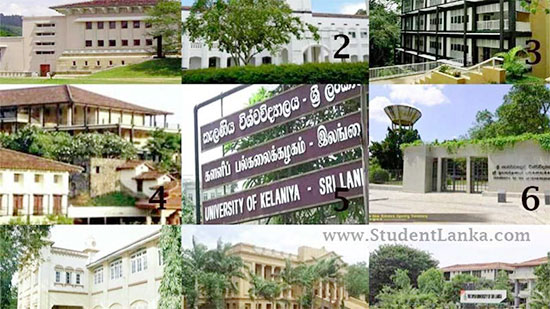
BY KAUSHALYA HERATH
Recent socio-political debates in Sri Lanka on higher education suggest that universities are being viewed as neo-liberal institutions set up to produce human capital for the market. State imperatives to produce employable graduates with the desired mix of knowledge, skills, and competencies to serve the (global) economy have translated to a growing marginalisation of the arts in favour of science, technology, engineering and mathematics (STEM) programmes at universities. How come our universities have uncritically embraced this approach to higher education? Is there still potential to shift the vision of higher education to one that envisages universities as places of critical learning, that produce passionate thinkers, as well as contextually relevant knowledge, in the service of humanity?
Colonial knowledge systems
Movements to decolonize universities are spreading across both the global North and South. When it comes to the Global South, however, the education institutions, and structures that continue to date are a legacy of cultural colonisation under western imperialism. As Edward Said argues In Orientalism, what we know and understand about our histories and ourselves has been constructed through Western epistemologies and lenses. Post-development theorists, like Andre Gunder Frank and Arturo Escobar, further point out that the development process that created underdevelopment in so called third world countries, has also marginalised other ways of imagining those countries and their knowledge systems.
Our universities currently follow deductive approaches to producing knowledge. Our undergraduates are taught theories and models developed in the West with little regard to their relevance to the local setting. The gaps and epistemological power hierarchies we experience in our higher education institutions and in society at large when we bring these knowledge systems to practice, could be also due to such cultural irrelevances. As Nihal Perera discusses in Transforming Asian Cities, we try to understand Asian cities through theories developed to understand cities elsewhere. This is common in most disciplines whether in the humanities or natural sciences. We seem to be unable to free ourselves of the colonial knowledge apparatus that continue to inform and shape our educational institutions, including the universities.
Today, many degree programmes include practicums or internships to sensitise graduates to corporate work. While such training opportunities do enable students to obtain hands-on experience, and “learn by doing,” this should not permit industry/corporate actors to dictate what they expect of graduates or influence the curriculum. The requirements of the corporate sector are not limited to the knowledge and skills to perform the work but also include “soft skills” to fit the neoliberal workplace. Universities, once the executors of cultural colonisation, are being colonised by the corporate sector, where the university must produce an employee to match the corporate culture.
Inciting passionate and critical thinking
Universities should be places where individuals who already have certain types of knowledge and sensibilities can come together to dialogue and build on their knowledge. Yet, this is not what is happening in most universities today. Most often it is assumed that undergraduates enter higher education institutions possessing zero knowledge on a subject. From this perspective, the sole purpose of a degree programme becomes support for students to stock up on knowledge. Overlooking or dismissing experiential knowledge as irrelevant is oppressive and even violent.
If we are to ignite passion in our undergraduates to explore and understand societal problems, we need to make pedagogical processes more relevant to their histories, experiences and aspirations. Developing vernacular epistemologies to read our own spaces and society is critical to developing grounded solutions to address societal problems. Critical pedagogies that employ bottom up or inductive approaches towards understanding local social processes are crucial, especially in the current moment when we are seeing devastation unfolding before our eyes with no foreseeable solutions in sight. Universities should develop mechanisms to understand and theorise local knowledge systems. How the universities can decolonize and indigenize knowledge production without going into the other extreme of nationalism is a bit tricky and will require dialogue and reflection.
Instilling in students the idea that they can collaborate in knowledge production processes, and be designers of their own theories and knowledge, is a responsibility universities hold.
The prevailing examination system at our universities values individual achievements over collective efforts. The closed book examination system and individual assessments reinforce and entrench individualistic ideals of achievement. Shifting towards collective approaches to knowledge production may create spaces that help undergraduates to grow into passionate and critical thinkers. While there are some informal systems and collective efforts led by students, it might be worthwhile to brainstorm how classrooms can adopt such methods, understanding that some of these may themselves be marginalising or violent.
The social sciences and humanities must necessarily play a role in this huge undertaking. However, as discussed previously in this column, the arts are increasingly being discredited and delegitimized at multiple levels. While the hierarchy between the natural sciences and the arts is pushing students to select STEM streams, this means that young people often select subject streams without passion or a sense of purpose.
Education for work?
After the Advanced Level exams every year, I receive calls from numerous young people hoping to enter a state university from different parts of the country. A common question, whether from district firsts or those with marginal marks, is “which degree programme will get me a job quickly?” Often the question is not even about what kinds of jobs they will get after their degree, but rather how soon they will get a job and how much it will pay. The passion to do something other than pursuing materialistic ideals of individual ‘success’ seems to have got lost somewhere along the way in the process of being educated.
The separation of passion and employment is also a form of divide and rule. Your contribution to the economy in terms of work must remain separate from your passion and other interests, which you are expected to pursue when you are no longer working for the neoliberal market. The separation of work and passion, like the separation of work and vacation, is happening through forms of coloniality.
As much as arts and humanities education are disdained in Sri Lanka for producing “unemployable” graduates, STEM education is also narrowing down to a technical orientation to produce graduates who can fit into the capitalist economy. While higher education as a whole is losing its humanity as well as philosophical touch, this power struggle is also leading to increasing compartmentalisation of STEM and arts education.
The multidisciplinary approach in STEM degree programmes is withering away to only accommodate more technical modules that will enable specialisation in specific tasks, but not enable critical intellectual readings of larger contexts. For example, this year, the BSc (Hons) in Town and Country Planning programme at the University of Moratuwa has changed the entrance criteria for new applicants. Earlier, students who fulfilled the required cut-off mark from any stream could enter, but now applications are entertained only from students from the natural sciences. The decision to restrict a multidisciplinary degree programme to students who took natural sciences subjects at the Advanced levels speaks to the hierarchical understanding of natural sciences and humanities, and the increasing compartmentalisation of degree programmes more broadly.
In a time when multidisciplinarity, interdisciplinarity and/or transdisciplinarity are being promoted worldwide, our higher education institutions are applying more and more restrictions and compartmentalising programmes to be free of the social sciences and humanities. The Moratuwa example is just one example among many; recent curriculum changes in STEM programmes in state universities display a similar trend. Adopting “employability” as a benchmark, and marketing degree programmes on this basis, could be a key driver of developing arts-free technical curriculums in STEM education.
In conclusion, colonisation of the university system is ongoing with various pressures to conform to utilitarian approaches that seek to create employees for the global economy. To decolonise the universities, and create critical thinkers and passionate scholars, it is imperative that we make university curricula more relevant to the sensibilities and experiences of our undergraduates and indigenize knowledge production processes. The social sciences and humanities would necessarily play a major role in this undertaking.
Kuppi is a politics and pedagogy happening on the margins of the lecture hall that parodies, subverts, and simultaneously reaffirms social hierarchies.
(The writers is PhD student, University of Dundee, Scotland, UK)


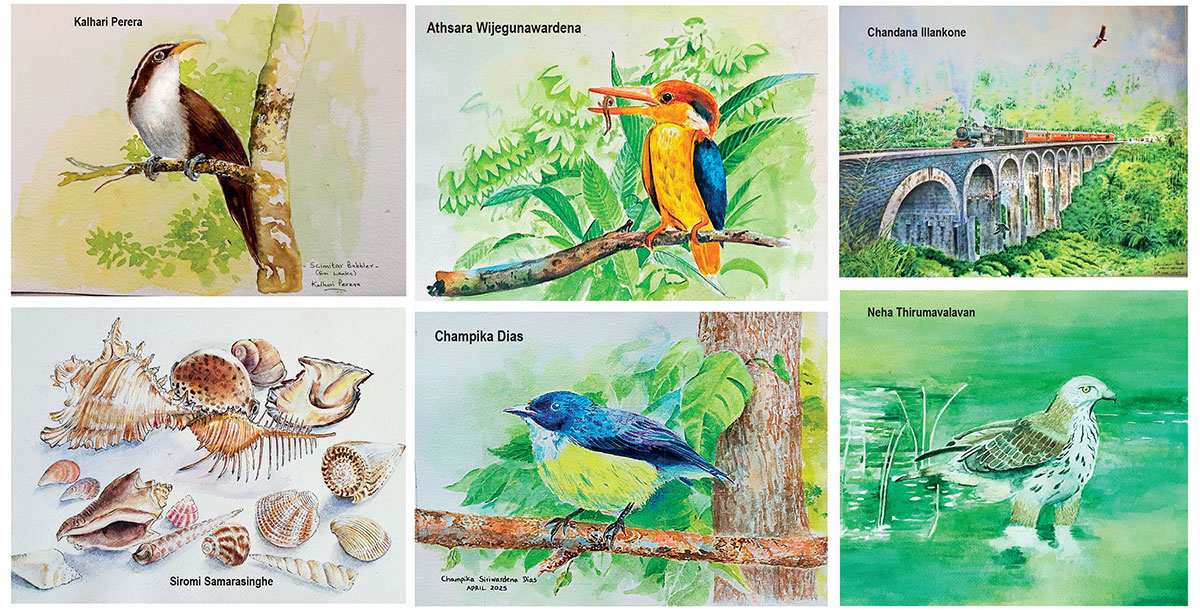
A new art exhibition, titled Spectrum ,will be held at the Lionel Wendt Art Centre on the 20th and 21st of June 2026, bringing together a collection of works by ten emerging artists.
Athsara Wijegunawardena
Neha Thirumavalavan
Dillai Joseph
Wasantha Siriwardena
Champika Dias
Nipun Dias
Dr. Prasanna Siriwardena
Kalhari Perera
Siromi Samarasinghe
Chandana Illankone
All ten artists have trained under the guidance of renowned Sri Lankan artist Royden Gibbs, and this exhibition marks an important point in their individual journeys.

Dr. Prasanna Siriwardena
Spectrum brings together a mix of styles, subjects and approaches, giving visitors a chance to experience a wide range of work in one place. The exhibition will include pieces in watercolors, soft pastels, oils and charcoal, reflecting both the discipline and personal direction of each artist. The work ranges from scenery and portraits to still life and studies of the human form, offering different ways of seeing and interpreting familiar subjects.
-
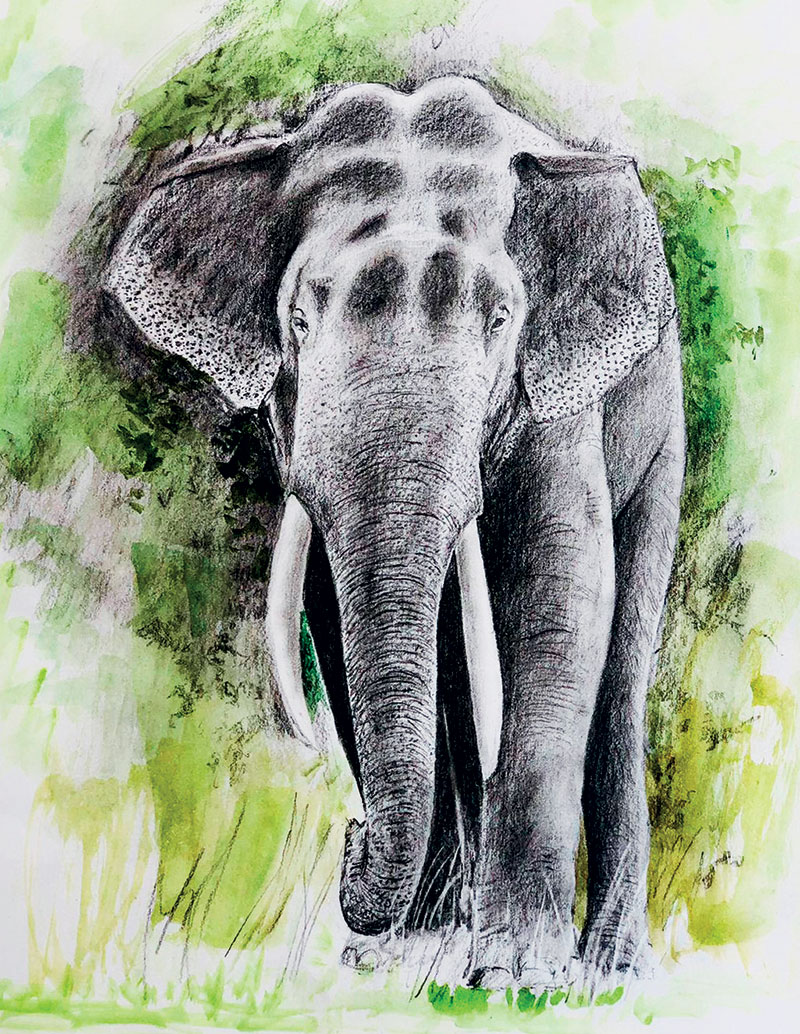
- Nipun Dias
-

- Wasantha Siriwardena
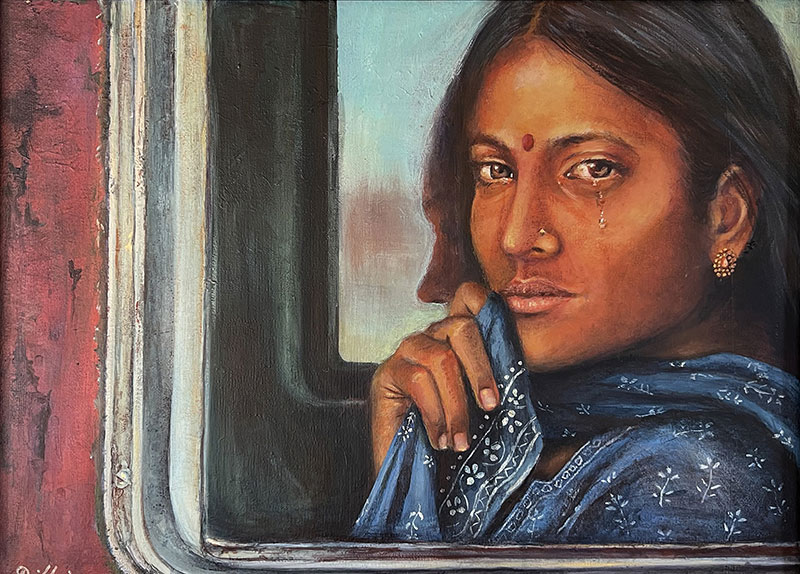
Dillai Joseph
Although they share the same mentor, each artist presents a distinct point of view. The result is a show that feels varied yet connected, with each piece carrying its own character and intent. It is this balance that gives Spectrum its identity.
The exhibition aims to support and highlight emerging talent within Sri Lanka’s art scene, while also creating a space where artists and audiences can connect. Visitors will find work that shifts between quiet observation and more expressive pieces, making it an engaging experience for both seasoned collectors and those simply interested in art.
Spectrum is expected to draw art lovers, collectors, students and members of the wider creative community. It also offers an opportunity to discover and support new artists at an early stage in their careers.
Open to the public over two days, Spectrum invites visitors to experience a range of work in a venue that has long been part of Colombo’s cultural landscape.

“Craving begets sorrow, craving begets fear. For him who is free from craving there is no sorrow; how can there be fear for him,” Dhammapada verse 216 states. The mental factor craving, Tanha in Pali, is central to Buddhist Teaching, as its ultimate goal is the cessation or extinction of it—tanhakkhaya. Even though Tanha is translated as craving here, it can sometimes mislead modern readers into thinking tanha only refers to extreme or physical addictions. Just as with any Pali term, it has broad meanings. Venerable Walpola Rahula describes it as “thirst” or unceasing wanting, one of the deep-rooted proclivities or latent tendencies (anusaya) of life (Rahula 1959), without which life as we know would not exist.
Even though the Buddha recognized this natural phenomenon two and a half millennia ago, it was only in the late 20th century that science took note of it and gave it a captivating term—the Hedonic Treadmill. The advantage of this empirical investigation to us Buddhists is that it provides a way to gain penetrative, experiential comprehension (anubodha) of this concept using the vernacular of this technology-savvy age—an alternative to struggling with the language of a bygone era.
These investigations have revealed that there are no hard-to-comprehend metaphysical or mysterious elements involved with this phenomenon; it is a biochemical process fundamental to sustaining life. What is more, an effort to grasp this concept would be well within the goals of Vipassana meditation described in the Sutta Pitaka, incorporating the four elements of investigation: body (kayanupassana), sensations (vedananupassana), mind (chittanupassana), and natural laws (dhammanupassana).
Vipassana and modern science
Vipassana meditation is an in-depth exploration of how humans perceive the world, gain knowledge, and interact with themselves and the environment. Knowing this with wisdom allows one to lead a harmonious way of life (samadhi), a condition conducive to curbing the “thirst” and achieving the Buddhist ideal. The goal of modern science is also to investigate life, but humanity has often used that knowledge to increase material wealth and comfort, providing only lip service to spirituality on the fringe.
An attitude that tends to ignore the consequences of wanting more and more – thirst, potentially endangering the planet. However, that does not prevent us from using scientific information as and aid or a tool to grasp Buddhist concepts. The scientific method bears parallels to the Buddhist approach: it is based on causality (paticcasamuppada), empirical verification (ehipassiko), systematic observation (meditation), and rejecting dogma and beliefs. The primary difference is simply the vocabulary used.
The process of perception: five aggregates
Our five external sense organs receive data (vedana) containing information on the environment: Eyes: receive light, Ears: receive sound, Skin: senses physical contact and temperature, Nose & Tongue: sense chemical properties of substances. The data received by the sense organs is transmitted to the brain, where it is registered as neural networks (sanna). Neural networks, which are interconnected groups of nerve cells (neurons) can be viewed as mind-readable QR codes.
The activity of the brain, or mind (mano), processes this data and converts them into actionable information (sankhara). Modern neuroscience and psychology have made great advances in understanding these processes at the molecular level. This process allows the individual to become aware of their environment, build an autobiographical memory or the notion of a self (atta), and take actions to protect and perpetuate life.
The Pali term vinnana refers to the collection of information committed to memory. Translating vinnana as “consciousness” can be confusing, as the latter often refers to all brain activities. All physical phenomena that sense organs encounter and the mental constructs (sankhara) are referred to as Rupa. This activity of mind forms the basis of all knowledge, representing the entire world as perceived by the individual. This process is what the Teaching refers to as the Five Aggregates (pancakkhanda). The critical takeaway is that the world we perceive is merely a mental construct. While an objective world exists, our sense organs have limitations in seeing it—a fact easily realized through the hundreds of illusions used for entertainment.
Evolution and emotion
The evolutionary purpose of this data processing mechanism is to enable living beings to respond to environmental factors for survival. The psychological and physiological state that arises prior to acting is called emotion. Primarily, emotions can be of three kinds: desire (loba) – seeing a new phone causes an urge to buy it, even though the current one works fine; aversion (dosha) – encountering a vicious dog triggers a “fight or flight” response; delusion (moha) or illusion – an unanswered message to a loved one triggers worry or speculation. Thus, tanha or thirst represents how we connect to the world in its entirety; it can be desire, aversion, and delusion, not merely simple greed. Consequently, these are natural phenomena beyond our immediate control, which are intended to sustain life. In other words, emotions are the forerunner to volitions or intentions, which the Teaching defines as kamma.
The biochemistry of craving
Emotions result from the interaction between the nervous system and biochemicals known as neurotransmitters and neuromodulators (e.g., dopamine, serotonin, epinephrine, GABA, glutamate, acetylcholine, and endorphins). Just as the Buddha’s simile of two bundles of bamboo supporting each other describes, these two processes are interdependent and co-arising. Every thought or emotional state corresponds to patterns of neural firing. When neurons fire, they release these chemicals into synapses, influencing how one feels and acts. This release perturbs the body’s normal balance, or homeostasis. Once an action is complete, these chemicals are reabsorbed, and the body returns to its baseline.
Return to baseline is essential for survival. For example, if we stay satisfied with just one meal forever, we could not sustain life. Nature has developed another mechanism to prevent us from being satisfied – we also habituate. In the case of dopamine, the brain adapts by reducing the response to the same stimulus. To get the same level of satisfaction with repeated experiences, the amounts of neurotransmitters needed keeps increasing. This leads to the cycle of craving and dissatisfaction—the Hedonic Treadmill. You “run” toward happiness on the treadmill, but it does not take you anywhere, leaving you in the same emotionally unsatisfactory state, wanting more and more.
Breaking the cycle
This explains why achievements and possessions do not bring permanent happiness, and lead to a cycle of struggle, addiction, crime, and other ills of society. For Buddhists, it also explains why we cling to meaningless rituals. The Dhamma captured this complex phenomenon in the Four Noble Truths: pleasant experiences are impermanent (anicca), leading to grasping (tanha) and unsatisfactoriness (dukkha). The remedy is the Eightfold Path that involves wisdom (panna), conduct (sila), and harmony (samadhi).
Neuroplasticity and the point of liberation
While we cannot stop the sense organs from receiving stimulation (vedana) and sending them to brain, the mind can be developed to prevent vedana from leading to tanha. This is the “point of liberation,” the seventh link in the paticcasamuppada formula. We may not have free will, but we have ‘Free Won’t’ or the ability to say no to the natural tendency to act upon stimuli. We can rewire our neural connections to do so. This ability can be cultivated by practice and repetition, and neuroscience refers to it as neuroplasticity—the brain’s ability to change with experience.
The natural tendency of the brain is to strengthen frequently used neural networks while weakening and eliminating lesser used networks and building new ones as needed. This is known as neural plasticity or rewiring the brain. As described in the Eight-fold Path, the way to weaken and eliminate dopamine-driven neural networks includes three aspects. First, the process leading to thirst must be understood. One must engage in sila – activities and thoughts that cultivate Metta: loving-kindness and goodwill, Karuna: compassion, Mudita: appreciative joy, and Upekkha: equanimity, emotional stability, calmness, and evenness of mind in the face of gain and loss, praise and blame, fame and disrepute, pleasure, and pain. That must be done with wisdom, ritualistic behavior does not strengthen the correct neural networks. These activities promote a “cocktail” of oxytocin, serotonin, and GABA, subduing the role of dopamine and helping us step off the Hedonic Treadmill. This leads to a tranquil state of mind and a harmonious existence – samadhi. Again, it is an interdependent, co-arising process that improves upon repetition. Using mind altering substances hijacks this process, thus the need for adhering to the Fifth Precept.
The goal of Vipassana is to understand this process and train the mind to say “no” to tanha. It is not just about sitting on a mat; it requires developing a lifestyle that maintains homeostasis or harmony, samadhi, at every moment. Pali term bhavana means the development of wisdom and insight. In modern vernacular – rewiring brain. This model must be assessed for its efficacy by the individual and realize the benefits by themselves –ehipassiko; knowledge without practice does not work. According to what the Buddha taught, that is the path to cessation or extinction of craving – tanhakkhaya, the supreme goal.
by Geewananda Gunawardana, Ph.D. ✍️
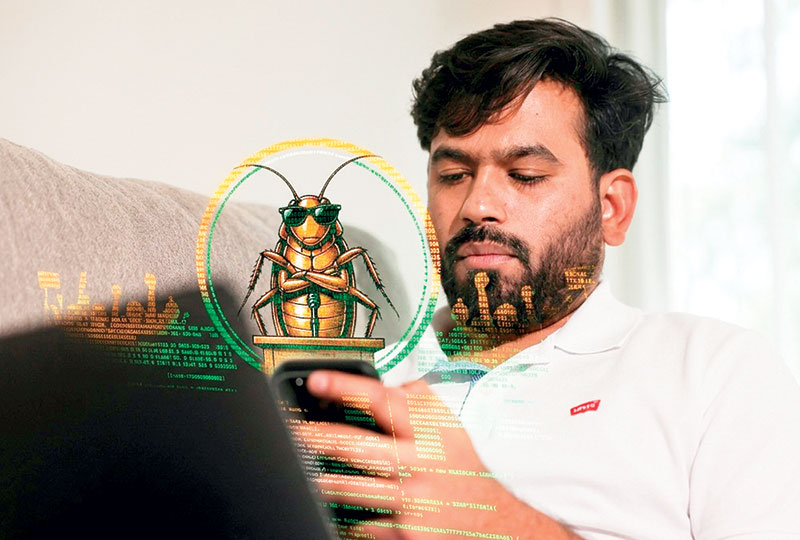
No matter how it is framed or softened in institutional language, what a section of India’s judiciary once said by comparing unemployed youth to “cockroaches” remains unacceptable in any serious democratic order. Not because judges are not entitled to critique society, but because language from institutions that claim moral neutrality does not float above society. It sinks into it. It becomes sediment in public consciousness, especially in societies already saturated with frustration, inequality, and institutional fatigue.
When unemployment is widespread, when entry into stable work is mediated by examinations that fail, leak or collapse in public trust, and when entire cohorts of educated youth experience a prolonged delay in adulthood, words from authority do not merely describe reality. They define it. This is precisely what, in earlier stages of human civilization, was done in the name of casteism, slavery or tribalism, to justify exclusion and domination.
Instead of confronting these moral and structural failures, modern political authorities tend to re-engineer and repackage social fatigue in humanity into new forms.
Unemployment in most societies is not primarily a moral failure of individuals. It is an outcome of structural arrangements including uneven access to opportunity, concentration of economic power, credential inflation, and political economies that distribute growth unevenly. In that sense, the language of blame directed at youth functions less as diagnosis and more as displacement. It relocates systemic dysfunction onto those who experience it most acutely. The result is not clarity but distortion. Systems that fail to absorb their own educated populations often resort, consciously or otherwise, to rhetorical simplification. The unemployed become “unmotivated”, the critical become “disruptive”, the protesting become “misguided”, and in more extreme rhetorical registers, they become something less than fully human.
It is in such conditions that movements like the so-called Cockroach Janata Party in India emerge, not as anomalies but as predictable expressions of political pressure under digital acceleration. Whether one interprets it as satire, protest or early-stage political organization, its significance lies less in its formal structure and more in what it reveals about the communicative breakdown between institutions and a generation that experiences itself as structurally unaddressed. The internet does not create this anger. It aggregates it, compresses it and returns it in forms that are often aesthetically simplified but socially legible.
The claim that such movements are purely manufactured or externally orchestrated misunderstands how contemporary political energy forms. Coordination can exist at the margins, amplification can be strategic, and actors with an interest in shaping discourse may certainly engage with viral moments. But the deeper substrate is usually more mundane and more uncomfortable. It is widespread grievance seeking narrative form. The temptation to assume hidden orchestration is itself politically revealing. It reflects a discomfort with the idea that large-scale dissatisfaction might emerge organically from lived experience rather than being directed by identifiable hands. In many modern democracies, legitimacy is easier to defend against conspiracy than against the accumulation of ordinary disappointment.
At the same time, it would be equally naïve to treat viral political identity formation as ideologically neutral. Digital environments reward compression. Complex institutional critique is reduced to symbols, metaphors and repeatable identities. Satire becomes a vessel because it allows entry into political speech without requiring institutional permission. What begins as irony often stabilizes into identity because identity is what platforms amplify most efficiently. A label, even a derogatory one reclaimed, can become a container for diffuse frustration. That transformation is not unique to any one country. It is a structural feature of networked political communication.
The Arab Spring did not begin as a unified programme but as accumulated social frustration expressed through singular catalytic events. The Occupy movement did not begin with a legislative agenda but with a symbolic framing of inequality that spread faster than its organizational capacity.
Modern democratic systems face a particular paradox in this respect. They are structurally dependent on expression but institutionally resistant to volatility. They require citizens to speak, but they struggle when speech becomes rapidly collective, emotionally charged and difficult to stabilize into negotiable policy terms. The result is a recurring cycle of emergence, amplification, institutional alarm, partial engagement, and eventual dissipation or transformation. In digital democracies, this cycle is compressed into shorter and more unpredictable intervals.
The question of whether such movements are “serious” or “satirical” becomes increasingly irrelevant at the moment they begin to generate political attention. Satire does not remain outside politics once it becomes a site of mobilization. It enters the system and begins to exert pressure regardless of original intent. What matters is not whether participants initially intended political consequences, but whether the system now treats them as politically consequential actors. In that transition, ambiguity itself becomes a form of power.
There is also a deeper institutional issue at play. The credibility gap between formal democratic language and lived experience becomes more visible under such conditions. When institutions describe stability while individuals experience precarity, when official narratives emphasize growth while access to its benefits feels uneven, and when mechanisms of accountability appear slow relative to the speed of public anger, language itself begins to lose authority. In that vacuum, alternative vocabularies emerge. Some are constructive, some are chaotic and some are deliberately provocative. All of them, however, are attempts to reassert interpretive control over reality.
The fear that such movements might be externally engineered often reveals less about the movements themselves and more about the anxieties of established political systems confronted with unpredictable forms of mobilization. External influence is not impossible in modern information environments, but it is rarely sufficient to create sustained mass resonance without pre-existing conditions of receptivity. Influence requires soil. Without it, even sophisticated messaging fails to take root.
What remains consistent across contexts is that youth-led political expression tends to intensify precisely at the point where institutional pathways appear blocked or unresponsive. This is not unique to any one democracy. It is observable across systems that combine mass education with limited economic absorption capacity. The symbolic forms differ, the languages differ, but the underlying pattern remains structurally similar. A generation tests the boundaries of participation and discovers friction.
To describe this as collapse would be inaccurate. To describe it as manipulation would be incomplete. It is better understood as stress. Democratic systems absorb more communicative energy than their institutional architectures were designed to process. In such conditions, satire becomes politics, politics becomes performance, and performance becomes a site of genuine contestation over meaning.
The uncomfortable conclusion is that democracies do not only fail through repression or corruption. They also strain under their own communicative openness. The more voices are allowed, the more difficult it becomes to distinguish between signal and noise, between movement and moment, between grievance and programme. And yet it is precisely within that indistinction that new political forms begin to take shape.
We are not outside this process observing it objectively. We are inside it, producing it, reacting to it, and being shaped by it. And in this distorted order of meaning—where language both reveals and obscures, where satire becomes structure and structure becomes fatigue—we are not merely citizens of stable systems evaluating disruption from a distance. We are participants in a continuous instability of interpretation, trying to locate truth in environments that reward speed over clarity.
We, in this distorted world order and disputed democracies, are shaped again and again by the logic of cockroach-like existence. Cockroaches do not spread through resistance against an enemy, but through rapid reproduction and adaptation to conditions that outlast attempts at control. Their continuity is not survival in a heroic sense, but persistence through cycles of collapse and renewal, allowing successive generations to emerge in similar forms, shaped by the same constraints and environments. Just like our votes.
by Nilantha Ilangamuwa

Prez in the dock

Climate compliance pressure mounts on Lankan businesses

Serenity Tissa; Gateway to southern Sri Lanka’s timeless heritage

Sabina Yousaf shines as the face of Tiesh

Fresh look and fresh formulas

Lamabadusuriya ranked No. 14 in international Scrabble rankings

‘Dates have the highest sugar content to fight Coronavirus’

Sunday Island 27 December – Headlines

#SundayIsland 17th December – Headlines

Sunday Island – 28th March

Sunday Island Headlines – 21 March

Sunday Island – 21st February – Headlines
-

 News5 days ago
Lankan duo emerge winners in Latin dance championship held in Blackpool, UK
-
 Business6 days ago
IMF’s unstated rate:Sri Lanka’s $695m loan costs about 5.33% per annum
-

 Latest News3 days ago
Kusal Mendis, Pathum Nissanka, bowlers put Sri Lanka 1-0 up
-

 News3 days ago
New US tariffs proposed on 60 countries, including Sri Lanka
-

 Business6 days ago
Sri Lankan scientist-innovator Milinda Edirisinghe introduces AI-integrated gem testing system to gemological world
-

 Features2 days ago
Power crept into the Sangha and is now tearing it apart
-
 News6 days ago
UNP challenges NPP move to amend Vihara – Devalagam Act
-

 News5 days ago
Sri Lankan teen killed in Chennai clash; three arrested