
Opinion
Comprehending “Consumer Strategy”: Myriad memories of a Mentor


Ten years have passed so rapidly. It reminds me of the late Prof. Uditha Liyanage, my management mentor. He was a sage of our age, in touching many minds as a marketing maestro, left us on 10 August 2015 at the age of sixty-one. There was a valued volume titled, “Consumer Strategy,” published posthumously containing myriad thoughts of my mentor. Today’s column is a reflective revisit of his contributions.
The Postgraduate Institute of Management has posthumously published his final contribution, “Consumer Strategy” in 2016. We renamed the PIM library as “Prof. Uditha Liyanage Memorial Library” in honour of him. In August, 2019, we launched “Prof. Uditha Liyanage Memorial Oration” as a biennial event. My attempt is not to repeat his accolades but to reflect on his renderings of brilliance.
I still recall how the alumni of the Postgraduate Institute of Management (PIMA) together with the Sri Lanka Institute of Marketing (SLIM) and the Chartered Institute of Marketing (CIM) organised an event that revolved around the book, “Consumer Strategy,” a collection of articles by Prof. Liyanage published posthumously. After a brief recollection of reminiscent memories of Prof. Liyanage by Dr. Wickrema Weerasooria, Deepal Suriyaarchchi provided a comprehensive review of the book. Next was a panel discussion featuring Eardley Perera, Dr. Asanga Ranasinghe, the current Director of PIM, and me, as the then Director of PIM. It was heartening to see my idea of a collaborative event involving PIMA, PIMA, SLIM, and CIM becoming a meaningful and memorable reality.
At the panel discussion, I mentioned that I am not competent enough to comment on this masterpiece and suggested offering a non-marketer’s perspective. Ironically both me and Dr. Asanga Ranasinghe ( then President of CIM) were in the same MBA batch of PIM, being students of Prof. Liyanage. On the other hand, Eardley Perera, a pioneering marketeer, had been a teacher of Prof. Liyanage in the MBA programme of PIM.
Deepal in his emotional thought sharing identified Prof Liyanage as a marketer, strategist, leader, and a philosopher through his writings in the book. He meaningfully linked the contents of the book to the cognizance of Prof. Liyanage’s life. It reminded me the way I wrote the forward to the book stating that “Consumer Strategy” is a compilation of comprehensive articles written by perhaps the most conceptually rich person I have ever met. His ingenious ideas have immensely inspired us, in inviting us to be intellectually enriched and interactively engaged. I am glad that I had the privilege of being mentored by him but indeed sad that it could not be continued.
The twenty articles contained in this volume are all selected by Prof. Uditha Liyanage himself some time ago. They cover a wide range of topics in the broad domain of management, with specific emphasis on marketing and strategy. The depth of conceptual appeal and the breadth of concrete application appear as the hallmark of the veteran author. Variety of valued marketing models developed by Prof. Liyanage is included in this volume, inviting the readers to think afresh, instead of blindly transplanting the western marketing models. Similar is true for strategy as well.
We were keen on launching Consumer Strategy together with a felicitation ceremony for this fascinating human being. Destiny decided otherwise. Nevertheless, Prof. Uditha Liyanage the author will continue to live in our minds through his myriad insights. We at PIM committed ourselves in carrying his legacy forward. Publishing Consumer Strategy and jointly organising an evening event to discuss the contents of it are significant steps in that solid endeavour.
Contents Revisited
As it has always been, Prof. Uditha Liyanage invites us not just to read the book, but to recognise the key themes, reflect on the main ideas, and relate the concepts covered to the current challenges. It should reinforce the way one professionally applies the key lessons, in playing a managerial and leadership role in one’s workplace. In essence, knowing should lead to doing and that in turn will deliver results.
“Consumer Strategy” essentially revolves around two key themes, viz. consumer and strategy. Among the articles related to consumer aspect in the broad spectrum of marketing, Marketing Strategy and Society: From CSR to SRB is an interesting one. Prof. Liyanage clearly differentiates philanthropy from strategic Corporate Social Responsibility (CSR). We need this clarity, as I saw in the judging process of last National Business Excellence Awards, where there is often confusion between the above two terms.
Among the other insightful papers, “Brand Marketing: From 1P to 6Ps”, “Five Hats of the Consumer”, “Goods – Services Dichotomy: The Place of the Tangibility Construct”, “Towards a Positioning Strategy for Tourism in Post-war Sri Lanka” and “Consumer Behaviour and the Anatomy of a Brand” appear prominently. Also, “Profiling the Sri Lankan Consumer,” ” A Customer Value Typology: Beyond the Functional – – Emotional Dichotomy” also offer many insights.
Prof. Liyanage’s conceptualization of “Sri Lanka’s New Mod-tradi Consumer” is indeed an interesting one. “The harmonization of the traditionalist and modernist forces gives rise to postmodernist tendencies in the Sri Lankan marketplace,” observed he. “A mis-match of the two, produces either an overly traditional, and therefore, an old fashioned and obsolete proposition or a hyped rendering of an overt western and modernist proposition.”
“The challenge of today’s marketer is to sense the emerging postmodernist propensities of the emerging consumer and develop propositions and products that avoid the two extremes of being either overly traditionalist or modernist.” says Prof. Liyanage. “Such an endeavour must be based on the recognition of the points of confluence and fusion that appeal to a new breed of postmodern consumers.” “This in turn would be possible only through the deep-going understanding of the psyche and the behaviours of the new and emerging Sri Lankan postmodern consumer,” he concludes.
Strategy Focus
Prof. Liyanage gave a new twist to the often hacked term strategy. His bold arguments are present in the article, “Planning is not Strategy: Big 5 Strategy Questions”.
Strategy is often confused with planning. The many definitions and delineations of strategy, which highlight one or more aspects of strategy, while ignoring the others, have led to a state of confusion as to what strategy really is. This is evident in the content-analysis of the vision, mission, and value statements of a number of companies. Not only were the analyzed company – specific statements vague and general, they were also unrelated to one another. Specifically, the espoused values were generic and terminal in nature and unrelated to the tasks and goals at hand. (Liyanage, 2015)
In order to avoid the confusion in the minds of practitioners, and as reflected in the literature itself, Prof. Liyanage proposes a Strategy Quadrant, consisting of Stand, Standing, Shared values & Supportive Resources and Capabilities, and Steps.
“Seeing strategy as action is also flawed. “Our strategy is to merge …,” and “….to double our research and development expenditure” are commonplace expressions which tend to pass-off as strategy,” observes Prof. Liyanage. “Putting the planning cart before the strategy horse is a blunder that bedevils many an organization in its attempt to hone strategic action,” he opines.
In a more applied manner, Prof. Liyanage has elaborated on how strategy execution took place on the battle front. This article is based on the content analysis of two comprehensive post-war presentations made by military experts. The way he compares the adaptation of suitable military strategies to marketing is indeed insightful.
“Don’t be an “arm chair” leader but a “behind the wheel” leader! When the leader has superior knowledge of a particular area of activity, not making full use of it in his direct engagement with operations, is a waste of a vital resource. The often- espoused leader-role hinders such a direct approach. (Liyanage, 2015)
Among the other interesting articles related to strategy, “The Myth of Pay-for-Performance” and “In Search of Resilience: From Pilot to Architect” also offer salient points to ponder.
Letting a turbulent environment get the better of you is fraught with the prospect of extinction. Responding to turbulence with resilience is the way forward. The Darwinian approach of adaptation as reflected in the rebound cycle is natural. Its intent is to get through the crisis and emerge unscathed as far as possible. A more Singarian approach, characterized by an internal locus of control as reflected in a renewal cycle, is to continually renew oneself in order to stay ahead of unfolding patterns and the trajectory of turbulence (Liyanage, 2015).
Way Forward
We at PIM are indeed proud of our profound management legendary and would continue to preserve his intellectual capital for the generations to come. It is encouraging to note that Dr. Asanga Ranasinghe and three have joined together in providing us a taking the seminal work of Prof. Liyanage to a new level with their recent publication titled, ” Contemporary Sri Lankan Consumer.” They have given due respect to Prof. Liyanage’s seminal work and expanded the approach which is rich with current contextual relevance.
“A life well-lived is a life never forgotten,” This is very true for our marketing maestro, Prof. Uditha Liyanage. More than a mere marketer, I saw the serene spiritually of a daily-meditating and a dearly caring human being, in him. We will respectfully remember him with the next biennial oration planned for 3 September, 2025, delivered by Dr. Harsha Cabral, renowned legal luminary, and a friend of the late Prof. Liyanage. I am eagerly looking forward to it.
Ajantha Dharmasiri, a Senior Professor in Management, and Independent Non-executive Director, can be reached at ajantha@pim.sjp.ac.lk, ajantha.dharmasiri@gmail.com or www.ajanthadharmasiri.info.)
by Ajantha Dharmasiri ✍️
Senior Professor in Management, Postgraduate Institute
of Management

Opinion
Bleeding Treasury: Multi-billion rupee liquor sticker scam and urgent need for systemic reform


by Prof. Asoka. S. Seneviratne
For a nation navigating the perilous waters of economic recovery, fiscal discipline is not a mere bureaucratic preference, it is a matter of absolute national survival. Every single rupee leaked from the state Treasury directly compromises public services, infrastructure, and the socioeconomic welfare of millions of citizens. Yet, while the public bears the burden of high taxation, a monumental revenue hemorrhage has been silently occurring at the heart of the state’s revenue framework.
The security sticker system, ironically introduced by the Department of Excise to curb tax evasion and regulate alcohol production, has evolved into an unprecedented conduit for systemic fraud. Recent disclosures by the Parliamentary Committee on Public Finance (COPF) and the Committee on Public Accounts (COPA) have laid bare a terrifying reality: a multi-billion rupee scam that has starved the state treasury of critical revenue while enriching an entrenched network of colluding officials, foreign contractors, and unscrupulous local distilleries. This article deconstructs the anatomy of this institutional disaster, exposes those who turned a blind eye, and outlines the radical legislative and structural overhaul required to permanently safeguard our national revenue.
Shocking Scale of Treasury Revenue Leakage
The financial dimensions of the liquor security sticker fraud are staggering. According to parliamentary oversight committee revelations, the calculated revenue leakage resulting from the circulation of counterfeit and illegally diverted genuine security stamps has reached an estimated tens of billions of rupees annually. To contextualize this loss for the public, legislative watchdogs noted that the volume of state funds evaporating through this single loophole is equivalent to financing multiple massive national health infrastructure projects on the scale of the Suwaseriya ambulance service.
When an illicitly produced or unrecorded bottle of liquor enters the formal retail supply chain bearing a compromised sticker, the treasury loses the entirety of the heavy excise duty levied on it. For every bottle of standard spirits pushed through this parallel economy, thousands of rupees bypass the state completely and flow straight into the pockets of criminals. This is not a minor leak; it is a macroeconomic catastrophe.
The Anatomy of an Exploitative Procurement Blueprint
The foundation of this multi-billion rupee hemorrhage was laid not in illicit distilleries, but within the fine print of a deeply compromised state procurement contract. The state entered into a long-term agreement with an external vendor, Madras Security Printers (MSP), to supply physical tax stamps and digital authentication features. Under the terms of this active contract, which runs until January 2, 2027, the state has been paying an inflated rate of approximately US$ 7.99 per 1,000 digital markings—inclusive of port and customs levies.
The technical absurdity of this arrangement was laid bare by COPF: over 80% of local alcohol manufacturers have transitioned away from physical paper stickers to digital markings printed directly onto bottles during high-speed production. Despite the total elimination of physical paper, printing, and shipping costs, the state continues to pay the maximum contract rate for a digital label that inherently costs fractions of a single cent to generate. The treasury is effectively subsidizing an extortionate profit margin for an external vendor under the guise of security procurement.
Deliberate Inaction: Who Ignored Warning Signs?
A fraud of this magnitude cannot survive in a vacuum; it requires the oxygen of institutional indifference. Multiple administrative layers systematically ignored glaring red flags for years. When the initial procurement process was floated, the Presidential Secretariat’s Procurement Appeal Board intercepted the project and ordered a complete recall due to glaring technical and procedural irregularities. Yet, administrative bodies willfully bypassed these warnings, re-tendering and locking the state into a contract with the exact same questionable entity.
Furthermore, international watchdogs and civil society groups had repeatedly raised alarms regarding the specific foreign contractor’s operational history, citing severe software manipulation disputes, security breaches, and counterfeit controversies in developing nations such as Kenya, South Sudan, and Bangladesh. By turning a blind eye to these verified international precedents, the high-level decision-makers who finalized this framework effectively left the keys to Sri Lanka’s revenue vault in compromised hands.
The primary regulatory bulwark against liquor tax evasion is the Department of Excise, yet its leadership presided over a total collapse of operational oversight. In an era dominated by rapid technological advancement, oversight committees exposed a staggering vulnerability: the Excise Department completely lacked an integrated, automated backend database system to cross-reference and validate the serial numbers of stamps issued.
By keeping the monitoring framework fundamentally manual, rudimentary, and disconnected, the department created the perfect blind spot. Even worse, the physical QR codes printed on the labels were found to be non-functional for field verification by standard smartphones, making point-of-sale authentication an impossibility. This technical failure ensured that whether a sticker was poorly counterfeited or illicitly leaked from an official batch, it could circulate in retail outlets with complete impunity.
Systemic Inside Collusion and Forensic Truth
Recent law enforcement interventions have shattered the narrative that this scam is merely the work of isolated, low-level bootleggers. Following extensive raids conducted by the Criminal Investigation Department (CID) at illicit distribution hubs, such as the massive bust in Malabe where thousands of liters of untaxed alcohol were seized, forensic teams uncovered a dark truth. Many of the “fake” security stamps affixed to the illegal bottles were not counterfeits at all; they were authentic, officially generated high-security labels.
Arrested suspects and trade union whistleblowers have detailed a deeply entrenched criminal nexus inside the regulatory apparatus. Corrupt excise officials reportedly coordinated directly with sub-agents to divert genuine sticker batches straight into illicit blending plants. There are even documented allegations of senior executives actively calling field teams to abort ongoing raids on compromised retail outlets, and in some cases, transporting seized illicit stocks into regional offices to manually paste genuine stickers after the fact to contaminate legal evidence.
Abolishing the Corrupt “Spot Fine” Loophole
For decades, the wealthy masterminds behind revenue fraud have exploited a massive legal loophole embedded within antiquated sections of the Excise Ordinance: the compounding of offenses via “spot fines.” Under this archaic system, when a prominent distillery or major retail distributor is caught manufacturing or selling untaxed liquor with fraudulent stamps, the department frequently settles the matter quietly behind closed doors through an administrative fine.
This spot fine framework must be completely and unconditionally abolished. It strips the judicial system of its jurisdiction and allows corporate criminals to view state penalties as a minor, predictable cost of doing business. A multi-billion rupee assault on the state treasury cannot be settled with an administrative slap on the wrist. Every instance of sticker fraud must be automatically escalated to the Attorney General’s Department for mandatory criminal prosecution, eliminating the arbitrary discretionary powers currently weaponized by corrupt bureaucrats to shield their corporate conspirators.
A Mandate for Drastic Punishments: Confiscation and Mandatory Prison
To break the back of these deeply entrenched syndicates, the state must introduce an overwhelming “fear factor” into the law. Populist rhetoric and minor financial penalties have failed. The legislative framework governing both the illicit liquor industry and the narcotics trade must be overhauled to introduce draconian, non-negotiable statutory punishments (see graph 1).
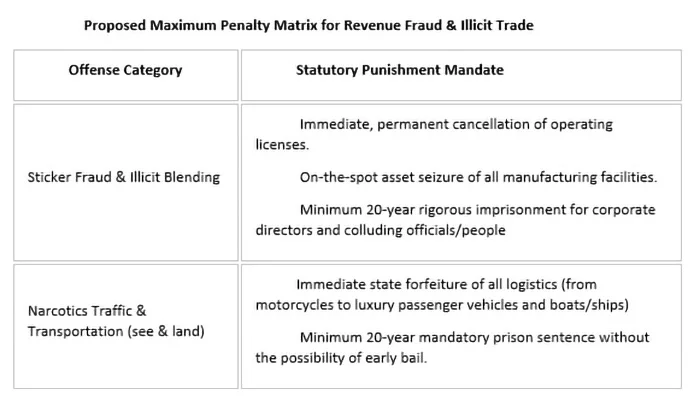
When an illicit operation is raided, the state should not wait for a decade of exhausting litigation to freeze assets. The law must allow for the immediate, on-the-spot physical confiscation of all manufacturing infrastructure, land, distribution vehicles, and liquid capital involved in the crime. Combining this immediate economic destruction with a mandatory 20-year minimum prison sentence will fundamentally alter the risk-reward calculus for these criminal syndicates.
It is essential that the above-mentioned penalties be imposed on those who possess illegal firearms and on individuals involved in their unlawful use, possession, or distribution.
Tracing the Spoils: Wealth Investigations and Absolute Asset Forfeiture
The corporate directors, high-ranking state officials, and external collaborators who orchestrated this scam did so driven by unadulterated greed, funneling their illicit gains into luxury real estate, high-end vehicle fleets, and hidden offshore accounts. True justice demands that the prosecution extend far beyond the physical boundaries of the distilleries.
Under the Prevention of Corruption Act and modern anti-money laundering statutes, the state must launch aggressive, retroactive wealth investigations into every single public official, technical evaluation committee member, and excise executive associated with the liquor sticker procurement and enforcement timeline. If an official’s lifestyle, property holdings, or family assets fail to align with their legitimate state-salaried income, those assets must be frozen under public property laws and permanently forfeited to the treasury. Jail time is insufficient if the perpetrator is allowed to return to a hoard of hidden wealth upon release.
Global Best Practices
The systemic vulnerabilities paralysing Sri Lanka’s revenue collection are entirely preventable, as demonstrated by the stringent protocols enforced in developed jurisdictions. Countries like the United Kingdom, Germany, and Singapore do not rely on disconnected, manual validation systems or unchecked external monopolies to collect excise duties.
* Integrated Digital Traceability:
Developed nations deploy advanced, state-owned encrypted track-and-trace networks. Every bottle is assigned a unique, cryptographically secure digital identifier at the moment of manufacture, which is fed directly into a centralized blockchain or real-time ledger managed directly by the state’s central revenue authority, completely bypassing third-party contractors.
* Zero-Tolerance Enforcement Models:
In these jurisdictions, the discovery of a single unrecorded or falsely authenticated product results in the immediate, automated shutdown of the entire facility, multi-million dollar corporate forfeitures, and immediate criminal indictments for corporate directors.
* Independent Oversight:
Revenue departments are audited by completely independent anti-corruption bodies operating outside the ministry’s hierarchy, rendering internal bureaucratic cover-ups virtually impossible.
Uplifting Excise Department:
Architecture of True System Change
A genuine “system change” requires that we simultaneously clean out corruption and completely modernise our institutional infrastructure. The Department of Excise must undergo (i) a comprehensive operational evolution, (ii) matching the standards of modern global revenue authorities.
This transformation must begin with complete digitalisation. The entire department must be integrated into (i) a single Revenue Administration System, (ii) creating a real-time, (iii) transparent data link between the manufacturer, (iv) the customs point, (v) the department’s operations room, and (vi) the Inland Revenue Department. Field officers must be equipped with secure, state-encrypted mobile devices capable of instantly validating digital bottle markings on retail shelves. Furthermore, the human resource structure must be professionalized—merit-based recruitment, independent performance scorecards, and high technical qualifications must completely replace political appointments and arbitrary promotions, building an institution where integrity is structurally guaranteed.
The multi-billion rupee liquor security sticker scam is a stark warning of the catastrophic dangers of institutional decay. It is a textbook case of how flawed procurement, technical loopholes, and insider collusion can combine to systematically drain the lifeblood of our national economy. Sri Lanka can no longer afford to sustain these parallel criminal economies while honest citizens bear the brunt of national recovery.
The upcoming expiration of the current supplier contract on January 2, 2027, presents a critical, unmissable window for absolute reform. The government must seize this moment to dismantle the failed physical sticker framework, bypass exploitative contractor monopolies, and transition to a state-owned, transparent digital tracking architecture. Simultaneously, the legal system must act with uncompromising severity—abolishing spot fines, enacting mandatory 20-year prison sentences, and aggressively liquidating the assets of every official and corporate executive who participated in this betrayal of public trust. The eyes of the nation are wide open, and the demand for real, structural accountability can no longer be ignored.
(The writer served as the Special Adviser to the Office of the President of Namibia from 2006 to 2012 and was a Senior Consultant with the UNDP for 20 years. He was a senior economist with the Central Bank of Sri Lanka (1972-1993). He can be reached at asoka.seneviratne@gmail.com.)
by Shiran Illanperuma
Back in 2022, when the Sri Lankan economy was circling the drain, the economics establishment used the term ‘voodoo economics’ to describe policies such as the 2019 tax cuts and the Central Bank financing of the budget deficit – what is popularly called money printing – which were considered to be the proximate causes of the crisis.
In the English language, the term ‘voodoo’ is synonymous with savagery and superstition – it evokes imagery of dark-skinned natives dancing around a bonfire, performing irrational rituals. This is an imagery we have learned from Hollywood and Western media. In fact, the word voodoo is steeped in a racist and colonial history.
Voodoo is an English corruption of the word vodun, which means ‘spirit’ or ‘deity’. It may be similar to the Sinhala word yaksha or yaka. During colonialism, Europeans enslaved millions of West Africans and brought them to the Caribbean to work on sugar plantations. Their labour provided the finances for the Industrial Revolution.
These slaves – from the Fon, Ewe, Yoruba, and Kongo peoples of Africa – had their own indigenous spiritual and philosophical systems. Even as slavery dehumanised them, they held on to their beliefs in whatever small ways they could. Many camouflaged their gods and beliefs through Catholic saints and imagery. Throughout the African diaspora, especially in places like Haiti, this belief system became known as voodoo.
Think of that history next time you hear the term voodoo economics. Remember that plantations came to Sri Lanka after slavery was outlawed in the Caribbean. But in fact, the labour practices in Sri Lankan and Caribbean plantations were not that different. The treatment of the indigenous peasants in the process of land acquisition, was not that different. Voodoo is, in some way, part of our history too.
Mainstream Economics Miseducation
Economists tell us that the cause of the 2022 crisis was that the people were deceived by voodoo economics. This is not to defend the short-sighted economic policies of that government, but to point out that the longer-term structural crisis of Sri Lanka’s colonial economy has been ignored. The spectre of voodoo economics became a convenient way to discredit anything that challenged the cookie-cutter prescriptions of neoclassical economics.
In a sense, it was the economics establishment’s way of absolving itself from blame – it is not mainstream economics education, but the lack of it, that is to blame. The solution was not to change the prescription but to increase the dosage.
Starting this year, the Ministry of Education plans to roll out a syllabus on Entrepreneurship and Financial Literacy from Grades 6 to 11. The syllabus is about personal budgeting, digital banking, tax literacy, and micro-business management. It is basically a self-help manual. There is nothing in this syllabus about production.
What are the economics of the production of rice, our national staple? What are the economics of the garment sector’s supply chains. How are labour contracts between workers and employers negotiated? These are not questions the syllabus is interested in. The economy as a social process, and a system of social relations, does not exist. We are all entrepreneurs in waiting.
Similarly, the Central Bank of Sri Lanka has a Financial Literacy Roadmap, which is based on a Financial Literacy Survey. According to the survey, only 58% of Sri Lankans are financially literate. That implies that 42% of Sri Lankans are financially illiterate. It’s a polite way of saying they are stupid, uneducated, and irresponsible. It is also a subtle way of placing personal blame for structural issues. Why are you poor? Well obviously, it’s because you have misbehaved, you have been irresponsible.
What mainstream economics tells people about their poverty is not so different from what the IMF, the World Bank, and the industrialised countries tell the poorer nations. You are in debt because you have misbehaved, taxed too little, and printed too much money. You have been corrupt – as if there is no corruption in the United States, the European Union, and Japan.
It’s a strange assertion. Last year, the United Nations Conference of Trade and Development (UNCTAD) published landmark report titled ‘World of Debt’. Consider the following statistics:1
1. Public debt in developing countries is growing at twice the speed as developed countries.
2. Borrowing costs are 2 to 5 times higher for developing countries than developed ones.
3. 3.4 billion people, across 46 developing countries, live under governments that spend more on interest payments than on healthcare and education (Sri Lanka is one of those countries – around 50% of the government’s budget is for debt servicing).
Is it feasible and rational that all these 3.4 billion people have been plunged into debt because of irresponsibility and corruption? Is it a strange coincidence that all these 3.4 billion happen to be black and brown people in the Global South? Or, is there something more fundamentally wrong with the structure of the global economy? Is there a historical legacy that has not yet been overcome?
Reclaiming Sri Lankan Economics
The year 2025 marked 75 years since the birth of modern Sri Lankan economics. Not a single economics department in this country, not a single professional or students association, celebrated this milestone. It is not something that is memorialised or written in history books.
To explain why 2025 should be considered the 75th anniversary of Sri Lankan economics, let us first revisit that conjuncture:
* In 1948, Sri Lanka received ‘flag independence’, graduating from British colony to dominion status.
* In 1949, the Gal Oya project, the first major post-independence infrastructure project, began. The contract for that was awarded to an Idaho-based US company called Morrison-Knudsen.
* Also in 1949, US economist John Exter wrote a report which was tabled in parliament and led to the creation of the Central Bank of Sri Lanka.
Exter himself became the first governor of the central bank.
· In 1950, the Sri Lankan rupee was devalued 30% against the US dollar and the CBSL began its operations.
· Also in 1950, Ceylon joined the IMF and World Bank – two organisations headquartered in Washington DC, whose policies are directed by the US Treasury Department.
In fact, what we call independence was actually a handover from the English to the US. Colonialism was replaced by what Ghana’s first president, Kwame Nkrumah, called neocolonialism – a system of indirect control using primarily economic rather than political and military means.
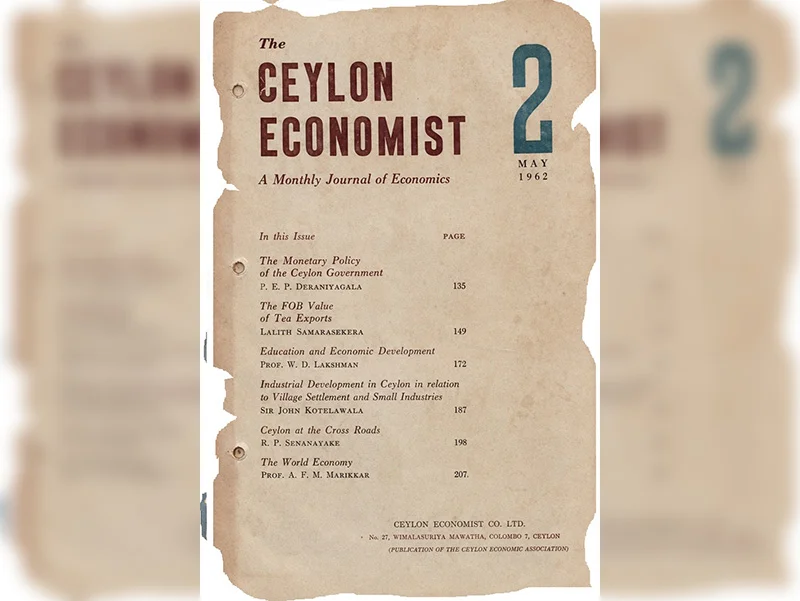
It is in this milieu that, in 1950, Sri Lanka’s first economics journal was published – the Ceylon Economist. It was an attempt by the first generation of the Ceylonese intellectuals to find solutions to our own economics problems based on our own analysis of our conditions. Sadly, many of our own university professors and students hardly reference these giants, or that journal.
The contributors to the Ceylon Economist included figures such as F. R. Jayasuriya, G.V.S. De Silva, N. M. Perera, P. Kandiah, Gamani Corea, S.A. Wickramasinghe, S.B.D. De Silva, Philip Gunawardena, and others. These individuals were not simply academicians looking to publish papers or gain tenure. They were movement leaders and institutionalists, steeped in practical action. They were committed to building up a nation from the ashes of colonialism. They had the confidence to stand up and assert their intellectual sovereignty.
What happened to that spirit? To the spirit of the Ceylon Economist? Why do we not celebrate those intellectuals? Is it because we do not recognise their achievements? Or is it because today’s intellectuals have turned their backs on the project that that generation started but could not complete? Can Sri Lankans do economics?
(The article is based on a speech delivered at ‘Economic Policy Paradigms for Development: Beyond the Mainstream Horizon’, organised by the University of Colombo Department of Economics, Economics Student Association, and Tricontinental: Institute for Social Research)
(Shiran Illanperuma is a Sri Lankan journalist and political economist. He is a researcher at Tricontinental: Institute for Social Research and a co-editor of Wenhua Zongheng: A Journal of Contemporary Chinese Thought. He is a visiting lecturer at University of Colombo, Bandaranaike Center for International Studies, and National Defence College Sri Lanka.)
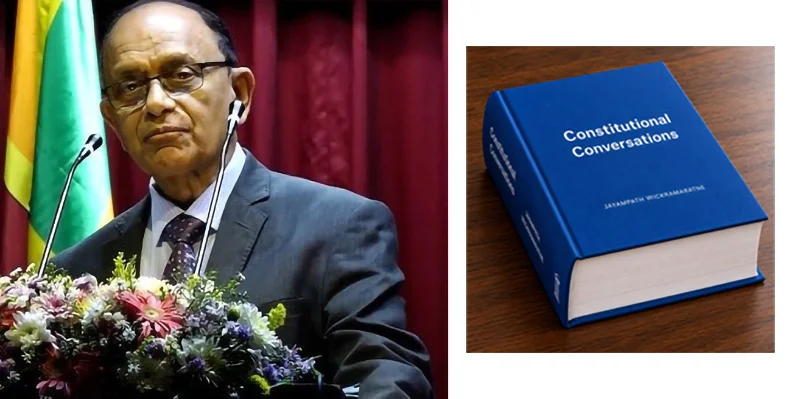
Let me first, on behalf of Lake House Printers and Publishers and myself, thank you for accepting the invitation to attend this launch.
I will not say anything about the book but will leave that to others; Saliya and Dinesha have already done so. Thank you, Saliya and Dinesha, for your contribution.
Why do we need conversations about constitutional law and constitutional reform?
Sri Lanka, like most countries in the Commonwealth, is a common law country. Common law countries are distinguished by their reliance on judicial precedent and judge-made law, which evolve through case-by-case reasoning rather than comprehensive codification. This tradition emphasises flexibility, judicial independence, and the adversarial process.
In common law countries, the legal community therefore has a vital duty to critique judicial decisions, as precedent-based systems rely on ongoing scrutiny to ensure fairness, coherence, and legitimacy. Without critique, judge-made law risks stagnation, bias (whether institutional, personal, or doctrinal), or detachment from evolving social values. A critique is a structured, analytical evaluation of a work, idea, or situation that highlights both strengths and weaknesses, aiming to provide constructive insights rather than mere faultfinding. It differs from simple criticism by being more formal, balanced, and evidence-based.
Critique ensures that precedents are tested, refined, or overturned when they no longer serve justice. It often inspires legislative intervention when judicial precedent proves inadequate. Critiquing judgments trains lawyers to think critically and equips them to argue for doctrinal changes. Transparent debate reassures citizens that judicial power is exercised responsibly. Critique allows courts in different common law countries to learn from each other’s reasoning.
“The law is what the last judge said in the last case” is a pithy way of expressing a feature of the common law—that the law develops through judicial precedent and that the most recent authoritative decision ordinarily represents the current law. There is no such thing as settled law; what appears settled remains so only until a later judgment unsettles it. An example would be helpful.
The makers of the Indian Constitution debated whether the exception to the protection of life and liberty should be limited to a procedure established by law or to due process of law. If it was according to procedure established by law, the legislature ought to be trusted not to make bad laws. If it were according to due process of law, the judiciary would have the authority to question a law on the ground that it is not good law and is not in consonance with fundamental principles. The Constituent Assembly consciously decided on ‘procedure established by law’.
Soon after the Indian Constitution was adopted, it was argued in A.K. Gopalan v Madras that the word ‘law’ in Article 21 meant the principles of natural justice. That argument was rejected.
But a quarter of a century later, in Maneka Gandhi’s case, the Supreme Court headed by Chief Justice Bhagwati laid down that any law which deprives a person of his life or personal liberty is invalid unless it prescribes a fair and just procedure for such deprivation. In short, the Court read ‘due process’ into Article 21 despite the Constituent Assembly’s conscious decision not to use the phrase.
In 1991, at the first SAARCLAW conference in Colombo, Justice Bhagwati, who had retired by then, spoke on Indian developments in public law. I asked him at question time how he did it in the face of that conscious decision by the Constituent Assembly. His response was that a country must keep pace with modern legal developments and that the people are entitled to benefit from them.
A few words about the influence of foreign jurisprudence. Some in the legal community are reluctant to draw on foreign jurisprudence, viewing it as incompatible with domestic legal traditions, or just because it is foreign.
Just two examples of how foreign jurisprudence has helped develop the law in Sri Lanka.
In India, the Supreme Court had given an expansive meaning to equal protection of the law by holding that ‘anything that is arbitrary violates equal protection’. In Elmo Perera v. Jayawickrama, Mr HL De Silva PC strenuously argued for a similar expansion. A full-bench, divided 6 to 3, declined, holding that the petitioner had not shown that there was unequal treatment. Justice Wanasundera, in his dissent, held that in the case of a person in a group, the comparison would be with the norm or protection applicable to the group.
In the landmark case of Jayasinghe v Attorney-General, Justice Mark Fernando went further and held that a violation of the norm would be a violation of equal protection, as judicial notice could and should be taken of the fact that the norm is ordinarily followed. That judgment has since been followed consistently. This was made possible because of developments in India.
As to the actions of state-owned companies and corporations violative of fundamental rights, our Supreme Court initially took a restrictive view, especially in Wijetunga v Insurance Corporation, Chandrasena v National Paper Corporation, and the five-member bench case of Wijeratne v People Bank, all three judgments penned by Chief Justice Sharvananda. He was supervising my doctoral thesis at that time and used to engage in lengthy discussions with me. I expressed my reservations on the correctness of the 3 judgments, and he was ready to listen. One day, he asked me to read Sukhdev v Bhagatram, a judgment by Justice Mathew, whom he held in high esteem. That judgment supported my line of thinking, and I included it in my draft, noting that our Supreme Court has taken a very narrow view. I remember making an ‘oral submission’ as if I was in Court before him. He listened and nodded occasionally. Just that.
Later, I was junior counsel to Mr Batty Weerakoon in a fundamental rights case against some corporation; we appeared for some Sama Samajist trade unionists who had a strong case. Mr NTS Kularatne, who taught me Local Government Law at Law College, appeared for the corporation and confidently cited the three judgments of Chief Justice Sharvananda that I mentioned. Addressing him, the Chief Justice said, ‘Mr Kularatne, do you want to proceed with that argument? I have reconsidered this issue, and I am prepared to write a judgment.’ Mr Kularatne back-tracked, much to my disappointment. We were denied a judgment on the issue which, I am sure, would have been a lucid one.
But very soon, Justice Atukorale, in Rajaratne v Air Lanka, adopted the views of Justice Mathew in Sukhdev v Bhagatram.
A law student from one of the universities interviewed me for an assignment she was working on. She was outspoken and told me that my critiques of judgments seemed measured, temperate, and overtly respectful of the courts. ‘You always say “I submit”, “it is respectfully submitted”.’ I explained to her that a critique of a judgment should not become a polemical exercise, as polemics are adversarial, rhetorical attacks aimed at winning arguments rather than at deepening understanding or improving the law. In the legal community, polemics risk undermining the credibility and constructive purpose of critique.
I took the example of my treatment of Namasivayam v Gunawardena, a judgment by Chief Justice Sharvananda in a case which I myself had argued. The Police officer concerned swore an affidavit to say that he boarded the bus in which the petitioner was travelling, ‘required’ the petitioner to accompany him to the Police Station for questioning, and ‘released’ him after recording his statement. The Chief Justice held that it amounted to an arrest as the Petitioner was deprived of his liberty to go where he pleased. I have described that part of the judgment as a watershed in the field of personal liberty in Sri Lanka, but was critical of another aspect of the judgment.
The petitioner was detained under a detention order under emergency regulations, but fresh orders were not made every month, which, I argued, made continued detention unlawful.
Section 4 of the Public Security Ordinance provides that the expiry or revocation of any Emergency Proclamation shall not affect ‘any offence committed, or any right, liberty or penalty acquired or incurred’. Chief Justice Sharvananda, referring to section 4, stated that the liability to be detained was a penalty incurred by the petitioner under the Emergency Regulations. So, monthly detention orders were unnecessary. I was appalled and said this in my draft chapter:
‘By no stretch of imagination could the liability of a person arrested under Regulation 18 to be detained be termed a ‘penalty’ incurred.’
Chief Justice Sharvananda went through that part, did not say a word, but struck off the words ‘by no stretch of imagination’ with a pencil. The message was clear: ‘Be temperate in the use of language, but you are entitled to critique my judgment’.
The book now reads: ‘It is respectfully submitted that the liability of a person arrested under regulation 18 to be detained cannot be termed a ‘penalty’ incurred.’ I learnt a lot.
Soon after the judgment, the Public Security Ordinance was amended to provide that fresh orders need not be made each time the emergency is extended.
Talking about critique, once when I met Justice Shirani Bandaranayake, she inquired about the progress of the second edition of my book, ‘Fundamental Rights in Sri Lanka’, which she knew I was working on. Among other things, I told her that I was critical of the three determinations on the freedom of religious propagation she had authored. Her response was: ‘Oh! That is alright, as long as you don’t call me names.’ Now, that is the correct spirit.
This book is not only about constitutional jurisprudence but also constitutional reform. I hope the reform process will benefit from my contribution.
I want to thank Lake House Printers and Publishers for a job well done.
Now that this book is finally out, I will rest for a few weeks and start work on the 4th edition of ‘Fundamental Rights in Sri Lanka.’
Text of the speech by Dr. Jayampathy Wickramaratne
at the launch of his latest book, Constitutional Conversations in Colombo on 16 July 2026)

Taskin Ahmed withdraws from LPL to prepare for Australia tour

US and Saudi Arabia announce nuclear cooperation deal

Navy seize Indian fishing trawler, nine fishermen poaching in Sri Lankan waters

Sri Lanka edge Qatar in Davis Cup opener

Dambulla Sixers hand Galle Gallants first defeat in LPL 2026

Jaffna Kings beat Colombo Kaps by five runs

‘Dates have the highest sugar content to fight Coronavirus’

Sunday Island 27 December – Headlines

#SundayIsland 17th December – Headlines

Sunday Island – 28th March

Sunday Island Headlines – 21 March

Sunday Island – 21st February – Headlines
-
 Features4 days ago
Two memorable excerpts from a former SLAF commander’s memoir
-

 Business4 days ago
‘Giving up was never an option’: The fisherman who fought back after losing millions in SL
-

 Latest News5 days ago
Davis cup Asia/Oceania Group IV 2026 to be held in Colombo from 20th to 25th July
-

 Features4 days ago
Erdoğan’s New Republic
-

 Life style4 days ago
Taste of the Swiss Alps comes to Colombo
-
 News5 days ago
Evidence recorded in money laundering case against Yoshitha Rajapaksa
-

 News5 days ago
Dengue outbreak gallops ahead: Infections surpasses 73,455, leaving 50 dead
-
 Midweek Review1 day ago
Three high-profile alleged suicides shaping key investigations