
News
Collective Cabinet responsibility won’t be at country’s expense

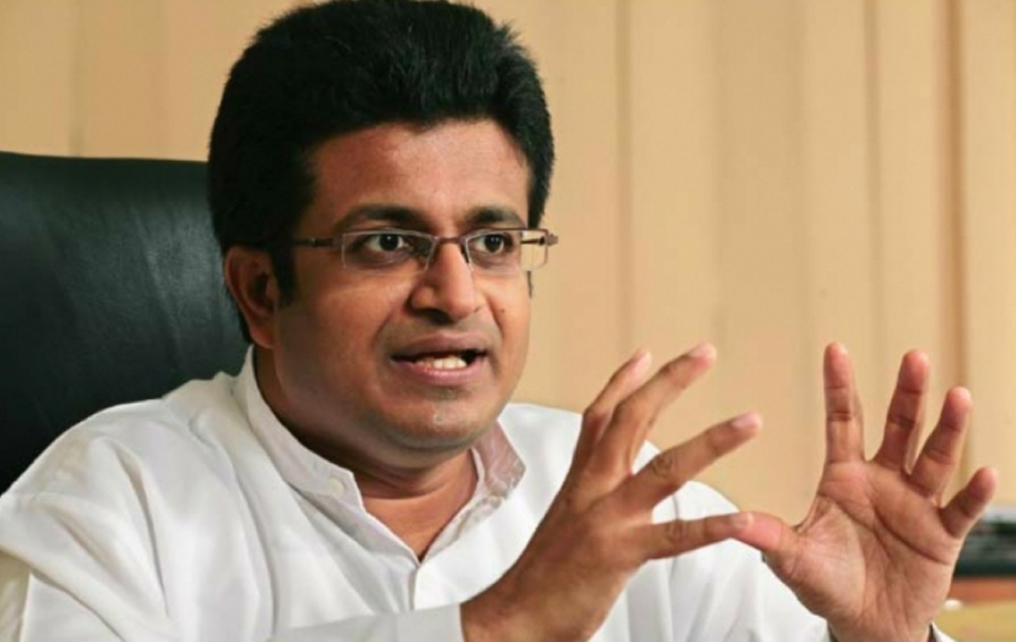
Udaya: We are ready to face consequences of revolting against backdoor Yugadanavi deal
By Shamindra Ferdinando
Energy Minister Udaya Gammanpila says that in spite of being members of the Cabinet, he along with National Freedom Front (NFF) leader Wimal Weerawansa and Democratic Left Front (DLF) leader Vasudeva Nanayakkara, have supported the petitions filed against the government entering into a framework agreement with US-based New Fortress Energy in respect of Yugadanavi Power Plant, etc., as they strongly felt that collective Cabinet responsibility should not be at the expense of national security.
Pivithuru Hela Urumaya (PHU) leader and Attorney-at-Law Gammanpila emphasised they had challenged the Cabinet over the controversial agreement following careful examination of what he called a politically charged situation.
The Colombo District MP said that they were ready to face the consequences of legal measures they had resorted to. Minister Gammanpila said so in response to The Island query whether they could continue as members of the Cabinet after having objected to an international agreement, finalised by the government.
Gammanpila said that they had never tried to hide their intentions and they felt embarrassed by the way some in the government manipulated the very process that was meant to ensure transparency and accountability.
Treasury Secretary S.R. Attygalle, on behalf of the government, entered into an agreement with New Fortress Energy, a company listed in the NASDAQ, on July 7, 2021, two days after Cabinet decided on the matter.
Gammanpila said they had tried to settle the issue at the Cabinet level and at the government parliamentary group. “Finally, we were left with no alternative but to denounce the New
Fortress deal and then throw our weight behind those who moved the Supreme Court against it,” Minister Gammanpila said.
The SLPP repeatedly demanded that whatever the issue the constituents should settle it within the government parliamentary group and the Cabinet.
Minister Weerawansa told Parliament on 11 November that an Attorney-at-Law would represent the trio at the Supreme Court proceedings.
Responding to another query, Minister Gammanpila questioned the rationale behind bringing in a company that hadn’t been involved in the tender process in respect of a high profile project involving the West Coast Power Limited (WCPL). The minister said that the US firm had spurned the tender process as it received an assurance as regards the contract.
The US government pushed for the deal meant to secure 40 percent shares of the WCPL at a cost of USD 250 mn, Minister Gammanpila said.
The Cabinet memorandum as regards the sale of WCPL shares, in addition to the floating storage regasification unit, mooring system and the pipelines and the supply of LNG (Liquefied Natural Gas) is dated 06 Sept., 2021, months after Sri Lanka entered into FA with New Fortress Energy.
Asked whether the NFF, PHU and DLF would receive the support of other parties including the SLFP, Minister Gammanpila said that those who had pledged support for their cause remained committed and confident.
In addition to the NFF, PHU and DLF with a combined strength of eight MPs, the grouping against the New Fortress deal included the SLFP (14 members), CP (1 MP), Yuthukama (2 members) and Tiran Alles. Over two dozen elected and appointed members of the SLPP are against the New Fortress deal.
Of the smaller constituents in the government, the MEP (Mahajana Eksath Peramuna) has distanced itself from the campaign against the energy deal.
Minister Gammanpila said that in his current capacity as the energy minister he had been compelled to struggle against the energy project as it posed a threat to the country. Referring to the then President Ranasinghe Premadasa sacking ministers, Lalith Athulathmudali, Gamini Dissanayaka and G.M. Premachandra in 1991, Minister Gammanpila said that the UNPers sought the Supreme Court intervention. The SC ruled that in case ministers had been deprived of an opportunity to discuss some matter at the cabinet, they could do so with the public, Gammanpila said, adding that they pursued a strategy based on that SC position.
Minister Gammanpila said that Sri Lanka couldn’t afford to create a foreign monopoly in the gas supply to the country. The situation would be far worse as the proposed monopoly would be American, Gammanpila said, noting that in spite of entering into a spate of other agreements with foreign partners under controversial circumstances, the incumbent government seemed to have perpetrated an unpardonable act.
Minister Gammanpila said that the US energy deal would deliver a knockout blow to Sri Lanka’s efforts to tap gas in the Mannar seas. The consequence of this arrangement would be far reaching and devastating as far as Sri Lanka was concerned, the minister said. If the New Fortress deal was carried pit. Sri Lanka wouldn’t be able to bring in other investors to extract gas from the Mannar basin, the minister said.



News
Establishment of an Institutional Framework to Inagurate Upper Hydro Catchment Areas Management Authority

Policy approval of the Cabinet of Ministers was granted at their meeting held on 08.06.2026 to establish the Upper Hydro Catchment Areas Management Authority for identification and
execution of a formal and long – lasting remedy to secure the central hills including the upper hydro catchment areas enabling them to sustain amidst extreme weather conditions
due to natural calamities and human activities as well as to be used for the sustainable development of the country.
Accordingly, a concept paper has been prepared including
institutional structure, activities, powers, active subject area as well as administrative and coordination mechanism for the proposed authority by an expert technical committee appointed by the Secretary to the President.
Based on the said concept paper, the Cabinet of Ministers granted approval to the resolution furnished by the President to instruct the Legal Draftsman to prepare a draft bill including legal provisions required for the establishment of Upper Hydro Catchment Areas Management Authority.
News
Introduction of Flora and Fauna (Regulation of actions of the Indigenous Community within the nominated areas) Regulations
With the objective of securing the traditional livelihood and the eco system of the indigenous community, it has been recognized the necessity of introducing a formal regulation methodology to secure their engagement in livelihood activities by being more sensitive to the existing laws.
Thereby, the Fauna and Flora (regularizing) regulations under the Fauna and Flora Protection Ordinance (Authority 469) have been prepared so that nominated activities within the prescribed area to a member of the indigenous community
who has been registered for securing the rights acquired from law or custom or usage or traditional stance to execute an act within a certain state land that is fundamental to the survival of the indigenous community permission can be granted
Accordingly, the Cabinet of Ministers granted approval to the resolution furnished by the Minister of Environment to publish the said regulations in the government gazette notification and thereby submit to the Parliament for its concurrence.
Latest News
M. M. D. J. Senarathne, appointed Director General of the Department of National Botanical Gardens
The Cabinet of Ministers approved the resolution furnished by the Minister of Environment to appoint M. M. D. J. Senarathne, who is the senior most officer in Grade I of Sri Lanka Scientific Service se

Establishment of an Institutional Framework to Inagurate Upper Hydro Catchment Areas Management Authority
Introduction of Flora and Fauna (Regulation of actions of the Indigenous Community within the nominated areas) Regulations
M. M. D. J. Senarathne, appointed Director General of the Department of National Botanical Gardens

Harmanpreet Kaur steps down as India captain

Turkiye, Pakistan agree Saudi Arabia military deployment under Mecca pact

Rumesh Tharanga among nominees announced for World Athlete of the Year 2026

‘Dates have the highest sugar content to fight Coronavirus’

Sunday Island 27 December – Headlines

#SundayIsland 17th December – Headlines

Sunday Island – 28th March

Sunday Island Headlines – 21 March

Sunday Island – 21st February – Headlines
-

 Latest News7 days ago
Gold winner Tharanga gets brand-new Honda Vezel from SLAAJ
-

 News6 days ago
US-assisted ‘Ice’ detection: NPC to examine IGP’s move to transfer drug-busting team
-

 Features7 days ago
Why Sri Lanka needs an Inclusive Civic Nationalism – urgently
-

 Editorial5 days ago
Colombo Port drug bust: The plot thickens
-

 News7 days ago
Civil society activist accuses govt. of favouring Ven. Gnanasara
-
 Midweek Review7 days ago
Dappula’s Easter Sunday ‘grand conspiracy’ claim demolished
-

 Editorial7 days ago
When crime bosses rise above law and shrines
-
Editorial6 days ago
Drug busting, transfers and trust deficit