
Business
Breaking the Bias: Celebrating the women at Samsung

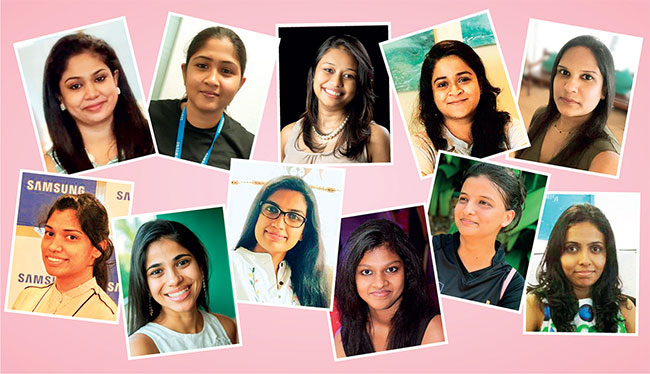
With International Women’s Day taking on greater meaning for many of us this year, Samsung asked their women colleagues of various backgrounds to share what motivates and empowers them to be their best.
In sharing everyone’s unique experiences, the overarching lesson we all came to realize is that great ideas can come from anyone, no matter their skill level, gender or background — an important revelation at a company whose mission it is to help people everywhere defy barriers.
Gender diversity in technology remains an obstinate problem despite the growing voices pushing for gender equality in the industry. Reports show that as women make up 59% of the total workforce, they present only 30% in major tech companies.
When it comes to economic access, women entrepreneurs also face significant barriers and are behind in the race for economic opportunities. Declination over the past few years of women’s participation in a STEM (Science, Technology, Engineering and Math) discipline is another factor making females away from technology. In this way, there is a need to empower and build strategies to unlock growth and prosperity for women in technology. For companies to achieve gender equality, recruiting more women in their IT team can be an obvious solution.
Samsung’s unwavering commitment to women’s equality is evidenced by the action we take to create positive change both within our organization and in the communities where we live. That action is reflected across the board from our citizenship programs that foster girls’ interest in STEM to our Women in Samsung Electronics (WISE) Employee Resource Group (ERG), a network created to promote and encourage a workplace culture where everyone can thrive.
From software backgrounds to service marketing, Samsung’s women have been empowered to be the best version of themselves.
Anjalee Erathna- Manager, Software Quality Assurance
The culture at Samsung Sri Lanka has allowed us to be our best versions and thrive at the workplace. With constant training, supportive management and teammates, Samsung Sri Lanka is a key driver in women empowerment.
Kumudi Panditharathna- Asst. Manager, Finance
I know many women have faced prejudices throughout their career however I, very positively, cannot say that I have faced any. My career has definitely seen a great positive change ever since I joined Samsung and I look forward to furthering my career and skills through Samsung.
Nilanga Ranagala- Manager, Finance
You don’t need to be at the top at Samsung to have a strong female voice. All employees are heard and valued at Samsung Sri Lanka.
Judith Jansz- Manager,
Product IM
Samsung is a progressive workplace with an inclusive and equal environment. In a time where women are achieving great heights in many industries in Sri Lanka, it is a privilege to be a part of this change.
Nilusha Wanasinghe- Manager, Marketing, IM
We would love to see more archetypal women holding up a chain of smaller female figures who climb up a mountain together, helping each other on the way and raising their flag – reflecting the strong female voices and unstoppable leadership potential, which is the culture that is cultivated in Samsung Sri Lanka.
Pawani Lakshani- Executive, Marketing
I am seeing a positive change in Samsung Sri Lanka with regards to equality and diversity. In the beginning, it wasn’t uncommon for me to be the only woman in the room. It was a little intimidating at first, but I was persistent because I knew I had the talent to continue on my career path.
Natalie Goonawardene- Manager, Service Marketing
At more senior levels in the tech industry, certainly, there are more challenges. While working through them, it is important to raise visibility and pave the path for others. The industry at a large is slowly learning to judge people based on their work, rather than who they are or where they come from.



The secondary market yield curve remained broadly stable during the past week as subdued trading activity persisted around the Treasury Bond auction. Meanwhile, weighted average yields at the weekly Treasury Bill auction recorded declines across all tenors, First Capital Research stated in its latest weekly report.
According to the report, secondary market activity opened on a cautious note with selling interest emerging ahead of the T-Bond auction, causing a slight upward adjustment in yields amid moderate trading volumes. As the week progressed, investor participation remained muted, with market participants largely staying on the sidelines in anticipation of the auction, keeping the yield curve broadly unchanged.
Following the successful completion of the bond auction, the market witnessed mixed sentiment, with selling pressure concentrated at the short end and buying interest emerging in longer-dated maturities. However, activity remained subdued, and the yield curve largely held its ground through the weekend.
At the Treasury Bond auction held on July 13, 2026, the Public Debt Management Office (PDMO) successfully raised the full offered amount of LKR 150.0 billion. This comprised LKR 70.0 billion through the 2030 maturity, LKR 50.0 billion through the 2034 maturity, and LKR 30.0 billion through the 2037 maturity, at weighted average yields of 11.57%, 12.04%, and 12.58%, respectively.
Similarly, at the weekly Treasury Bill auction held on July 15, 2026, the PDMO raised the full offered amount of LKR 120.0 billion. The 3-month, 6-month, and 12-month bills raised LKR 55.0 billion, LKR 35.0 billion, and LKR 30.0 billion, respectively. Weighted average yields declined across all tenors, with the 3-month bill easing by 8 basis points (bps) to 10.13%, the 6-month bill by 3 bps to 10.27%, and the 12-month bill by 1 bp to 10.20%.
On the external front, the Sri Lankan Rupee (LKR) depreciated against the US Dollar, closing the week at LKR 336.3/USD compared to LKR 334.7/USD seen previously. Market liquidity within the banking system expanded significantly, starting the week at LKR 125.89 billion and closing higher at LKR 157.19 billion.
Thus the market data may highlight a clear divergence between short-term liquidity comfort and long-term caution, which points toward a gradual steepening of the yield curve in the near term.
The emergence of buying interest in longer-dated maturities (2034 and 2037) shows that institutional investors are eager to lock in double-digit yields while liquidity is high. This institutional support will likely place a temporary ceiling on long-term rates.
The mild depreciation of the rupee (moving to LKR 336.3/USD) acts as a cautionary counter-signal. If the currency continues to face pressure, it could limit how far short-term yields can fall, flattening the curve back out.

The Colombo Stock Exchange (CSE) witnessed a quiet trading session on Friday, with the benchmark All Share Price Index (ASPI) edging marginally lower down by 42.16 points or 0.20% to close at 21,405.41.
Market turnover remained thin, coming in at Rs. 0.72 billion (approximately US$ 2.2 million), reflecting a general lack of investor participation as most sectors encountered downward pressure.
A total of 31.94 million shares changed hands across 13,397 trades, resulting in a negative market breadth where declining counters outpaced gainers 127 to 91. Blue-chip counters Sampath Bank PLC (SAMP), Lanka IOC PLC (LIOC), and John Keells Holdings PLC (JKH) anchored the day’s market turnover, while a notable off-market crossing was recorded in Chevron Lubricants Lanka PLC (LLUB). Trading volume in SAMP alone was highly concentrated, accounting for 12% of the day’s total turnover.
Sector performance remained mixed, with the Banking sector emerging as the most actively traded, posting a modest gain of 0.18%. The Health Care Equipment & Services sector secured the spot as the day’s best performer, rising by 0.55%.
Conversely, the Household & Personal Products sector faced the steepest decline, dropping 1.95% to finish as the worst-performing sector of the day. In terms of individual movements, Blue Diamonds Jewellery Worldwide PLC [Voting] (PINS.N) led the gainers, advancing by 6.11%, while Agstar PLC (AGPL.N) emerged as the top loser, shedding 9.09%.
By Hiran H. Senewiratne
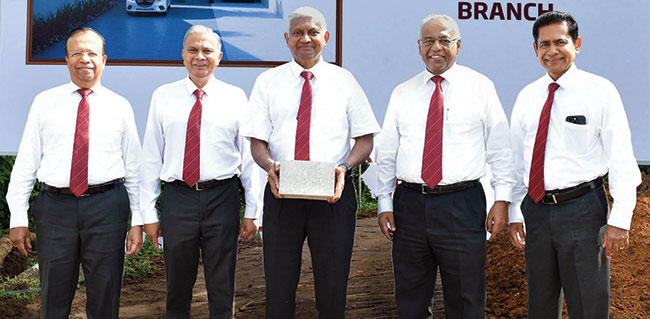
Ceylinco Life has commenced construction of its 36th company-owned branch building with the laying of the foundation stone for a new eco-friendly edifice in Kirindiwela, reaffirming the life insurance market leader’s continued investment in sustainable infrastructure and enhanced customer service.
The ceremony was attended by Ceylinco Life Chairman Mr R. Renganathan, Managing Director/CEO Mr Thushara Ranasinghe, members of the Board of Directors and senior management of Ceylinco Life, alongside valued customers and distinguished invitees from the Kirindiwela area.
Driven by its commitment to delivering superior service in a welcoming and customer-centric environment, Ceylinco Life has consistently invested in purpose-built branch buildings that serve as flagship locations. The Kirindiwela branch will join a network of 35 such company-owned buildings currently in operation across the country, each designed to offer elevated standards of service and modern facilities.
The new building will be constructed on company-owned land and developed in line with the Company’s green building concept, incorporating environmentally responsible design principles and energy-efficient technologies.
Spanning a floor area of 3,440 square feet, the Kirindiwela branch will utilise locally developed prefabricated construction technology from the National Engineering Research and Development Centre (NERD). The building is planned to operate on a 100 per cent self-sufficient solar electricity system, eliminating reliance on the national grid.
Key sustainability features of the proposed building include natural ventilation design, a topography-friendly layout, a green patch with grass grown in between interlocking blocks, energy-efficient air conditioning and lighting systems, and a rainwater harvesting facility. A dedicated Sewerage Treatment Plant (STP) will recycle wastewater for toilet flushing and gardening, while the company will practice the green concept of ‘Reuse’ in air-conditioning and electronic equipment, further minimising environmental impact.

Malinga, Asalanka seal Galle Gallants win in LPL opener

Showers may occur in the Western, Sabaragamuwa and North-western provinces and in Kandy, Nuwara-Eliya, Galle and Matara districts

Dengue outbreak gallops ahead: Infections surpasses 73,455, leaving 50 dead

Evidence recorded in money laundering case against Yoshitha Rajapaksa

Former IGP C.D. Wickramaratne dies in suspected suicide

CAA sets aflatoxin limit for processed liquid milk from January 2027

‘Dates have the highest sugar content to fight Coronavirus’

Sunday Island 27 December – Headlines

#SundayIsland 17th December – Headlines

Sunday Island – 28th March

Sunday Island Headlines – 21 March

Sunday Island – 21st February – Headlines
-

 Features6 days ago
Prison riots and politics: NPP’s biggest challenge and Sri Lanka’s biggest opportunity
-
 Features3 days ago
Dirty Money
-

 Editorial6 days ago
Much ado about crime: Fish or cut bait
-

 Features6 days ago
More on Saudi Arabia: ARAMCO and beyond
-

 News1 day ago
Money laundering case against Yoshitha, fixed for pre-trial conference
-

 Sports6 days ago
The banker who rescued Sri Lankan cricket
-

 Midweek Review3 days ago
The sordid tale of theft and tragedy at Finance Ministry
-

 Latest News4 days ago
Oil prices hit 1-month high as US-Iran attacks dim Strait of Hormuz outlook