
Features
Towards necessary exercise in discursive disentanglement?

(Prof. Sasanka Perera’s recent speech as guest speaker to the National Academy of Sciences)
In present times, there is an intriguing, but at times seemingly dangerous entanglement between science, belief and state policy or government action. This kind of phenomena range from the government’s sudden ban of Glyphosate in 2015; the state sponsorship of a conference on the air power of the mythical king Ravana to the layers of stories surrounding the advent of what is now popularly known as the Dammika Peniya. These are merely three well-known phenomena from a whole series of such phenomena in the country with varying impacts on social life, politics and commerce. As a collective of occurrences with their own structure of associated events, these phenomena have not been reckoned with seriously. We have not carefully reflected upon them and asked ourselves why they are more evident now, and what their broader consequences and reasons for manifestation might be. As a result, we do not have credible sociological explanations for these phenomena that goes beyond popular rhetoric. These phenomena are seemingly dangerous too, because many of them defy what we might think of as commonsense and leads in the direction of collective chaos and counter-productive action on the part of the state. And in this journey, ‘science’ is one of the most obvious casualties.
To me, all this points to a contradictory entanglement involving science, belief, and state policy when ideally such contradictory entanglements should not take place. By ‘science’ I do not merely mean the vast systems of knowledge that originated in the west, which now have global hegemony including in our country. Instead, science is any system of knowledge “concerned with the physical world” and phenomena emanating from this world along with formal “observations and systematic experimentation.”i In other words, a “science involves a pursuit of knowledge” that covers “general truths” as well as “the operations of fundamental laws.”ii In this sense, Ayurveda, Unnani, present day engineering, allopathic medicine or any other system of formal knowledge are mostly matters of science though the bases for their fundamentals would vary considerably from the more dominant post-enlightenment sciences to much older systems of knowledge.
Similarly, by ‘belief’, I mean not only matters of faith rooted in religion and tradition but also contemporary beliefs that are created by the repetitive circulation of ideas across media whether they are based on fact and science or not. Often, these ideas address contemporary issues and politics though they might be camouflaged in a rhetoric of the past, resort to specific conventions, and identity politics. And these associations are quite important today given the propensity for fake news and the enhanced ability of people to accept these ideas easily without being formally countered.
In the same sense, ‘state policy’ and actions linked to such policies are expected to be based on formal legal principles and empirical facts, and ideally should have nothing to do with matters of faith or untested assumptions and should benefit the polity.
Generally, I consider science, belief, and state policy to be independent discourses with their own epistemological routes and purposes though there will be close and necessary interactions among these such as between science and state policy. At other times, as we are seeing now, this association can be between belief and state policy where science might be eclipsed.
My intention today is to simply place in context three recent phenomena of this kind that are structurally very similar but contextually very different, which I think would explain to some extent how this amalgamation of discourses function, and the ways in which their politics manifest. As far as I am concerned, what I have to say today are simply preliminary thoughts about which I would like to think further and theorize.
Phenomenon 1: Glyphosate Ban
The use of the weedicide glyphosate was banned by presidential order in 2015. In a paper published in the same year, Jayasumana, Gunatilake and Siribaddana note that people in areas where kidney disease has become endemic have been exposed to multiple heavy metals and glyphosate.iii Their conclusion as far as I could see as a non-expert, was very vague, which amounted to the following observation: “Although we could not localize a single nephrotoxin as the culprit” “multiple heavy metals and glyphosates may play a role in the pathogenesis.”iv This is one of several public articulations related to this matter that has some semblance of what I may call scientific noise, but clearly inconclusive.
The ban was quite sudden and was implemented following on the heels of intense lobbying by Member of Parliament and Presidential Advisor, Reverend Athuraliye Rathana. He argued along with his supporters that this chemical caused chronic kidney disease of unknown etiology (CKDu) in the North Central and Uva Provinces. But what is clear is no reliable and specific scientific evidence was offered by him or the President’s Office as the basis for the ban. In this overall process, it does not seem that the Registrar of Pesticides; Fertilizer Secretariat; Medical Research Institute and Tea Research Institute, all of whom could have presented valuable and more formal input into the decision were consulted. It almost seems that the ban found its genesis in the popular belief that chemicals are bad.
The fact that there is considerable prevalence of kidney disease in parts of the country is a fact, which needs to be more rigorously studied to work out its causes. Personally, I am not a supporter of excessive use of chemicals for anything including agriculture, and to the extent possible, I have made changes in my personal lifestyle to address this anxiety. But that kind of personal, emotional or popular anxieties cannot be the foundation for state level decision-making, particularly if the government and the people both subscribe to the idea of commercial agriculture and the eradication of hunger.
The consequences of the ban have been substantial in monetary terms. It caused production costs to increase substantially and the industry, particularly the tea sector, incurred losses up to 10-20 billion rupees annually while the ban lasted. Though the ban was eventually partially lifted, even at that time, no credible and conclusive data supporting the ban existed. So, it appears, that the ban was solely based on a popular and largely correct general belief of the negative impacts of chemicals, tempered by political rhetoric emanating from matters of faith and popular beliefs. I am sure we can all agree, while we can entertain popular beliefs or even conspiracy theories among people, if they are injected into broader politics and formation of state policy, that would have serious consequences as this event has shown. Part of the problem here is not only the undue credence given to freely circulating popular notions without situating them in the context of formal and reliable knowledge, information and science, but the ability of popular political leaders to convert untested ideas into practices of state policy and action without facing consequences.
Phenomenon 2: The State’s Embrace of Ravana
People of my generation will know that Ravana and his flying machine were merely elements in an interesting story in our youth while in some parts of the country specific local stories linked to this myth circulated. Unlike India and elsewhere in South Asia and in the east right up to Bali, there is no evidence of Ramayana performances which may have included a dramatization of the Ravana narrative in Sinhala cultural lore. But this situation has dramatically changed in recent times where Ravana’s popularity has rapidly increased among a cross section of the people, while his name and alleged historicity have also been openly embraced by the state.
By 2019, the story of Ravana had been directly appropriated by the Sri Lankan state and engrossed in a highly superficial but allegedly scientific discourse on aviation. In July 2019, Civil Aviation Authority of Sri Lankan organized a “conference of civil aviation experts, historians, archaeologists, scientists and geologists” in Katunayake.v The Authority’s Vice Chairman at the time, Shashi Danatunge told Indian media, “King Ravana was a genius. He was the first person to fly. He was an aviator. This is not mythology; it’s a fact. There needs to be a detailed research on this. In the next five years, we will prove this.”vi He further noted, “they had irrefutable facts to prove that Ravana was the pioneer and the first to fly using an aircraft.”vii The conference’s main conclusion was “that Ravana first flew from Sri Lanka to today’s India 5,000 years ago and came back.”viii Many conference participants in their own peculiar wisdom, dismissed the powerful stories narrating Ravana’s kidnapping of Lord Rama’s wife Sita, as a mere “Indian version.”ix For them, this was not possible because Ravana was a noble king.”x
Intriguingly, one part of the myth cluster became a fact while another became fiction based simply on nothing more concrete than emotional and nationalist appeal. The ideas expressed in public on this matter were not private articulations of individuals. Particularly the Vice Chairman of Civil Aviation was speaking as a representative of a state agency. Also, the general conclusions of the conference and the acceptance of the Ravana story as historical fact could simply not be entrained by formal historiography and archaeology.
By 2020, the same agency took its sense of scientificity of these claims even further by launching a research project looking for evidence of Ravana’s flying and his “aviation routes.”xi The theme of the project was, “King Ravana and the ancient domination of aerial routes now lost.”xii Towards this, the Civil Aviation Authority placed advertisements in national newspapers asking people to send in evidence they may have. The purported scientific objective and the reason for the Civil Aviation Authority’ central involvement in this state-sponsored effort was explained as follows: 1) Because the Civil Aviation Authority was “the main aviation regulatory authority in Sri Lanka,” it was the most logical entity to host such and effort, and 2) Because “there are multiple stories over the years about Ravana flying aircrafts and covering these routes” there was a necessity “to study this matter.”xiii
Though there are seemingly rational and seemingly scientific ‘noises’ in this episode, the entire exercise is enveloped in taking myth as fact, and that too, with the direct participation of the state.
Phenomenon 3: The Advent of the Dammika Peniya
Now we come to the advent of the Dammika Peniya which is formally known as ‘ශ්රී වීර භද්රධම්ම කොරෝනා නිවාරණ ප්රතිශක්ති ජීව පානය’ (Shri Vira Bhdradhamma Corona Nivaranana Prathishakthi Jiva Panaya). According to its inventor, Mr Dammika Bandara, the formula for the syrup was given to him by Goddess Kali in a dream. This is a crucial point in which the genesis of this syrup differs from the more formal discourses of knowledge in Ayurveda and Sinhala medicine, within which this claim is located.
It was a claim protected by rhetoric of local medical superiority, power of ancient knowledge and very loud articulations of cultural and political nationalism. But certain things need to be understood clearly. Even within the structure of faith and belief in Sinhala culture, goddess Kali, the alleged ultimate progenitor of the syrup is not known for healing. She is seen more as a powerful deity but with considerable destructive potential. More typically associated with healing is goddess Pattini. So, the claim seems to be out of place even in the context of conventional Sinhala myth and belief. Second, though Ayurveda and Sinhala medicine have associations with faith and ritual, the bulk of their formal discourses on medicine are based on experimentation, repetitive practice and fine-tuning and formally scripted knowledge or that which is handed over word of mouth across generations. My maternal grandfather wrote two books in the early 1970s after he had retired from his Ayurvedic practice and teaching. The first was called Rasayana saha Vajikarana (රසායන සහ වාජිකරණ) in which he presented a specific body of knowledge already known to his field, but with fine-tuning offered by his own practice and studies. The second, called Avinishchitha Aushada (අවිනිශ්චිත ඖෂධ) was very different. It dealt with a series of plants whose medical utility was unknown or unsure. In it, he dealt with the unknown, based on both generations of institutionalized uncertainty as well as conjecture on his part, but based on his long years of practice and observation. Both these point to the nature of the scientific discourse of contemporary Ayurveda.
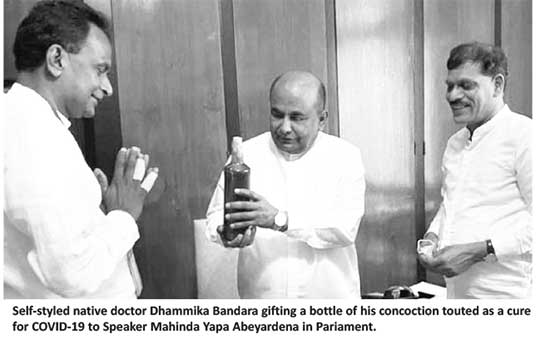
Compared to this kind of background, Mr Bandara offers a set of contradictions. He is not a medical practitioner, but a mason by profession who runs a small Kali shrine in his neighborhood. However, his claim over having invented a treatment for Corona received massive publicity via media outlets supportive of the state and unreserved public support from numerous local and national political leaders including the Minister of Health and the Speaker of Parliament all of whom consumed the concoction in public along with some of their colleagues. This does not tantamount to formal state support as in the other two cases. But such open adulation and support by senior members of the government is a public performance of confidence for an untested medication with a dubious claim. These actions played a major role in ensuring large numbers of people flocking to Mr Bandara’s house in Kegalle in search of this ‘miracle’ drug – in the midst of a pandemic. This is not a general condemnation of traditional medicine. In the 1950s, the establishment of the Ayurvedic Research Institute was to offer traditional medicine a sound research and dissemination base and bring it on par with formal understanding of science. But Dammika Peniya has no such provenance; it simply came from a dream according to its inventor himself, and such provenance simply cannot be the basis for its public adulation by political leaders. Most criticisms of the concoction and its provenance were vociferously put down in public as acts of anti-nationalism and lack of respect for traditional culture. A dubious study involving several colleagues of the Wathupitiwala Hospital and a handful of test cases had taken place though it is not clear to me if this exercise even had ethical clearance. A committee consisting of medical professionals has now been appointed to undertake a clinical study of the concoction using acceptable clinical trial criteria and practices. Its results have not yet been published.
What does all this mean?
All these three incidents have several obvious things in common:
the core notions in all stories are based on popular assumptions and untested ideas;
they all have powerful political and state support directly or indirectly;
their main arguments are governed by belief whether tempered by faith or by the mere repetition of mass circulating non-facts; and
in all cases, science in the formal sense – from allopathic medicine, Ayurveda and natural sciences to archaeology and history – have been dispelled even though such input could have more sensibly impacted these discourses if they were formally made available.
Moreover, the public manifestation and power of these discourses became possible due to the very clear inability of the public services directly associated with these contexts to be guided by formally collected data and scientific conclusions and their inability to advise their political Masters, and withstand the pressures of political interference. Such political interference is obviously not based on advice from subject experts or from a clear political vision, but from short-term political agendas for popular mobilization. This main conditionality allowed these unstable claims to become part of national politics and in some cases become policy or in the very least lead to actions sanctioned by the state.
But how does one explain the massive public support especially for the last two incidents. I have noticed for many years that people in our country, and particularly the Sinhalas seem to have a desperate urge to be part of grand historical claims and narratives. But I have not yet been able to gather adequate data or theorize what might be going on. But one can tentatively make some observations. The rediscovery of Ravana and brining him from the pages of myth and epic narrative of the Ramayana to state-sponsored formal discourses of populist and non-empirical historicization, and therefore formal reiteration of myth itself shows the urge to control what might be thought of as a popular and powerful narrative of the past. The way in which Sinhalas have reinvented Ravana over the last decade or so is not only as an aviator, but also as an engineer, medical expert, inventor, scientist and scholar. And this is done within an idiom of nationalist discourse that insists a pre-Vijayan and wholly Sri Lankan civilization once existed in which Ravana is a central attraction. These claims also assert this civilization was somehow superior to the cultural landscape across the ocean in the rest of South Asia. This seems to me to be more like what anthropologists would call millenarian mythmaking where Ravana appears at least in part as a millenarian hero. Generally, millenarian stories, beliefs and heroes have to do with delivering a society from danger, introduction of new ideas and technologies to ensure the safety of a collective, and so on. Such stories generally manifest in times of crisis. In the case of the Ravana story, the preoccupation is to recreate an important place for Lanka in the broader political history of South Asia in the context of a politically unstable present.
Even the story of the Dammika Peniya has some of these millenarian features. After all, it was presented as a very local remedy for COVID 19 based on a lost Sri Lankan body of scientific knowledge delivered directly by a goddess in a dream. And that too at a time when people were desperate to be safe and keen to protect their livelihoods from the vagaries of Corona virus at a time the state’s effort at controlling it appeared to be faltering. The Peniya seemed to be a sign of miraculous deliverance from the island’s past glory emerging in the midst of its chaotic present.
To end this preliminary sketch let me refer to a final comment. It seems to me, these kinds of stories emerge in times of crises – be these emotional, social, or political crises. This is not unique to Sri Lanka, and can also be seen in many other parts of the world in structurally similar circumstances. These stories have their genesis in realms of conjecture. I am not objecting to the deployment of conjecture as such. Most good ideas in all our disciplines would often begin with conjecture. As we know, the philosophy of science has shown us the importance of “assumptions, foundations, methods” and “implications of science.”xiv Reflections in philosophy of science also indicate the efforts to distinguish between what is considered science and what is thought of as non-science.xv It is in the latter domain where untested conjecture would generally be located until they can be given a basis in science or dispelled.
In this general context, it seems to me, these stories allow people to be part of a more powerful and often a winning idea of history and hyper-real present even though that domain of belief might have very little or nothing to do with lived reality as such. Partly, these can also be seen as coping mechanisms in difficult and turbulent times. But these are clearly not remedies for very real socio-political or public health issues that can be utilized brazenly by the state as long as their core ideas remain in domains of belief and conjecture.
The collective failure that typifies our situation is the inability of many people to understand this commonsense and as a result, become dangerously entangled in the internal logic of these stories, which have no external empirical foundations except for the real-life calamities some of them might generate. It is also likely our political leaders consciously and deliberately promote these stories and phenomena to divert people’s attention from evolving crises.
In this situation, I find it unfortunate that Sri Lankan social sciences have not yet spent the time to collect these stories and study them more carefully in their border social and political contexts and offer a more coherent, empirically-based, and nuanced theoretical explanation.
(Sasanka Perera is a trained anthropologist and is a professor at South Asian University in New Delhi. This is the text of a guest lecture delivered at the Induction Ceremony of the National Academy of Sciences of Sri Lanka on 22 January 2021)



Biodiversity is the sum of all the patterns of life that nature creates in biomass
An ecosystem is defined as a geographic area where biotic (living) organisms—plants, animals, microorganisms interact with each other and with the abiotic (non-living) components like air, water, sunlight, and soil, creating a self-sustaining unit of life. A pond with its attendant diversity is the ecosystem that supports pondlife, from frogs to fish or dragonflies, while an ocean is an ecosystem that supports fish to whales. So, it will be seen that ecosystems and their components change with scale. This creates a challenge for investment, what is the scale chosen for investment in the ecosystem?
In terms of biodiversity, ecosystems represent an evolutionary process over geological time, to sustain life through climate extremes. Over the span of existence, life forms and consequently their ecosystems have developed to be responsive to changes and represent the most successful combination of species in that environment.
On a geographic scale they manifest today as tropical rainforest or as temperate peatland or Andean paramo, each displaying a unique biodiversity complex that enables sustainability of that ecosystem in that place. These patterns suggest that the form and function of any resident ecosystem can provide a guide for designing restoration programmes and activities in that environment.
During the last two centuries, the landscapes of Sri Lanka were subject to massive changes. The total destruction of the montane forests, removed both above ground and below ground biomass. Fire cleared the land of standing vegetation, followed by the erosion of eons of topsoil. The forests were replaced with monoculture plantations which were very low in biodiversity. A response to address this loss of forest biodiversity was proposed as a ‘tree dominated ecosystem analogous to the lost native forest’. This system was tested and codified as Analog Forestry. In this process the structure and function of the original forest is used as the baseline for creating a tree dominated ecosystem.
Why should we try to mimic forests? Forests produce oxygen, filter water, cool landscapes, support biodiversity and provide renewable biomass as critical ecosystem services. In addition, forest soils contain one of the most species rich ecosystems on the planet, full of microbial life, while at the same time acting as a repository of organic carbon that stores moisture and substrate. Yet conventional financial systems treat the destruction of this productive infrastructure as a negative externality to the cost of doing business, forcing the environment to bear the cost. The pollution output of industry is an example. Similarly, the loss of ecosystem services was ignored as a negative externality to the cost of establishing plantations. It is the accumulation of these externalities that has brought us to the present crisis in environmental sustainability.
Analog Forestry seeks to reclaim some of the lost ecosystem services by establishing a tree-dominated ecosystem that is analogous in architectural structure and ecological function to the original climax or sub climax vegetation community. This vegetation complex may comprise natural or exotic species in any proportion, the contribution to creating an ecosystem analogous in structure and function, being a major factor that determines its design. The ecological functions of the system can be measured by a number of variables. The most critical being an understanding of the architecture that evolves in any ecosystem progressing through the process of seral succession. After this, functions within this ecosystem can be addressed. Some examples are; the ecological function of providing microhabitat, keystone species, stabilizing nutrient cycles, or maintaining trophic flows.
Analog Forestry also draws on the strengths of traditional knowledge. Many traditional responses mimic the structure or succession process of their local forest vegetation. The use of successional stages of natural ecosystems to design cropping systems have been recorded in many traditions. Analog Forestry encourages further complexity into the structure of such cropping systems, thus creating space for many species of the original forest to extend their ranges, either by design or effect.
As the species composition in each design varies according to different production goals, species utilised are selected from a comprehensive database.
It is in the output of this ecosystem where value can be generated and a platform for investment can be offered. Currently, only the farm product entering the economy has value in the market. The farm ecosystem has no value. One way to increase both biodiversity and rural income is by value addition through certification systems confirming clean, responsible production as in organic or regenerative agriculture. However, the true value of the contributions of ecosystem services generated by the farm, remain opaque to the economy.
The global economy operates on a fundamental accounting error: it classifies the depletion of natural capital as a “negative externality” to the cost of any process in creating a product. Thus, pollution of air, water or soil are considered negative externalities, with no responsibility by the consumer.
A useful response to this negative trend is to consider creating a product that enhances natural capital through actions such as oxygen production, water purification, climate regulation, soil formation or biodiversity maintenance.
These activities generate positive externalities into the environment and have been recognised for what they are, Ecosystem Services. Current economic models place the global value of ecosystem services at exceeding $145 trillion annually, substantially exceeding global GDP. However, these services remain invisible on current institutional balance sheets.
An early attempt at utilising ecosystem services was the capitalisation of biomass through the voluntary carbon and biodiversity credit market. Driven by net-zero commitments, mandatory ESG disclosure frameworks, which are part of the reporting frameworks used by companies for the disclosure of data covering business operations, were developed; They address opportunities and risks that are related to environmental, social and governance (ESG) aspects of business. The Kunming-Montreal Global Biodiversity Framework’s 30×30 conservation targets, which mandates signatory nations to effectively conserve and manage at least 30% of the world’s terrestrial, inland water, and coastal and marine areas by 2030, while simultaneously placing 30% of degraded ecosystems under active restoration, create a demand for high-integrity environmental credits. This demand has been accelerating at a pace at which the existing market infrastructure cannot adequately serve. The combined addressable market across carbon, biodiversity, water and ecosystem credits are projected to exceed $370 billion by 2035.
The regulatory frameworks driving this growth such as the TNFD a global, market-led initiative that provides organisations with a risk management and disclosure framework to identify, assess, manage, and report on their nature-related dependencies, impacts, risks, and opportunities, or the CSRD a new European law that requires organisations to report sustainability information on an annual basis, are already in force.
Analog Forestry provides opportunities for investment in the ecosystems that it creates by providing high value outputs across a range of ecosystem services. For example,the high values placed on carbon sequestration services in the carbon market, could create designs in the floral architecture to provide the greatest aboveground biomass. Such designs could also provide effective cooling of the ambient atmosphere through transpiration. The application of Analog Forestry promotes the growth of organic soils that increase the water retentivity value of that land. A further output is the conservation of biodiversity facilitated by trophic and microhabitat creation.
Investment in such processes requires the setting and monitoring of standards in regard to the chain of custody in the supply of crops to markets or for conservation of biodiversity. In Analog Forestry such a standard was instituted by the International Analog Forestry Network (IAFN) in response to the demand for a certification system that conforms to the philosophy and principles of Analog Forestry. This system of certification, termed Forest Garden Products (FGP), has been functioning for over 20 years and standards maintained by the IAFN. The certification confirms clean production and biodiversity conservation.
A more complete evaluation of the ecosystem is one that combines all the value fractions of a land, this has been introduced by AQUAE Labs as the Aquae Labs Ecosystem Conservation Index (ALCI). It has been presented as the world’s first scientifically rigorous, field-validated set of measurement protocols for the financial recognition of natural capital. This system measures ecosystems as living, productive, regenerative infrastructure—and converts their verified output into institutional-grade, tradeable, insured digital assets. Their protocols are available to any interested person.
Thus, environmentally restorative activity has a large potential for generating business opportunities, ranging from investment in data secure tokens to trading in a diverse range of products and outcomes, Analog Forestry provides an example of a production design for the direction ahead.
by Dr. Ranil Senanayake
In the tea-scented hills, the sprawling paddy fields of the dry zone, in various types of daily conversations, academic disclosures at very high levels, extremely loud political discussions in all areas of our Motherland, and even in the crowded markets of Colombo, a single phrase of foreign origin has begun to circulate with the ominous weight of a prophecy: El Niño. It is talked about as a vile harbinger of impending doom.
To many Sri Lankans already battered by years of economic turbulence, as well as unreliable and incompetent political governance, the warnings issued from global climate monitors and the Department of Meteorology of our island, sound just like the dastardly plot of a dystopian novel. We are told that from about July 2026, the island would face an unprecedented climate threat: a major drought capable of drying up reservoirs, decimating crops, and crippling an already fragile power grid.
Yet for all that, as the rhetoric heats up, so does public scepticism. In a nation aimlessly navigating through a severely bruised rupee, skyrocketing costs of living, erratic transport costs, and an endless cycle of political scandals, a collective weariness has set in. It is completely natural to ask: “Is this climate crisis real? Or is it merely a well-timed political smoke screen, a government ploy designed to divert our gaze from systemic corruption, economic mismanagement, and the everyday struggle to survive?”
To find the truth, we must separate genuine meteorological science from political convenience and understand that nature’s cycles have been profoundly altered by the modern world.
Framework of a Distant Monster: What really is El Niño?
El Niño
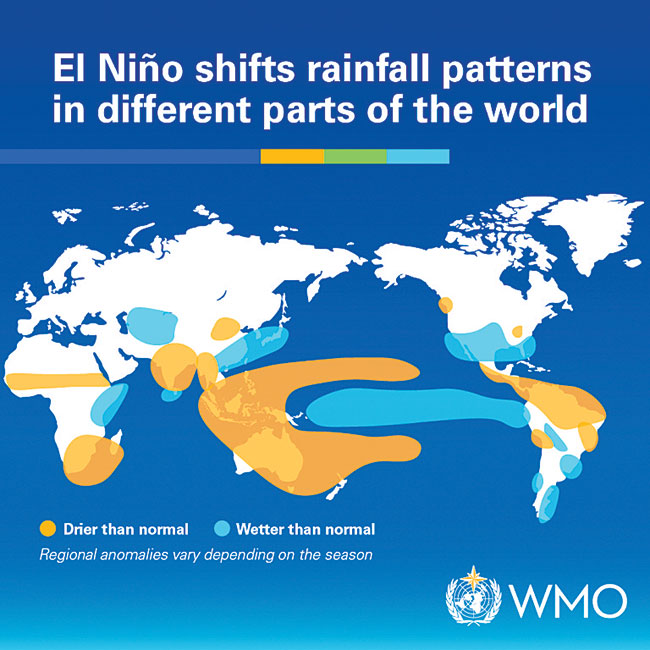
, which is Spanish for “The Boy Child,” named by Peruvian fishermen who noticed the warm ocean currents peaking around Christmas, is not a sudden, man-made disaster or an unpredictable catastrophe that is profoundly inevitable. It is one half of the El Niño-Southern Oscillation (ENSO) Cycle; the planet’s most powerful natural climate driver. Under normal conditions of the globe, strong trade winds blow from East to West across the equatorial Pacific Ocean, pushing warm surface water towards Asia and Australia, while deep, cold, nutrient-rich water wells up along the South American coast.
During an El Niño event, these trade winds weaken or even completely reverse. The pool of warm water sloshes backwards, migrating toward the Americas. This shift alters the atmospheric circulation across the entire globe, shifting jet streams and flipping weather patterns upside down. Where there was rain, there is drought; where there was dry air, there are torrential floods.
The weakening of the trade winds does not happen spontaneously. Instead, it is the result of a massive, fragile feedback loop between the ocean and the atmosphere known as the Bjerknes Feedback. We need to think of the Pacific Ocean as a giant bathtub. Normally, trade winds push all the warm water to the West (near Asia), leaving cold water in the East (near South America). Because the West is warm, it creates rising air, clouds, and low pressure. Because the East is cold, it creates sinking air and high pressure. This pressure difference is what keeps the winds blowing.
An El Niño event begins when this loop encounters a disruption. Deep in the Western Pacific, sudden, intense bursts of wind blowing from the West (opposite of normal trade winds) occur. These are often triggered by natural weather phenomena, like the Madden-Julian Oscillation, described as a massive band of rain and wind that circles the globe every 30 to 60 days.
Then there is the Oceanic Wave. These wind bursts push a massive, subsurface wave of warm water, called a Kelvin Wave, in the direction of the East across the Pacific. As this warm water moves East, it warms the cold Eastern Pacific. The result thereof is that because the East is now warm, the temperature and pressure difference between the East and the West shrinks. With the pressure difference gone, the trade winds collapse completely.
It is not spontaneous, but it is uncontrolled. It is a self-regulating, natural oscillation. The Earth’s climate system builds up heat over time. Think of the tropical Pacific as a solar heat collector. Eventually, it traps more heat than it can distribute normally. El Niño acts like a planetary pressure release valve. It releases the trapped oceanic heat into the atmosphere, which is why global temperatures spike during an El Niño year. Once the heat is dissipated, the system naturally resets, often swinging to the opposite extreme called La Niña, where trade winds become violently strong and the Eastern Pacific becomes abnormally cold, before returning to neutral.
It is totally reasonable to look at something as massively disruptive as El Niño and wonder if human hands are pulling the triggers, especially given how much we have messed with the planet’s ecosystems. Man’s actions are NOT directly responsible for triggering El Niño, but we are guilty of intensifying its impacts. Because of human-induced greenhouse gas emissions, the oceans have absorbed over 90% of excess global heat. Therefore, when a natural El Niño develops today, it is operating on a much hotter baseline. A “strong” El Niño today causes far more severe heatwaves and droughts than what an El Niño did 100 years ago. In addition, while human stupidity does not directly cause the weather pattern, political negligence, corruption, and deforestation make us completely defenceless against it. Nature creates the drought; human mismanagement creates the famine.
An El Niño event does not just randomly occur; it is highly predictable, but only up to a certain point in time. Meteorologists use a massive network of deep-sea buoys, satellites, and advanced computer models to track sub-surface ocean temperatures. Because those Kelvin Waves take months to travel across the Pacific, scientists can see an El Niño incident brewing even six months before it actually changes the weather on land.
For Sri Lanka, sitting in the warm embrace of the Indian Ocean, this remote shifting of the Pacific engine behaves like a massive atmospheric vacuum. By mid-2026, the developing El Niño is projected to significantly weaken our Southwest Monsoon (Yala season). The moisture-laden winds that usually drench the western slopes and central hills are disrupted, leading to prolonged dry spells, suppressed rainfall, and soaring temperatures: an impending doom of unpredictable severity.
The Mirage of the “Natural Cycle”
A frequent and valid argument raised by sceptics is that Sri Lanka has always survived droughts. Our ancient civilisation was entirely built upon a sophisticated cascade of tanks (Wewas) engineered by our ancient Kings to balance the natural cycles where rain and flood inevitably follow dry spells. Why should 2026 be any different?
The answer lies in a dangerous convergence: the intersection of a natural cycle with an unnaturally altered planet. Historically, El Niño events occurred in predictable intervals of two to seven years. However, decades of global greenhouse gas emissions have trapped immense thermal energy within the world’s oceans. When an El Niño occurs today, it acts on top of a baseline global temperature that is already higher than at any point in recorded human history. It injects a massive burst of heat into an atmosphere that is already supercharged.
Furthermore, our local buffering systems have been systematically dismantled. The natural cycles of nature rely on healthy ecosystems to self-regulate. Decades of rampant deforestation in our central catchments mean that when rain does fall, the soil can no longer retain it; it washes away as flash floods, leaving the land parched shortly after.
Our ancient tank systems are heavily silted due to unchecked agricultural runoff and poor maintenance, dramatically reducing their storage capacity. Today, our population has increased many times over since the last great historical droughts. The margin for error has vanished. When a dry spell hits in 2026, it is no longer just a meteorological event. It becomes an immediate, high-stakes threat to our collective survival.
The Dual Faces of the Peril: “Climate Whiplash”
The relationship between El Niño and Sri Lanka’s climate is highly complex and profoundly uneven. It is quite a hazardous oversimplification to state that the entire island will simply dry up into a desert. In reality, scientists warn of a phenomenon known as “climate whiplash”, a brutal, two-phase sequence that tests different parts of the island in different ways.
This dual nature makes preparation immensely difficult. While the western agricultural zones face severe water stress during the crucial Yala growing season, the Eastern and Northern Plains may experience a stronger-than-normal Northeast Monsoon later in the year, threatening the Maha harvest with floods rather than lack of water.
Compounding this is the impact on marine life. The disruption of oceanic currents halts the upwelling of cold, nutrient-rich waters along our coasts, threatening the phytoplankton populations that form the foundation of our fishing industry. A crisis in the ocean quickly transforms into a livelihood crisis for our coastal communities.
A Convenient Shield: Is the Government likely to exploit the “Crisis”?
Given the undeniable scientific reality of El Niño, why does the suspicion of a “government ploy” remain so stubbornly entrenched in the public psyche?
The truth is that while the weather phenomenon is entirely natural, the political exploitation of it is a time-honoured strategy. For an administration presiding over a heavily depreciated rupee, staggering inflation, fuel shortages, and an electorate deeply disillusioned by systemic corruption and unethical political behaviour, a looming natural disaster is a highly convenient distraction.
Historically, political regimes globally have utilised “disaster capitalism” and the rhetoric of impending doom to achieve three distinct political objectives:
1. Shifting the Blame:
Politicians can attribute economic misery, power outages, and food shortages to an “act of God” rather than years of policy failures, financial scams, and a lack of long-term planning.
2. Consolidating Control:
Under the guise of national crisis management, governments can divert public funds, bypass standard procurement transparency, and suppress public dissent or protests regarding living costs. They can even use draconian laws nonchalantly to quell protests.
3. Securing Foreign Aid:
Crying “imminent drought” acts as a powerful tool to solicit international foreign aid and concessions. Such a step could secure foreign exchange that can prop up a failing currency.
It is a most unfortunate but quite q realistic tragedy of loss of faith that, when our leaders shout “drought,” the citizens do not see a proactive state protecting the public. Politicians are perceived as villains looking for an exit strategy from their own defaults and scandals. The public cynicism is born out of a well-earned, deeply ingrained suspicion: one that is based on abundant past experience.
Bridging the Divide: Real Science Meets Justified Anger
We must not let political pessimism blind us to physical reality. The rising temperatures, the drying up of rural wells, and the global oceanic data, are not fabrications cooked up in a political campaign office; they are verifiable facts measured by independent scientists worldwide.
If we dismiss El Niño as a mere myth, we play directly into the hands of the very politicians we distrust. Total apathy ensures that when the agricultural yields drop, when food prices skyrocket further, and when the power grid fails due to a lack of hydropower, the public will be left entirely unprotected, while the political elite remain insulated in their air-conditioned enclaves.
The real challenge facing Sri Lanka in 2026 is a dual crisis: we are being forced to battle a volatile climate anomaly while simultaneously navigating a severe governance deficit.
The Path Forward: Demanding Accountable Resilience
Surviving the coming months requires a radical shift in how we view governance and climate preparation. We must transform our justified anger into an unyielding demand for transparency and structural resilience.
=Dynamic Energy Management: With hydropower severely threatened by drying reservoirs, the state must immediately diversify our energy mix. This means removing the bureaucratic hurdles that have historically stalled private solar and wind initiatives, often held back to protect corrupt coal and heavy fossil fuel monopolies as well as political henchmen.
= Decentralised Water and Food Security:
Rather than waiting for centralised, state-led distribution networks that are historically prone to corruption and inefficiency, local provincial councils must be empowered. Investment must be funnelled into rehabilitating local cascades, scaling up regional rainwater harvesting, and accelerating tech-driven solutions like the Thalaiyadi desalination efforts in parched Northern Zones.
= Transparent Climate Audits:
If the state claims it requires funds to mitigate El Niño, the civil society and independent media MUST demand a line-by-line public accounting of every rupee spent. If food is imported to offset local crop failures, the procurement processes must be completely transparent to prevent the predictable scams that have plagued past crises.
El Niño
is a very real possibility in the months to come, and its atmospheric mechanics are entirely beyond our control. We could only pray that we will be spared to th greatest extent possible. There is the distinct possibility that the power dynamics of nature could even be completely inverted by a force that could even be similar to the energy associated with the movement of a tectonic plate. Recently there have been a lot of opinions presented by many people, including so-called “experts”, and “pundits”,, pontificating on the likely impact of El Niño on our resplendent isle. These have varied from projected rather innocuous and tame effects on Sri Lanka, to some of them escalating the impact to major disastrous effects on the island. As usual, politicians of all hues have even waxed eloquent, most of them at the top of their voices, on the perceived potential effects of this likely natural calamity.
Yet for all that, even in the face of all the water that has gone under the bridge (pun unintended), it is vital to understand that the impact of an El Niño affair on our lives would be determined completely by human action, policy, preparedness, strategy implementation, and, of course, absolutely candid integrity. We cannot stop the Pacific Ocean from warming. However, we can prevent our institutions that need to deal with the phenomenon from sinking down to vile behaviour patterns, and even stimulate the deteriorating as well as decaying essential response portals.
The ultimate “litmus test” for Sri Lanka in 2026 is not merely whether we can survive a natural dry spell. The real, true, and candid trial for all of us would be the ultimate result as to whether we can be resilient enough to withstand the projected volatile developments of nature, while severely holding accountable the political forces that have left us ever so vulnerable to all types of quirks of nature, as experienced by the management of natural disasters even in the not-too-distant past.
By an Aficionado

Dark Fire
From a tale set just over a 100 years ago, I move back several centuries to one set in the 16th century, in the reign of Henry VIII. This was given to me by my friend Daniel Moylan – Lord Moylan I should say, which is how he was announced when he came to see me in the flat of a friend in London. He had mentioned enjoying tales of a Tudor detective, and when I expressed interest, he brought me the second in the series. The first had introduced the hero, a hunchback lawyer called Mathew Shardlake, who worked for Thomas Cromwell, Henry VIII’s Chief Minister after the fall of Cardinal Wolsey. Here, too, it is Cromwell who gets Shardlake to find out more about a secret weapon that had been brought to his notice.
The book by C J Sansom, is called Dark Fire and this refers to fire that in Byzantine days could be projected onto enemies and their equipment, notably ships, to set them immediately ablaze. But the secret had been lost, except that it seemed that a soldier, back from the east, had brought home a barrel of the stuff, which had been discovered in one of the monasteries that Henry VIII had dissolved.
Two shady individuals, including a lawyer called Gristwood, had told Cromwell about the weapon and given him a demonstration, which led him to tell the King that he could see the fire in action in a couple of weeks. But the lawyer Gristwood had torn off the formula from the document describing the weapon, and Cromwell asked Shardlake to persuade Gristwood to hand it over.
He forces Shardlake to agree by involving himself in a case Shardlake had taken on to defend a young girl, Elizabeth Wentworth, accused of having murdered her cousin in whose house she was dwelling after she had been orphaned. Joseph, her oldest uncle, who loved her, thought she would do better in town with his rich brother Edwin rather than on his farm, but she hated the house and its inhabitants, and they were all determined, including her grandmother, who was blind but dominated the household, to have her found guilty, after she was found near a well in which her cousin had drowned and his sisters said she had pushed him in.
She refuses to plead, and the judge orders her to be pressed, a form of torture, which would soon have cost her life, but Cromwell sends a trusted servant to get the judge to suspend the sentence for two weeks. And the servant, Jack Barak, tells Shardlake that he must now see Cromwell, who says that the price of the girl’s freedom is finding out Gristwood’s secret.
After this convoluted beginning, the story moves swiftly. Gristwood and his brother are found murdered. Shardlake and Barak realise they are dealing with ruthless men, and Gristwood’s wife and the librarian who had given Gristwood information about the old soldier, are taken into safe custody by Cromwell. The wife, meanwhile, tells Shardlake about Gristwood’s mistress, and they go to a brothel to find her but she flees with her brother, having evidently been sought out previously by the murderers.
Finally, the youngsters agree to meet Shardlake, but when they get to Gristwood’s house, as had been arranged, they find the boy killed, and the girl so injured that she soon dies, though not before having told Shardlake that Gristwood had told her that his contacting Cromwell was part of a plot against him.
Meanwhile, Shardlake has also been working on his own case, and realises that the key to that mystery was the well, from which there had been a foul smell when the body of the boy was brought out. This was by the house steward, who is the confidante of the family, and fancied it seemed by one of the two sisters of the murdered boy.
Shardlake and Barak explore the well on two separate nights, fleeing the first time when dogs are set loose, but also because Barak is horrified by what he seems to see there. The next time he confirms that there were dead animals there, and also the body of a little boy. And after he had managed to get Elizabeth to speak, if obliquely, she then makes it clear that these were victims of her cousin, who had been aided in his cruelty to animals by his sisters.
Shardlake has many narrow shaves from the two murderers, who follow him to the different places he has to visit, and who seem to have a source of information about what he thought was known only to him and Barak and Cromwell. He does wonder then about the three intermediaries through whom Gristwood had got his story to Cromwell, two lawyers and an aristocratic lady whom Shardlake begins to fancy, feeling that his interest is reciprocated.
To his relief she is not the traitor, nor is the lawyer who had vanished for a couple of days, though the other – who had been feared dead when his ring was found on a dismembered finger, near Lincoln’s Inn, where they all practised – was implicated along with the fountainhead of the plot, who was determined to bring down Cromwell.
So he turns up at the climax, which comes in a shed by the river where Shardlake and Barak are trapped. But after the plotters have told them what they had done, they escape since Shardlake had a dagger which Barak uses to cut his bonds, and in the scuffle the chief murderer is killed. His accomplice had died earlier, having fallen off the top of the cathedral, where he had been cornered by Shardlake and Barak, after a hectic chase.
Before the principal murderer in Dark Fire was killed by Barak, the chief plotter had left. The lawyer who had been his principal accessory was caught but before he could be taken to Cromwell, he tried to kill Barak when he was off guard. He was only stopped by Shardlake shooting the last remains of Dark Fire at him, and him being set alight by a candle so that he threw himself into the Thames.
The evidence then is gone but Shardlake and Barak have no doubt that Cromwell will believe them, and they go to his office. He is away, but his secretary says he will send a message, and the two go back home, to rest, after Barak’s wounds have been attended to, by the physician Guy, who had, one gathers, assisted Shardlake also in the first book about him.
They are surprised when there is no word from Cromwell the following morning, but they have decided that they must now go to the Wentworth home to conclude that case. The father of the murdered boy is not there, but they go to see his mother, who is with the steward. She seems to realise the game is up, and having invited them to have a drink she confesses to what had happened.
But Shardlake then realises that he has been poisoned, though he has the presence of mind to remember that Guy had told him an emetic was the answer, and he swallows some mustard and is sick, as Barak is to whom he passes the mustard pot. The steward flees, for Barak has his sword in his hand, and before the pair collapse the grandmother rises in a panic and knocks her head against a wall when she stumbles and falls.
Shardlake had managed to call for a constable before he falls senseless, and had managed to tell the constable who comes in to get Guy, who attends to the two men. The steward is caught, and a magistrate is brought in to take depositions. Edwin is distraught, for he knew nothing of what had gone on, and his brother Joseph tries to comfort him, evincing the goodness that had made Shardlake take on the case in the first place.
The story comes out at the court hearing the next day, and the crusty old magistrate has to acquit Elizabeth and arraign the grandmother and the two sisters. But when Shardlake and Barak go to the Inns, they find that Cromwell has fallen. The Catholics are now in the ascendancy, and Shardlake and Barak leave London, though since the reaction is mild, they get back a few months later. They find that the grandmother has died, and the two sisters have been imprisoned for the murder, for one of them had pushed the boy in, and then both had concealed this and tried to blame Elizabeth.
Shardlake resumes his practice, with Barak now his assistant. His former assistant, who continues though he now needs more support, had turned out to have bad eyesight, which Shardlake had not noticed. Barak had brought this to his attention, which made him realise that underneath the rough exterior was a sensitive soul. And as the extract from the next novel indicates, they will be a pair, on Holmes and Watson lines, or Poirot and Hastings.

ICC launches post-pregnancy return-to-play guidelines

Chamari Athapaththu: ‘I think I’m a failure as a captain’

Navy’s prompt search and rescue mission saves lives at sea

UK’s Starmer resigns as prime minister

President chairs discussion on providing swift solutions to challenges in apparel sector

Schools close as more than half of France under red heat alerts

‘Dates have the highest sugar content to fight Coronavirus’

Sunday Island 27 December – Headlines

#SundayIsland 17th December – Headlines

Sunday Island – 28th March

Sunday Island Headlines – 21 March

Sunday Island – 21st February – Headlines
-

 News7 days ago
Beijing Capital Airlines to resume flights to Colombo signalling boost to tourism
-
 Features6 days ago
Killing of Colombo’s ancient trees — a warning on UN’s World Desertification Day – 17 June
-

 News4 days ago
Creditor receives USD 2.5 mn as Lankan public bears loss from theft of Treasury funds
-

 News3 days ago
Creditor not yet paid
-

 News3 days ago
Consumers bearing 22% tax burden despite 18% VAT claim: Dr. Harsha de Silva
-

 Opinion5 days ago
Beyond diagnosis: A strategic design for 7% growth by 2029 (Part I)
-

 Opinion7 days ago
Fifty years after Soweto uprising
-

 Sports7 days ago
Catch every moment of the 2026 FIFA World Cup free on the Dialog PLAY App