
Opinion
Murder of Ehelepola family, Bogambara Wewa and Sightings of Wangediya

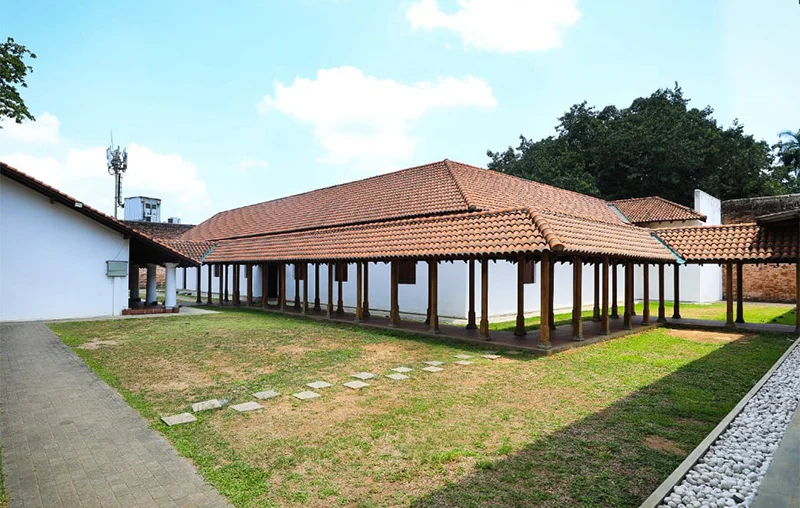
Preamble and the Accused
Ehelepola tragedy has twists and turns; I start with the African proverb, “Until lions have their own historians, the history of the hunt will always glorify the hunter.” In this story, hunters are the Kandy king, his first Adigar Ehelepola, and the British colonial government.
Within a few years of becoming king of Kandy in 1798, Sri Wickrama Rajasingha began to feel his unpopularity spread across the country and right under his nose among the Kandyan elites. He murdered captured British soldiers receiving hospital treatment in Kandy and let Major Davie die in captivity. He executed his Prime Minister, Pilima Talawa Sr., in 1812 for suspicion of colluding with the British, and, as John D’oyly revealed, was envious of the former’s alleged schemes to get his son married to the granddaughter of the late King Kirthi Sri Rajasingha (1747-1782) to establish a blood relationship to royalty.
The king then appointed Ehelepola, nephew of Pilima Talawe as the First Adigar. Continuing his wanton execution regime, he touched a nerve in Kandyans with the sacrilegious act of killing Buddhist monk Moratota Paranatala Unnanse, accused of spying for John Doyly, whom Gananath Obeyesekere called “Master Spy.” The King’s reign was an oppressive, oligarchical system consisting of himself, his family, the Chiefs, and some in the Buddhist sacerdotal fraternity in the Kandyan country.
Sri Wickrama Rajasingha was an illegitimate king, with a dubious claim to a direct royal bloodline, which weakened him as a ruler. As we know now, he was ruling the kingdom with borrowed time. Six months after the Ehelepola killings, he was deposed by the British, the empire-builder with its full power, passion, and double dealings.
The King had an irritable and short-tempered demeanour. In 1816, even as a prisoner of the British being conducted on board HMS Cornwallis, in the morning of the 26th day at sea, William Granville, the British Civil Servant heard him screaming with dreadful passion, hacking and hewing into pieces with a hatchet an extra bedstead in front of his cabin kept for him to sit occasionally. The reason for his fury was that one of his attendants had slept on it the previous night, disgracing his honour!
The Murders
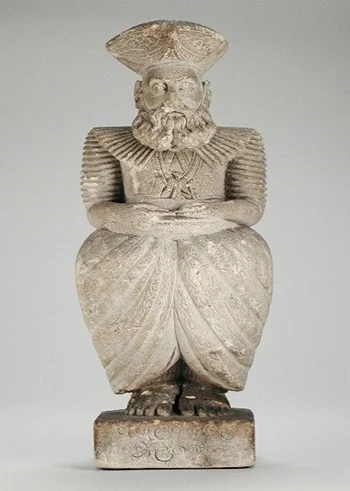
Ehelepola Nilame. Los Angeles
County Museum of Art.
The king was accused of Ehelepola murders, and Ehelepola Adigar stands as an accessory by failing to prevent the crime and willfully refusing to help the victims by abandoning the scene.
Headwinds of the crime started when Ehelepola Adigar, Dissave of Sabaragamuwa, was accused of the stabbing deaths of two koralas, under him. When the king ordered him back to Kandy for questioning, he refused. In May of 1814, the Adigar, fully aware of what the king, with his sinister bearing, would do to his family, sealed their fate by throwing away any chance of saving them, and escaped to Colombo seeking British protection.
The enraged king took hostage Adigar’s wife, Kumarihamy, and her four children, along with a few relatives, until the patriarch’s return. After hearing a rumour that the Adigar was planning to spirit away the family from the prison, the king, breaking principles of elemental justice, decided to put his family to death at a public event.
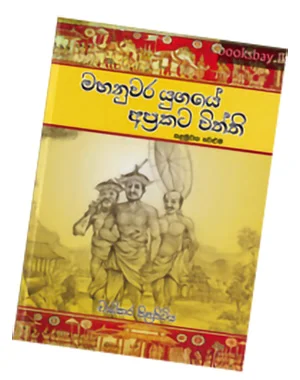
Ehelepola’s misogynist disposition is evident in an old Ola book, recently found in Padiyapelella. In his Mahanuwara Yugaye Aprakata Withthi by historian Chamikara Pilapitiya includes a statement Ehelepola made right before he returned to Kandy with the British army. He bemoaned the loss of his two children, probably the two sons. He added that they were like his two eyes, and, without them, he asked what the use of titles and a good life, referring to rumors that he was planning to get the kingship with British support. He said no word of sorrow for his wife and two daughters, who perished together with the two sons!
In Interior of Ceylon (1821), John Davy, the British Army Doctor (1816–1820), provided the most accurate description with firsthand information of the beheading of the children and the drowning of their mother. The vengeful king summoned Kumarihamy, her four children – two sons, 11 and 9 years old, a daughter, and a nursing baby, and the son of Adigar’s brother and three women to the execution stage near the Natha and Maha Vishnu devale by the palace.
After analyzing contemporary writings, including D’oyly’s Diary, Gananath Obeyesekere has determined the execution date as May 21, 1814. On this day, executioners brought implements of the crime – a wangediya (rice mortar) and a pestle. King then ordered them to decapitate the children first and place the severed heads in the wangediya. When the elder son Lokubanda dithered, his nine-year-old brother Maddumabanda stepped forward and uttered the now legendary words: “Brother, fear not. Let me show you how to die.”
The wadakayo decapitated the children and put their heads into the wangediya and handed the pestle to the agonizing mother. The king ordered her to pound the heads. If she did not, he threatened with an ultimatum – banishment in marriage to Rodiyas, the untouchables in the country, an unfathomable humiliation to her clan. Trusting it would benefit her husband, Kumarihamy declared she would do the unthinkable. With surprising courage, she began to pound the lifeless heads of her children. Some watching this catastrophe wailed, in silence, like driftwood on a deserted shore. A Chief fainted.
Henry Marshall, Surgeon of the British Forces (1808–1821), tells of the perfidious role of one Kandyan Chief who was present that day. When the king ordered the mother to pound the heads in the mortar, Kumarihamy first wavered. The Chief, who was a relative of her husband and supervised the execution, asked her to accept the king’s terms and save the family from the disgrace of living with a Rodiya clan. She did not require such encouragement. With her children slaughtered, soon to face the same fate herself, the only thing left to save was her self-serving husband and his malicious treachery for abandoning them, which she was probably not aware of at the time.
After listening to an eyewitness account, Major Forbes (1840) described the “fortitude and propriety of her conduct” by going through the “most awful scene to which any mother was ever subjected.”
Afterward, the wadakayo and slave women in the palace, carrying the remains of the children, led Kumarihamy and three women to the Bogambara Wewa, which the king could see from the palace.
Six months later, Governor Robert Brownrigg would write what happened next. The “woman herself and three more females, whose limbs being bound, and a heavy stone tied round the neck of each, they were thrown into a lake and drowned.”
King’s retributive justice regime crossed the boundaries of the 32-punishment realm under the murky and ancient Laws of Manu and Kandyan Code of Honor. Pounding heads of decapitated children in wangediya was not in those codes. For the king, it was a theater of death to warn anyone who dared to cross his path. In Discipline and Punishment: Birth of Prisons (1977, 1995), Michel Foucault wrote that such exhibitionist punishments as “the theatrical representation of pain.” But the deposed king, while aboard HMS Cornwallis, placed the blame on Kandyan laws in general, asking William Granville, “Did I make those Laws?”
Interestingly, in The Doomed King: A Requiem for Sri Wickrama Rajasingha (2017), Gananath Obeyesekere, with flimsy evidence, rules out Bogambara Wewa as the site of the drowning. He calls it a myth developed in popular stories like Purana Ehelepola Hatana, invented in the low country. He calls some informants of early writers of the Ehelepola story as “inventive mills, overloaded with falsities,” and no British account exists of Bogambara as the lake where the tragedy took place! But two decades before Purana Ehelepola Hatana, L. De Bussche wrote in Letters on Ceylon (1817) that the dead family was cast into the lower lake of Kandy. Davy was more specific. He wrote in 1821 that the women were “led to the little tank in the immediate neighborhood of Kandy called Bogambarawave [sic] and drowned.”
The alternative location Obeyesekere provides is another smaller tank north end of the city, Borawewa, near the present-day Katugastota railway tunnel. It was also closer to the Asgiriya Temple and the Royal Burial grounds, making it unlikely the king would execute prisoners and dump the bodies close to such sacred places. Obeyesekere seems to disregard Adigar himself, and Dissave of Wellassa, other Chiefs and eyewitnesses still living in Kandy who provided firsthand information to Davy and Henry Marshall.
Bogambara Wewa – The Place
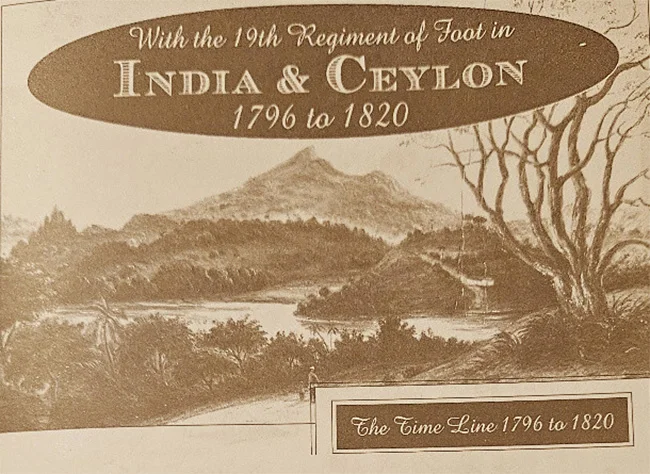
Bogambara Wewa (1796–1820). Green Howards Regimental Museum, London, reproduced in Mahanuwara Yugaye Aprakata Vitti (II) by Chamikara Pilapitiya (2018).
This Wewa, also known as Palledeniya Wewa, is believed to have been built by Rajasingha II (1635–1687). Robert Knox wrote in 1681 that the king made a bank of earth across a valley, far above a cable’s length (200m) and four fathoms high. To prevent erosion, builders made a ralapanawa (revetement) along the inner slope of the bund. He had a “banquetting house about a musket-shot from his palace” [sic] on a little hill by this pond.
In the stylish praise poem Parangi Hatana (c.1642), Bogambara Wewa is likened to the Buddhist cosmic lake Anotatta. Although Kandy Lake looks dandy, the former, with a storied past and the memory of its sepulchral encounter with the Ehelepola heartbreak, was entrenched in the public pantheon of city’s aesthetics.
When measured against the Kandy maps of Lt. Col. Henry Evatt (1768–1851) of Royal Engineers in 1816 reproduced in Nihal Karunaratna’s From Governor’s Pavilion to President’s Pavilion, and in Davy’s in 1821, this bund appears to cross the narrow valley separating Bahirawakanda range between the Police Station and a projection of the Hantana range behind the Education Office near the Railway station. Furthermore, the painting Bogambara Wewa (c. 1796–1820) shown in the image clearly shows a man and a boy walking on the bund of the wewa running in the direction where, in the distance, the distinctive summit of Hantana range is visible. The artist drew it looking towards the hospital, standing on the Pushpadana College slope of Bahirawakanda, behind the police station.
In 1817, De Bussche wrote that this Wewa covered about 6 or 8 acres. Contemporary maps show it occupied the general area bordered by sections of present-day streets named Colombo, Dalada, Yatinuwara, and the Police Station, and the elevated land where the now-decommissioned Prison Complex stands, and the Bund of the Kandy Lake. Except for a few ephemeral ponds scattered along the foot of the hills in the west of the valley, this Wewa remained the main source of water for the city until the Kandy Lake came on board in 1812.
Both lakes were fed by streams originating from Dunumadalawa forest on hills bordering the south side of the city and from Udawattakele in the North. It was unlikely the palace used water from the Bogambara Wewa since it was located uphill from the Wewa. However, as Knox wrote 135 years earlier, the king had water brought to the palace in ditches cut on mountain sides in the North and East and stored in “little ponds made with lime and stone and full of fish,” probably a well and a pond near the palace. One such pond is seen east of the Kundasale road, current Malabar Street, east of Maligawa, on the Dutch Map of 1766, reproduced in Aprakata Vitti. The 1816 map signed by Henry Evatt of the Royal Engineers shows a ditch originating from Kandy Lake to the moat in front of the palace. It then curves West, and goes North parallel to Trincomalee Street. On this map, Bogambara Wewa turns to the south and tapers off as a thin strip parallel to Old Colombo Road, the present-day Peradeniya Road.
Kandy was topographically too compact, surrounded by hills and two lakes in the middle. The area occupied by the Bogambara Wewa and fields below was the only direction the city could expand. Thus, after the British occupied it in 1815, one of their first tasks was to drain it to create more land.
The ensuing building boom in the city began soon. When Davy came to Kandy in 1817, Bogambara Wewa had already been drained. So, he wrote the city “standing on the border of an artificial lake made by the last king,” unquestionably referring to Kandy Lake (Kiri Muhuda). A few years later, Governor Edward Barnes (1824–1831) rode with Rev. Reginald Heber in 1825, proudly showing off another construction project a kilometer from the Kandy Lake – the 500-foot-long tunnel through the Aniwatta hills, a shortcut to the ferry at Halloluwa on the Mahaweli River. Building of the Pavilion (Governor’s Mansion) started around 1826 during Governor Barnes’ tenure.
Last Tango of the King and Adigar
 On January 10, 1815, Brownrigg declared war on the Kandyan kingdom. On February 11, eight months after the Ehelepola executions, the king fled Kandy. On the 12th, Major Willerman entered the city, followed by Governor Brownrigg on the 14th. Unlike later in 1819, when the Governor, as the new Lord of the land, returned to Kandy with Davy, on this inaugural day of entry, there was no pomp and pageantry with arches of white olas (gokkola) to receive him along the road from Gannoruwa. Immediately after, Ehelepola entered Kandy with Major Hook and joined Lieutenant Mylius and Ekneligoda pursuing the killer of his family. On February 18, they arrested the king and his family in a house near Medamahanuwara. The British escorted the king to Colombo, and 11 months later, banished him and his entourage to Vellore. He died there in 1832, aged 52.
To mollify the feared tempest of emotions in Kandyan people after deposing the king and ending Sinhala sovereignty, Governor Robert Brownrigg wrote in the official declaration to the Chiefs, reminding them of the king’s “bold contempt of every principle of justice, setting at nought all known grounds of punishment, dispensing with the necessity of accusation, and choosing for its victims helpless females uncharged with any offence, and infants incapable of crime.”
Two weeks after signing the Kandyan Convention, even before formal religious services for his family, Ehelepola informed the Governor that he planned to marry Pilima Talawe Jr.’s sister (widow of Migastenna Adigar) and asked for financial assistance for the wedding. Then, in April 1815, with wounded pride after being sidelined by the British, Adigar gave a mataka dana to 20 monks in memory of his family. His fantasy of becoming the “Deveni Rajjuruwo” did not materialize. Instead, the British gave him the feel-good title of “Friend of the British Government.” In 1818, the “friends” took him into custody. He was never charged but kept in confinement in Colombo. In 1825, he was banished to Mauritius and died in 1829.
Gananath Obeyesekere wrote that when Ehelepola was banished to Mauritius, Sinhala power was lost. Six decades after Adigar’s death, Lawrie wrote that the Ehelepola family line was extinct.
But the Adigar left it to history to judge what a cowardly and callous patriarch he was, having intentionally allowed his wife and children to perish at the hands of a roguish king’s executioners.
Sightings of Wangediya
After the bodies and implements used in the executions disappeared in the watery grave, the mood of the thickly knitted social, cultural, and superstition pathologies of Kandyans undoubtedly prevented any chance of naturalizing the wangediya, by saving it as a household item, or relic of the Ehelepola saga. It was a heartbreak and a cultural shock, painful, grisly, to give this object of murder a place within a residential confine.
But nine decades later, the first written account of the rice mortar used in the killings appears in A.C. Lawrie’s 1896 Gazetteer of the Central Province (Vol. I). He refers to the Kandy DC case number 30962, where a Malay named Sadim Kumba had stated to the Temple Land Commissioner that, in 1843, on land close to the new police station, he saw the stone trough used in the Ehelepola killings, and, in 1858, it was in the Kandy Pavilion.
This episode seems to have continued later with the alleged involvement in it of a T.B. Paranathala. In 1895, he was a Clerk in the Kandy District Court and was appointed as an English-speaking Special Juror (Gov. Gazette of 1895, Part II, p. 43). He probably had come across Kumba’s evidence, and, knowing its historical value, could have related it to Lawrie, who was a judge in Kandy at the time and working on the Gazetteer, which came out a year later.
When the construction of the police station began around 1843, workers moved a lot of earth in and out of the adjoining empty lake bed and its shoreline, and that it is possible to expect the chance of stumbling upon items buried in the former lake floor reappearing.
Sadim Kumba may have been privy to this information for two reasons. He was probably either part of the construction crew on the police station project or, as a boy growing up in the city, may have joined the crowd that followed the Ehelepola ladies on their last journey and saw the spot where wangediya was rolled down the bund.
If what Kumba saw is true, after the way the city cried seeing the executions, and as Brownrigg wrote then that Sinhalese are a “Superstitious Race,” it is incomprehensible that any sane person would take home a bloodied wangediya.
Thus, all physical evidence of the bloody Ehelepola episode, too, remained buried in the watery grave. Therefore, it was not until three decades after the wewa was drained that the British had any contact with what was buried in the lake floor, when wangediya surfaced perforce during grading work on the new police station site.
The British also feared that if remains of his family were to resurface, Ehelepola Adigar, remarried and living comfortably in retirement, but still a formidable character in Kandyan affairs with the title of Maha Nilame, though under a cloud of suspicion, would be upset, and create political instability by regrouping friends to take retribution against the chiefs who sided with the king.
With the scars of the 1818 revolt still in mind, following the 1843 discovery, the British would strategically remove the wangediya to the Pavilion, away from the public eye to prevent rekindling of sentiments among the Kandyans until after 1858, when it disappeared from the pavilion.
However, Chamika Pilapitiya, who inspected ola manuscripts and listened to oral histories in Kandyan country, had shared new insights into the wangediya saga with me. According to him it was found in an Ala Kola Landa (shrub land). A Muhandiram in a Malay soldier phalanx then took possession of it, washed, and used it at his home. His son Cader, who inherited it, sold it to a T. B. Paranathala Nilame. In 1929, it changed hands again, this time to Dr. J. W. Artigala, as stated by M. Malius de Silva.
If this story holds true, in three instances starting from 1843, three generations of Malay families – Kumba, Malay Muhandiram, and his son Cader in Kandy – were in contact with the wangediya in some form or another until early 20th Century, when it changed hands with Paranathala.
In conclusion, I implore scholars at the National Museum, Kandy Museum, and Ehelepola Museum to follow up on this lost trail. Because this wangediya is the only object now existing out here to have had contact with, and heard cries of, the eponymous family 211 years ago at Deva Sanhide, a stone’s throw from Ehelepola residence. If the museum can secure it, it is a solemn and endearing gesture to this family, now only admired as wax figures, standing in silence, unable to tell their story.
Only then can we write the last coda for the Ehelepola Requiem.
Lokubanda Tillakaratne writes about the Ethnography of Nuwarakalaviya.
by Lokubanda
Tillakaratne

By Chandre Dharmawardana
chandre.dharma@yahoo.ca)
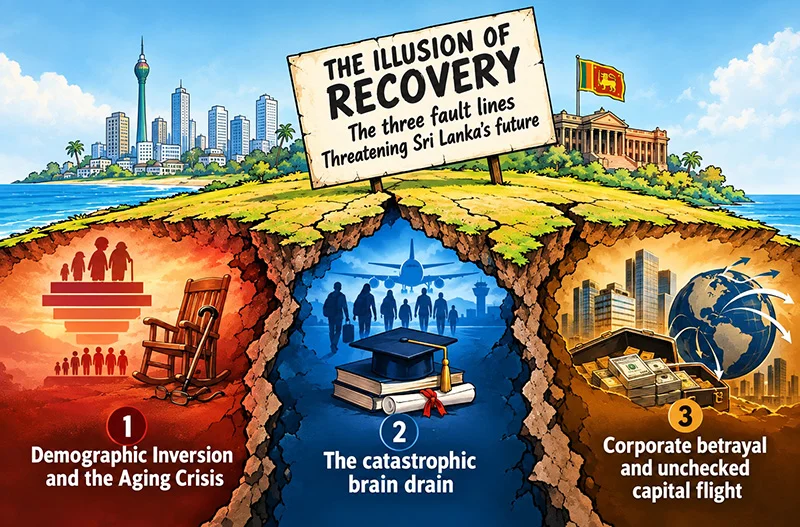
The official narrative surrounding Sri Lanka’s economic recovery is optimistic and up-beat. President Anura Kumara Dissanayake has repeatedly assured the public that the nation, which faced catastrophic bankruptcy in 2022, is finally entering “safe waters.” This political optimism is backed by data from the Central Bank of Sri Lanka (CBSL [1]), which projects an annual economic growth rate of approximately 5%, bolstered by the country’s recent structural upgrade to “middle-income” status. On paper, the macroeconomic indicators suggest a remarkable turnaround.
However, this statistics-based triumph masks a much darker, systemic reality. Below the surface of stabilised foreign reserves and GDP growth lie at least three dystopian structural fault lines: massive capital flight, an unprecedented brain drain, and a severe demographic inversion. Together, these factors form a quiet crisis that threatens to rapidly destabilise Sri Lanka, rendering its current economic recovery fragile and potentially unsustainable. In addition, we must factor in the devastating effects of climate change and sea-level rise that will play out unabated.
Independent economists note that “safe waters” at the state level have yet to translate to ordinary citizens. The 5% growth and upgraded income status have been achieved through aggressive taxation (VAT hikes) and high energy costs, meaning that while the state’s coffers are recovering, real household poverty remains painfully high and becoming worse, while the rich-poor gap is widening.
Fault Line 1: Corporate betrayal and unchecked capital flight
While the government actively pursues high-profile political figures for historical financial crimes, the most devastating drainage of Sri Lanka’s wealth is happening legally and semi-legally through the corporate elite. Capital flight has severely hollowed out the state’s financial foundation.
Research from global watchdogs like Global Financial Integrity (GFI) reveals that trade mis-invoicing, i.e., the practice of under-invoicing exports and over-invoicing imports to illicitly park profits in offshore accounts, has stripped Sri Lanka of billions of dollars annually (GFI, 2024, [2]).
This is compounded by massive migration within the garment and manufacturing sectors. Facing exorbitant domestic energy tariffs and steep Value Added Tax (VAT) hikes, major conglomerates have steadily relocated production capacities or established vital subsidiaries in more cost-effective hubs, including Kenya, Jordan, and Oman (National Chamber of Exporters, 2025, [3]).
The state’s recent investigation into over $1 billion in “phantom imports”, where advance payments were sent abroad via Telegraphic Transfers without any goods ever entering the country, demonstrates that the private sector continues to drain the country of the very foreign exchange required to sustain its recovery.
While big capital has systematically flown out of the country, exploiting critical financial loopholes intentionally created during the Yahapalanaya (Maithripala-Ranil) era, successive administrations have persistently attempted to deflect blame for Sri Lanka’s financial collapse onto external or secondary factors. A glaring example of this misdirection occurred when major international media outlets, most notably The New York Times, claimed that Chinese infrastructure loans and “debt-trap diplomacy” were primarily responsible for the country’s economic insolvency—a narrative that independent economic data has since thoroughly debunked. Similarly, a favourite rhetorical theme among all political leaders is that bribery and state-level corruption by their rivals were the singular drivers of the crisis.
Neither geopolitical debt nor political corruption has been as structurally catastrophic as the quiet, massive flight of private investment capital. This exodus was critically accelerated when the Yahapalanaya administration, under Finance Minister Ravi Karunanayake, systematically dismantled the nation’s regulatory guardrails by repealing the robust Exchange Control Act No. 24 of 1953 and replacing it with the highly liberalised Foreign Exchange Act No. 12 of 2017. This legislative shift effectively decriminalised unauthorised foreign currency retention, removed stringent tracking mechanisms on export proceeds, and opened the floodgates for legal and semi-legal capital flight in the critical years leading up to the Gotabaya Rajapaksa administration and its financial collapse. By prioritising the convenience of the corporate elite over national reserve security, these policy manoeuvers permanently starved Sri Lanka of vital foreign liquidity at the exact moment it was in dire need of retaining and attracting stable investment capital.
The removal of these Exchange control and Foreign exchange acts would seem entirely destructive to Sri Lanka in hindsight today. However, both Ranil Wickremesinghe and Ravi Karunanayake are avowed neo-liberal ideologues who would have viewed the removal of those legislations as part of their idea of full free trade and over-arching globalisation. However, perhaps unknown to them, globalisation had hollowed out the Western manufacturing base; nationalist populism and tea-party politics had already raised its head in the West. Finally, the Covid epidemic drew the curtain on the era of neoliberalism, with even the more ardent “Ayn Randyan” opponent of state intervention conceding to massive state intervention to face Covid.
To evaluate which factor has a greater structural impact on Sri Lanka’s economic stability, we must look at data from international watchdog groups like Global Financial Integrity (GFI) alongside localized corruption cases since the beginning of the Sirisena-Wickremesinghe administration (2015) up to 2026. We do this in Table 1.
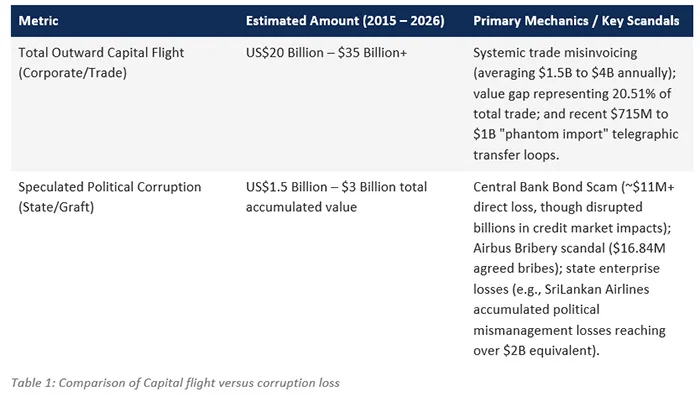
MetricEstimated Amount (2015 – 2026)Primary Mechanics / Key Scandals
Total Outward Capital Flight (Corporate/Trade)US$20 Billion – $35 Billion+Systemic trade misinvoicing (averaging $1.5B to $4B annually); value gap representing 20.51% of total trade; and recent $715M to $1B “phantom import” telegraphic transfer loops.Speculated Political Corruption (State/Graft)US$1.5 Billion – $3 Billion total accumulated valueCentral Bank Bond Scam (~$11M+ direct loss, though disrupted billions in credit market impacts); Airbus Bribery scandal ($16.84M agreed bribes); state enterprise losses (e.g., SriLankan Airlines accumulated political mismanagement losses reaching over $2B equivalent).Table 1: Comparison of Capital flight versus corruption loss
The data reveals that corporate capital flight dwarfs political corruption by an order of magnitude, making it the far more critical structural threat to the country’s economic baseline. Ultimately, while the media and politicians focus on the theatre of political arrests, the quiet, systemic white-collar flight of capital by the country’s “Big Tycoons” acts as a far more lethal haemorrhage dragging Sri Lanka back down into financial collapse.
Fault Line 2: The catastrophic brain drain
An economy cannot expand at a sustained 5% rate without human capital. Yet, Sri Lanka is currently experiencing an unprecedented exodus of its professional class. The economic collapse of 2022, followed by the subsequent imposition of heavy income taxes, soaring inflation, and a diminished quality of life, triggered a massive wave of migration.
Unlike the labour migration of previous decades, which consisted primarily of low-skilled workers sending back remittances, the current “brain drain” consists of the nation’s intellectual bedrock: doctors, software engineers, university professors, accountants, and aviation technicians. According to data from the Sri Lanka Bureau of Foreign Employment (SLBFE, [4]), record numbers of professionals have left the island for Europe, the Middle East, and Australia. The impact on critical infrastructure is already dystopian. Government hospitals frequently report a severe shortage of specialized consultants and anesthetists, while the domestic tech sector faces a crippling deficit of senior developers. Sri Lanka is effectively funding the free education of its youth, only for foreign economies to reap the productivity and tax revenues of those graduates.
The articles by (i) Hasini Lecamwasam entitled “The emptying university: why are academics leaving? (Island, 15th September 2026) [5], and Prof. Amarasiri de Silva’s article entitled Sri Lanka’s university crisis: Brain drain and union action demand urgent reform (Island, 14th September 2026) [6], specifically expose the dire situation faced by the existing 17 Sri Lankan Universities today, even though President AKD hopes to open 50 more universities shortly. Realistically, the available resources completely rule out the President’s proposal. Sri Lanka spends roughly 1.5% to 2% of its Gross Domestic Product on public education, one of the lowest in the world. Meanwhile many degree-certificate granting institutions (“private universities”) that have commodified higher education have sprung up to fill the need.
In any case, as we explain in the next section, the population is Sri Lanka has peaked, and its population pyramid has inverted, with fewer youth than older adults. There will be closure of schools as rural areas become hollowed out, and decreased enrolment in regional universities.
Fault Line 3: Demographic Inversion and the Aging Crisis
Perhaps, the most irreversible threat to Sri Lanka’s long-term stability is its rapidly changing demographic profile. Sri Lanka is currently undergoing a severe population inversion, transitioning into an aging society at a much faster rate than its regional peers.
Due to a combination of declining fertility rates, increased life expectancy, and the mass migration of reproductive-age young professionals, the demographic pyramid has flipped. For the first time in modern history, the population of elderly citizens (aged 60 and above) is growing faster than the younger demographic required to support them. According to United Nations and World Bank demographic assessments, Sri Lanka is projected to have one of the oldest populations in South Asia within the coming decade (World Bank, 2025 [7]).
This inversion creates a devastating double-bind for the state:
· Shrinking Tax Base: As young people leave or age out of the workforce, the pool of taxable income contracts.
· Exploding Welfare Costs:
The state faces ballooning expenditure requirements for geriatric healthcare, social safety nets, and pensions.
· The flight of businesses seeking cheap labour:
As the young workforce shrinks, manufacturing and businesses leave the country to relocate in other countries where labour is cheap. This flight of capital was discussed by us as “fault line number 1”.
Unlike Western nations that grew wealthy before they grew old, Sri Lanka is facing a demographic crisis while still trying to climb out of bankruptcy. According to recent data from the Sri Lankan Census and demographic researchers (De Silva 2025 [8]), Sri Lanka’s population peaked at 22.1 million in 2022 and has already entered a structural contraction. Sri Lanka’s total Fertility Rate (TFR) has collapsed to an ultra-low 1.3 children per woman—a rate lower than many highly developed Western nations, and well below the 2.1 needed for sustaining the population from extinction.
Sri Lanka had a rapid population increase after WWII, thanks to its adoption of modern agriculture (Green Revolution), control of infectious diseases such as malaria. However, Sri Lanka could not profit from the potential of its demographic bulge as a labour force. It moved towards a sluggish Marxist economy that sought state control and dismantled its plantation sector, placed draconian control over foreign exchange and investments.
Right after Independence, Sri Lanka prioritised universal free education and extensive reproductive health literacy. Meanwhile, free education led to exceptionally high female literacy rates early on. Historically, whenever female education rises, birth rates plummet—even if the nation’s GDP per capita remains relatively low.
From 1956 to 1977, Sri Lanka implemented economic policies directed towards increasing state control every aspect of the economy with foreign exchange controls. A stagnant economy led to youth uprisings that took the form of intra- and inter-ethnic conflicts that took a toll of youth populations. While an open economy was heralded in 1977 youth uprisings had already established themselves. Even children were mercilessly recruited as child soldiers by the LTTE and forced into an unwinnable conflict where about 7% of the population in the North and East (Tamils) were pitted against the government that drew strength from some 80% (Sinhalese and Muslims) of the remaining population.
Furthermore, many in the local work pool found it more lucrative to go to the Gulf countries as migrant workers, depleting the local availability of labour.
When Sri Lanka opened its economy in 1977 it succeeded in using its cheap labour pool to establish a world-class industrial base in clothes and similar industries. However, the rate of population growth slackened with increased literacy and today the population pyramid has completely inverted, with its labour pool shrinking and implying a demographic nightmare of ethnic extinction for Sri Lankans.
Countries such as Sri Lanka that do not have the financial power of countries such as South Korea or Japan (which are able to resort to robotics and AI agents) may have to turn to sperm and ova banks, in-vitro fertilisation, as well as state sponsored group parenting to sustain its population or simply face extinction. The need for such technologies was anticipated by scientists such as J. B. S. Haldane in 1924 [9], with corresponding themes were built into fictional works such as Aldous Huxley’s “Brave New World”. (To be concluded)

World Gratitude Day
by Lalith de Silva
Senior Advisor for Governance and Transformation
As we commemorate World Gratitude Day on 21 September, perhaps it is an appropriate time for all of us to pause and ask ourselves a few simple but profound questions:
What have I received? Who contributed to what I have become? What is my responsibility in return? And what can I give back?
We live in a world where we are constantly encouraged to seek “more”—more income, a better career, a higher standard of living, greater recognition, greater comfort and greater success.
There is nothing wrong with aspiration. Individuals need aspirations, and nations need progress.
However, while constantly pursuing what we do not yet have, we can easily overlook something equally important: recognising and appreciating what we already have and what we have already received.
That is where gratitude begins.
Gratitude is much more than simply saying “thank you”. It is recognising the good we have received, appreciating the people, institutions, society and natural environment that have contributed to our lives, and allowing that appreciation to influence our behaviour, responsibilities and actions.
An Ancient and Universal Human Virtue
Gratitude does not belong to any one religion, nation or culture. The world’s major religious and philosophical traditions have recognised its importance for thousands of years.
For Sri Lanka, a particularly meaningful illustration comes from the Buddhist tradition.
Following his Enlightenment, before beginning his great teaching mission, the Buddha is traditionally described as spending the second week gazing at the Bodhi tree in appreciation and gratitude for the shelter it had provided him.
There is a profound message in this simple act.
Even after attaining Enlightenment, the Buddha did not take for granted the benefit received from a tree. Buddhist teachings also associate gratitude and thankfulness with the qualities of a good and virtuous person.
Christianity, Islam, Hinduism and other religious traditions similarly emphasise thanksgiving, appreciation, duty, compassion and service in different forms.
The underlying human message is universal:
Do not take the goodness we receive in life for granted. Recognise it. Appreciate it. And respond to it through positive action.
None of us succeeds alone
If we look honestly at our lives, none of us can truly claim to be entirely “self-made”.
Before we could walk, someone carried us. Before we could read, someone taught us. Before we could earn, someone fed, protected and supported us.
Parents and caregivers made sacrifices. Teachers gave us knowledge. Friends encouraged us. Organisations gave us opportunities. Doctors, nurses and other healthcare professionals cared for us. Farmers produced our food. Thousands of workers and service providers make our everyday lives possible.
Our lives also depend upon air, water, sunlight, soil, trees and complex natural ecosystems.
Our country provides education, infrastructure, institutions, security, cultural heritage and opportunities through which we build our lives.
Gratitude begins when we stop treating all these contributions as things to which we are automatically entitled.
It reminds us of a fundamental truth: we are interconnected and interdependent.
Gratitude and Happiness
Modern research in psychology and wellbeing has examined the relationship between gratitude and subjective wellbeing, life satisfaction, positive emotions, stronger relationships and behaviours that benefit others.
This is particularly relevant because many of us unconsciously postpone happiness.
“I will be happy when I earn more.”
“I will be happy when I receive that promotion.”
“I will be happy when this problem is over.”
Yet when one goal is achieved, another often appears.
Gratitude does not tell us to abandon ambition. Instead, it teaches us to build tomorrow without becoming blind to the goodness that exists today.
Gratitude may not change what we have, but it can change how we see what we have.
This does not mean that gratitude is a cure for illness, psychological distress, poverty or injustice. Such problems require appropriate professional, social, economic and institutional responses.
Gratitude does not ask us to deny suffering. Rather, it can help us recognise that even during difficult periods there may still be people, relationships, opportunities and sources of support worth appreciating.
From gratitude to compassion and responsibility
The wider social value of gratitude emerges when we move beyond the feeling of “I am grateful” and ask:
“If I am grateful, what is my responsibility?”
If I appreciate the sacrifices my parents made for me, what is my responsibility towards them?
If teachers and educational institutions contributed to my development, what can I contribute to the next generation?
If an organisation gave me opportunities, am I serving that organisation honestly and responsibly?
If my country provided education, infrastructure, opportunities and rights, what am I giving back to my country?
This changes our thinking from:
“What more can I get?”
to:
“What have I received, and what can I contribute?”
Recognising the contributions of others can encourage humility. Understanding their sacrifices can deepen empathy and compassion. Recognising how much we have received can encourage generosity, service and a greater sense of responsibility.
Gratitude therefore has the potential to move beyond personal wellbeing and become a foundation for responsible citizenship.
What Does This Mean for Our National Challenges?
Sri Lanka, like many countries, must address serious social and national challenges, including corruption, fraud, crime, substance and alcohol misuse, violence, misuse of public property and waste of public resources.
Gratitude is not a single solution to these complex problems.
We need strong laws, effective and independent institutions, transparency, accountability, education, appropriate treatment and rehabilitation, economic opportunities and good governance.
But alongside all of these, there is another important dimension:
Human character.
Laws are essential, but laws alone cannot create an ethical society.
Law seeks to control wrongdoing from outside. Good character can help prevent wrongdoing from within.
Consider a public official who genuinely thinks:
“This authority has been entrusted to me by the people.”
That mindset can influence how authority is exercised.
Consider a leader who thinks:
“This position is not merely a privilege; it is a responsibility.”
That can influence leadership behaviour.
Consider a citizen who understands:
“Public resources do not belong to somebody else. They belong collectively to all of us.”
That can influence how public property is treated.
Gratitude can therefore help encourage a movement from entitlement to responsibility, from selfishness to compassion, from exploitation to stewardship, and from merely receiving to giving back.
It cannot replace law, governance or accountability. But it can contribute to the character and values upon which good institutions ultimately depend.
Begin with Our Children
If we want to influence the future culture of our nation, we should begin with our children.
Teaching a child to say “thank you” is a good beginning. But we can go further.
“I am grateful to my parents.”
Then what is my responsibility towards them?
“I am grateful to my teachers and school.”
What is my responsibility as a student?
“I am grateful for my country.”
What kind of citizen should I become?
At this point gratitude becomes more than good manners.
It becomes character education.
Schools can help children connect gratitude with respect, responsibility, care for public property, kindness, service and good citizenship.
What Can We Do on 21 September?
World Gratitude Day should not become simply another commemorative day on the calendar. It can become a starting point for practical action.
Individuals can contact someone who has made a difference in their lives and sincerely thank them. A telephone call, letter or simple message of appreciation can be deeply meaningful. We can go further by doing something useful for another person or for our community.
Families can spend a few minutes together identifying what they appreciate about one another. We often assume that the people closest to us know how much we value them. Expressing it can strengthen relationships.
Schools, universities and Pirivenas can organise short discussions, essays, art, debates, gratitude letters and community-service activities around gratitude, responsibility and good citizenship.
Public and private organisations can recognise the contributions of employees, customers and communities and ask an important organisational question: What have we received from society, and what can we give back?
Religious and community organisations can highlight gratitude, compassion, service and responsibility through their own traditions while recognising gratitude as a universal human value.
A Simple National Initiative
The Government can also facilitate national awareness of World Gratitude Day on 21 September.
This need not require a large budget or elaborate celebrations.
A national awareness message could encourage citizens to reflect on gratitude. Schools and public institutions could be encouraged to undertake simple voluntary activities. Community service could be promoted. Public institutions could recognise people whose often-unnoticed work contributes to society.
Most importantly, World Gratitude Day could encourage a national conversation about gratitude, responsibility, service, integrity and good citizenship.
Such an initiative should be inclusive and non-sectarian, recognising gratitude as a universal human virtue shared across Sri Lanka’s religious, ethnic and cultural communities.
In future years, Sri Lanka might also consider developing the period around 21 September into a National Gratitude Week, allowing schools, government institutions, businesses, religious organisations, civil society and communities to develop activities appropriate to them.
The purpose should not be ceremony for ceremony’s sake. The objective should be to encourage reflection followed by action.
From One Day to a Way of Life
One day cannot transform Sri Lanka.
But one day can begin a practice.
Practice → Habit → Character → Culture → National Transformation
Repeated practice can become habit. Habits influence character. Character influences behaviour. When enough people practise similar values, they begin to influence the culture of families, organisations, communities and eventually society.
On 21 September, therefore, let us begin with four simple principles:
Pause. Recognise. Appreciate. Give Back.
Pause and look at our lives.
Recognise the people, opportunities, institutions, society and natural environment that have supported us.
Appreciate what we have received.
Then ask:
“If I am grateful, what is my responsibility—and what can I give back?”
Sri Lanka needs economic transformation. We need institutional and governance reform. We need technological progress and greater opportunities for our people.
But alongside all of these, we also need human transformation—a transformation that strengthens gratitude, compassion, responsibility, integrity and commitment to the common good.
The journey can be expressed simply:
Gratitude → Happiness → Compassion → Responsibility → Integrity → Good Character → Stronger Communities → A Better Nation
Let World Gratitude Day on 21 September become an opportunity to begin that journey.
Let us make gratitude not merely a feeling, but a practice; not merely a practice, but a habit; and ultimately a way of life.
Let us ignite a Gratitude Revolution—from the individual to the family, from the family to the community, and from the community to the nation.
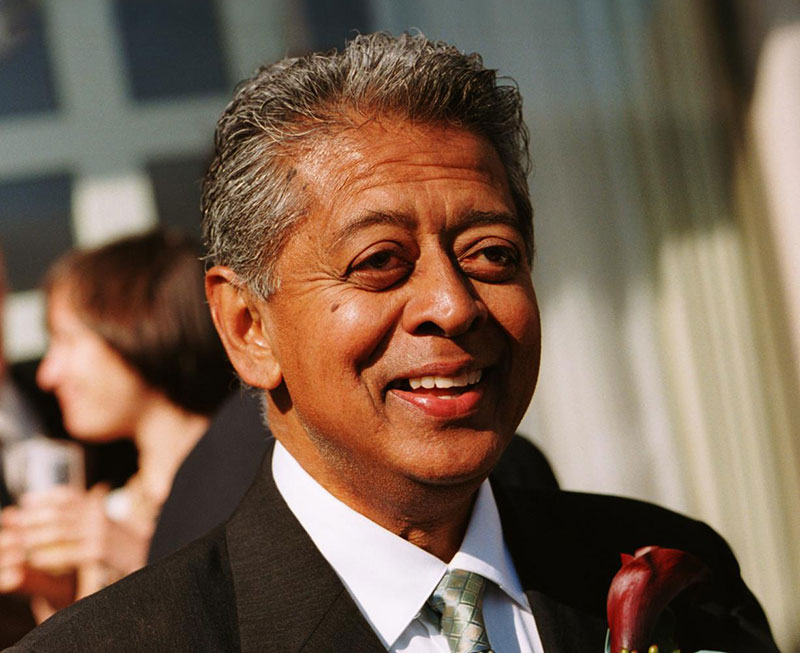
Vijaya Chandrasoma, a frequent and valued contributor to this newspaper I edit passed away at 85+ in Colombo a few days ago, far from his family domiciled in the United States; but his children with whom he was in close touch were able to make it for the funeral on Sunday. Vijaya or Vicky as he was best known to friends and family had a visceral hatred of President Donald Trump, no doubt shared by a majority of mankind. This he was not slow in expounding in the widely read columns he wrote for us.
In the covering letters accompanying his articles, he always included a cryptic note: “Yours to do as you please” demonstrating the generosity of his nature leaving open the exercise of any editorial judgment with no hard feelings whatever. That was the quintessential Vicky who sometimes wondered whether he was indulging in an overkill of Trump whom he detested as much as he loved Obama.
He loved Obama as much as he loved the USA which he felt had given him and his family a second chance which his family seized but he, as he freely admitted, allowed to slip by. He had the honesty to publish a self-deprecating book titled All Show And No Substance sub-headed A Cautionary Tale he meant mainly for his grandchildren “in the hope that they may learn something of the life and times of their grandfather and the world in which he lived.”
Vijaya Chandrasoma was second of the four sons of M. (Tissa) and Gertie Chandrasoma, his father being a member of the prestigious Ceylon Civil Service (CCS) reputed for his efficiency. While Vicky had classified his family as “upper middle class” a better description might have been “well to do.” As schoolboys we used to walk home for lunch together from Royal College along Fifth Lane, him to turn off at the barrel drain behind Ladies College now called 27th Lane and I onward to Charles Way further down the lane.
Vicky being a couple of years senior, my memories of him in school are dim but I do remember his telling me how his father, a reputed university athlete, cheered him with a “come on Vicky” at an inter-house athletics meet and how he and a partner defeated a champion combination in a game of tennis doubles. We had a distant kinship too through my mother’s paternal roots in Galle and he was very close to my cousin, best known by his nickname Koiman, who teamed up with him as fellow students in London.
The Chandrasomas went off to London after Tissa, a favourite of then Prime Minister, Sir. John Kotelawela, resigned after a disagreement with SWRD Bandaranaike, Sir John’s successor. He got a plum private sector job, number two at the foreign-managed Shell Company which dominated the petroleum import and distribution market in then Ceylon. Vicky makes no secret of what he called his “dissolute” life in London as a teenager concentrating on booze, horses and greyhounds.
Nevertheless he was accepted by St. Andrew’s University in Scotland, Cambridge and Oxford he eventually joined only to be “rusticated” after a year. His life in Colombo on his return from the UK was predictably fast with a stint in an accountancy firm his father got him into as an articled clerk, managing a hotel in the Maldives whose tourism industry was just taking off, running a tourism business in Colombo, an attempt at immigrating to Australia and finally ending up in Los Angeles.
He eventually relocated, alone to Colombo with his family remaining in LA. To his immense pride his children did very well in Ivy League Universities and thereafter “no thanks to me.” I bumped into him at the HSBC branch then at Dharmapala Mawatha and was able to introduce him to the bank to open an account. We reconnected and hence his many columns to these pages all written free gratis and for nothing.
He, like his father before him wrote very well and his copy was not all Trump bashing. There were so many readable pieces of his time at Oxford, his days with his friend Gamini Disssnayake to whom he was a trusted aide and speechwriter, and a memorable interview he did in Canada with Singapore Prime Minister Lee Kwan Yew. “This was sprung on me and I was absolutely unprepared. My heart was in the pit of my stomach. But PM Lee helped me through.”
A colourful life has ended, one where he blamed nobody but himself for anything that went wrong. Rest in peace my friend. Pity our long-promised meeting never happened.
Manik de Silva

High Court convicts 14 over deadly Easter bombings

Mandhana, Shafali and Ghosh lead dominant India to Asian Games gold

Fatima Sana and Umm-e-Hani secure bronze for Pakistan in Asian Games

India bat first in Asian games womens cricket final

Showers about 100mm will occur in the Western, Sabaragamuwa, Central and North-western provinces and in Galle and Matara Districts

Govt. confident of 2/3 majority despite NPP split speculation

‘Dates have the highest sugar content to fight Coronavirus’

Sunday Island 27 December – Headlines

#SundayIsland 17th December – Headlines

Sunday Island – 28th March

Sunday Island Headlines – 21 March

Sunday Island – 21st February – Headlines
-

 News6 days ago
US embassy won’t comment on IGP’s probe into joint drug raid
-

 News4 days ago
Shanakiyan urges urgent action over reported death sentence for Lankan in Saudi Arabia
-

 News5 days ago
Bid for Basil’s extradition nears final stage: Police
-

 Business6 days ago
All-new Bolero MaXX unveiled in Sri Lanka
-

 News3 days ago
Namal Rajapaksa Buddhist gambit fails, bail denied
-
 Opinion6 days ago
A journalist who wrote across the divide
-

 Editorial7 days ago
More fuel price shocks shrouded in secrecy
-
 Sports7 days ago
MAS Holdings, official clothing sponsor of Sri Lanka team at Aichi–Nagoya 2026 Asian Games