
Life style
The ” Indian burger ” McDonalds can’t master

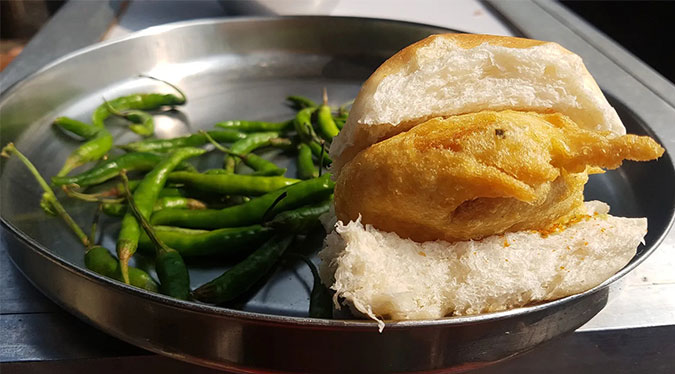
Thakur dropped another batch of potato patties, known as batata vada, into the cooking oil that had been sizzling in a massive iron pan since early morning. He’d already shaped the patties, made with mashed potato mixed with masala spices, green chilli and, occasionally, finely chopped raw onion, into near perfect spheres, and dipped them quickly in a thick chickpea batter just before frying. The vada made a gentle hiss as they hit the oil, and the aroma of the chickpea batter floated in the air, making me impatient. A few tosses and turns, and the vada were ready.
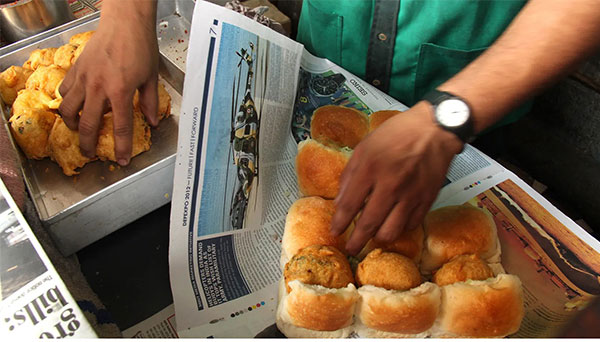
Thakur sliced open a soft, square bread roll called a pav, slathered on some green chilli-coriander chutney, and gesturing to me with a bowl of dry garlic chutney asked, “Lahsun?”
I nodded, and he sprinkled on a generous quantity of garlic chutney, then pressed the vada on top. He wrapped the sandwich in a piece of old newspaper, added a side of fried green chilli (in case the spice hit was not enough) and handed it to me in exchange for 12 rupees (roughly 14 pence).
As my teeth sank into the soft cloud of pav and the crispy vada, it was almost as if I was biting into the original taste of Mumbai. It was a perfect contrast of tastes and textures: the chewy blandness of the pav acting as a foil to the piquant crunchiness of the vada. Even to my palate, shaped by years of spicy food, the first mouthful was a fiery hit. I could feel the tang of both chutneys spread across my tongue. The vada pav is a delectable carb overload – an instant energy boost.
Today, this snack is synonymous with the city of Mumbai, with almost every resident, from factory workers to college students to Bollywood stars, unabashed in declaring their love for it. More than two million of these crispy, flavourful sandwiches are consumed in India’s financial capital and largest metropolis every single day.
“For a city that’s always on the move, I think the vada pav makes for the quickest, wallet-friendly, on-the-go snack,” travel blogger Kaushal Karkhanis, who runs a dedicated to this single dish, told me. “I think it’s the first ‘eating out’ experience for just about anyone in Mumbai. At this price, it cuts across social strata and is a great leveller.”
While the vada pav is delicious (as fried snacks tend to be), the overwhelming love for this snack often leaves outsiders bemused. But the truth is that the Maharashtrian capital has a close cultural connection with the vada pav that goes way beyond taste.
The dish is believed to have been invented in 1966 by a Mumbaikar, Ashok Vaidya, who opened the first vada pav stall opposite the Dadar train station, through which hundreds of thousands of workers – often in need of a quick, inexpensive snack – passed every day on their way to the textile mills in suburbs such as Parel and Worli. Vada pav was an instant hit with Bombayites (as Mumbaikars were then known). Vaidya remains a Mumbai icon; one local journalist even made a documentary about him.
After strikes throughout the 1970s and ‘80s eventually led to the textile mills’ closures, many former mill workers opened vada pav stalls of their own with the encouragement of Maharashtra state’s right-wing political party, Shiv Sena.
“The vada pav was subsequently co-opted by the Shiv Sena in order to offer a Maharashtrian alternative to the Udupi joints that were extremely popular at the time,” explained Mumbai-based food writer Meher Mirza, referring to the stalls set up by people from the South Indian temple town of Udupi in Karnataka. Shiv Sena’s campaign followed the rise in popularity of several south Indian dishes: the dosa (a crepe-like pancake made from fermented batter, traditionally stuffed with a spicy potato filling) and the idli (a savoury steamed cake made from black lentils and rice). The goal was to convince Mumbaikars to spurn ‘outside’ snacks and embrace their own cuisine, a strategy that worked very well in those turbulent economic times.

Ironically, both of vada pav’s main components – the potato and the bun – are European imports, brought into India by the Portuguese around the 17th Century. The only key ingredient originally belonging to the region – or even India – in the dish, is the besan (chickpea flour) in which the potato mix is coated before being deep-fried. Still, Mumbaikars consider the vada pav a thoroughly ‘Bombay’ (as Mumbai is still called by many of its residents) dish.
The vada pav industry in Mumbai chugged along peacefully until the 1990s with the arrival of international chain restaurants like McDonald’s, which served vegetarian burgers similar to vada pav to accommodate many Indians’ aversion to beef. But although the patties consist of fried potato, McDonalds’ McAloo Tikki burger could not be more different from the beloved vada pav. Not only does it not match the spice levels of the home-grown vada pav, but it also leaves little room for artistry. The flavour of vada pav depends entirely upon the whims of the cook, with every vendor claiming to have a secret recipe or a special ingredient that makes his vada pav unique: a pinch of ground masala, or a topping of choora (the crispy crumbs left at the bottom of the frying pan) along with the vada. It’s no wonder that the vada pav has always remained more popular in Mumbai, where it flies off street stalls like the proverbial hot cake.
In the early 2000s, local entrepreneur Dheeraj Gupta saw an economic opportunity and franchised the vada pav in his chain . “Calling it the ‘Indian burger’ immediately gave it an aspirational value, as well as a cultural context for those outside Mumbai city,” Gupta told me.
The company also introduced several new spins on the traditional treat, such as the Schezwan vada pav (inspired by Chinese cuisine) and the Nacho vada pav (topped with tortilla chips). Gupta says that the modern variants have struck a chord with consumers, accounting for more than 40% of sales. JumboKing now has 75 outlets in Mumbai alone, with each selling more than 500 vada pav every day, Gupta said. The chain can also be found in cities like Pune and Indore, and Gupta has plans to expand his reach even further over the next five years.
However, many Mumbai residents still vouch for the taste of the vada pav made in the street-side stalls. The most popular vada pav stalls – such as Aaram Milk Bar opposite the Chhatrapai Shivaji Terminus or Ashok Vada Pav in the suburb of Dadar – can still be found near suburban train stations across the city in order to serve the commuters who rely on the ‘Bombay local’ trains (as residents call them) to get to work. Some vendors have even begun serving adapted versions, dishing out Schezwan and sweetcorn vada pav with panache.
But as a former Mumbai resident, I am still partial to the original vada pav. To me, it’s the true taste of the city.– BBC

By Ifham Nizam
The boat had been travelling for hours under the relentless sun when Royden Oswald Gibbs finally reached the lighthouse.
For most people, the journey would have been enough. For Gibbs, it was only the beginning.
He opened his sketchbook and began to draw, carefully observing the structure, measuring it and recording its details. His student Wasantha Siriwardena photographed the lighthouse as Gibbs worked. The heat was punishing. Eventually, Gibbs fainted from dehydration.
But after recovering, he had only one thought.
“Let’s go and cover the other lighthouse.”
He never gave up.
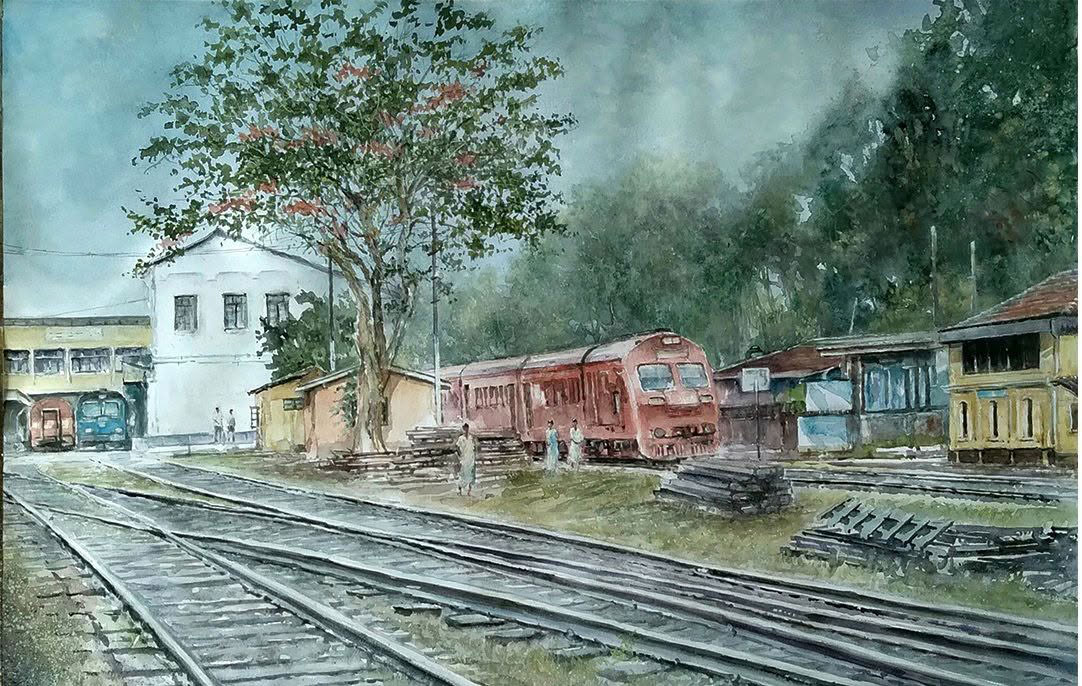
That determination defined much of Gibbs’s 65-year journey as an artist – a journey that took him across Sri Lanka in search of places, landscapes, buildings and fragments of history that he believed should be preserved for those who came after him.
He travelled on foot, by bus, car and boat. Distance and discomfort rarely stood in his way. His interest in historical places and nature drew him into forests, across mountains, along coastlines and towards remote temples and lighthouses.
He painted the Sri Lanka he saw – and, unknowingly perhaps, created a record of a Sri Lanka that was already beginning to disappear.
Gibbs died on 14 July 2026, leaving behind a remarkable collection of paintings that friends and students believe should be regarded as part of the country’s cultural heritage.
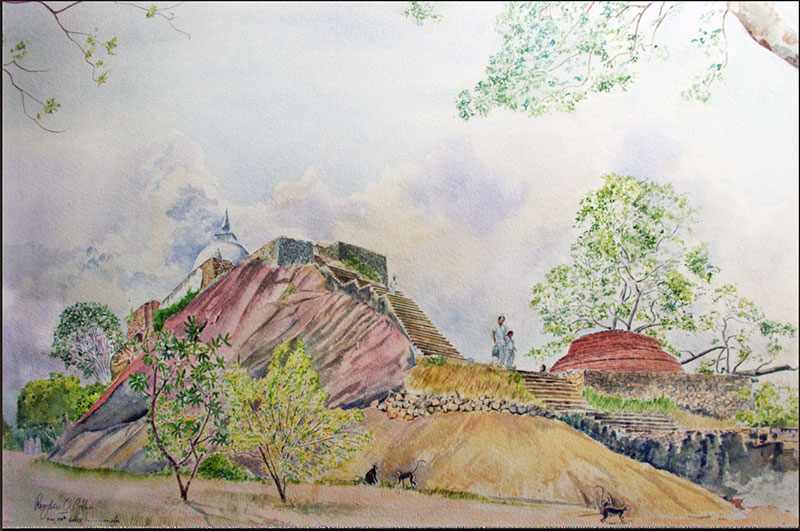
His subjects included Raja Maha Viharayas, Tampita temples, forts, ambalamas, old houses, bridges, lighthouses and landscapes.
-
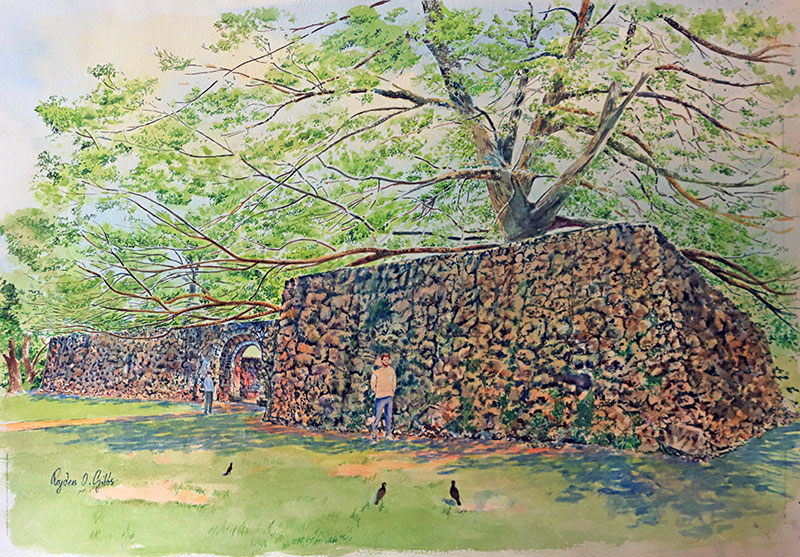
- Dutch Fort Katuwana, Matara
-
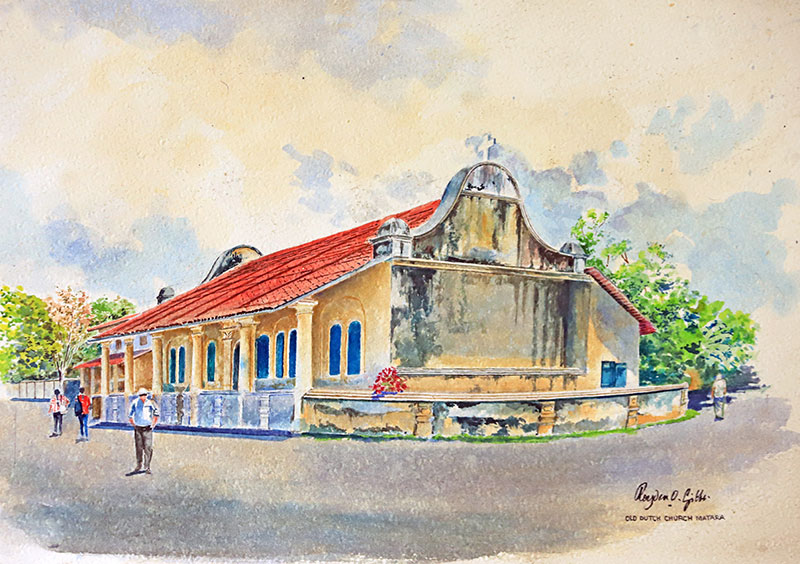
- Church Matara
Some have changed. Some have disappeared.
And some survive today principally because Gibbs thought to paint them.
Painting against disappearance
Among the most significant works in his collection is his painting of the Mullaitivu Lighthouse, which was destroyed during the civil war when the area was under LTTE control.
The painting has assumed an importance beyond its artistic value. It provides a rare pictorial record of a lighthouse that no longer exists.
The Galle Lighthouse, regarded as Sri Lanka’s first lighthouse, was also among the subjects he captured.
For Gibbs, painting was never simply about producing a beautiful picture.
“He was a patriotic person and wanted to document the historic sites, the old houses, the buildings, the Raja Maha temples, the Tampita temple, the lighthouses and the bridges – everything that was fast vanishing,” says senior environmental lawyer Dr. Jagath Gunawardena, a longtime friend of the Gibbs family.
Gunawardena believes Gibbs was thinking about generations yet to come.
“He wanted to keep a visual record of everything he had seen for upcoming generations. He didn’t think of his life or the present day. He thought of the future.”
That makes the collection particularly important today.
A painting of an old building becomes something different when the building is demolished. A landscape acquires another significance when the landscape has been transformed. A lighthouse painted in another era can become historical evidence after the structure disappears.
Gibbs’s work, therefore, occupies a space somewhere between art and memory.
A lifetime with colour
Gibbs was a student of St Peter’s College and studied painting at the Cora Abraham School of Chitra and Mudalindu, under the late Mudaliyar A. C. G. S. Amarasekara.
He began painting professionally at 16 and continued for approximately 65 years, participating in both solo and group exhibitions.
He worked in watercolour, oil, acrylic, pastel, charcoal, pencil, coloured pencil and pen and ink.
But watercolour remained particularly important to him.
“He used to always say watercolour is the most difficult medium and once you get hold of it, the others are easy,”
Gunawardena recalls. “His motto was to start off with a difficult thing and go to easy things, and not the other way around.”
Gibbs had an unusual ability to distinguish subtle variations in colour.
“He had a great ability to see even the most delicate colours,” Gunawardena says.
His artistic discipline did not diminish with experience. Even after establishing himself as a highly accomplished artist, he continued to study and experiment.
“He knew he was an excellent artist and a master, but he still went on improving,” Gunawardena says.
Gibbs kept a substantial collection of art books and believed artists should continue learning.
His advice was simple: learn from everything, but ultimately do what you like.
-
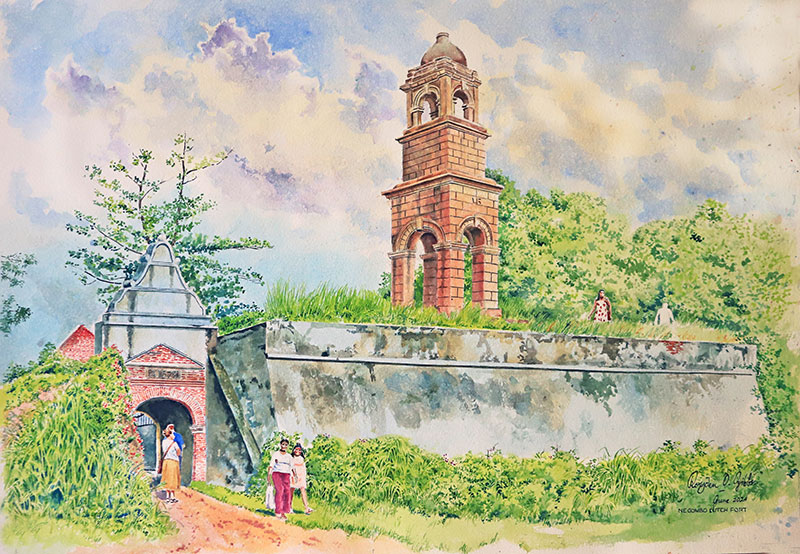
- Negombo Fort
-
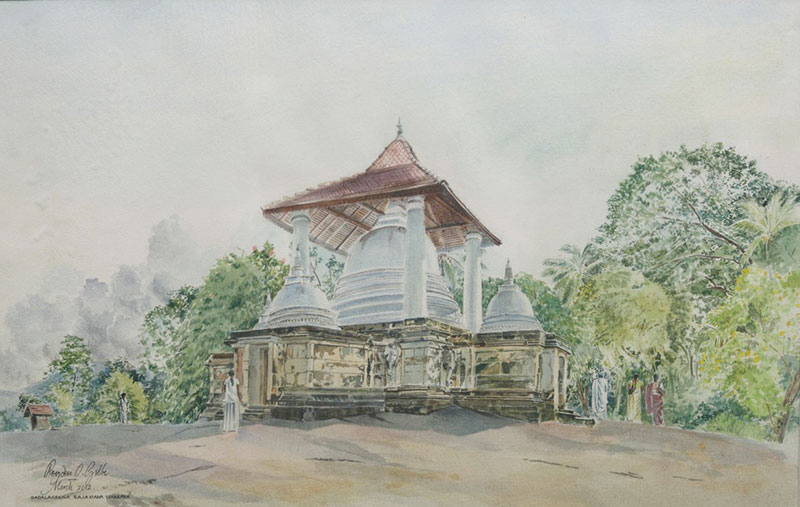
- Gadaladeniya Rajamahaviharaya
-
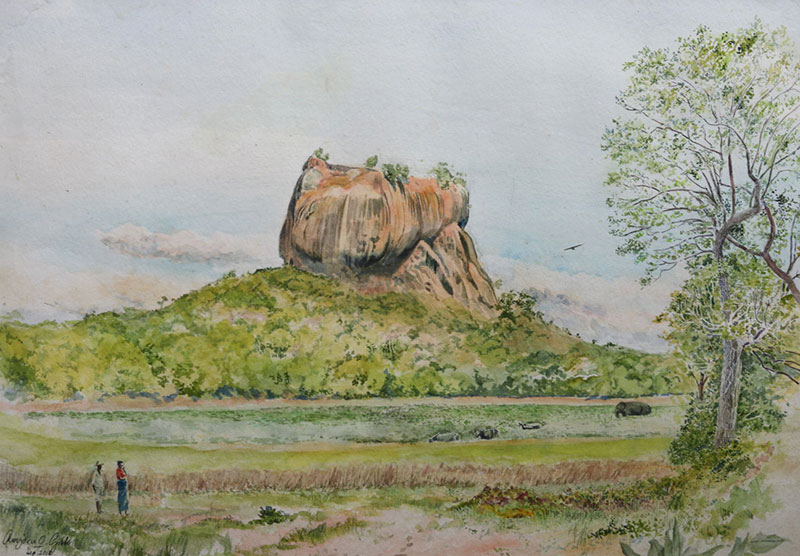
- Sigiriya
-
- Sithulpawwa
The teacher
For many of his students, however, Gibbs’s greatest legacy was not what he painted, but what he taught.
“He was a national treasure,” says student Dillai Joseph Rodrigo. “All he told us, as aspiring artists, was to one day leave something for the country. He, indeed, showed it by action by recording some of the places that no longer exist.”
Student Kalhari Perera remembers a teacher who demanded much more than technical ability.
“I don’t know of any artist in Sri Lanka who has travelled across the country and painted live – on mountains, oceans and temples,” she says.
Yet she believes the country did not sufficiently appreciate his contribution.
“It breaks my heart to know that we, as a country, have failed to appreciate this amazing talent. It’s a pity that art in Sri Lanka is so commercialised rather than appreciated.”
Perera had lived for about a decade down the road from Gibbs without knowing that he conducted classes.
When she eventually became his student, she discovered a demanding teacher.
“He demanded perfection, discipline, regular practice and passion.”
Gibbs was not interested in keeping students merely for the sake of numbers.
“He most often gave up on students who didn’t connect well because he never thought of money,” Perera says. “He had many ‘first-class students’, he said – the ones who never came back after the first class.”
Learning to see
Perera says Gibbs taught her something no textbook could provide.
“He was the teacher who opened my eyes to colour and how to identify my surroundings like an artist.”
She remembers listening to his stories of travelling across the country, including journeys undertaken during the war, when he would spend hours in boats, under the scorching sun, painting lighthouses.
She was also fortunate enough to paint outdoors with him.
His last live painting session was with her at Beddagana Bird Park.
Gibbs and his wife Linda became close to her.
“Sir and his sweet wife Linda were like my own mother and father,” she says. “Linda makes the best coffee in Colombo. He served that coffee to me with great pride.”
The memory is revealing of the man behind the artist.
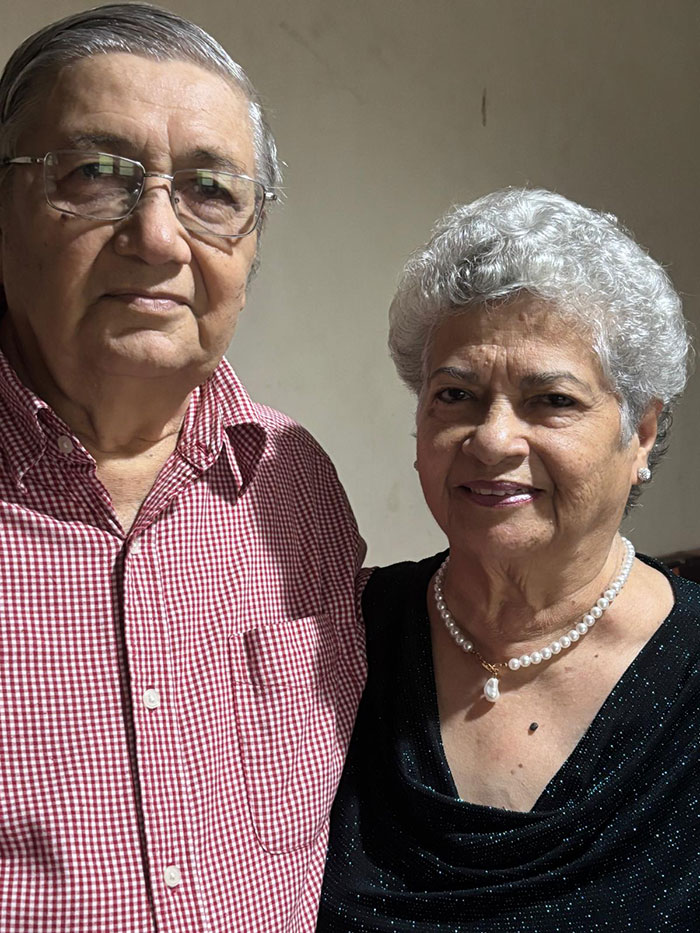
Royden and wife Linda
“He appreciated the simple things in life. He was a simple man.”
Trincomalee in the 1980s
One of Perera’s most treasured Gibbs paintings is of Trincomalee Harbour, painted in the 1980s.
Gibbs was selective about whom he sold his work to. He wanted his paintings to go to people who genuinely appreciated them.
“I gave the money I had at that time and told him to give me a painting of his that he would like me to have,” Perera says.
He gave her the Trincomalee Harbour.
“The harbour doesn’t look the same now. This I will treasure for the rest of my life.”
For Perera, the painting is also a reminder of the responsibility that comes with being his student.
“I am so fortunate to have got my foundation from him. A solid, unshakable foundation. Now I have the task of building on.”
The journeys that mattered
Wasantha Siriwardena remembers joining Gibbs on expeditions to Jaffna and Delft Island and later travelling with him to see some of the country’s most remote lighthouses.
They wanted to reach the Kirinde lighthouse and the Great Basses and Little Basses.
Few people had visited some of these locations.
They stayed overnight at Kirinde and left by boat at around 6 a.m. with the Coast Guard.
They reached the lighthouse at about 10.30 a.m.
While Gibbs sketched and measured the structure, Siriwardena photographed it.
Then Gibbs collapsed from dehydration.
After recovering, he wanted to continue.
“He never gave up,” Siriwardena says.
The same persistence was evident in his teaching.
“When he was ill, I used to drop him at the hospital. When he comes back home, he calls me and says, ‘Good evening, I am back.’ He was very energetic.”
This time, however, Gibbs did not return.
A master of many mediums
Student Chandana Illankone met Gibbs in 2020 and describes him as possibly the finest watercolour artist he had encountered in Sri Lanka.
“He may be the best in mastering watercolour in Sri Lanka. Nobody has done such type of art in watercolours in Sri Lanka.”
Pen and ink, too, was among his strengths.
“Not many people can do it. He was an expert in every medium.”
Illankone remembers Gibbs’s paintings of Raja Maha Viharayas and other historic locations.
“Some of those places have changed now. Even during the civil war he went and did his paintings.”
But recognition did not always follow achievement.
“He has done so much for the country. Sri Lanka should preserve these paintings,” Illankone says.
A threefold legacy
Gibbs was unable to attend the launch of his final exhibition of paintings by his students on 19 June 2026 because of illness.
Gunawardena attended in his absence.
“I didn’t think Gibbs would leave us so soon,” he says.
Gibbs had experienced periods of illness and recovery for several years. Yet he continued to paint, teach and travel whenever he could.
Gunawardena sees his legacy as threefold.
“A lot of paintings, a lot of techniques and a lot of students.”
His life outside painting was equally marked by curiosity.
He loved ornamental fish, their vivid colours and the pleasure of watching them spawn. He decorated the fish tank on his verandah with the same artistic imagination that informed his larger works.
He also took great pleasure in nurturing his peacock fern, watching it grow.
Perhaps this was the essence of Gibbs: he paid attention.
He looked closely at a lighthouse, an old temple, a bridge, a tree, a bird, a fish or a flower. He saw details that others might pass without noticing.
Then he recorded them.
What remains
Gibbs’s death leaves behind more than an archive of paintings.
It leaves a question.
What will happen to these works?
If they are scattered, forgotten or allowed to deteriorate, Sri Lanka risks losing not merely the work of an accomplished artist but an irreplaceable visual record of its own past.
Gibbs understood that the things he painted might not survive.
So he preserved them in colour.
His paintings now offer a glimpse of lighthouses that have vanished, landscapes that have changed, historic places that have been altered and buildings that may no longer stand as he knew them.
He travelled because he wanted to see.
He painted because he wanted others to see.
And he kept going because he believed that what mattered should be recorded.
Perhaps the finest tribute to Royden Oswald Gibbs would, therefore, be to ensure that his paintings do not become another part of the history he worked so hard to preserve.
They belong to the country he spent a lifetime documenting.
And somewhere in those colours – in the faded walls of an old temple, the distant outline of a lighthouse, the green of a forest or the blue of a harbour – is the Sri Lanka Gibbs saw, loved and quietly saved for us.

For years, Ramani Fernando has been part of Colombo Fashion Week, bringing her expertise in hair, beauty and styling to one of Sri Lanka’s most anticipated fashion platforms. From the excitement backstage to the glamour of the runway, her journey with CFW reflects the remarkable evolution and the growing importance of beauty in completing a designer’s vision. Her contribution backstage has helped shape the distinctive beauty and glamour that bring the runway to life.
(Q) You have been associated with Colombo Fashion Week for many years. What does CFW mean to you personally and professionally?
(A)Colombo Fashion Week has been a very special part of my journey, both personally and professionally. I’ve had the privilege of watching it grow and evolve, and to have been part of that journey is something I’m very proud .
For me, CFW is not just about fashion. It is about creativity, collaboration and showcasing Sri Lankan talent to the world. Every year, there is a new energy, new designers, new ideas and new ways of interpreting beauty. Being part of that is incredibly exciting.
(Q) How has your involvement with CFW evolved since the early days?
(A) When we started, the focus was very much on creating beautiful hair and makeup looks for the runway. Over the years, our involvement has become much more collaborative.
Today, we work much more closely with the designers and the CFW team to understand the overall concept and make sure the hair and makeup complement the collection rather than simply looking beautiful on their own. It has become a much more creative and considered process.
(Q) What changes have you seen in hair and makeup trends on the CFW runway over the years?
(A) There has definitely been a huge evolution. In the earlier years, runway beauty was often more glamorous and defined. Today, there is much more freedom to experiment.
We’ve seen everything, from very polished, sculpted looks to fresh, natural skin, textured hair and more unexpected creative elements. What I love is that beauty on the runway has become less about following a trend and more about telling a story and complementing the designer’s collection.
(Q) How do you translate a designer’s vision into the right hair and makeup look?
(A) The first step is always listening. I want to understand what the designer is trying to communicate through the collection—the colours, fabrics, silhouettes, inspiration and overall mood.
Then we look at how beauty can support that vision. Sometimes the right look is very minimal because you want the clothes to speak. Other times, hair and makeup become an important part of the statement. It is about finding the right balance.
(Q) What is the creative process between you, your team and the designers before the show?
(A) It is very much a team effort. We discuss the collection with the designer and the CFW team, look at references and understand the mood they want to create.
Then my team and I work on the hair and makeup direction and make sure the looks are presentable across the entire show. There is a lot of communication and, of course, a lot of testing and fine-tuning before we arrive at the final look.
(Q) What happens behind the scenes before the models walk onto the runway?
(A) There is a tremendous amount of work happening backstage that the audience never sees. Our teams are working continuously on hair and makeup while models are changing outfits and moving between different designers.
Timing is everything. Everyone has to know exactly what they are doing, because there is very little room for mistakes. It can be intense, but it is also one of the most exciting environments to work in. When the music starts and the first model walks out, all that backstage energy suddenly comes together.
(Q) What has kept you coming back to CFW year after year?
(A) The people, the creativity and the energy.
Every year brings something different. I love seeing new designers, new talent and new ideas coming through, and I also love seeing how much the platform has grown.
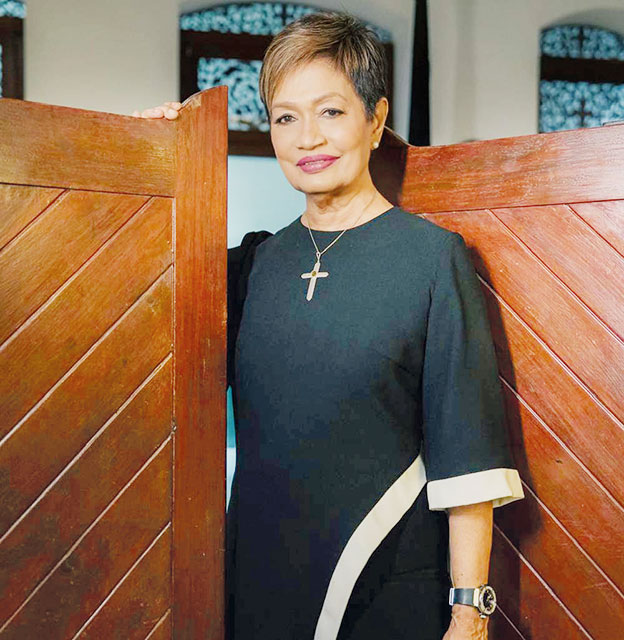
Ramani Fernando
There is a real sense of pride in being part of something that continues to give Sri Lankan fashion a platform.
(Q) How important has CFW been in putting Sri Lankan fashion on an international platform?
(A) I think CFW has played a very important role in creating visibility for Sri Lankan fashion. It has given our designers a professional platform to present their work and connect with an audience beyond Sri Lanka.
It has also shown that we have the creativity, craftsmanship and talent to create fashion that can stand confidently on an international stage. That exposure is extremely valuable for the industry as a whole.
(Q) What are the major challenges you face with hair and makeup for a major fashion show?
(A) The biggest challenge is always time. You have a large number of models, multiple designers and very tight schedules, and everything has to be perfect when the model steps onto the runway.
Then there are practical challenges—different hair textures, different skin types, quick changes between looks and sometimes completely different beauty directions within the same day.
It takes a very experienced and well-coordinated team to manage all of that, and I’m very proud of the teams we have built over the years.
(Q) What makes Sri Lankan fashion distinctive in your view?
(A) I think our biggest strength is our ability to combine our heritage with modern creativity. Sri Lanka has such a rich culture, beautiful craftsmanship, incredible textiles and so many stories to draw inspiration from.
Our designers are able to take those influences and interpret them in a contemporary way. That combination of our identity and modern design is what makes Sri Lankan fashion special.
(Q) If you had to describe your Fashion Week journey in three words, what would they be and why?
(A) Creativity. Collaboration. Evolution.
Creativity because every collection brings a new opportunity to create something different.
Collaboration because Fashion Week is never about one person. It takes designers, models, stylists, makeup artists, hairdressers, production teams and so many people working together.
And Evolution because I have been part of Colombo Fashion Week from its inception, 23 years ago. I have had the privilege of watching CFW, the fashion industry and our own beauty industry grow and change over the years. Being part of that evolution has been an incredible journey.
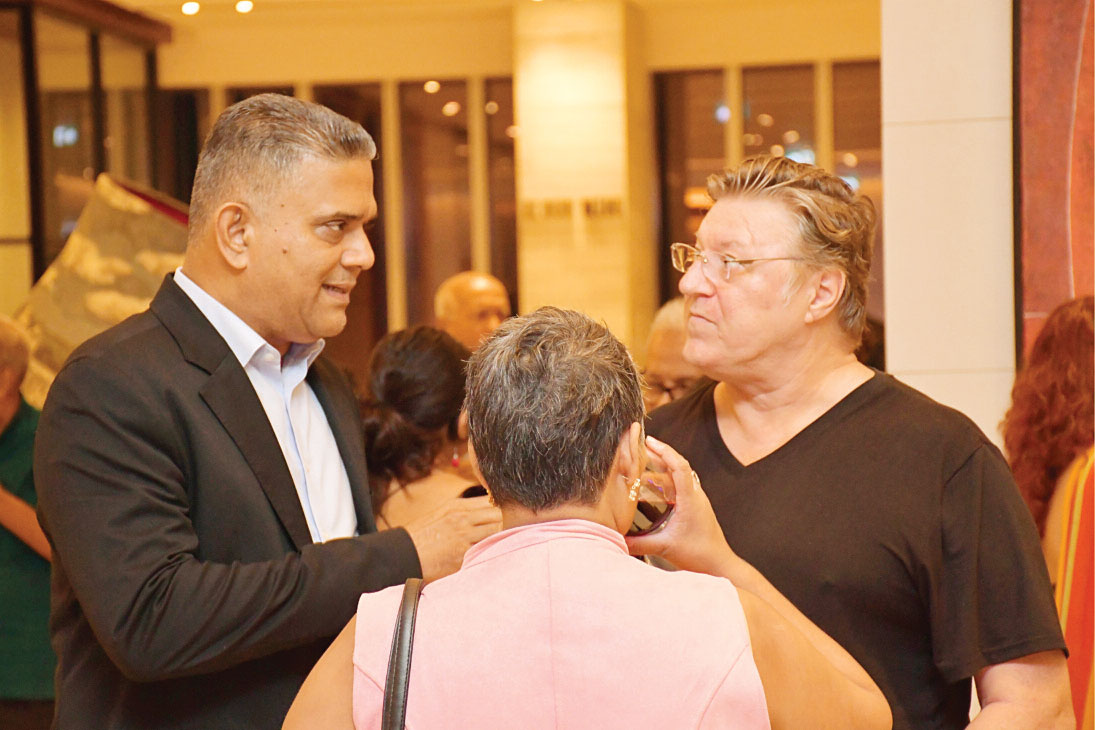
Some stories are carried in words. Others survive in gestures, images and fragments of memory passed quietly between generations. Channa Ekanayake’s What Lives Between, curated by Kasun Jayamanne, looks towards these less visible forms of inheritance, drawing on Sinhala folk poetry and the lived experiences of Sri Lankan women to consider how culture continues to shape identity.
Presented as the eighth edition of Artist Spotlight by John Keells Foundation and City of Dreams, the exhibition brings Ekanayake’s distinctive contemporary practice into a setting where art becomes part of the wider Cinnamon Life experience. His work draws from Sri Lanka’s architectural, spiritual and natural environments, translating familiar forms into compositions shaped by geometry, colour, rhythm and restraint.
Explaining the ideation behind What Lives Between, artist Ekanayake says, “The process began with an interest in memories that outlast the people, places and moments that shaped them. Sinhala folk poetry carries many of these memories, particularly stories and experiences connected to women that have travelled through generations. I wanted to explore that inheritance through a contemporary visual language, allowing the familiar to become something that can be seen and considered anew.”
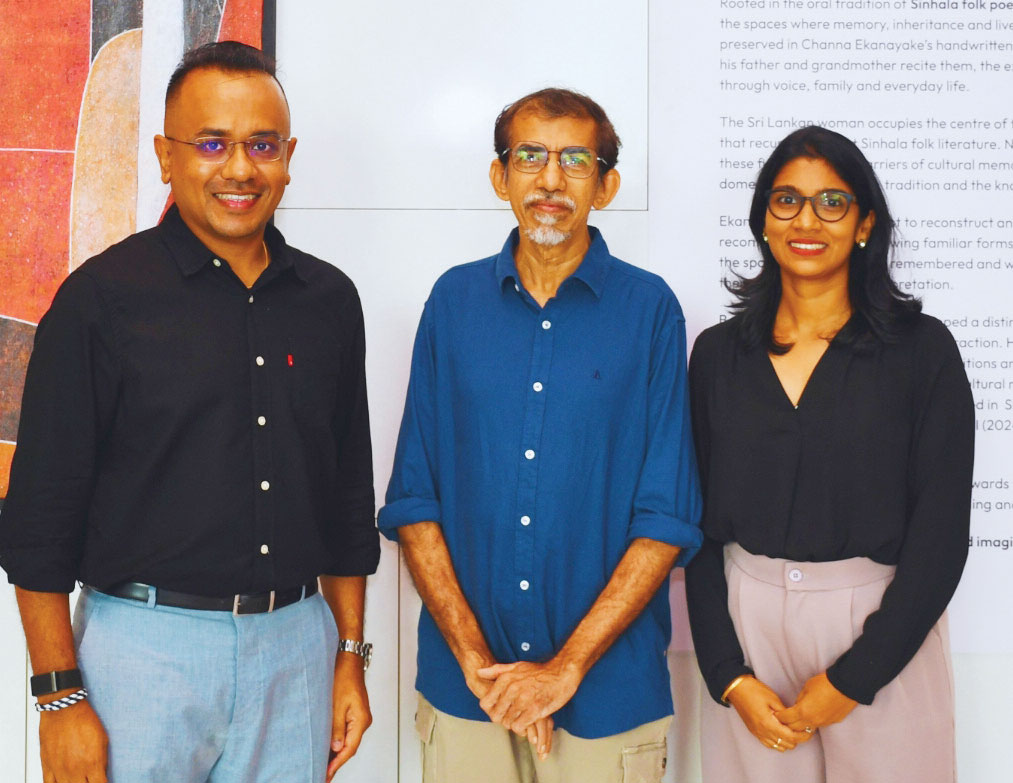
Captivated crowd gathers for Channa Ekanayake’s”What Lives Between’
That exploration extends a practice developed across more than two decades. His early solo exhibition Dwellings, in 2001, established an interest in architecture and inhabitation, while later works including Silence of the Blue and BODHI explored spirituality, environment and cultural symbolism. International presentations, such as Islanded at Aicon Contemporary in New York, further expanded his engagement with Sri Lanka’s visual and cultural landscape.
What Lives Between continues this trajectory while turning its focus towards cultural memory and Sri Lankan womanhood. Folk poetry serves as a point of departure rather than a literal source, allowing Ekanayake to simplify and reconfigure familiar references into a visual language that invites interpretation.
Kamal Munasinghe, Senior Vice President, Colombo Hotels, Cinnamon Hotels & Resorts and General Manager, Cinnamon Life at City of Dreams, says, “Art has a powerful ability to create connections, particularly when it becomes part of an environment where people can encounter it naturally. Artist Spotlight allows us to bring Sri Lankan artistic expression into the City of Dreams experience while giving artists an opportunity to engage audiences who may encounter their work for the first time.”
That philosophy places Artist Spotlight within a broader commitment to creating meaningful encounters between artists and audiences. The initiative gives Sri Lankan artists a platform to reach new audiences, collectors and art enthusiasts, while positioning City of Dreams as a living gallery where local artistic expression can be experienced alongside the hospitality and lifestyle environment.
Carmeline Jayasuriya, Head of CSR, John Keells Group, says, “Supporting artists is about enhancing space for creativity to be seen, experienced and valued by diverse audiences. Through Artist Spotlight, we hope to contribute to a stronger creative ecosystem in Sri Lanka while encouraging conversations around the stories, identities and experiences that shape our culture. As in the case of all our art-based activities, John Keells Foundation’s aim is to provide a platform that provides wider opportunities to the artist while promoting cultural understanding and appreciation through the amazing artistic talent of Sri Lanka.”
At its heart, What Lives Between is an invitation to look beyond what is immediately visible. Ekanayake’s work brings together poetry, memory and visual form to consider what survives, changes and continues to connect generations, giving audiences an opportunity to encounter a distinctly Sri Lankan story through a contemporary artistic lens.

Rare pink diamond goes on display in France 100 years after amateur heist

Nursery owner in China jailed for life after hundreds of children poisoned

Pakistan, Sri Lanka look to find the right mix as World Cup countdown begins

Mumbai Indians and head coach Mahela Jayawardene part ways

Review of progress in reforms and modernisation of key state revenue-collecting institutions

Rose Bowl expanded to include Australia vs New Zealand T20Is

‘Dates have the highest sugar content to fight Coronavirus’

Sunday Island 27 December – Headlines

#SundayIsland 17th December – Headlines

Sunday Island – 28th March

Sunday Island Headlines – 21 March

Sunday Island – 21st February – Headlines
-

 News7 days ago
Sri Lanka escalates anti-graft drive with Shiranthi’s jailing
-

 News7 days ago
Iranian ships stranded, Lanka fears US sanctions
-

 Latest News6 days ago
Farhan and Sadaqat help Pakistan seal series in style
-

 Latest News4 days ago
Nissanka’s return headlines Sri Lanka’s Test squad against Pakistan
-

 Features6 days ago
Intake 16: 45 years of duty and honour
-
 News6 days ago
Malwathu Chapter issues statement on talks with President over Gnanasara Thera’s robes
-
 News7 days ago
Navi Pillay’s Lankan affairs in focus as she wins 2026 Nobel Peace Prize
-
 News6 days ago
CP alleges NPP has taken the blame for illegal US sanctions on Iranian vessels