
News
The Caspian Sea is set to fall by 9 metres or more this century – an ecocide is imminent

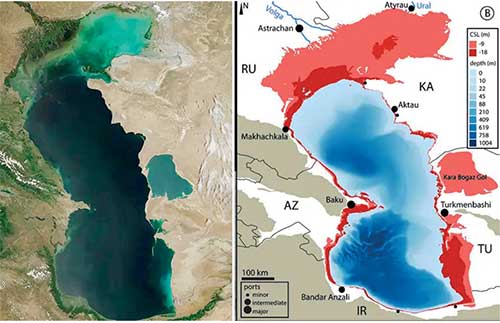
The Moderate Resolution Imaging Spectroradiometer (MODIS) on NASA’s Terra satellite captured this natural-color image of the Caspian Sea, left, on June 4, 2010. The map on the right shows the impact of Caspian Sea level projections of -30 feet and -60 feet at the end of the 21st century. Red regions fall dry.(NASA image by Jeff Schmaltz, MODIS Rapid Response Team / Map by Prange, M., Wilke, T. & Wesselingh, F.P. The other side of sea level change.)
Imagine you are on the coast, looking out to sea. In front of you lies 100 metres of barren sand that looks like a beach at low tide with gentle waves beyond. And yet there are no tides.
This is what we found when we visited the small harbour of Liman, on the Caspian Sea coast of Azerbaijan. The Caspian is actually a lake, the largest in the world and it is experiencing a devastating decline in its water level that is about to accelerate. By the end of the century the Caspian Sea will be nine metres to 18 metres lower. That’s a depth considerably taller than most houses.
It means the lake will lose at least 25 per cent of its former size, uncovering 93,000 sq km of dry land. If that new land were a country, it would be the size of Portugal.
As we found in our new research, the crisis may well result in an ecocide as devastating as the one in the Aral Sea, a few hundred kilometres to the east. The Caspian’s surface is already dropping by 7 cm every year, a trend likely to increase.
In five years, it might be about 40 cm lower than today and in ten years almost one metre lower. Maritime countries worldwide are coming to terms with one metre or so of sea level rise by the end of the century. The Caspian Sea faces a drop of that size — except it will happen within a decade.
Climate change is the culprit. The Caspian Sea waters are isolated, its surface is already around 28 metres below global oceans. Its level is the product of how much water is flowing in from rivers, mostly the mighty Volga to the north, how much it rains and how much evaporates away.
At the end of the century, the Volga and other northern rivers will still be there. However, a projected temperature rise of about 3? to 4? in the region will drive evaporation through the roof.
Future misery despite past crises
The Caspian Sea has a history of violent rises and falls. In Derbent, on the Caucasus coast of Russia, submerged ancient city walls testify to how low the sea was in medieval times. Around 10,000 years ago, the Caspian was about 100 metres lower. A few thousand years before that it was about 50 metres higher than today and even overspilled into the Black Sea.
Yet people who lived beside the sea were able to overcome the swings. No human infrastructure was around to be destroyed and many animal species simply moved up and down with the sea levels, as they had done over the past 2 million years or so. But this time is different. The fall will affect the Caspian’s unique and already stressed animal and plant life, along with human societies along the coasts.
In some areas, the coastline is about to retract hundreds of metres a year or more. Can you imagine building new piers and harbours that fast? By the time they are ready, the sea will have moved kilometres or tens of kilometres further away. Coastal promenades will soon be landlocked. The beaches of today will be the sand ridges stranded in barren plains of tomorrow.
The drop will also affect lowland rivers and deltas around the Caspian Sea. Once-fertile plains will become too dry for watermelon and rice farming to continue.
Unique Caspian life in peril
The town of Ramsar, on the Iranian coast, gave its name to a global wetland convention. But as the sea recedes, the town is becoming landlocked and the surrounding wetlands will be gone within decades.
The shallower “shelves” of the northern and eastern Caspian are major food supplies for fish and birds, yet the entire northern and eastern shelves will transform in dry barren lands. This will devastate fish species, the Caspian seal and a richness of molluscs and crustaceans species unique to the sea.
These Caspian inhabitants have already suffered badly in the past century from pollution, poaching and invasive species. About 99 per cent of Caspian seal pups are raised on the winter ice of the north Caspian. Yet both the winter ice and indeed the whole north Caspian will disappear.
Remaining biodiversity hotspots in depths between 50 metres and 150 metres will be affected as rivers dump nutrients into the deeper central basins combined with rising temperatures. This will decrease oxygen levels and developing ecological dead zones could affect the remaining refuges of Caspian species. A genuine ecocide is around the corner.
The situation cries for action, but possibilities are limited. Rising global CO2 levels, the main driver of climate conditions causing the Caspian crisis, can only be dealt with global agreements. In Soviet times, large scale water diversions from Siberian rivers were proposed to deal with the shrinking Aral Sea to the east. But such large works — in the case of the Caspian Sea, a canal from the Black Sea might be considered — come with huge ecological and geopolitical risks.
Yet action is necessary to safeguard the Caspian Sea’s unique plants and animals and the livelihood of the people who live around it. The stranded small harbour in Liman is further from the sea every year. If no action is taken, it will be left alone in more than one way.
(The Conversation)


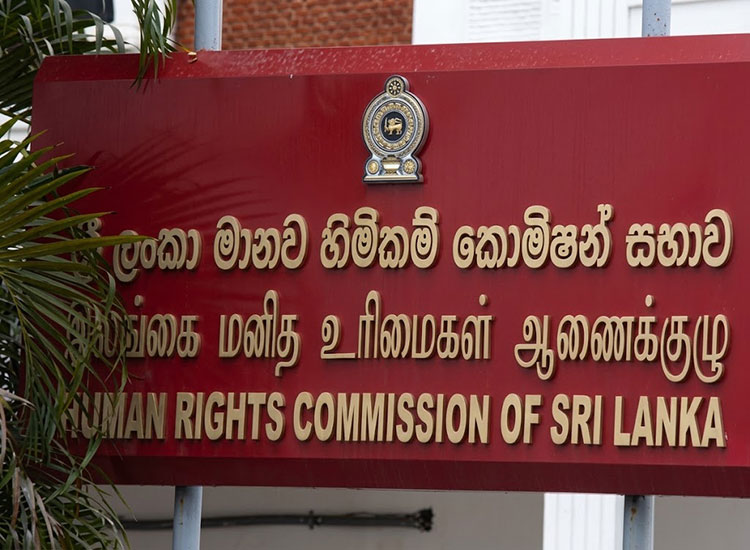
A complaint was lodged with the Human Rights Commission of Sri Lanka (HRCSL) against a Sub-Inspector and a woman police constable attached to the Badowita Police Post of the Mount Lavinia Police Station, alleging that they had falsely implicated a woman in a heroin case.
The complaint was lodged yesterday by family members of the woman through a lawyer, alleging that she was taken into custody by the two police officers on Wednesday and subsequently produced before the Magistrate’s Court.
According to the complaint, the woman was placed in police custody and later learned in court that police had informed the Magistrate that she had been arrested with 10 milligrams of heroin. She was subsequently remanded until next Monday and is due to be produced before the High Court in connection with the alleged possession of heroin.
The complainant alleges that the woman had initially been questioned by the Sub-Inspector and the WPC about suspected narcotic dealers operating in the Badowita area. They claim that, after she failed to provide information, she was taken to the Badowita Police Post and subsequently implicated in the drug case.
The complaint further alleges that the Sub-Inspector has previously been accused of introducing narcotics and falsely implicating individuals in drug cases. The complainants have also alleged that the officer had recorded videos of suspects allegedly being tortured and shown the recordings to his girlfriend.
It also refers to alleged audio recordings circulating on social media concerning complaints made against the officer to the Inspector General of Police and Police Headquarters.
The complainant has further alleged that the officer was involved in a road traffic accident several weeks ago, but that no proper investigation has been conducted.
They also cited a previous allegation that the officer had assaulted a suspect at the police station and subjected him to electric shocks, following which the suspect allegedly collapsed and was admitted to the Kalubowila Hospital.

President of the Colombo High Court Permanent Trial-at-Bar, Priyantha Liyanage, while hearing a case involving the alleged fraudulent supply of substandard Human Immunoglobulin to the Ministry of Health and the alleged defrauding of more than Rs. 1.4 billion in public funds, on Wednesday, cautioned Deputy Solicitor General Lakmini Girihagama against preventing prosecution witnesses from answering questions or exerting pressure on them.
“You have brought these witnesses as prosecution witnesses, but once they are before the Court, you cannot stop them from answering or exert pressure on them. The Court is observing your conduct,” the judge said.
The remarks came during cross-examination of a prosecution witness by defence counsel in the case being heard before the Colombo Permanent High Court Trial-at-Bar.
The accused include Sudath Janaka Fernando, owner of Isolez Biotech Pharma, who is facing charges over the alleged supply of substandard and fraudulently manufactured medicines to the Ministry of Health and the alleged defrauding of more than Rs. 1.4 billion in public funds.
During proceedings, defence counsel questioned a pharmacist from Karapitiya Hospital about notifications issued through the Swastha system concerning the withholding of certain pharmaceutical products, including Human Immunoglobulin and products associated with Live Health Biopharma.
The witness repeatedly said he could not remember whether the matters had been raised when the Criminal Investigation Department recorded his statement.
The defence argued that the absence of such information from the witness’s CID statement pointed to deficiencies in the investigation.
The prosecution objected to some of the questions, prompting the judge to clarify that the defence was entitled to examine whether the investigation had been properly conducted.
An Additional Secretary of the Cabinet Office subsequently testified on procedures governing Cabinet memoranda, including their preparation, submission, consideration and approval.
The trial continues.

SLPP National Organiser and MP Namal Rajapaksa yesterday alleged that 120,000 metric tonnes of coal worth approximately Rs. 4.62 billion had gone missing from 19 coal shipments imported into the country.
Addressing Parliament, Rajapaksa maintained that the quantity of missing coal was equivalent to nearly two shiploads and questioned who was responsible for the alleged discrepancy.
“We brought in 19 shipments of coal. But of those 19 ships that arrived, 120,000 metric tonnes of coal have gone missing,” he said, placing the value of the missing coal at Rs. 4.62 billion.
Rajapaksa made the allegation while criticising the government for the procurement of what he described as substandard coal, and challenged its claims of having taken action against corruption.
“You started out by saying you were going to catch thieves. That is now your great slogan,” he told the Government.
Referring to President Anura Kumara Dissanayake’s remark that they had not “eaten and tasted” the coal before purchasing it, Rajapaksa used the phrase metaphorically to allege that coal had been misappropriated both before and after procurement. He said the reported shortage raised questions over the fate of the equivalent of two shiploads of coal.
“Now, who swallowed these two coal ships?” Rajapaksa asked, urging the Government to explain the alleged disappearance.
He also criticised the government’s claim that billions of rupees were available at the Ministry of Finance, saying such financial resources were not reflected in development activity at village level.

‘Lord Edgware Dies’

Complaint to HRCSL alleges woman framed in heroin case

Judge cautions DSG against pressuring prosecution witnesses in immunoglobulin fraud trial

Namal blows whistle on 120,000 MT of coal that allegedly went missing after being shipped here

HFC girls set new meet record at Relay Championship

DDS set to lose Test captaincy

‘Dates have the highest sugar content to fight Coronavirus’

Sunday Island 27 December – Headlines

#SundayIsland 17th December – Headlines

Sunday Island – 28th March

Sunday Island Headlines – 21 March

Sunday Island – 21st February – Headlines
-

 News6 days ago
Namal remanded until Sept. 18 over Airbus deal investigation
-

 Latest News5 days ago
Tharanga creates history with Diamond League crown in Brussels
-

 News5 days ago
Dispute which triggered listed company director being detained at BIA resolved
-

 Features4 days ago
After the parade: What a traffic OIC’s walk-out tells us
-

 Editorial6 days ago
Power vs Equality
-
Editorial4 days ago
Arrests as theatre
-

 Latest News7 days ago
SLPP MP Namal Rajapaksa arrested by CIABOC
-

 Latest News4 days ago
Harshitha’s composed knock seals Sri Lanka’s semi-final berth