
News
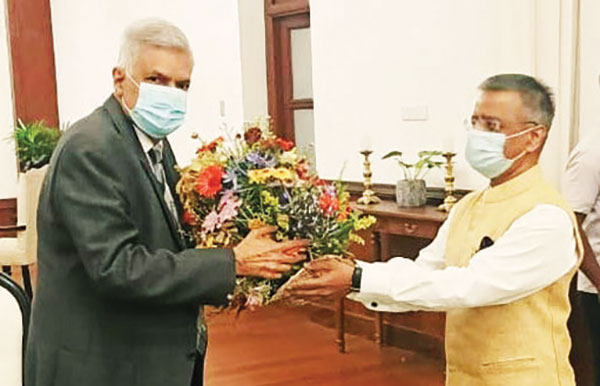
Talks planned for India to restructure $1.3-billion credit line to Lanka

BY S VENKAT NARAYAN
Our Special Correspondent
NEW DELHI, May 14: India will hold talks with Sri Lanka for restructuring the island nation’s $ 1.3 billion Line of Credit (LoC), seeking to assist its southern neighbour battling a severe economic crisis.
The Indian government backs the LoC from Export Import Bank (EXIM Bank).
The exact terms of the loan will be finalized in talks that the Indian government will conduct and the EXIM Bank will participate in.
Repayments on credit have been done till the end of March 2022. The restructuring is likely to involve deferment on repayment principal, said sources in EXIM Bank.
In February 2022, India’s EXIM Bank and Sri Lanka’s government signed a $500-million LoC agreement to help Colombo to cope with its current fuel shortages.
India said this week it is “fully supportive” of Sri Lanka’s democracy, stability and economic recovery, responding after that country’s Prime Minister Mahinda Rajapaksa quit amid massive protests against the raging economic crisis.
On April 12, the Sri Lankan government said it will suspend debt servicing on its foreign-currency obligations amid steeply rising external funding pressures.
Standard & Poor’s has downgraded Sri Lanka’s long-term foreign currency sovereign credit rating to ‘SD’ (selective default) from ‘CC’.
Meanwhile, EXIM Bank has posted a 190.5 per cent increase in net profit at INR7.38 billion on FY22 from INR2.54 billion in FY21. Its loan book grew by 13.26 per cent Year on Year to INR1.17 trillion at the end of March 2022. The capital adequacy improved to 30.49 per cent in March 2022 from 25.89 per cent a year ago.
EXIM Bank Managing Director Harsha Bangari said the bank raised foreign currency resources aggregating $2.05 billion and rupee resources aggregating INR190.46 billion in FY22.
In FY23, the institution plans to raise about $3 billion, depending on the market conditions. About $1-1.5 billion will be raised by issuing long-term securities and balance through short-term loans. The domestic borrowings will be around INR200 billion in 2022-23, Bangari said.


Approval of the Cabinet of Ministers was granted to the preparation of the Appropriation Bill for the financial year of 2027 at their meeting held on 30.06.2026.
Accordingly, clearance of the Attorney General has been given to the Appropriation Bill prepared by the Legal Draftsman.
Therefore, the Cabinet of Ministers approved the resolution furnished by the President in his capacity as the Minister of Finance, Planning and Economic Development to publish the aforementioned draft bill in the government gazette notification and thereby submit the same to the Parliament for its concurrence.
Latest News
Cabinet approves aditional Rs. 2,500 million to the Paddy Marketing Board to purchase 2026 Yala harvest

The Cabinet of Ministers has approved the resolution furnished by the Minister of Agriculture, Livestock, Land and Irrigation to provide an additional Rs. 2,500 million to the Paddy Marketing Board on a reimbursable basis from the Rs. 7,500 million additional allocations granted to the Ministry to implement
the expedited paddy purchasing program for the 2026 Yala harvest.
Latest News
Cabinet nod to host the 8th Asian Regional Conference of the Commonwealth Parliamentary Association and the 3rd Joint Asian and South-East Asian Regional Conference of the Commonwealth Parliamentary Association
The 8th Asian Regional Conference of the Commonwealth Parliamentary Association (CPA) and the 3rd Joint Asian and South-East Asian Regional Conference of the CPA are planned to be held over three days in Colombo during April/May 2027.
Approximately 90 delegates including speakers, Deputy Speakers, Member of Parliamentarians, and Parliamentary officers representing member countries of the Commonwealth Parliamentary Association, in the Asian and South-East Asian regions, are expected to participate in these conferences.
The Cabinet of Ministers has approved the resolution furnished by the Prime Minister of the Parliament of Sri Lanka to host the said conferences considering the opportunities to strengthen parliamentary diplomacy and regional cooperation, as well as to enhance international recognition of the Parliament of Sri Lanka within the Commonwealth Parliamentary Association.

Draft of the Appropriation Bill for the Financial Year 2027 su mitted to the Parliament
Cabinet approves aditional Rs. 2,500 million to the Paddy Marketing Board to purchase 2026 Yala harvest
Cabinet nod to host the 8th Asian Regional Conference of the Commonwealth Parliamentary Association and the 3rd Joint Asian and South-East Asian Regional Conference of the Commonwealth Parliamentary Association

SAARC Training Workshop on Financial Modeling for Renewable Energy Projects from 5th to 7th October in Colombo
National Children’s Week from 25th September to 01st October

Nairobi and Munich to host 2029 and 2031 World Athletics Championships

‘Dates have the highest sugar content to fight Coronavirus’

Sunday Island 27 December – Headlines

#SundayIsland 17th December – Headlines

Sunday Island – 28th March

Sunday Island Headlines – 21 March

Sunday Island – 21st February – Headlines
-

 Sports5 days ago
DDS set to lose Test captaincy
-

 News5 days ago
Sri Lanka faces new grid challenge as rooftop solar surges: former CEB GM
-
 Latest News5 days ago
Shafali, Deepti power India into sixth T20 Asia Cup final
-

 Opinion7 days ago
Navigating Sri Lanka’s Israeli Dilemma
-
 Latest News4 days ago
Sri Lanka thwart Fatima Sana challenge to secure Asia Cup final spot
-

 Features6 days ago
Lost for 90 years: Rare Goby resurfaces in Jaffna
-

 News3 days ago
Gnanasara Thero absconding after SC ruling
-

 News4 days ago
Ammunition cache found in old Kandy bungalow