
Business
‘Sri Lankan tea’s current crisis only reinforces the value of productivity-linked wages’


By Dr. Roshan Rajadurai
“An incentive is a bullet, a key: an often tiny object with astonishing power to change a situation”
– Economist, Steven Levitt
Almost 7 months from the Government’s initial decision to ban the import and use of synthetic fertilizers and as at the date of this publication, Sri Lanka’s entire agriculture and plantation economy is still frantically in search of any viable option to mitigate the threat of declining yields.
Without any prior planning or notice, our entire sector has been coerced into blindly participating in the most unscientific experiment ever attempted in Sri Lanka’s history. We are all left to now anticipate what the implications of an immediate, nation-wide halt to all established and essential best practices relating to plant nutrition, pest, fungus and weeds will be.
We are told that arrangements are being made to import organic fertilizer from various, untested sources, and agreements are minted to produce organic fertilizer locally, much akin to attempting to rebuild an airplane while it is still in flight. Nevertheless, the inconvenient truth remains. At present, all supplies of “organic” and inorganic fertilizer are in short supply.
Stocks which are available, have increased in price owing to both supply-demand dynamics, disrupted supply chains and unprecedented increases in landed costs. These escalating payments are making Sri Lankan tea’s already high cost of production (COP) even higher, which is placing Sri Lankan plantations under even further stress. This a few short months after an increase in worker wages was thrust through the Wages Board.
Sri Lankan tea’s strange new normal needs to be re-evaluated immediately
With the end of the year approaching, and the window for fertilizing crops closing, it appears that the industry will be locked into at least one – if not more – growth cycles absent basic nutrients of Nitrogen, Potassium, and Phosphorus, and with no ability to control pests and weeds. Without immediate solutions, the broad consensus among those with expertise is that we can start to see exponentially worse crop losses starting from the end of 2021, hitting approximately 40% by next year.
If RPCs were to have disregarded basic agronomic practices and norms in such a manner of their own volition, it would have been called criminal mismanagement. With agricultural best practices now being roundly ignored in favour of a largely undefined and unplanned strategy for transforming Sri Lanka into a nation with “100% organic agriculture”, this historic, and intentionally misinformed self-sabotage is being repackaged as visionary and progressive.
Meanwhile, the nation’s best agricultural experts are being ignored or in the case of Prof. Buddhi Marambe, sidelined and silenced, on the grounds that he simply stated scientific facts regarding the current agro-chemical ban and had been consistent in doing so, because he had previously spoken up against the previous Government’s disastrous decision to suspend glyphosate imports.
This was a policy which resulted in the rejection of Sri Lankan tea exports as a result of issues with Maximum Residue Limits (MRLs), and caused the permanent loss of extremely high value markets in Japan, and a similar escalation in costs; all without a single shred of scientific evidence being provided to justify the lasting damage caused. As a result, the Government of the time was compelled to backpedal on its decision, but not without irreversible damage being done for no apparent reason.
This “justification” highlights a dangerous trend of politicization of science. If the science does not agree with politics, then it now appears acceptable to simply dismiss the scientists, rather than engage with facts and ground realities.
A simple extrapolation shows a grim future for workers
Regardless of short-term political expediency, reality has a way of asserting itself. Spread across 14 districts, the tea industry alone provides direct employment to over 600,000 people engaged in cultivation and processing and indirect employment to a further 200,000 involved in the supply chain. The sector provides complete livelihood support for a resident population of one million in Regional Plantation Companies (RPCs) and 450,000 Tea Smallholders with one million dependents, hence supporting a total population of nearly 2.5 million.
When considering both employment and livelihood generation, it is estimated that the industry sustains more than 10% of our national population and its net foreign exchange earnings are only second to the garment industry.
Even if “organic” fertilliser is made available, there are still serious concerns as to whether it can provide sufficient nutrients. Hence, it appears that the writing is on the wall. With insufficient nutrients as a result of the unplanned push for organic, we anticipate a series of cascading failures stemming from a collapse in productivity. No amount of rhetoric will be able to turn back the tide of negative sentiment against such developments.
If not land productivity, at least labour
Unlike the garment industry, where progressive incentive structures were allowed to flourish, in our industry, workers remain bound to an outdated colonial era daily wage model. As a result, unlike the dynamism of the apparel sector, Sri Lanka’s plantation sector is also weighed down with one of the lowest labour productivity rates in the world. The combination of low land and labour productivity will create a series of cascading failures.
The only measure that could at least temporarily mitigate this dynamic is the implementation of productivity linked wages. This is a model which has the support of all RPCs, and which was has been widely practiced with tremendous success by tea smallholders. While they have been implemented with ease in low-mid grown estates, it is only in the high-grown regions, where resistance to these models has been encountered.
Crucially, this resistance is not from workers who have experience with productivity linked wages, but rather with Trade Unions who would likely lose relevance if such models were implemented. The benefits for workers are immense. In addition to creating a potential monthly earnings per worker of between Rs. 37,000-Rs 62,000, under previous proposals advanced by RPCs.
This will also give workers flexi-hours, empowering them to choose when and how they work. Given the labour shortages prevalent across the entire tea industry, such a move would at long last incentivize workers effectively, and reward them for achieving their full individual potential, thereby significantly optimizing labour productivity.
However, without a scientific resolution to the fertilizer crisis, wage reforms can only serve as a stop gap measure. As land productivity drops, RPCs, state plantations and smallholders alike will be forced to reduce the amount of work offered, leading to a continuous diminution of worker earnings.
The few remaining workers in the plantation industry will have no choice but to try their luck in other lines of work, accelerating the ongoing migration of labour from the estate sector. It is unclear whether other economic sectors have the capacity to absorb such a large group of workers at once.
Already, we have seen multiple outbreaks of mob violence on estates, with the majority of such incidents being triggered by disputes over wages. Without proper solutions to these burning issues, worker wages will eventually be disrupted. Will the authorities take responsibility for what will follow?


Pan Asia Banking Corporation PLC reported a strong financial performance for 2025, marking a year in which the Bank reinforced its position among Sri Lanka’s steadily expanding financial institutions. The Bank’s overall asset base surpassed Rs. 300 Bn, reaching Rs. 308.02 Bn its largest balance sheet to date while Profit After Tax amounted to Rs. 4.01 Bn. Earnings Per Share stood at Rs. 9.05, reflecting a solid core earnings base and disciplined balancesheet execution during a year of gradually easing macroeconomic pressures.
Total operating income grew to Rs. 16 Bn, supported by resilient net interest generation and sharp growth in non-interest revenue. Even though benchmark interest rates trended downward for much of the year reducing gross interest income at the market level, the Bank protected its core income through proactive liability repricing, careful funding management, and the retirement of high-cost borrowings. A healthier deposit mix supported by CASA growth helped reduce interest expenses by 4%, allowing the Bank to maintain profitability despite softer yields on loans and government securities.
A clearer picture of Pan Asia Bank’s true performance emerges once the nonrecurring sovereign debt gain recorded in 2024 is set aside. On this normalized basis, 2025 stands out as the Bank’s strongest year of underlying profitability in its 30-year history. Underlying Profit After Tax surged 35% to Rs. 4.01 Bn, while underlying Profit Before Tax climbed an impressive 52%, highlighting the Bank’s accelerating earnings momentum. Underlying EPS rose 35% to Rs. 9.05, supported by improved returns, with underlying ROE and ROA rising by 169 and 52 basis points, respectively. Together, these gains reflect the depth of the Bank’s core business strengths, broadbased revenue growth, and disciplined margin management during a year shaped by declining interestrate conditions.
Income diversification also played a pivotal role. Net fee and commission income expanded by 37%, supported by heightened lending activity, improved trade flows, stronger card-related transactions, and remarkable growth in remittance-related business. These developments helped offset the moderation in trading gains, which were affected by lower capital gains on unit trusts and government securities. A derecognition gain of Rs. 278.63 million on FVOCI assets and reduced marktomarket losses helped stabilize noninterest income, allowing the Bank to sustain earnings despite a more subdued trading environment.
Credit quality improved significantly. The Stage 3 loan ratio declined to 1.73% from 3.10% a year earlier one of the greatest improvements within the sector—reflecting the Bank’s continued emphasis on highquality underwriting, better borrower monitoring, and an effective earlywarning framework. Impairment expenses normalized following the unusually large reversal seen in 2024. ( Pan Asia Bank)
Business
SriLankan Cargo secures another South Asian First with IATA CEIV Live Animals Certification
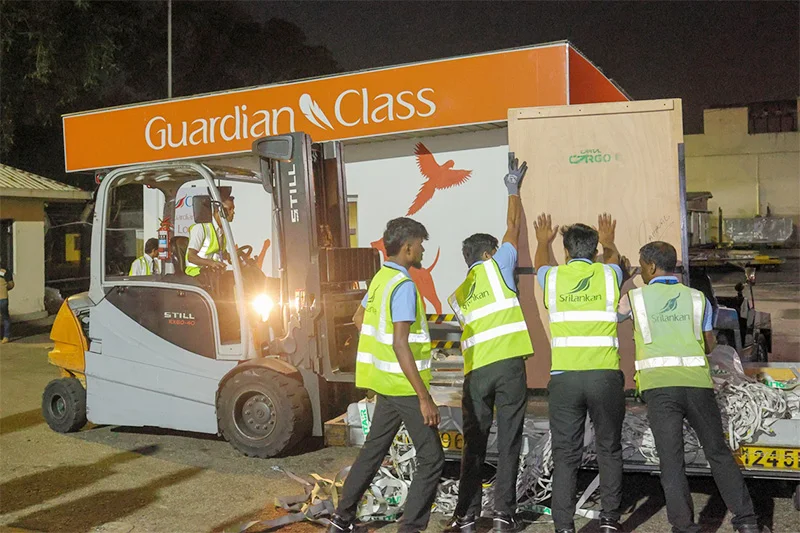
SriLankan Cargo, the air freight arm of SriLankan Airlines, has secured another regional first by becoming the first airline in South Asia to be awarded the Center of Excellence for Independent Validators (CEIV) for Live Animals Logistics Certification from the International Air Transport Association (IATA). Regarded as the premium global standard for the air transport of live animals, the certification serves as a powerful pledge to pet parents, livestock owners, conservationists and all shippers that SriLankan Cargo will transport animals in humane, safe and stress-free conditions across its worldwide network.
Chaminda Perera, Head of Cargo at SriLankan Airlines, commented on the achievement, stating, “Earning the IATA CEIV Live Animals Certification underscores our dedication to animal welfare and operational excellence, ensuring safer handling, trained teams and peace of mind for our customers.”
Sheldon Hee, Regional Vice President, Asia-Pacific, said, “The CEIV Live Animals certification is not only about compliance, but ensures the safety and welfare of live animals transported by air. This is particularly relevant as this is a market that continues to grow with more than 200,000 live animal shipments globally in 2025. We are pleased to see SriLankan Airlines achieve this important certification and ensure the implementation of the highest standards across the supply chain.”
The certification stands out for placing animal safety and welfare at the forefront, supported by best-in-class infrastructure and operational excellence. Achieving it requires a rigorous, multi-step process of training, assessment, validation, certification and recertification, ensuring that only organisations fully compliant with the IATA Live Animals Regulations and the Convention on International Trade in Endangered Species gain membership in this highly exclusive circle of airlines, which currently numbers 12 worldwide.
SriLankan Cargo remains firmly committed to upholding the highest standards stipulated in the IATA Live Animals Regulations throughout the shipment lifecycle, from acceptance and handling to loading, transportation and final delivery. Working closely with veterinary authorities, ground handlers and cargo partners, the airline ensures every check box relating to welfare and compliance is consistently ticked.
SriLankan Cargo also operates purpose-built facilities with precise temperature control procedures and robust contingency plans, enabling animals to travel in optimal conditions, including during transit. Dedicated CEIV-trained team members oversee each movement, safeguarding comfort, wellbeing and regulatory adherence at every stage.

Prime Lands Residencies PLC (CSE: PLR) reported strong financial performance for the quarter ended 31 December 2025, keeping shareholder expectations intact.
The company’s share price increased by more than 40% over the last three months, reflecting heightened investor confidence. Market expectations remained elevated given the scale of project launches over the past two years, including three towers in The Border Colombo (484 units), J’adore Negombo (333 units), The Golf Colombo 08 (64 units), Mon Vie Colombo 05 (349 units), Prime Colombo 9 (559 units), and The Seasons Colombo 08 (44 units).
Quarterly revenue grew by 43% year-on-year to Rs. 2.80 billion, compared to the corresponding period last year. This growth was primarily driven by accelerated construction progress in Towers C of The Border Colombo project, together with first time revenue recognition from The Seasons Colombo 08. Revenue from the newly launched remaining projects is yet to be recognized in line with construction milestones and the company’s prudent revenue recognition policy, establishing the growth potential in earnings in upcoming periods.

India look to go into Super Eight stage with all-win record

Cabinet approves construction of new 300 bed Base Hospital in Deniyaya

Heavy showers about 100 mm are likely at some places in the Eastern, Uva and North-central provinces and in Matale and Nuwara-Eliya districts

Cabinet nod to legally empower methodology for implementing the ‘Praja Shakthi’ poverty alleviation national movement

NPP not under Indian pressure to hold PC polls – JVP

Battery storage drive to power Sri Lanka’s renewable leap

‘Dates have the highest sugar content to fight Coronavirus’

Sunday Island 27 December – Headlines

#SundayIsland 17th December – Headlines

Sunday Island – 28th March

Sunday Island Headlines – 21 March

Sunday Island – 21st February – Headlines
-

 Life style3 days ago
Marriot new GM Suranga
-

 Business2 days ago
Ministry of Brands to launch Sri Lanka’s first off-price retail destination
-

 Features3 days ago
Monks’ march, in America and Sri Lanka
-

 Opinion6 days ago
Will computers ever be intelligent?
-

 Features3 days ago
The Rise of Takaichi
-

 Features3 days ago
Wetlands of Sri Lanka:
-

 News3 days ago
Thailand to recruit 10,000 Lankans under new labour pact
-

 News3 days ago
Massive Sangha confab to address alleged injustices against monks