
News
Battery storage drive to power Sri Lanka’s renewable leap


Sri Lanka is poised for a decisive breakthrough in its clean energy transition with the government moving to introduce large-scale battery energy storage for the first time in the country’s history — a development that could fundamentally transform how electricity is generated, managed and consumed.
Power and Energy Minister Kumara Jayakody told Parliament of Sri Lanka that a 160-megawatt battery energy storage system (BESS) will be constructed within the next six months, marking the single biggest technological leap yet in Sri Lanka’s power sector.
In parallel, tenders will soon be called for a further 300 MW battery storage facility, signalling the government’s intention to embed energy storage at the core of future power planning.
The announcement was made in response to a question raised by MP Suranga Ratnayake, with the Minister underlining that battery storage is no longer optional but a strategic necessity if Sri Lanka is to fully capitalise on its rapidly expanding renewable energy capacity.
“We are strengthening the transmission network while taking the initial steps to integrate battery storage systems alongside future solar power plants on selected lands,” Minister Jayakody said. “Our objective is to ensure that renewable energy can be absorbed into the national grid without instability or wastage.”
Energy sector analysts have long warned that Sri Lanka’s grid is structurally ill-equipped to handle the variability of solar and wind power. While renewable generation has grown steadily, large volumes of clean electricity are often curtailed during peak production hours due to the lack of storage and limited grid flexibility. The result has been a paradox where green energy exists, but cannot always be used.
The introduction of battery energy storage systems is expected to change that equation. By storing surplus electricity and releasing it during peak demand or low generation periods, batteries effectively convert intermittent renewables into stable, dispatchable power. This, in turn, reduces reliance on expensive thermal plants, lowers fuel imports, and enhances overall grid resilience.
Minister Jayakody said the new systems would also play a critical role in reducing the risk of power disruptions and in cutting long-term electricity costs. “Without storage, we are forced to fall back on fossil fuels even when renewable energy is available. Battery systems allow us to break that dependency and move towards a truly modern power system,” he said.
The move represents a clear shift in national energy policy — from merely adding renewable capacity to building an intelligent, future-ready power infrastructure. Integrating storage with solar parks and strengthening transmission lines are expected to unlock large-scale private sector investment, improve energy security, and align Sri Lanka more closely with global decarbonisation trends.
For a country grappling with high energy costs, foreign exchange pressures and climate vulnerability, the battery storage initiative is being seen not just as a technological upgrade, but as a strategic intervention with economic, environmental and geopolitical implications.
By Ifham Nizam






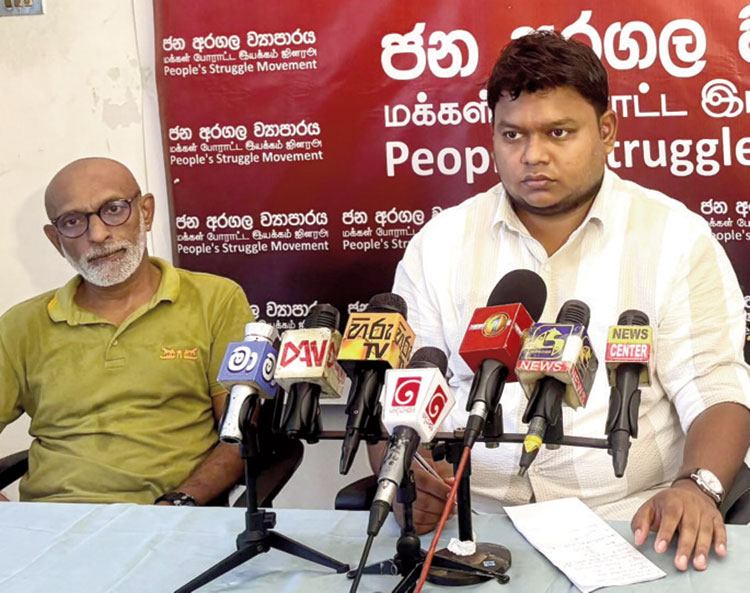
The Frontline Socialist Party-backed People’s Struggle Movement is set to stage a protest march in Colombo today (03) against what it describes as the growing tax burden on the public and the rising cost of living.
The organisers are due to commence the “Colombo March Against Unjust Taxes” at noon from Campbell Park, Borella. The FSP has also been mobilising support for the protest in Colombo and its suburbs in the run-up to the event.
People’s Struggle Movement National Executive Council member Wasantha Mudalige, speaking at a media briefing in Nugegoda yesterday (02), called on the public to join the protest, saying the movement intended to bring the tax burden faced by ordinary people to the forefront.
Mudalige alleged that successive tax measures had placed an excessive burden on households, particularly through taxes on food and educational items. He also criticised the Government over what he described as the high cost of basic food items and the difficulties faced by parents in meeting their children’s educational expenses.
He accused the Opposition of failing to adequately address the issue, claiming that opposition parties raised such concerns, mainly during election periods.
Mudalige also criticised the Government for what he described as a departure from promises made before the 2024 presidential election regarding taxes on educational equipment.
He questioned the tax burden on food items, citing figures of Rs. 100 per kilogramme on dried sprats, Rs. 310 per kilogramme on chicken and Rs. 11 per egg.
He further alleged that while ordinary people were bearing a heavy tax burden, wealthy groups were receiving tax concessions. He also criticised the Government’s economic programme and its implementation of measures associated with the International Monetary Fund (IMF).
The movement has framed today’s protest as part of a broader campaign over the cost of living and taxation. The People’s Struggle Alliance has separately announced that the Campbell Park demonstration will be the first in a series of public actions, with further protests planned in November.
Mudalige said the movement would continue to take the issue to the streets and urged the public to participate in today’s demonstration.
People’s Struggle Movement National Executive Council member Jayantha Amarasinghe also addressed the press.

The Colombo High Court yesterday postponed the trial in the case filed under the Prevention of Money Laundering Act against Yoshitha Rajapaksa, son of former President Mahinda Rajapaksa.
The case was taken up before Colombo High Court Judge Udesh Ranatunga, with Yoshitha Rajapaksa, who is currently out on bail, appearing in court.
The trial was postponed as the President’s Counsel appearing for the defence was indisposed.
The Attorney General has filed the case against Rajapaksa, alleging that he committed an offence under the Prevention of Money Laundering Act by purchasing five plots of land in Dehiwala and Ratmalana, worth more than Rs. 73 million.
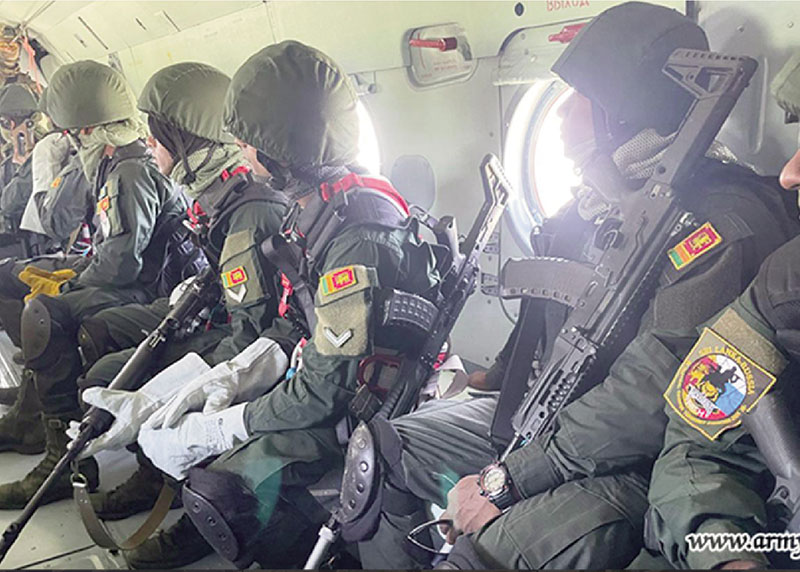
A contingent of the Sri Lanka Army, comprising 20 officers and 55 other ranks, participated in the combined military exercise ‘Wolverine Path II–2026’, conducted with the Armed Forces of the Russian Federation in Vladivostok, Russia, from September 18 to 25.
According to the Ministry of Defence, the exercise primarily focused on counter-terrorism operations and provided participating troops with training in a challenging combined operational environment.
The exercise included a range of tactical activities, including heli-rappelling, close-quarters battle (CQB), ambush operations, sniper firing, drone operations, buggy training and combat medical support.
The Ministry said the training enabled Sri Lankan troops to further develop their combat skills, tactical coordination and operational readiness.
It also provided an opportunity for the two militaries to exchange professional knowledge, operational experience and tactical expertise. Sri Lankan personnel gained exposure to training methodologies, tactical approaches and operational practices adopted by the Russian Armed Forces, the Ministry said.
The participation also enabled the Sri Lankan contingent to identify lessons from the joint training and share its own experiences with the Russian military.
The Sri Lankan contingent returned to the country following the exercise and arrived at Mattala Rajapaksa International Airport on September 28.
The Ministry said participation in the exercise contributed to enhancing the professional knowledge, tactical awareness and operational preparedness of Army personnel while promoting military-to-military cooperation, mutual understanding and professional relations between Sri Lanka and Russia.

Turkish court detains football refereeing chief pending corruption trial

Ten injured after car crashes into rugby supporters in Australia

Polls open in Latvia against backdrop of perceived Russia threat

Abhishek, Tilak and spinners secure gold for India at Asian Games again

Tharindu Rathnayake, bowlers secure Asian Games Bronze for Sri Lanka

G7 to release 100 million barrels of oil and diesel after Trump export ban threat

‘Dates have the highest sugar content to fight Coronavirus’

Sunday Island 27 December – Headlines

#SundayIsland 17th December – Headlines

Sunday Island – 28th March

Sunday Island Headlines – 21 March

Sunday Island – 21st February – Headlines
-

 News6 days ago
Police remove Thileepan statue in Jaffna
-

 Features6 days ago
The 22nd Amendment, constitutional recovery and illiberal slippage
-

 Features6 days ago
Of foreigners as CEOs of Lankan ventures
-

 Latest News4 days ago
Gold winner Tharanga gets brand-new Honda Vezel from SLAAJ
-

 News6 days ago
Sajith rejects Jt. Opp. protest sabotage claim; SJB TU chief demands remedial action
-

 Features4 days ago
Why Sri Lanka needs an Inclusive Civic Nationalism – urgently
-

 Features5 days ago
Thailand’s biggest new global star …
-

 News3 days ago
US-assisted ‘Ice’ detection: NPC to examine IGP’s move to transfer drug-busting team