
Foreign News
Singapore executes man for supplying cannabis

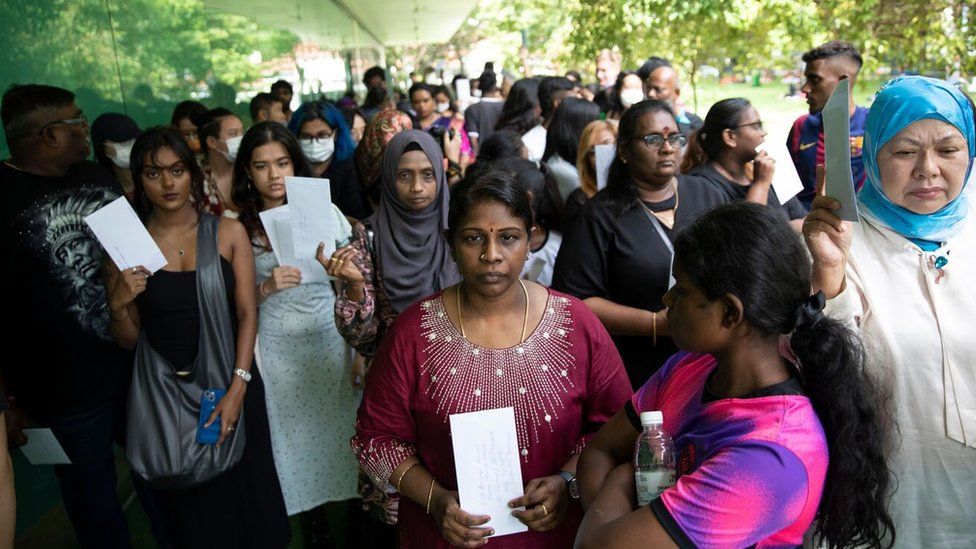
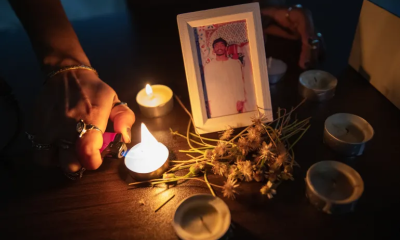
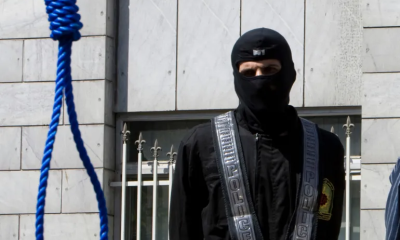
BBC reported that Singapore has executed a man for conspiring to traffic cannabis despite pleas for clemency from his family, activists and the United Nations.
Tangaraju Suppiah, 46, was hanged at Changi Prison at dawn on Wednesday, his family said.
Activists said he had been convicted on weak evidence and had had limited legal access during his prosecution. The authorities said he had received due process and criticised activists for questioning the courts.
Singapore has some of the world’s toughest anti-drug laws, which it argues are a necessary deterrent to preventing drug crime.
Last year the country executed 11 people on drugs charges, including an intellectually impaired man for trafficking heroin.
On Wednesday, Tangaraju Suppiah’s family had gathered at the prison in the city’s east. “The family said they weren’t going to give up on him right until to the end. It has been such a harrowing experience for them,” anti-death penalty activist Kirsten Han told the BBC on Wednesday. “They still have a lot of unresolved questions about his case, and the evidence against him.”
Singapore’s stringent drug laws and use of capital punishment put it increasingly at odds with other countries in the region, activists say. Its neighbour Malaysia abolished mandatory death sentences earlier this month, saying they were not an effective deterrent to crime. Cannabis has been decriminalised in many parts of the world including in neighbouring Thailand where its trade is encouraged.
On Tuesday, Singapore’s courts had rejected a last-minute appeal from Tangaraju Suppiah’s family against his 2018 conviction.
In recent days they and activists had delivered letters to Singapore’s President Halimah Yacob in a last-minute plea for clemency, while British billionaire Sir Richard Branson had called for a halt of the execution and a review of the case.
“I know that my brother has not done anything wrong. I urge the court to look at his case from the beginning,” the condemned man’s sister, Leela Suppiah, had told reporters on Sunday.
Tangaraju Suppiah was convicted of “abetting by engaging in a conspiracy to traffic” about 1kg (35oz) of cannabis from Malaysia to Singapore in 2013. He was not found with the drugs or during the delivery. But prosecutors said he had been responsible for co-ordinating it, and they traced two phone numbers used by a deliveryman back to him. He claimed he was not the person communicating with others connected to the case. He said he had lost one of the phones and denied owning the second one.
Singapore law mandates the death penalty for drug trafficking and has lesser penalties for couriers.
In Tangaraju Suppiah’s last appeal, the judge agreed with the prosecution that he had been responsible for co-ordinating the delivery, which made him ineligible for a more lenient sentence.
Activists had raised concerns that he had not been given adequate access to a Tamil interpreter and had had to argue his last appeal on his own since his family was unable to secure a lawyer. Singapore authorities say he requested an interpreter only during the trial, and not earlier. They add that he had access to legal counsel throughout the process.
Sir Richard, who had previously criticised the 2022 execution of intellectually impaired Nagaenthran Dharmalingam, said the latest case was “shocking on multiple levels”.
Rebutting his allegations, Singapore’s Home Affairs Ministry accused him of “disrespect for Singapore’s judges and our criminal justice system”. It said that the death penalty was “an essential component” in a multi-pronged approach that had been “effective in keeping Singapore safe and secure”.








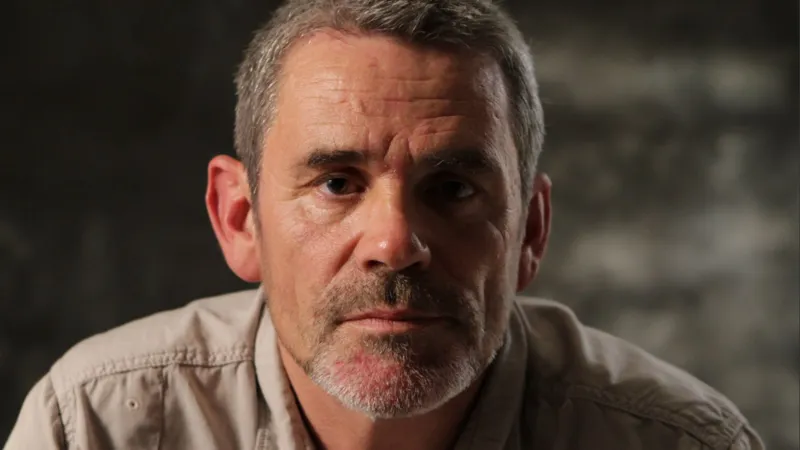
Tributes have been paid to the war photographer Paul Conroy who has died at the age of 61.
He covered conflicts around the world and was wounded in the Syrian army’s bombardment of Homs, which killed his Sunday Times colleague Marie Colvin in 2012.
Their fateful assignment was depicted in the 2018 movie A Private War, with the actor Jamie Dornan playing Conroy.
The Liverpool-born photographer died from a heart attack on Saturday in Devon, where he had lived, his brother Alan told the BBC.
“He did all his life what he wanted to do to make a difference – he found great pleasure in exposing wrongs,” Alan added.
BBC newsreader Clive Myrie posted that he was “utterly devastated” by the news, describing Conroy as “a wonderful photojournalist and a wonderful human being”.
“I counted him as a friend and a decent, principled and kind man. My brutha you will be sorely missed. RIP”
Lindsey Hilsum, international editor at Channel 4, added: “All of us who knew and loved him are devastated.”
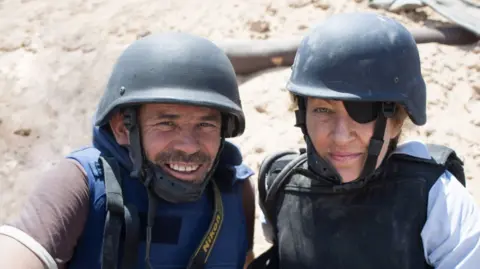
Conroy also spent seven years with the Royal Artillery as a soldier before becoming a professional photographer and was a trustee of the Frontline Club for media professionals, diplomats and aid workers.
Its founder Vaughan Smith, who was also in the Army, said: “He was one of the characters – those people who stand out because everybody adores them and they make you feel better.”
The 2018 documentary Under the Wire was made about Conroy’s escape from the 2012 bombardment of a makeshift media centre in Homs, where his colleagues Marie Colvin and Remi Ochlik were killed.
Referring to the Syrians who were killed in the area, he said: “These beautiful people who were being slaughtered, I wanted to tell their story.”
He only realised how badly injured he was when he returned to the UK.
“Obviously I knew I had a huge hole in the back of my leg,” he said.
“But in London I found out I also had a great big piece of shrapnel wedged under my kidneys. I had 23 operations on my leg and others on my abdomen and back. I was in hospital for five months.”
Conroy worked in Libya and Ukraine and had recently returned from an assignment in Cuba.
He also took photos for the British singer Joss Stone and wrote music with her.
She said she was “so grateful to have known him and honoured to call him my friend”.
“I wouldn’t be the person I am today without Paul. Paul Conroy was a legend. A wonderful person through and through. Always standing up for what was right. Always there for those in need.”
He leaves behind a wife, three sons and grandchildren.
[BBC]
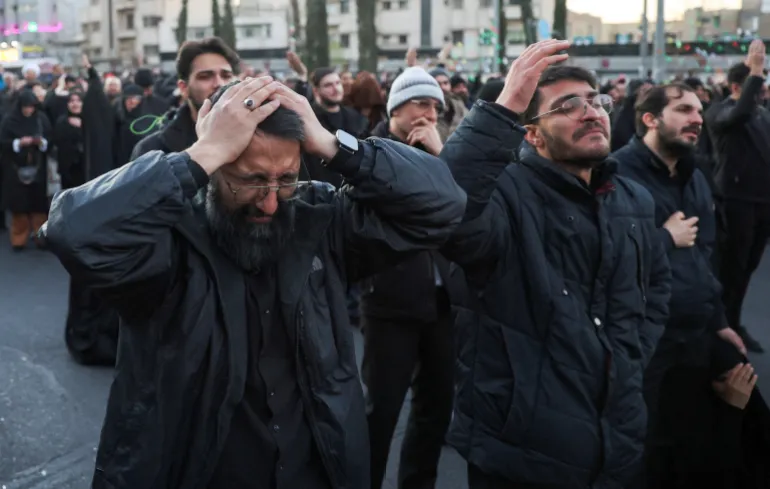
Iran has begun 40 days of mourning after Supreme Leader Ayatollah Ali Khamenei was killed in ongoing attacks by the United States and Israel, according to Iranian state media.
Top security officials were also killed in Saturday’s strikes, along with Khamenei’s daughter, son-in-law and grandson. The killings mark one of the most significant blows to Iran’s leadership since the 1979 Islamic revolution.
President Masoud Pezeshkian condemned the killing as “a great crime”, according to a statement from his office. He also declared seven days of public holidays in addition to the 40-day mourning period.
Reporting from Tehran, Al Jazeera’s Tohid Asadi said people were pouring into the streets of the capital following the news of Khamenei’s killing.
“There will be expected ceremonies,” he said, noting they would likely take place amid continuing bombardment across the country.
Protests denouncing Khamenei’s killing were also reported elsewhere, including Shiraz, Yasuj and Lorestan.
Footage aired by Iranian state media showed supporters mourning at the shrine of Imam Reza in Mashhad, with several people seen crying and collapsing in grief.
The killing also led to protests in neighbouring Iraq, which declared three days of public mourning. In Baghdad, protesters confronted security forces in the heavily fortified Green Zone, which houses Iraqi government buildings and foreign embassies.
Videos verified by Al Jazeera showed demonstrators waving flags and shouting slogans, with witnesses saying some were attempting to mobilise towards the US Embassy. Footage also showed protesters blocking vehicles at a roundabout near one of the entrances to the area.

There was also a protest in the Pakistani city of Karachi, where footage, verified by Al Jazeera, showed people setting fire to and smashing the windows of the US consulate.
However, there have also been reports of celebrations in Iran, with the Reuters news agency quoting witnesses as saying some people had taken to the streets in Tehran, the nearby city of Karaj and the central city of Isfahan.
Meanwhile, the official IRNA news agency reported that a three-person council, consisting of the country’s president, the chief of the judiciary, and one of the jurists of the Guardian Council, will temporarily assume all leadership duties in the country. The body will temporarily oversee the country until a new supreme leader is elected.
Khamenei assumed leadership of Iran in 1989 following the death of Ayatollah Ruhollah Khomeini, who had led the Islamic revolution a decade earlier.
While Khomeini was regarded as the ideological force behind the revolution that ended the Pahlavi monarchy, Khamenei went on to shape Iran’s military and paramilitary apparatus, strengthening both its domestic control and its regional influence.
Meanwhile, the Islamic Revolutionary Guard Corps (IRGC) pledged revenge and said it had launched strikes on 27 bases hosting US troops in the region, as well as Israeli military facilities in Tel Aviv.
[Aljazeera]
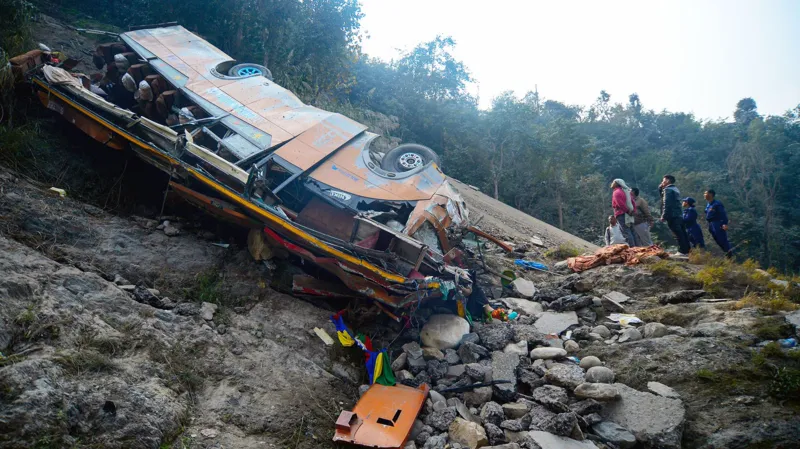
A 24-year-old British man is among 19 people who were killed in a bus crash in Nepal, police say.
The bus – which had been carrying tourists – had been travelling to the capital, Kathmandu, when it lost control and fell 200m on to the bank of the Trishuli river, in the country’s central Dhading district, in the early hours of Monday morning.
There were 44 people onboard including the driver, 25 of whom suffered injuries. The bus had been travelling from Pokhara, a popular tourist spot.
Nepal’s Home Ministry has created a five-member taskforce to investigate the cause of the incident. The UK Foreign Office said it was assisting the family of the Briton who was killed.
Nepalese authorities identified him as Stewart Dominic Ethan. His name has not been confirmed by the Foreign Office.
Nepalese police say they have identified all 19 bodies, including a 40-year-old Chinese woman and a 32-year-old man from India. Among the injured is a Chinese national and a New Zealander.
All the injured had been taken to hospitals in the capital, they added. Children were among those onboard.
Multiple teams were sent to the site, including police units, the army and a rescue team of divers, authorities said.
Police spokesman Abinarayan Kafle said 17 people died at the scene, with two more dying while receiving treatment, BBC Nepali reported.
Road accidents are relatively commonplace in Nepal, due to a range of factors including poor road maintenance and narrow paths in mountainous areas.
In 2024, at least 14 people died after a bus travelling from Pokhara to Kathmandu fell into the Marsyangdi river in the Tanahun district.
“We are supporting the family of a British man who has died in Nepal and are in contact with the local authorities,” a Foreign Office spokesman told the BBC.
Nepal is a popular destination for many international visitors, especially climbers, who travel there to access a key section of the Himalaya mountain range that includes Mount Everest.
Home to eight of the world’s tallest peaks, mountaineering is a significant source of revenue for the country – in 2024 climbing fees brought in $5.9m.
[BBC]

War photographer Paul Conroy dies as tributes paid

Allies of US in the Gulf bear brunt of Iran attacks

Dry weather will prevail in most parts of the island

Israel resumes attacks as Iran vows to avenge supreme leader’s death

CPC has enough fuel stocks

Lanka, Pakistan strengthen ties at 13th JEC

‘Dates have the highest sugar content to fight Coronavirus’

Sunday Island 27 December – Headlines

#SundayIsland 17th December – Headlines

Sunday Island – 28th March

Sunday Island Headlines – 21 March

Sunday Island – 21st February – Headlines
-
 News7 days ago
Prime Minister Attends the 40th Anniversary of the Sri Lanka Nippon Educational and Cultural Centre
-
 Opinion3 days ago
Jamming and re-setting the world: What is the role of Donald Trump?
-
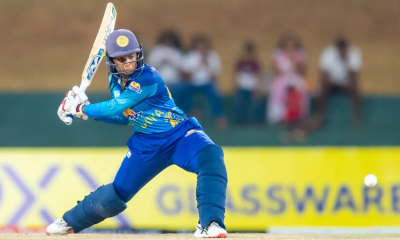
 Sports7 days ago
Dottin out obstructing the field as Sri Lanka clinch series
-
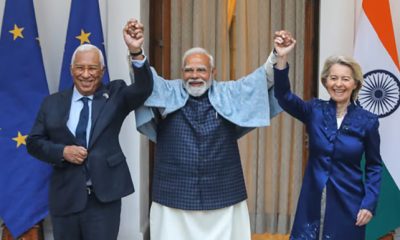
 Features3 days ago
An innocent bystander or a passive onlooker?
-

 Features5 days ago
Building on Sand: The Indian market trap
-
 Opinion5 days ago
Future must be won
-
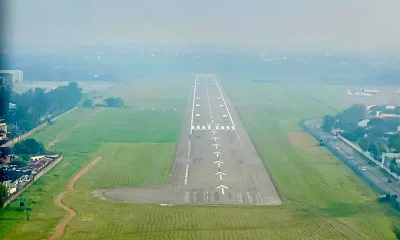
 Features4 days ago
Ratmalana Airport: The Truth, The Whole Truth, And Nothing But The Truth
-
 Business4 days ago
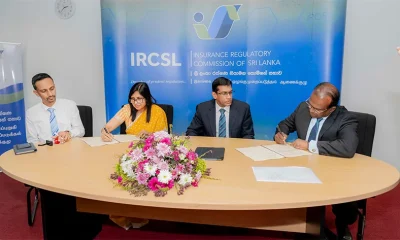
IRCSL transforms Sri Lanka’s insurance industry with first-ever Centralized Insurance Data Repository