
Business
The $2bn dirty-money case that rocked Singapore

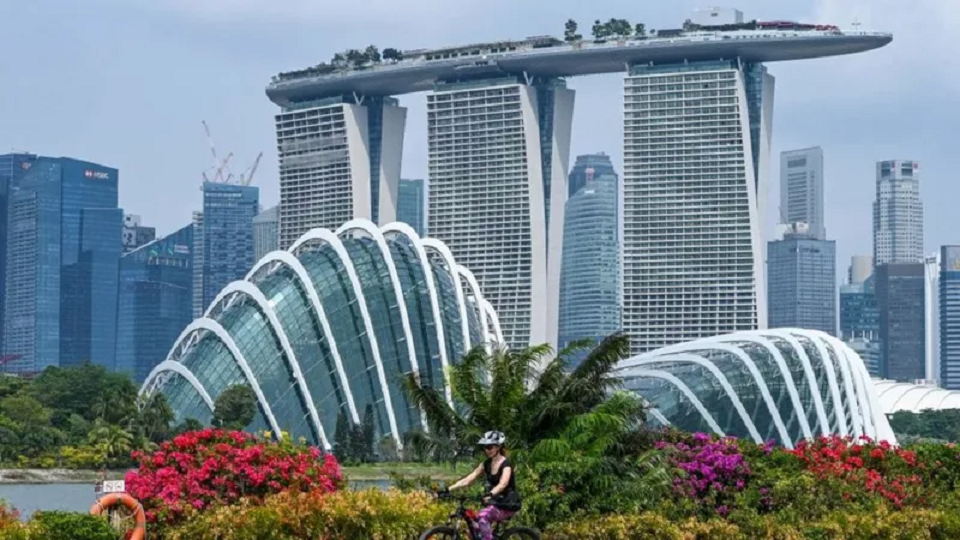
A Singaporean court has begun handing out sentences in a sensational case, which saw 10 Chinese nationals charged for laundering $2.2bn (£1.8bn) earned from criminal activities abroad.
The scandal embroiled multiple banks, property agents, precious metal traders and a top golf club. It led to extensive raids in some of the most affluent neighbourhoods, where police seized billions in cash and assets. The lurid details have gripped Singaporeans – among the seized assets were 152 properties, 62 vehicles, shelves of luxury bags and watches, hundreds of pieces of jewellery and thousands of bottles of alcohol.
Earlier this month, Su Wenqiang and Su Haijin, became the first to be jailed in the case. Su Haijin, police said, jumped off the second-floor balcony of a house trying to flee arrest. Both men will serve a little over a year in prison, after which they will be deported and barred from returning to Singapore. Eight others are still awaiting the court’s decision.
Even as it draws to a close, the case – the biggest of its kind in Singapore – has raised inevitable questions. The money that paid for their plush lives in the country, prosecutors said, came from illegal sources overseas, such as scams and online gambling.
How did these men, some of whom had multiple passports from Cambodia, Vanuatu, Cyprus and Dominica, live and bank in Singapore for years without drawing scrutiny? It has sparked a review of policies, with banks tightening rules, especially around clients who hold multiple passports.
Most important, the case has spotlighted the country’s struggle with welcoming the super wealthy, without also becoming a destination for ill-gotten gains.

Luxury cars were among assets police seized in their raids (BBC)
Singapore, which is often referred to as the Switzerland of Asia, started wooing banks and wealth managers in the 1990s. Economic reforms in China and India had begun to pay off, and then in the 2000s, a newly-stable Indonesia saw wealth grow as well. Soon, Singapore became a haven for foreign businesses, with investor-friendly laws, tax exemptions and other incentives.
Today, the ultra-rich can fly into Singapore’s private jet terminal, live it up in luxurious quayside neighbourhoods, and speculate on the world’s first diamond trading exchange. Just outside the airport is a maximum security vault called Le-Freeport that provides tax-free storage for fine art, jewels, wine and other valuables. The $100m-facility is often dubbed Asia’s Fort Knox.
Singapore’s asset managers drew S$435bn from abroad in 2022, almost double the figure in 2017, according to the country’s market regulator. More than half of Asia’s family offices – firms which manage private wealth – are now in Singapore according to a report by consulting giant KPMG and family office consultancy Agreus.
They include those of Google co-founder Sergey Brin, British billionaire James Dyson and Chinese-Singaporean Shu Ping, boss of the world’s biggest chain of hotpot restaurants, Haidilao.
Authorities say some of the accused in the money laundering case may be linked to family offices that were given tax incentives.
“There is an inherent contradiction for a place like Singapore, which prides itself on clean and good governance but also wants to accommodate the management of massive wealth by offering advantages such as low taxes and banking secrecy,” says Chong Ja-Ian, a non-resident scholar at Carnegie China.
“The risk of also becoming a banker for individuals who earned their money through nefarious or illicit means grows.”

Singapore’s attraction for the ultra-rich comes with risks, analysts say (BBC)
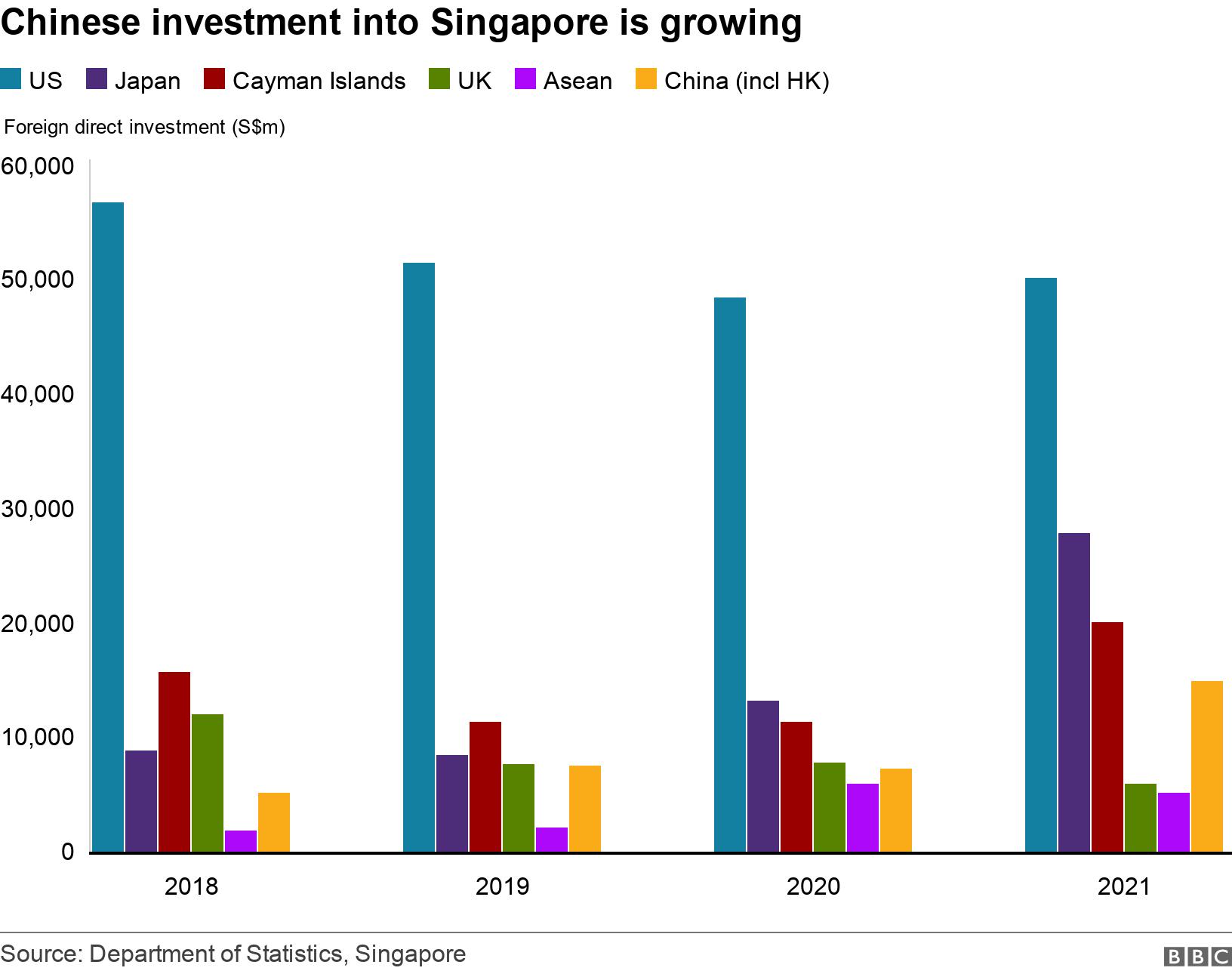
For rich Chinese, Singapore is a top choice because of its reputed governance and stability, as well as its cultural links to China. And more Chinese money has been entering Singapore in recent years.
One of the 10 suspects in this case was wanted in China since 2017 for his alleged role in illegal gambling online. Prosecutors claimed that he settled in Singapore because he “wanted a safe place to hide from the Chinese authorities”.
This isn’t the first time Singapore-based banks have been implicated in a financial crime. They were found to have played a role in cross-border laundering in the 1MDB scandal, where billions were misappropriated from Malaysia’s state investment fund. Dan Tan, who was once described by Interpol as “the leader of the world’s most notorious match-fixing syndicate” also had strong business links to Singapore. He was arrested here in 2013.
The country has strict rules targeting white collar crimes and is an active member of the Financial Action Task Force, a global body which targets money laundering and financing for terror networks. Over the years, banks have invested heavily to strengthen compliance, to screen prospective customers and to urge regulators to report suspicious transactions. But none of this is foolproof.
For one, it is difficult for regulators to spot suspicious cases in a sea of high-value transactions. “It’s not just one needle in a haystack, but one needle in several haystacks,” Singapore’s second minister for home affairs, Josephine Teo, told parliament in October last year.
Singapore’s buoyant property market is a popular means to “clean” dirty money, some experts pointed out. And there are the casinos, nightclubs and luxury stores.
“Massive amounts of money pass through Singapore’s banking system every day. Criminals can exploit this feature and disguise their money laundering activities among legitimate ones,” accounting professor Kelvin Law from Singapore’s Nanyang Technological University told the BBC.

Singapore’s property market is one of the routes for dirty money, experts say (BBC)
Singapore also does not limit the amount of cash that can be carried in and out of the country, only requiring a declaration if the sum exceeds S$20,000. And that is an advantage, says Christopher Leahy, the founder of Singapore-based investigative research and risk advisory firm Blackpeak.
“If you want to move lots of money, you hide it in plain sight and Singapore is a great place for that. There is no point putting it in the Cayman Islands or the British Virgin Islands, where there is nothing to spend money on,” he said.
When asked for a response to analysts’ comments that Singapore’s advantages as a financial capital are also a draw for dirty money, authorities pointed the BBC to the law and home affairs minister interview in a local newspaper last year.
“We can’t close the window, because if we did that, then legitimate funds will also not be able to come. And legitimate business also can’t be done, or becomes very difficult to do. So we have to be sensible,” K Shanmugam said.
“When you are successful, you are a major financial centre, a lot of money comes in, some ‘flies’ will also come in,” he added, referring to an oft-repeated quote of the late Chinese leader, Deng Xiaoping.
Singapore has to decide how far it will go in accepting “money with varying shades of grey”, says Dr Chong of Carnegie China.
While increased regulation will help, he says transparency poses a bigger challenge: “Transparency goes against the very model of discretion that allows many wealth management hubs to thrive.”
Some analysts say this may well be the price Singapore is willing to pay to retain its position as a financial hub.
“The vast majority of the funds are legitimate, after all,” Mr Leahy says. “But there is an inevitable cost to being a major financial centre.”
(BBC)









By Hiran H. Senewiratne
Sri Lanka’s financial literacy rate is approximately 58 percent. Such literacy is absolutely necessary for the inclusion of people in the country’s financial system which in turn is central to overall economic development, Central Bank Governor Dr. Nandalal Weerasinghe said.
‘One needs to have knowledge and skills of a financial nature to figure in financial inclusiveness. While 86 percent of Sri Lanka’s population has access to the country’s financial system, 82 percent of the public has at least a savings account in the country’s banking system, Dr Weerasinghe said.
The Governor made these comments recently at the inauguration of Financial Literacy Month 2026 at the Central Bank’s Centre for Banking Studies, Rajagiriya.
Dr. Weerasinghe added: ‘Suitable, affordable and quality financial instruments are needed to enhance financial literacy in the country.
‘Financial information has to be accurate, risk-free and accountable, thus creating confidentiality in the financial system, which would enable the sector to reach greater heights’.
Meanwhile CBSL sources said: ‘The Literacy Month opened with the two-day ‘FinLit Expo Colombo’. The expo gives the public the opportunity to engage with institutions, better understand financial services, gain practical insights into managing their finances and learn how to protect themselves from financial fraud and scams.
‘The CBSL is leading the program in collaboration with stakeholder institutions. It forms part of the Financial Literacy Roadmap for Sri Lanka, which is implemented under the National Financial Inclusion Strategy (NFIS), the national framework for widening access to and use of formal financial services.
‘The Colombo event will be followed by six regional ‘FinLit Expos’ aimed at direct engagement with local communities. Partner institutions will also run awareness activities. Together, the events are intended to provide financial education to communities and encourage people to apply financial knowledge in everyday life.
‘A public awareness campaign on television, radio, newspapers and social media will extend the program’s reach. The program also includes digital financial literacy activities and the promotion of QR codes and other online payment methods.
‘The public and stakeholder institutions are encouraged to take part in the month’s activities under the theme, “Towards a Financially Literate Sri Lanka”.

HUTCH Sri Lanka strengthened its position as a leader in digital engagement by securing five accolades at SLIM Digis 2.6, emerging as one of the most recognized brands at this year’s digital excellence awards. The achievement was further highlighted by HUTCH being the only telecom operator to be recognized at the event.
Organized by the Sri Lanka Institute of Marketing (SLIM), SLIM Digis is Sri Lanka’s premier platform celebrating excellence, innovation, and outstanding achievements in the digital marketing industry. The recognition highlights HUTCH’s growing strength in digital-first, agile, and creative marketing, and its ability to respond to everyday moments, engage audiences, and deliver impactful digital campaigns.
The Gold Award for Best Use of Agile and Moment Marketing, a Silver for Best Use of Digital in a Marketing Campaign, and a Bronze for Best Performance Marketing were all awarded for “Keeping Sri Lanka Connected Through Ditwah,” HUTCH’s response to the cyclone that struck Sri Lanka in November 2025, recognised for the speed and relevance with which HUTCH kept customers better connected and informed.
HUTCH Roaming also earned two further Bronze awards for Best Use of Digital in a Marketing Campaign and Best Use of Creative Content. Bringing together AI-led storytelling, the campaign was designed around distinct customer clusters, each characterized by unique travel behaviours, needs, and perceptions, delivering relevant content for different audiences within a single overarching campaign.
“These wins are a strong reflection of how HUTCH approaches marketing today, staying close to the moments that matter to our customers and responding with speed, relevance, and creativity. Being the only telco recognised at SLIM DIGIS 2.6, and across five categories, is proof that agility and thoughtful storytelling can go hand in hand. This recognition reflects the collective efforts with our strategic partners, whose collaboration, expertise, and shared commitment brought great campaigns to life,” said Hamdhy Hassen, Chief Marketing Officer, HUTCH Sri Lanka.
Sri Lanka’s Smart Luxury Business Hotel to Host Delegates and Contestants from Over 40 Countries as the Island Nation Hosts Its First-Ever Global Pageant of This Scale
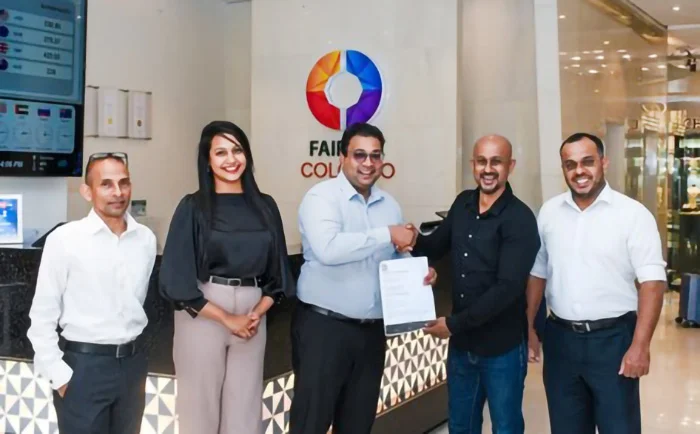
Fairway Colombo, a subsidiary of Fairway Holdings (Pvt) Ltd, has been appointed as the Official Accommodation Partner for Manhunt International 2026, one of the world’s most prestigious male pageants, scheduled to take place in Sri Lanka.
The event marks a historic milestone for Sri Lanka, as the country prepares to host a global pageant of this scale for the very first time. More than 40 contestants representing countries from across the world will arrive in Colombo, bringing together diverse cultures, international media attention, and a global audience — further strengthening Sri Lanka’s position as a premier destination for tourism, culture, and hospitality.
As the official accommodation partner, Fairway Colombo will welcome and host international delegates and contestants throughout their stay in Colombo, delivering the exceptional hospitality experience and personalized service that the hotel is recognized for.
A Landmark Partnership for Sri Lankan Tourism
“We are truly honored to be selected as the Official Accommodation Partner for Manhunt International 2026. This partnership is a proud moment not only for Fairway Colombo but also for Sri Lanka as a whole. Hosting an event of this global stature provides us with an opportunity to showcase our commitment to smart luxury, innovation, and authentic Sri Lankan hospitality to an international audience. We look forward to creating a memorable and seamless experience for all delegates and guests,” said Avinga Wanigasekara, General Manager of Fairway Colombo.
Strategically located in the heart of Colombo’s historic Fort district, Fairway Colombo is recognized as a Smart Luxury Business Hotel, combining modern comfort, advanced technology, and exceptional service. As part of Fairway Holdings (Pvt) Ltd, the property represents the group’s vision of delivering innovative, world-class experiences across the hospitality and leisure sectors.

Delegation from Korean Volunteer Association meet Secretary to the President

Imran Khan’s PTI braces to fight federal takeover of Khyber Pakhtunkhwa

Nissanka’s return headlines Sri Lanka’s Test squad against Pakistan

HRCSL issues recommendation on seizure of four books by B. Piratheepan by Sri Lanka Customs

Former Zimbabwe player and umpire Sarah Dambanevana dies aged 36

Deflated Sri Lanka look to prevent whitewash against dominant Pakistan

‘Dates have the highest sugar content to fight Coronavirus’

Sunday Island 27 December – Headlines

#SundayIsland 17th December – Headlines

Sunday Island – 28th March

Sunday Island Headlines – 21 March

Sunday Island – 21st February – Headlines
-

 Features5 days ago
The Sri Lankan who made Scottish history
-

 Sports5 days ago
Nissanka absence opens door for Sri Lanka’s young guns
-

 News4 days ago
NDB fraud Rs 60mn more than reported
-

 News6 days ago
Gnansara Thera to be assigned to prison printing section: Officials
-

 News4 days ago
Removing monk’s robes matter for Sangha to decide: Mahanayake Theras
-

 News6 days ago
OIC of FCID summoned before Maligakanda Magistrate
-

 Features5 days ago
Future of Sri Lanka’s state university system: Should it be shut down and reopened?
-

 News5 days ago
Shiranthi R remanded until 13 Oct.