
Latest News
Justin Greaves 202*, Kemar Roach 58* anchor West Indies to epic draw

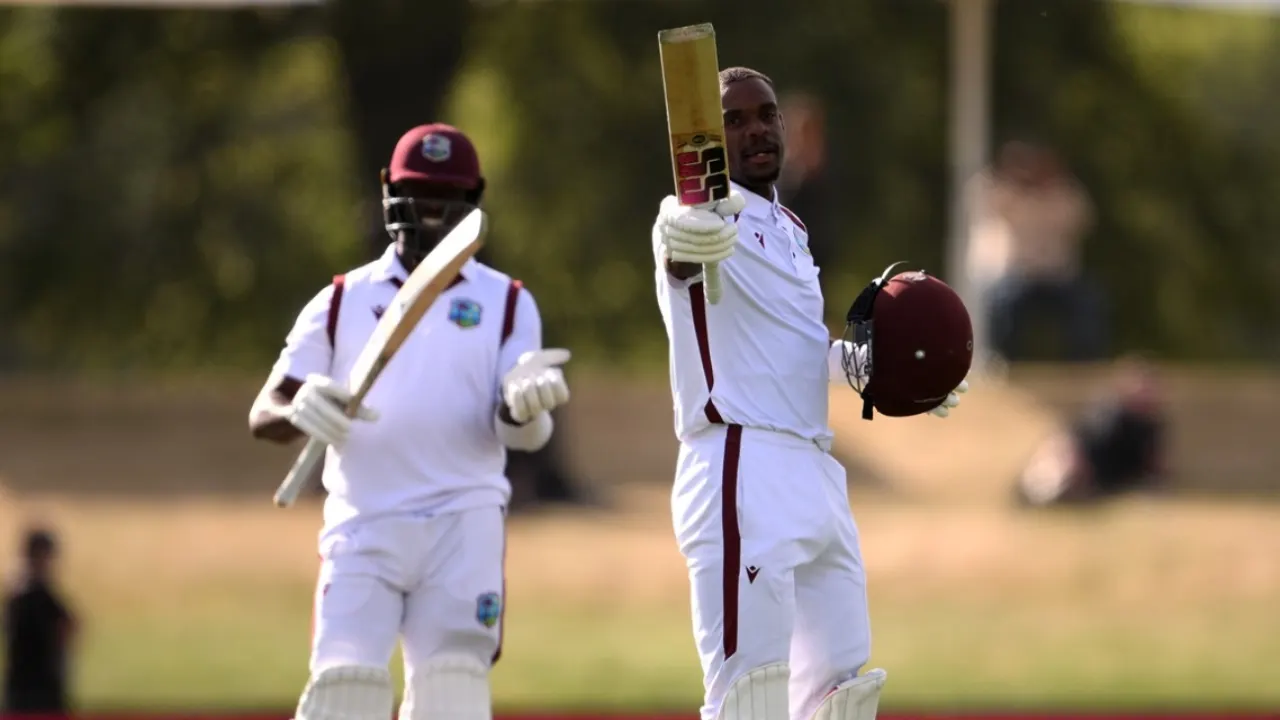
An epic stonewall from Justin Greaves had him face more than half the deliveries of his 12-Test career in this one innings alone, as West Indies pocketed their first points in their sixth Test of the 2025-27 World Test Championship cycle in Christchurch. The 163.3 overs they eventually faced is the longest fourth-innings in Tests for West Indies in 95 years.
Having played the supporting role to Shai Hope through their 196-run stand that rescued West Indies from 92 for 4 on Day 3, Greaves became the heartbeat of the innings once Hope (140) and Tevin Imlach fell in quick succession.
He brought up a stunning maiden Test double ton in the penultimate over when he sliced Jacob Duffy over backward point to pocket what was to be only his second boundary in all of the final session as his colleagues stood up to give him a standing ovation.
He finished 202 not out, having faced 388 deliveries, turning an innings that began with the typical artistic flair and flamboyance into a steely knock full of purpose and grit. Greaves wore more blows on the body than he could count, batted more deliveries than he had in his career, and reined in his natural instincts with single-minded purpose and determination.
His effort led to an astonishing turnaround from the first hour of the day, when West Indies stumbled to 277 for 6 in a mammoth chase of 531. A depleted New Zealand attack down to two weary frontline pacers in Zak Foulkes and Jacob Duffy, fancied their chances. But Greaves found an able ally in Kemar Roach, the 37-year-old veteran, who batted like his life depended on it in his comeback Test.
Roach made 58 not out – his highest first-class score – while facing 233 deliveries himself. Astonishingly, he made just 5 off the last 104 deliveries he faced during a dramatic final two hours of play even as the sun baked down hard on an increasingly docile Hagley Oval surface. Yet that should not take away from the epic rearguard from Hope, Greaves, and Roach.
The frustration of not being able to separate Greaves and Roach during the second and third sessions was evident, as New Zealand’s bowlers were ground into the dust. They would also have felt robbed when Roach appeared to have nicked Michael Bracewell to Tom Latham behind the stumps – though perhaps only having themselves to blame for burning all their reviews.
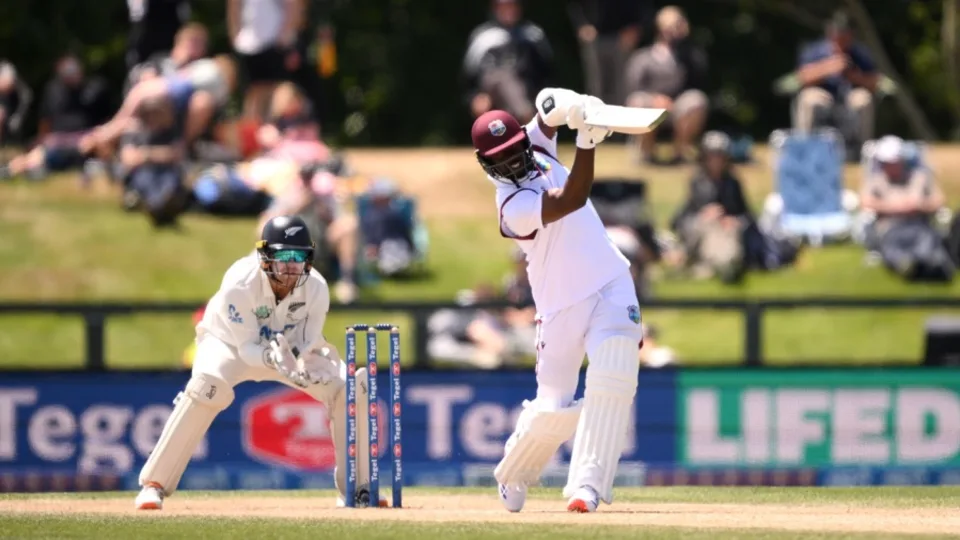
Even so, it was the thinnest of spikes that made it all the more challenging for Alex Wharf, the on-field umpire, who only a few minutes earlier made a cracking decision by turning down what everyone believed was an obvious inside-edge onto the pad to the slips, again off Bracewell. Replays showed Wharf had made a terrific call.
As admirably as Roach played, he also maximised his opportunities. On 30, he was put down by Foulkes at backward square leg when he attempted an expansive sweep off Bracewell. On 35, Blair Tickner, subbing for Matt Henry, missed a direct hit at the bowler’s end from a few yards away at short mid-on as Roach was misjudging a run.
Then on 47 came the most obvious chance, when Roach attempted to loft Bracewell had him nearly hole out to mid-on. Except, Glenn Phillips, the other sub, saw Tickner looking to intercept the ball from mid-off and palm it away.
With those three chances firmly behind him, Roach buckled down and offered a dead bat to anything that came his way against Bracewell. Foulkes and Duffy tried to ruffle him with the short ball from around the wicket, only for him to duck and weave.
Going into the final session, it became increasingly evident West Indies weren’t going to be enticed by the prospect of chasing down the 132 runs they needed in 31 possible overs. This clarity allowed them to approach the session with dead defence being the sole primary aim, even as Greaves began to tire and suffer cramps that needed medical attention at different times.
Not even the possibility of an impending double century enticed Greaves into attempting anything loose, even if Tom Latham gave him the open invitation to drive Bracewell against the turn through the covers. This wasn’t perhaps a risk not worth taking given how easily West Indies’ lower order collapsed in the first innings.
But long before a draw became the only possibility, even as New Zealand tried to attack with six fielders around the bat in the final session, Hope and Greaves pocketed runs at every available opportunity as the hosts rushed through their first six overs with part-time spin in a bid to take the second new ball quickly.
But even after they took it, there was hardly any assistance for the bowlers. Hope defended comfortably off a length with neither Foulkes nor Duffy consistently able to challenge the outside edge consistently. The occasional misfields, like – Rachin Ravindra letting one through his legs for four, or Will Young overrunning a throw while backing up – added to the sense of raggedness New Zealand had begun to feel.
A breakthrough lifted them shortly after drinks when Duffy dug in a short ball down leg, which Hope gloved behind, only for Latham to throw himself to his left and pluck a stunner from his webbing to end a marathon. Then came a second when Imlach was trapped by a nip-backer.
They may have thought then it was just a matter of time. It could’ve been had they not reprieved Roach, but those reprieves proved even more costly given they only had two fast bowlers and two part-timers available – all of them going full throttle to the limit – despite not getting much out of the surface.
In the end, the manner in which West Indies earned the draw may prove far more valuable. Above all, it was a day that reminded everyone of the slow-burn magic only Test cricket could deliver.
Brief scores:
West Indies 167 (Shai Hope 56, Tagenarine Chanderpaul 5; Matt Henry 3-43, Zak Foulkes 2-32, Jacob Duffy 5-34) and 457 for 6 (Justin Greaves 202*, Shai Hope 140, Kemar Roach 58*; Jacob Duffy 3-122) drew with New Zealand 231 (Kane Williamson 52, Michaell Bracewell 47, Jayden Seales 2-44, Kemar Roach 2-47, Ojay Shields 2-34, Justin Graves 2-35) and 466 for 8 dec (Ravindra 176, Tom Latham 145; Kemar Roach 5-78, Ojay Shields 2-74)
[Cricinfo]

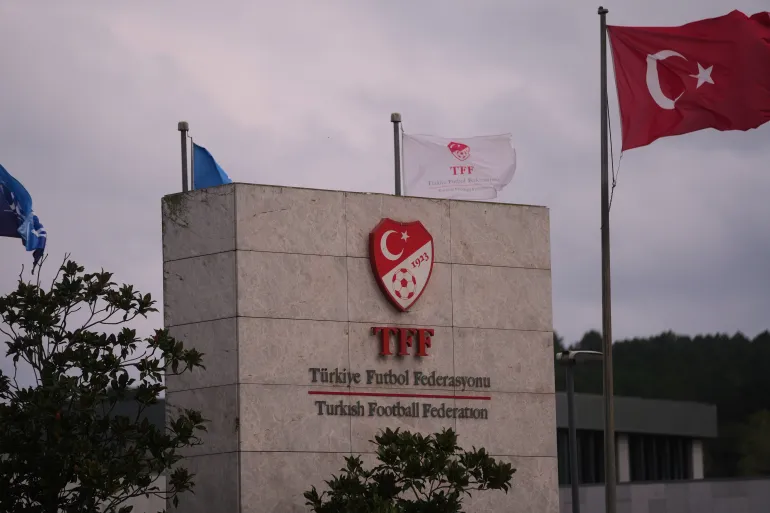
The head of Turkiye’s football refereeing body and four other officials have been placed in pretrial detention by a court as part of a corruption investigation, the state news agency Anadolu reports.
Ferhat Gundogdu, head of the Central Referees Committee, and six others appeared before a judge over allegations of manipulation of the referee administration process, Anadolu said on Saturday.
They appeared on Friday before a judge at Istanbul’s Caglayan courthouse on several charges, including forgery of official documents, breach of trust and illegal acquisition of personal data, the report said.
The judge remanded five people in custody and granted the other two conditional release, Anadolu said.
It was the latest scandal to shake football in Turkiye, coming exactly a year after the Turkish Football Federation (TFF) suspended 149 referees on charges of illegal betting.
On Thursday night, police from the illegal betting and sports crime unit also detained Yasin Kol, a referee from Turkiye’s top-flight Super Lig, as well as an assistant referee, media reports said.
Justice Minister Akin Gurlek said prosecutors are examining claims about “interference in the processes of referee classification, assignments, scoring and appointments as well as the exams on rules”.
During raids on Tuesday, police searched the VAR room at TFF’s headquarters in Istanbul. Observers said the investigation was likely linked to last year’s betting scandal and would have implications for the federation.
“It does seem to be a continuation of 2025, and it looks like it will continue further,” sports journalist Ayhan Sensoy told the AFP news agency.
Sensoy, who wrote a 2024 book on the issue called The Gambling Pit, said it was unlikely that federation bosses “have any chance of staying in office”.
So far, the TFF has not directly addressed the arrests as its top officials are due to fly home on Saturday after attending Friday night’s Belgium-Turkiye UEFA Nations League clash in Liege, which Turkiye lost 3-0.
[Aljazeera]
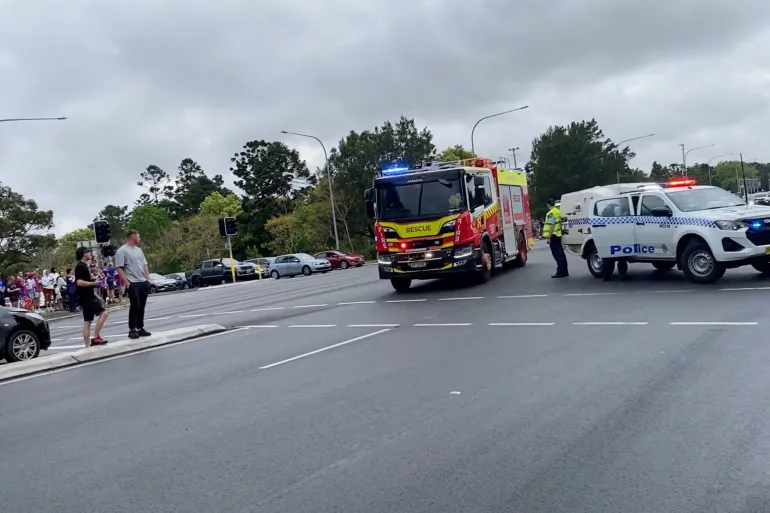
A car has crashed into a crowd of rugby league supporters in the eastern Australian city of Newcastle, injuring 10 people, including three children.
New South Wales police said on Saturday that two of the injured – a five-year-old girl and a 67-year-old man – were in a critical condition and the other eight were in stable condition in hospital.
Police said they had arrested the 18-year-old man driving the vehicle and were investigating what happened. They said the crash was not believed to be related to “terrorism”.
The crowd had gathered to farewell the local rugby league side, the Newcastle Knights, ahead of their grand final against the Sydney Roosters on Sunday.
Newcastle Lord Mayor Gavin Morris said the driver, a rugby league fan, had lost control of his vehicle and had been taken into custody.
“He was revving the car, he was excited, he was a supporter, he was there for the joy of the moment,” Morris told the national broadcaster ABC.
“Somehow he lost control of the car … and he’s gone into the crowd,” he added.
Prime Minister Anthony Albanese said: “My thoughts are with everyone injured or involved in the horrible incident this morning in Newcastle.”
“Rugby league brings people together, and this should have been a weekend of excitement and pride for Newcastle fans,” he wrote in a social media post.
[Aljazeera]
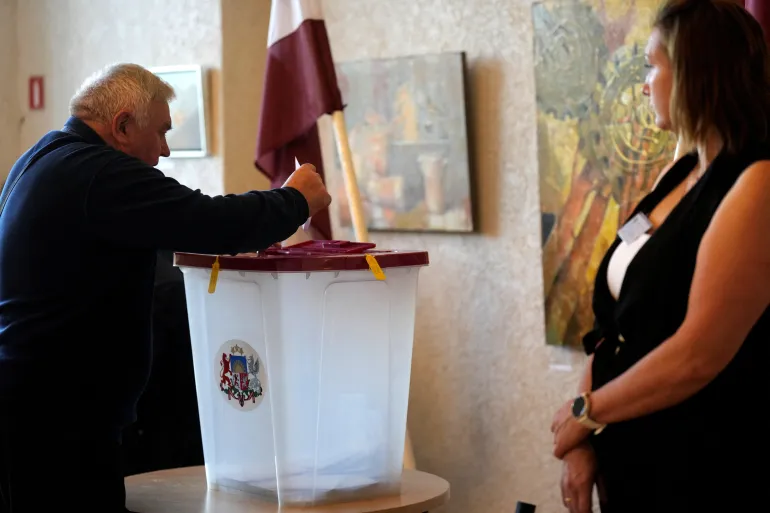
Polls have opened in Latvia for an election taking place against the backdrop of perceived security threats from Russia and a nationwide cost-of-living squeeze.
Saturday’s vote is the first electoral test for Prime Minister Andris Kulbergs after coming to power in May this year when his predecessor resigned due to a backlash from stray drone incursions from Ukraine.
Kulbergs, whose right-wing United List party is currently polling at about 20 percent, is expected to hold onto his position, but the decline of two allies in his current coalition means he is set for a complicated negotiation over the makeup of any future government.
Polls opened at 05:00 GMT and will close at 17:00 GMT. The results are not expected to change Latvia’s pro-European and pro-Ukrainian course.

About 1.5 million people are eligible to vote in the country’s 11th parliamentary election since independence from the Soviet Union in 1991.
Latvian politics are highly fragmented, with parties rarely seeing above 20 percent vote share and coalitions being the norm.
This year, 14 electoral lists are contesting the election, but polls indicate only seven are likely to enter parliament, with the rest expected to fail to meet the minimum 5 percent vote threshold.
Rising living costs, low wages, strains on the healthcare system and long-term population decline have all featured prominently in campaign debates.
Most parties in Latvia are pro-Ukraine; however, the populist Sovereign Power party – which says it wants Ukraine to win but argues money spent supporting Kyiv would be better spent at home – looks likely to become the country’s second-biggest party, with more than 9 percent of the vote. Most other parties have ruled out forming a coalition with Sovereign Power.
Latvia First, a pro-Ukraine and populist nationalist party currently polling at about 9 percent, could be a potential coalition partner for PM Kulbergs.
The Progressives, a pro-European social democratic party, are polling at 6 percent.
Ethnic Russians make up roughly one in four Latvian citizens, but their vote, which has traditionally been cast along identity-based lines, looks set to be made according to economic and social issues.
Latvia is the poorest of the Baltic states, and it has sharply increased its defence spending since Russia invaded Ukraine, now allocating nearly 5 percent of its gross domestic product (GDP) to defence.
[Aljazeera]

Turkish court detains football refereeing chief pending corruption trial

Ten injured after car crashes into rugby supporters in Australia

Polls open in Latvia against backdrop of perceived Russia threat

Abhishek, Tilak and spinners secure gold for India at Asian Games again

Tharindu Rathnayake, bowlers secure Asian Games Bronze for Sri Lanka

G7 to release 100 million barrels of oil and diesel after Trump export ban threat

‘Dates have the highest sugar content to fight Coronavirus’

Sunday Island 27 December – Headlines

#SundayIsland 17th December – Headlines

Sunday Island – 28th March

Sunday Island Headlines – 21 March

Sunday Island – 21st February – Headlines
-

 News6 days ago
Police remove Thileepan statue in Jaffna
-

 Features6 days ago
The 22nd Amendment, constitutional recovery and illiberal slippage
-

 Features6 days ago
Of foreigners as CEOs of Lankan ventures
-

 Latest News4 days ago
Gold winner Tharanga gets brand-new Honda Vezel from SLAAJ
-

 News6 days ago
Sajith rejects Jt. Opp. protest sabotage claim; SJB TU chief demands remedial action
-

 Features4 days ago
Why Sri Lanka needs an Inclusive Civic Nationalism – urgently
-

 Features5 days ago
Thailand’s biggest new global star …
-

 News3 days ago
US-assisted ‘Ice’ detection: NPC to examine IGP’s move to transfer drug-busting team