
Features
Settling into my job in London and helping Colombo in a delicate New Delhi assignment

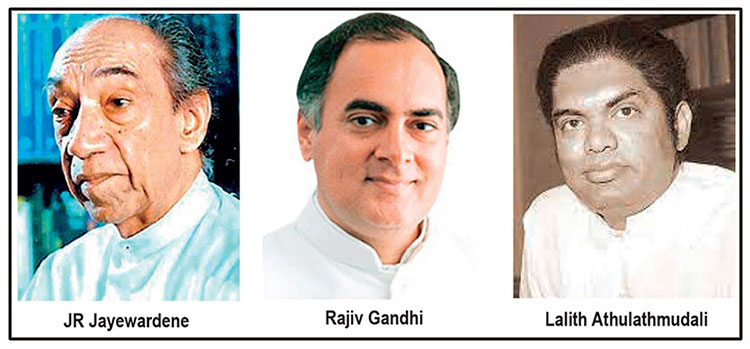
(Excerpted from the memoirs of Lalith de Mel)
After completing what may be described as my probationary period, I was ready to settle down to what I hoped would be a long and successful career. My first task was to really understand how Corporate Headquarters worked and how the various roles all fitted together so that I could make a success of whatever role I was given.
The Main Board had three Group Directors, each managing a piece of overseas territory. There was a separate Director for the UK and a Director of Finance and the Chief Executive who reported to the Chairman. The Group Director was responsible for developing, in collaboration with the heads of the businesses, the strategy for each country and compiling a comprehensive business plan dealing with all aspects of the business such as manufacture, supply chain, marketing, finance and human resources. These plans were presented to the Main Board. It was the responsibility of the Group Director to implement the agreed plan and he reported on the progress to the Chief Executive.
The Group Director was responsible for the larger businesses and his Regional Director performed an identical function for the smaller countries that were his responsibility. He had to present the business plan to his Group Director (not to the Main Board) and was accountable to him for implementing the plan. He liaised directly with the heads of the relevant business.
Many things in a business plan do not work out exactly as intended in the agreed plan. A good part of the job was fixing problems, identifying the support that was helpful, and providing it. This led to meetings to discuss the issues and the solutions. In the participative style of management, a number of people had to be brought into the discussion process and life was a series of meetings at Corporate or in the businesses. All of this meant constant traveling.
Lalith’s first job was to take over the role from his predecessor as the Regional Director for the Indian subcontinent, Singapore and Malaysia. He would report to the Group Director responsible for the whole Overseas Group, Ted Wright.
Another role
When the Chairman or Chief Executive visited an overseas business, the Regional Director had to accompany him. My first such role was when Sir James Cleminson, the Chairman, and Lady Judy Cleminson visited the Indian business and the businesses in Singapore and Malaysia, which at the time were based on exports from the UK. My first task was to develop the programme. Draft programmes were proposed by the business and I would discuss it with the Chairman and send back the amendments required.
These were very detailed programmes, which include sightseeing and social activities such as cocktail parties and dinners. I had to prepare a succinct summary of the businesses’ performance and issues as well. I had to get him into a position to say things like ‘Why is your shoe polish market share down by one percent’? and `I am pleased that sales are up seven percent’. This left the locals in the business amazed at his in-depth knowledge of their business. They never knew that he had memorized these details from my crib sheet for him.
Lady Cleminson was well-known to be difficult. As we took off in the plane she said, ‘I don’t like this programme,’ and this went on right through the trip. Fortunately she was very interested and knowledgeable about horse racing in the UK and I was a keen follower of the sport. From the time this was discovered, she became a different person. There was an important two-year-old race coming up and we disagreed about the likely winner. This led to a five pound bet. I won the bet but forgot all about it. Then I received this letter from her with five pounds.
`Dear Lalith,
Just to prove how I pay my debts at once even though you were on a sure-fire winner anyway! So now you can re-invest it on him for the Derby next year at eight to one.
But really to thank you so much for being so patient on our quick visit to your neck of woods and also such a nice traveling companion for us to have. No worries with the constant change of plans, our diet and drinking habits, all seemed to go so smoothly and well due to your insight. Thank you very much for all you did for me and I hope the effort was worthwhile.
Best wishes,
udy Cleminson
As a thank you at the end of the trip they asked me to return to London from Singapore on Concorde with them.” Shortly after Ted Wright retired, the three Group Directors, in line with the corporate structure as described, came into being. He then reported to the Group Director responsible for Australia, New Zealand, Asia, Africa, USA and Canada.
Lalith became Regional Director for the Indian sub-continent, the whole of East Asia including Japan and China and performed a staff role for Australia, New Zealand, USA and Canada. This was a very big role as his Group Director had a vast piece of territory as his responsibility. This was also an interesting opportunity since he had no experience of the American market and they had a very successful thriving business in the US. He was pleased to be able to have an involvement in the US business supporting his Group Director.
In the multinational world, nothing ever runs smoothly for very long and no job ever evolves into a nice, routine Monday-to-Friday job. Major problems had arisen in the Australian business, which was a major contributor to Group profits. It was decided that his Group Director David Totton should relocate to Australia for some time. North America was moved to another Group Director, but he remained the link and continued to perform the staff role. John West, the Chief Executive, took over David Totton’s remaining responsibilities, Africa and both parts of Asia, and he provided the staff support role.
“I moved into an office next to his and due to location in effect became a PA as well to the Chief Executive. He did not work in a very structured fashion. He was a successful gut-feel entrepreneur. He very quickly grasped the essentials that mattered and ignored and was bored by the relatively trivial details. He would ask me to look at this, that and the other on issues that concerned him. I struggled to sift the chaff and master the art of just focusing on the core that mattered. It was a good learning experience.
There was one memorable incident. He wanted me to look at a project for acquisition. In due course I went to see him and narrated all the ratios and how they compared with our hurdle rates and took him through the potential risks. I saw him become increasingly irritated and I knew he disliked tedious detail, but I felt I had to take him through it. Finally in complete exasperation, he screamed, ‘Don’t confuse me with the bloody facts, just go and write a board paper.’
It was a great opportunity to get an insight into how the top Board worked, to see the inter-relationships between Board Directors, and to catch a glimpse of how big businesses really operated.
I had a long link with South Africa and it started with my role as a Regional Director supporting John West, the Chief Executive. Those were the days of apartheid. I did not understand why he decided to have me, a coloured person, as Regional Director for South Africa as in the normal course of business it would be necessary to visit the business. Perhaps it was his sense of humour as the Afrikaans were generally both glum and arrogant and so he may have found it amusing sending someone coloured who could give them instructions.
The main hotels were strictly white only. They had a rather ingenious way of dealing with black senior ministers of neighbouring countries who came for discussions. They were made honorary whites and so I too was made an honorary white when I visited South Africa and stayed in the white only hotels. But on a visit to the trade at a supermarket, if I needed the loo, I had to use the one for blacks!
In course of time, Mr. Totton returned to London. Life went back to what it had been before.
Delicate assignment in New Delhi for JRJ government
Whilst ruminating about my career in London, I had a telephone call from Lalith Athulathmudali, Minister for National Security in Sri Lanka.
I knew Lalith from school days, and when I was at Cambridge, he was at Oxford. He always spoke at a measured tempo with an Oxford accent. In June 1987, I received a call from Lalith speaking rapidly which was very unusual. I knew he was very agitated about something. He fired a series of questions. “Was Arun Singh employed by Reckitt and Colman in India, were you his boss, do you know him well, do you know he is the Indian Prime Minister’s closest friend and key advisor.”
I told him that I knew Arun Singh well as he had worked for Reckitt and Colman in India for many years as Head of Marketing. He reported to the CEO, Ranjit Sikand, who reported to me. He asked whether Arun, then in an exalted position, would see me if I wanted an appointment. I said I was sure he will. He wanted me to go and meet Arun Singh and convey an important message from the Government of Sri Lanka and wanted me to get on the next plane and come to Colombo.
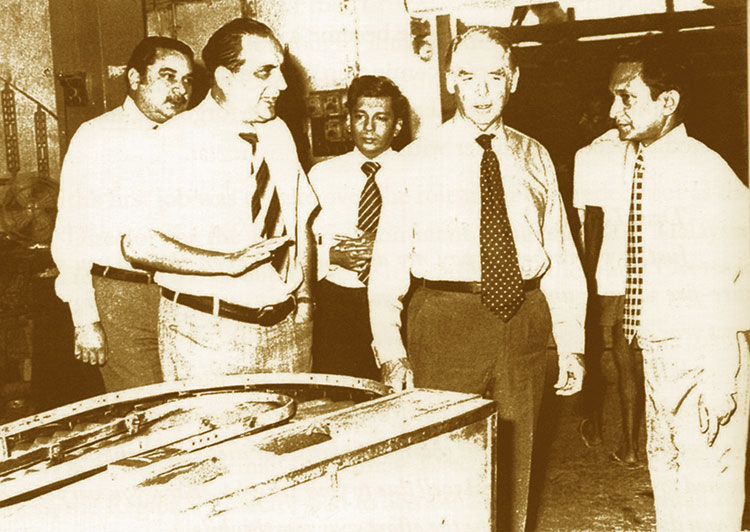
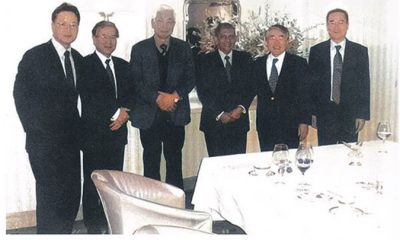
Sir James Cleminson, Chairman of Reckitt & Colman PLC, UK, on a visit to India, Lalith is third from the right, on his left Ranjit Sikand, Managing Director of the Indian business
The problem was Sri Lanka had was no soft contacts to Rajiv Gandhi or his new key officials. No people who could get close and whisper a word in the ear or leave a thought for consideration. After his mother Indira Gandhi was assassinated, Rajiv Gandhi got catapulted into the Prime Minister slot, and appointed a young team of friends to the key positions. Arun Singh, his closest friend from school days became his principal advisor. Sri Lanka had no contacts with this group.
The crisis
Lalith Athulathmudali explained the crisis. The heartland of the LTTE was Jaffna and they were surrounded by the Sri Lankan Army and there was a blockade of Jaffna. Food from outside was not getting through and the artillery fire was also causing some civilian casualties.
There was panic in Jaffna, agitation in Tamil Nadu and political pressure on the government of Rajiv Gandhi to intervene and get the blockade lifted. India had sent a message through their diplomatic channels volunteering to mediate. Sri Lanka had promptly rebuffed their overtures (A dangerous approach, with India much larger and more powerful in every way, and with the second largest standing Army in the world).
The Indian reaction to the rebuff was to send an unarmed flotilla of naval boats laden with food. They were blocked by the Sri Lankan Navy and had to turn back. The Indian response was immediate. They sent cargo planes with food but this time accompanied by Mirage fighter jets. The planes performed their mission, this time unopposed by the Sri Lankan military and dropped the food by parachutes into Jaffna. Sri Lanka had protested vehemently but India had refused to rule out further air drops.
The threat of invasion
India brushing off our protests caused panic in the high echelons of the government, and rumours of an Indian invasion were swirling around. The President and his key advisor, the National Security Minister who was Lalith Athilathmudali, feared that India on the pretext of protecting the Tamils may use the opportunity to invade and occupy Jaffna and eventually make it a new province of India just like they did with Goa.
The briefing
I arrived from London and went straight to Lalith’s residence and told him that Arun Singh had agreed to meet with me in Delhi. We then went to the presidential secretariat. After a brief chat with the Foreign Minister Hameed met the President J.R. Jayewardene, and Lalith Athulathmudali for a briefing session, on what to tell the Indians, on how to respond to their questions, and on how to end the session depending on the Indians’ attitude to our submissions.
The briefing comprehensively covered five strands. That LTTE was a terrorist organization. They did not represent the Tamil people who were living peacefully in all parts of the country. The Government was firmly committed to ensuring the well-being of the Tamils and all minorities. India being a valued and trusted friend, and importantly on how to deliver the punch line of Sri Lanka welcoming India’s help and collaboration in solving the terrorist problem.
In Delhi
I was not looking forward to the challenge of sitting across a desk and being questioned by a battery of Indian officials. I rang Arun Singh when I got to Delhi and he said “Let’s meet tomorrow at 10.30”. I asked where, and he said to come home, and added it will be just you and me. I was relieved. I went to Arun’s house which was next door to the Prime Minister’s residence and as I went in, I noticed a gate in the wall between the two houses. Nina, his wife who I knew well, greeted me and wanted me to stay for lunch. Both Arun and his wife are from princely Indian families. Arun is the second son of a Maharaja. They come from a background of gracious living and polite behaviour. Arun is very intelligent but soft spoken and always polite.
We sat in his sitting room and had a very long discussion. Arun with his forensic skill probed the Sri Lanka Government’s attitude and commitment to the well-being of the Tamil people and the way in which their concerns will be addressed. I was glad that I had been extremely well, briefed by Lalith and the President.
The end
By the time we sat down for lunch 1 felt the vibes were good. We chit chatted about old friends and at the end he said he will speak to the Prime Minister in the afternoon, asked me to come the next day and said the Prime Minister may want to meet me.
The next day he greeted me with a broad smile, and said it was not necessary to meet the PM. Arun said a message had been sent through the External Affairs Ministry and added that the Sri Lankan government will be pleased. I asked what it said and he said he could not tell me and that it was couched in formal diplomatic language.
I rang Lalith. They had got the message and were very pleased. A threat of invasion had faded away. I was warmly congratulated on completing the mission successfully. Then it was back to Colombo, a de-briefing session with Lalith and the President and then on a plane and back to my day job in London.
The Indo-Sri Lanka Accord was signed that July when Rajiv Gandhi visited Sri Lanka. Arun Singh was Defence Minister when he retired from politics. I met him a year ago when he visited London.”








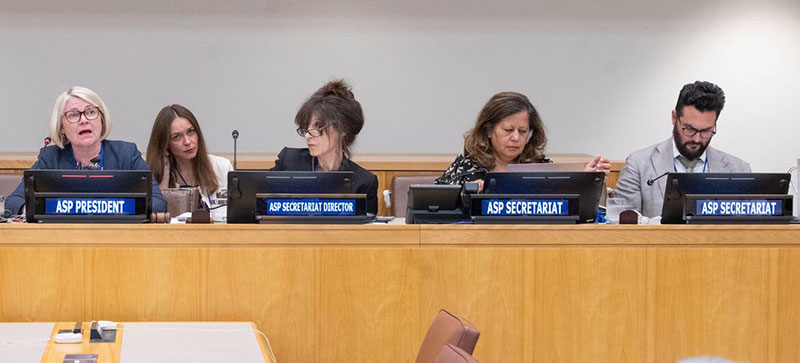
 US Secretary of State Marco Rubio’s warning to the International Criminal Court (ICC) was stark: ‘Either the ICC will end its threats, or we will end the ICC.’ It followed US central administration accusations that the court was unfairly targeting Americans on the basis of trumped-up war crimes charges.
However, a new plethora of sanctions has been clamped on the ICC by the US, which in turn has spurred accusations by sections of the world that the latter has unleashed an ‘assault’ on the international legal order.
What some of the sanctions would mean for the ICC was outlined by Rubio: ‘We will ban transactions with this rogue court, cutting off their resources and crippling their ability to operate against us.’
The ICC has shown consistency of purpose over the years. Despite some operational constraints it has indicted a large number of political strongmen from around the world, accused of war crimes and other governance excesses that come under its purview. Two such recent figures are: Russian President Vladimir Putin and Israeli Prime Minister Benjamin Netanyahu.
Rather than enjoy a mere nominal presence in the world community, the ICC has proved its effectiveness by detaining and bringing to justice scores of VIP politicians and others of their ilk who have been found guilty of human rights abuses and kindred excesses that come within the terms of reference of the ICC.
Accordingly, the international justice system would be stymied considerably as a result of the ICC being dis-empowered, particularly financially. Needless to say, potential and real perpetrators of the species of crime coming under the jurisdiction of the ICC would stand to gain most from such anarchic tendencies. That is, political repression globally would be enabled to enjoy a new lease of life.
A detailing of the types of crime coming under the purview of the ICC provides an idea of what it would cost the international community if the ICC’s operations are gravely hampered. They are mainly: genocide, war crimes, crimes against humanity and the crime of aggression.
That is, the part of the world to be worst affected would be the global South, since the latter is awash with the mentioned crimes. Needless to say, a chronically-disaffected South will sooner rather than later undermine the well being of the world dangerously. The world is already being put through these paces.
At the time of writing, ‘illegal migrants’ from the South, for example, are aggravating many a Western economy’s woes, besides creating for them acute law and order issues. The fact that these migrants’ presence goes on to become a virtual test of the migrant receiving states’ ability to forge domestic social inclusion in the face of jingoistic protests by mainly white supremacist groups is evidence of the latter. As is known, the US, to take just one example, has been up against this crisis for quite a while.
Accordingly, it will be in the best interests of the West if ‘illegal’ migrant arrivals on their shores are stemmed. If the socio-political and economic problems assailing the South are effectively managed through North-South collaborative, ‘trouble-shooting’ efforts the causes leading to ‘illegal’ migration and connected issues could be resolved at source as it were. For, it is the aggravation of the South’s material questions that lays the basis for the emergence of repressive and anti-democratic regimes in the hemisphere.
Until such time that the aforementioned issues in North-South relations are visited afresh and addressed urgently, a vibrantly functioning ICC would be needed. For, the latter would prove a deterrent to Southern political and military strongmen, highly prone to power abuse and like excesses, from coming into being in the wake of the South’s chronic material woes and the wars and conflicts that result from them.
It stands to reason then that the US would be acting in its own interests by enabling the ICC to perpetuate its mandate without hindrance. For a crop of issues that impinges negatively on internal law and order would be defused.
Meanwhile, there needs to be a meeting of minds among the rest of the West to put back in place a North-South dialogue process aimed at reducing some of the economic pressures that are weighing on the South.
Since economics usually drives politics it will be in the interests of the world community to scrutinizingly re-visit North-South issues of the past and put in place economic relief packages for Southern publics that would enable them to tide over their material hardships rather than permit the latter to aggravate into social disaffection and eventually armed militancy. It is the latter juncture that paves the way for the emergence of authoritarian rulers in the South who then go on to be a blight on their publics.
Accordingly, the Southern-based global development thinking of the past that envisaged a more equitable world economic order needs to be seen as an urgent need. That is, NAM’s international development paradigms need to be resuscitated to the extent possible.
It is unlikely that rightist governments of the West, such as the current Republican administration in the US, would find these projects feasible, but democratic states of Europe, led by perhaps the UK, are likely to think otherwise. For it would not be beneficial for the democratic world to be having on their hands repressive governments in the South who would be gravitating towards the major military and economic actors of the South, such as Iran and North Korea, who tend to be in constant power struggles with the West.
However, until such time that the mentioned, pro-people initiatives are given serious thought the ICC would need to be enabled by the international community to be in place comfortably and carry on with its mandate of bringing repressive rulers to book. Besides the ICC should pave the way for the peoples of the developing world to enjoy some substantial respite from the political repression and even terror which tend to be their lot.
Meanwhile, the wars of West Asia are relentlessly aggravating the economic hardships of people everywhere, driving the point home to enlightened sections that there is no alternative to peacemaking. A challenge is to convert the US under President Trump to this line of thinking.

 This week, I give you five simple, time-tested homemade remedies that help reduce the appearance of blemishes, control excess shine and leave your skin feeling softer and smoother.
The Honey and Lemon Brightening Dab:
For stubborn blemish marks, this is a classic. Mix one teaspoon of pure bee honey with three to four drops of fresh lemon juice. Apply gently, only on the affected spots, and leave for 10 minutes before rinsing with lukewarm water. While honey soothes and softens, lemon helps to brighten naturally. Use twice a week in the evening.
Besan and Rose Water Oil-Control Pack:
An ideal remedy to combat shine, especially on the T-zone. Take two teaspoons of besan (gram flour) and mix with sufficient rose water to form a smooth paste. Add a pinch of turmeric for its antiseptic goodness. Apply evenly, keep for 15 minutes and wash off. It absorbs excess oil without over-drying, leaving a beautiful matte finish.
Aloe Vera and Cucumber Ice Soother:
Blend fresh aloe vera gel with the juice of a grated cucumber and freeze the mixture in an ice tray. Each morning, wrap one cube in a soft muslin cloth and gently rub over a cleansed face for 30 seconds. It calms, tightens pores and imparts a baby-soft smoothness.
Oatmeal and Curd Gentle Polish:
Roughness and old blemish marks need gentle exfoliation. Combine one tablespoon of finely powdered oatmeal with one tablespoon of fresh curd (yoghurt). Massage very gently, in circular motions, for one minute, leave for five minutes and rinse. It removes dead cells and unveils softer, clearer skin.
Multani Mitti and Green Tea Magic Mask:
Brew some green tea and allow it to cool completely. Mix one and a half teaspoons of Multani Mitti (Fuller’s Earth) with the tea water to make a fine paste. Apply for 10 to 12 minutes – do not let it dry and crack completely – and wash off. It draws out impurities, fades blemishes and bestows a fresh, shine-free glow.
A Gentle Reminder:
As with any natural remedy, always do a patch test on your inner arm first. For those with oily or combination skin, avoid heavy coconut oil application and harsh scrubbing, as they tend to aggravate shine and blemishes.

 Dream of performing on a world stage? Well, here is your unique, golden opportunity!
The World Championships of Performing Arts (WCOPA) — the one and only official “Talent Olympics” — is the world’s premier global platform for aspiring singers, dancers, actors, models, instrumentalists, etc., to compete, shine and be discovered!
And, yes, this world stage is open to YOU, Sri Lankans living in Sri Lanka and overseas!
Held annually in glittering Las Vegas, WCOPA brings together over 70 countries, all competing for Gold, Silver and Bronze Medals, just like the traditional Olympics.

Lakisha Bernard: Will represent Team Sri Lanka at WCOPA 2027
Outstanding performers vie for the coveted titles of Junior and Senior Grand Champion Performer of the World, with winners and standout participants awarded over $500,000 in scholarships, cash awards and prizes to catapult their education and careers!
Sri Lanka is already making waves! At WCOPA 2026, Natharie Wickramasinghe, representing Team Sri Lanka, made the nation proud by winning a Bronze Medal in the Ethnic/Folklore Dance category!

Lakisha: Accomplished freelance Model and Fashion Design graduate
Recruitment for this prestigious competition is handled through a system of scouts and licensed National Directors — and this is where our very own Chris Rajendra, now based in Las Vegas, and National Director for Team Sri Lanka, comes into the scene.
If you are a singer, dancer, actor, model, instrumentalist — if you have talent burning inside you — contact Chris Rajendra today for registration and, who knows, you may find yourself in Las Vegas, and proudly draped in the Sri Lankan flag, at WCOPA 2027!
The contact address is: Chris Rajendra, wcopa.nationaldirector.sl@gmail.com
or chris.rajendra@gmail.com
Meanwhile, a star is born for 2027, in the form of Lakisha Bernard who is all set to represent Team Sri Lanka at WCOPA 2027.
Originally hailing from the sun-drenched coastal city of Colombo and now carving out her creative career in Canada, 22-year-old Lakisha is stepping into the international spotlight.
This accomplished freelance Model and Fashion Design graduate has officially been appointed as the Team Sri Lanka Promoter for Canada as she prepares to represent Team Sri Lanka at WCOPA in Las Vegas.
Lakisha brings a unique blend of high-fashion sensibility, captivating camera presence and expert garment design to the Team.
Having built her career, from local college shoots to high-glamour concepts, Lakisha’s inspiring journey embodies the true spirit of cultural bridge-building and creative resilience, bringing immense pride and recognition to Sri Lanka on the global stage.
WCOPA 2027 will be held at the legendary Westgate Hotel & Casino, Las Vegas, from 12th to 20th July – the very same iconic arena where the late, great Elvis Presley himself performed!
Your moment is now. Your stage is Las Vegas, so hurry and contact Chris Rajendra.

AgriConnect Sri Lanka’ to be launched on 30 October to Modernise the Agricultural Sector Through Digitalisation

57th Annual Saints’ Quadrangular Tournament on Saturday and Sunday

Showers or thundershowers will occur at most parts of the island

Prison rules to be revised over monks’ attire

AC President recuses himself from hearing prison attire case pertaining to Gnanasara Thera

Court orders steps to obtain INTERPOL Red Notice against Basil

‘Dates have the highest sugar content to fight Coronavirus’

Sunday Island 27 December – Headlines

#SundayIsland 17th December – Headlines

Sunday Island – 28th March

Sunday Island Headlines – 21 March

Sunday Island – 21st February – Headlines
-

 News7 days ago
NDB fraud Rs 60mn more than reported
-

 News7 days ago
Removing monk’s robes matter for Sangha to decide: Mahanayake Theras
-
 News6 days ago
NPP govt. reminded of its responsibilities as US warship leaves Colombo
-

 News5 days ago
Sri Lanka escalates anti-graft drive with Shiranthi’s jailing
-
 Latest News6 days ago
Farhan, Sadaqat help Pakistan ace 183 chase to go 1-0 up
-
 News7 days ago
BHC, Colombo: “LTTE remains a proscribed org. in the UK”
-

 Latest News4 days ago
Farhan and Sadaqat help Pakistan seal series in style
-
 News5 days ago
Iranian ships stranded, Lanka fears US sanctions